Great Outdoors Advertising Techniques That Work in 2026
Outdoor advertising is not one thing. It is a toolkit. The brands that win on the street know which tool to pick and where to swing it.
We have been running outdoor campaigns for years. In that time, we have installed murals on five-story walls in SoHo, pressed stencils into the pavement outside Madison Square Garden, projected brand messages onto buildings in the Meatpacking District at midnight, and deployed street teams at every festival and concert that matters in New York, Los Angeles, and Chicago. That experience has taught us one thing with certainty: there is no single best outdoor advertising technique. There are good techniques for specific goals, and bad technique matching is the reason most outdoor campaigns underperform.
This guide breaks down the real outdoor advertising toolkit. We cover what each format actually does, where it works, what it costs, and which goals it is built to serve. If you are a brand trying to figure out how to get off the screen and into the street, this is the practical starting point.
We are American Guerrilla Marketing. We run these campaigns ourselves, in the field, with our own crews and equipment. Everything in this guide comes from direct experience, not research roundups.
What Great Outdoors Advertising Technique Actually Means
The phrase “great outdoors advertising technique” sounds general. In practice, it points to something specific: the craft of placing a brand message in a physical environment where a defined audience moves, in a format that earns attention without demanding it.
The key word is earns. Outdoor advertising does not interrupt the way a digital ad does. It cannot force a click. It has to be good enough on its own terms to make someone stop, look, and engage. That changes the design requirement and the placement requirement significantly from what most brand managers are used to thinking about.
Great outdoor technique means the right format on the right surface in the right location at the right time for the right audience. Every one of those variables matters. Get four out of five right and the campaign works. Get three wrong and you have spent money on something nobody remembers.
Here is what we mean by format selection done correctly.
Format 1: Mural Advertising
Mural advertising is the flagship outdoor format for brands that want scale, permanence, and visual authority. A mural is a hand-painted or digitally rendered large-format image applied to a building wall, typically ranging from 15 feet to over 100 feet in width. The production time is longer, the cost is higher, and the brand impact is proportionally larger.
Where Murals Work Best
The best mural locations combine high foot traffic with the right sight-line distance. A mural painted on the side of a building facing a narrow alley has visual impact. The same mural facing a wide intersection with 50,000 daily pedestrian crossings has city-defining impact. We scout every proposed mural location before committing to it, looking at sightlines from all directions, the daily pedestrian and vehicle count, and the character of the neighborhood.
In New York, the best walls for brand murals are in neighborhoods where people linger. The blocks around Houston Street and Bowery in lower Manhattan. The Bedford Avenue corridor in Williamsburg, Brooklyn. The 5 Pointz zone in Long Island City. In Los Angeles, the Arts District walls off Mateo Street and the Abbot Kinney corridor in Venice. In Chicago, the Wicker Park and West Loop neighborhoods have walls with strong community visual presence and high foot traffic from creative professionals and visitors.
Mural Production Details
We work with a network of muralists who specialize in brand work. The production process starts with an approved digital rendering at final scale, which the muralist uses as a reference throughout the painting. For large walls, we use scaffolding or lift equipment to reach upper sections. Paint selection matters: we use exterior-grade acrylics with UV-protection additives for walls in direct sun exposure, and we apply a final clear seal coat to extend the lifespan and protect the surface from weathering and light vandalism.
A well-maintained mural in a sheltered location can hold its visual quality for three to five years. An unprotected wall in a high-humidity coastal environment may need touch-up within eighteen months. We factor that into our proposal when we recommend locations to clients.
Field note: The first thing we check when scouting a mural wall is the surface preparation requirement. Old painted surfaces, brick walls with mortar repairs, and textured concrete all need different prep before paint goes down. Skipping surface prep is the leading cause of mural quality failures we have seen on walls painted by other vendors.
Format 2: Sidewalk Stencil Advertising
Sidewalk stenciling is one of the highest-reach-per-dollar outdoor formats we run. We cut custom stencils from Mylar sheet and apply chalk-based paint through the cut areas onto sidewalk pavement. The result is a brand message at foot level, directly in the path of the audience you are targeting.
Stencil campaigns move fast. We can go from approved artwork to installed stencils across ten or fifteen Manhattan locations in a single overnight run. The format is temporary by design: chalk-based paint weathers away over one to three weeks depending on rain and foot traffic. That temporality is part of the pitch. It creates urgency and a sense of discovery without leaving a permanent mark on the surface.
Locations That Work for Stencils
The best stencil locations are high-foot-traffic approaches to specific destinations. The sidewalks on 8th Avenue between 31st and 34th Streets, on the approach to Madison Square Garden. The pedestrian corridors around Barclays Center in Brooklyn, specifically Atlantic Avenue and Flatbush Avenue inside a three-block radius of the arena. The Mag Mile sidewalks on North Michigan Avenue in Chicago. The walkways along the Grove and the Beverly Center in Los Angeles.
We look for surfaces with enough grime or texture to give the stencil contrast but enough flatness to let the stencil sit flush. Freshly poured concrete is hard to stencil because paint spreads unevenly on new surfaces. Old sidewalk pavement with a consistent texture is ideal.
Format 3: Projection Advertising
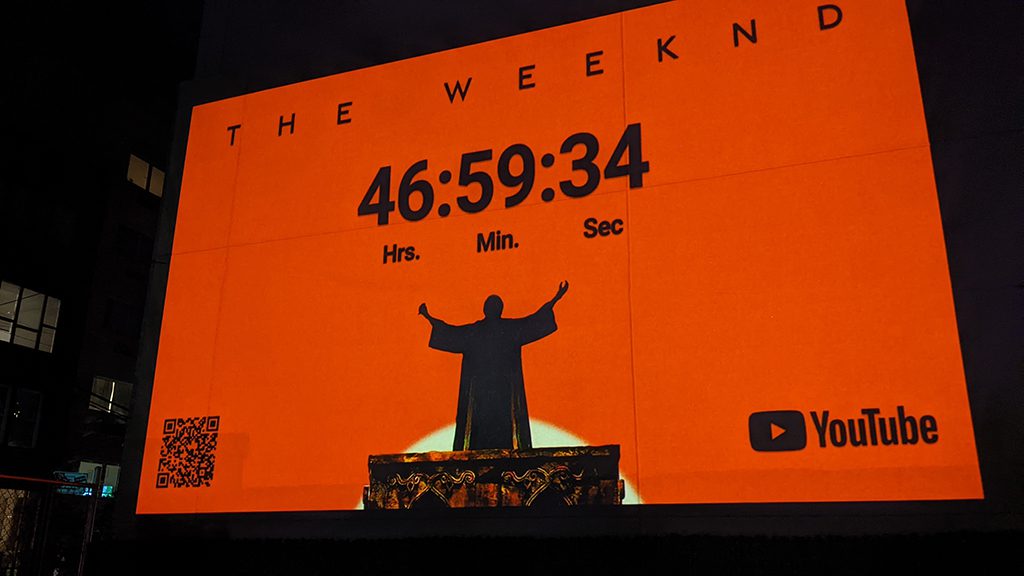
Projection advertising puts a moving brand message on a building wall, bridge face, or any large vertical surface using high-powered projectors. At night, in the right location, the effect is impossible to ignore. A brand message 40 feet tall, lit against a dark building face in the Meatpacking District, stops everyone who walks past it.
We use projectors rated at 20,000 lumens and above for building facades, positioned anywhere from 50 to 200 feet away from the target surface depending on the throw distance we need. The projectors are rigged in a vehicle or mounted on a portable stand, managed by a two-person crew. The installation footprint is minimal and the visual footprint is enormous.
Projection works best during evening and nighttime hours, typically 8 PM to midnight in busy urban environments. The format generates significant organic photography and social sharing, particularly when the projected content includes motion or animation.
Creative guidance: Projection content should be designed for the specific wall surface and building context. A projection that reads well on a smooth light-colored facade will not read the same way on a brick wall or a glass curtain building. Send us the proposed location and we will give you a content specification before your design team builds the final file.
Format 4: Poster and Flyer Distribution
Poster distribution has been a street-level advertising technique for over a century, and it still works. The format is simple: a printed poster, affixed to surfaces in locations where the target audience moves. But the execution quality varies enormously between campaigns that work and campaigns that become invisible clutter.
The posters that work are more than well designed. They are placed correctly, at the right density, in the right neighborhood, at the right height for the audience to engage with. We have placed posters at eye level on the wooden construction hoarding lining the sidewalk on 34th Street between 7th and 8th Avenue, on the phone infrastructure poles along Bedford Avenue in Williamsburg, and in the bathroom poster frames at venues from the Bowery Ballroom to the Troubadour in Los Angeles. Location and context are everything.
Street Team Poster Runs
For dense market coverage, we deploy street teams on overnight poster runs. A team of four to six installers can cover 50 to 80 locations in a single night in a concentrated neighborhood zone. We photograph every installation with GPS timestamp. The client receives a photo report within 24 hours of the run. That documentation is standard on every poster campaign we run because clients need to verify what they bought.
Format 5: Street Team Activations
Street teams are branded human assets: people who carry the message into the audience rather than waiting for the audience to find it. A street team activation puts brand representatives in the specific locations where the target demographic is already gathered, equipped with samples, flyers, promotional materials, or simply brand presence.
Street teams work best at high-density events: concert approaches, festival perimeters, food market Saturdays, trade show entrances, and transit hub rush hours. We staff street teams from a network of trained field representatives in every major market we operate in. Each representative is briefed on the brand, the campaign goal, and the specific deployment protocol before going into the field.
Product Sampling
Sampling campaigns are a specialized type of street team activation. Instead of conversation or literature, the team distributes a physical product: a sample-size version of the client’s product, a branded item, or a trial kit. The tactile quality of getting something in-hand is the most direct engagement an outdoor campaign can generate. A consumer who touches, smells, or tastes a product on the street is far further along the purchase consideration path than one who sees an impression from a billboard.
We have run sampling campaigns for food and beverage brands in Union Square Park in Manhattan, along the Venice Boardwalk in Los Angeles, at the Ferry Building Farmers Market in San Francisco, and at the Dallas Farmers Market. High foot traffic, dwell time, and a consumer mindset open to discovery all make farmers markets and outdoor markets particularly strong sampling environments.
Format 6: Reverse Graffiti
Reverse graffiti is a pressure-washing technique. We cut a custom stencil, secure it to a dirty urban surface, and pressure-wash the exposed areas. The brand message appears in clean negative space against the surrounding grime. No paint, no chemicals, only water under pressure.
The technique requires the right surface: one with enough accumulated grime to produce strong contrast once sections are cleaned away. The sidewalks on the approach to Madison Square Garden, the parking garage floors in the Meatpacking District, and the pedestrian underpasses near Penn Station all carry the kind of grime buildup that makes this format sing.
Reverse graffiti generates attention because it looks like art before it looks like advertising. Pedestrians slow down to figure out what they are looking at. That extra second of engagement is worth more than ten seconds of billboard exposure from a passing vehicle.
Comparing Outdoor Advertising Techniques: Format Selector
Format
Best For
Duration
Typical Cost Range
Social Sharing Potential
Mural
Brand authority, long-term presence
1 to 5 years
$8,000 to $40,000
High
Sidewalk Stencil
Event activations, launches
1 to 3 weeks
From $2,855 (5 stencils)
Medium
Projection Advertising
PR moments, launch events
1 to 5 nights
$3,500 to $12,000/night
Very High
Poster Distribution
Awareness, event promotion
2 to 6 weeks
$1,500 to $5,000
Low to Medium
Street Team
Sampling, direct engagement
Campaign-specific
$3,000 to $15,000
Medium
Reverse Graffiti
Surprise factor, PR value
2 to 4 weeks
$2,500 to $7,500
High
How We Build a Multi-Format Outdoor Campaign
The most effective outdoor campaigns we run use more than one format. A single mural in SoHo gets foot traffic exposures. The same campaign combined with stenciling on the approach routes to that mural and a street team activation on opening weekend creates multiple touchpoints with the same audience at different moments in their day.
We call this format layering. The idea is simple: cover the same geographic territory with complementary formats that hit different times of day and different attention modes. The mural is always there, building recognition. The stencils appear at foot level, catching eyes in motion. The street team creates direct human contact. Together, they produce a campaign presence that feels everywhere to the target audience.
Campaign Planning Process
Every campaign starts with a brief. We need to know the target audience, the key geographic markets, the campaign window, and the primary goal. From there, we build a format recommendation with location scouting, a production timeline, and a documentation plan. Clients receive photo reports and location logs for every installed element so they can track what was deployed and where.
We do not pitch formats that do not fit the goal. If a client needs broad awareness across three boroughs in two weeks, we recommend a stencil campaign and poster distribution, not a single mural that takes four weeks to produce. Matching the format to the timeline and the goal is the first job of campaign planning.
What Brands Get Wrong About Outdoor Advertising Technique
The biggest mistake we see is treating outdoor as a residual channel. Brands allocate their remaining budget to outdoor after the digital buy is done, then wonder why the street presence feels thin. Outdoor works best when it is planned from the start as a primary touchpoint, not a supplement.
The second most common mistake is over-designing for the format. A billboard has two seconds of attention from a passing vehicle. Put three lines of copy on it and nothing lands. A stencil on the sidewalk has five to ten seconds of attention from someone walking at normal pace. Put a complex illustration on it and the viewer only sees a blur. Outdoor advertising demands simplicity. The best brand messages in outdoor are six words or fewer and a single clear graphic element.
The third mistake is generic location selection. Picking a wall or a sidewalk because it is available rather than because it is right for the audience is how campaigns waste budget on high-visibility but low-relevance exposures. We scout every location before recommending it. Availability is necessary but not sufficient.
Markets Where AGM Runs Outdoor Campaigns
We are headquartered in New York and run the most volume there. Our primary markets for outdoor campaigns include New York City across all five boroughs, Los Angeles, Chicago, Miami, Austin, Boston, Atlanta, Seattle, Denver, San Francisco, Washington DC, and Nashville. For national campaigns, we coordinate multi-market deployments from a single brief and deliver unified reporting across all markets.
Our New York field team covers everything from the Bronx to Staten Island. In Brooklyn, we know which walls in DUMBO get the foot traffic from Brooklyn Bridge tourists. We know which surfaces on the L train corridor in Bushwick hold stencil paint well and which ones absorb too fast. In Los Angeles, we know the difference between morning foot traffic in Silver Lake versus afternoon traffic on Melrose Avenue, and we plan deployment timing based on that difference. In Chicago, we know which neighborhoods have the highest density of the target audiences our clients typically pursue, and we concentrate location strategy in those neighborhoods rather than spreading across the city and reaching everyone equally poorly. That kind of local knowledge is what separates a campaign that lands from one that goes unnoticed, and it is built through years of field work, not through a map and a media kit.
Frequently Asked Questions
What is the most effective outdoor advertising technique?
The most effective outdoor technique depends on your goal. For raw exposures, large-format murals and billboards win. For social media pickup and PR value, unexpected street-level formats like stencils, reverse graffiti, and projection advertising generate more organic sharing per dollar spent.
How much does outdoor advertising cost?
Costs range widely. Chalk stencil campaigns start around $2,500 for a single market. Mural production runs $8,000 to $40,000 depending on surface size and location. Projection advertising starts at $6,500 per projector per night in NYC, $7,500 outside NYC. Paid billboard placement varies from a few hundred to tens of thousands per month by market.
Which outdoor advertising technique generates the most social sharing?
Unexpected, visually surprising formats generate the most organic social sharing. Projection advertising, reverse graffiti, and oversized mural installations consistently generate street photography that spreads on Instagram and TikTok without any paid boost. The format has to be something people have not seen before in that location.
Can outdoor advertising work for small brands with limited budgets?
Absolutely. Street-level formats like stenciling, poster distribution, and street team activations give small brands meaningful presence in targeted neighborhoods at costs far below traditional media buys. A well-executed stencil campaign in three Manhattan neighborhoods can generate more exposures per dollar than a digital display ad running citywide.
What cities does AGM run outdoor campaigns in?
We run outdoor campaigns across more than a dozen major U.S. markets. Our most active cities are New York, Los Angeles, Chicago, Miami, Austin, Boston, Atlanta, Seattle, San Francisco, Denver, and Washington DC. We also run national campaigns with coordinated field teams across multiple markets at the same time.
How long does it take to set up an outdoor advertising campaign?
Timeline depends on format. A stencil campaign can go from brief to installed in 7 to 10 days. A mural installation typically takes 3 to 5 weeks from design approval to final seal coat. Projection advertising can be activated in 5 to 7 days once artwork is approved. Paid media placements on transit or billboards require 2 to 4 weeks for production and posting.
What artwork specs do outdoor advertising techniques require?
Specs vary by format. Stencil work requires clean vector artwork, ideally in a limited color palette. Murals accept full-color digital files, minimum 300 DPI at print size. Projection advertising requires digital files at minimum 1920×1080. We review every file before production and flag any issues that would affect output quality.
Does AGM handle outdoor campaigns outside of New York?
Yes. We have field operations in Los Angeles, Chicago, Miami, Atlanta, Austin, Boston, Seattle, Denver, San Francisco, and Washington DC. For national campaigns, we coordinate simultaneous deployments across multiple markets with unified reporting.