Gorilla Marketing: The Complete Street Campaign Guide
People spell it both ways. The concept is the same: unconventional, ground-level tactics that put your brand directly in front of real people, in real places, without renting a billboard or buying a 30-second spot.
People spell it both ways. “Gorillamarketing.” “Guerrilla marketing.” The search engines know what you mean, and so do we. The concept is identical either way: unconventional, ground-level tactics that put your brand directly in front of real people, in real places, without renting a billboard or buying a 30-second spot.
We have been running these campaigns for over a decade. Our crews have worked pre-dawn on Prince Street in SoHo, on the back walls of Williamsburg warehouses off Metropolitan Avenue, along the stretch of Melrose Avenue between Fairfax and La Brea, and at dozens of intersections most brand managers have never heard of. What we have learned cannot come from a textbook. It comes from hauling equipment up flights of stairs, reading a surface before you paste, and watching how foot traffic actually moves at 7 AM on a Tuesday.
This guide covers everything: what gorilla marketing is, how the major tactics work, where campaigns get executed, what separates a professional operation from an amateur one, and how to brief an agency that will not waste your budget.
What Is Gorilla Marketing? (And Why the Spelling Does Not Matter)
The term “guerrilla marketing” was coined by Jay Conrad Levinson in his 1984 book of the same name. He borrowed the term from guerrilla warfare: small, agile forces using unconventional tactics to outmaneuver a larger opponent. For marketing, that meant small businesses finding ways to compete with big-budget advertisers without big-budget spend.
Four decades later, the environment has shifted. The tactics Levinson described as scrappy alternatives are now deployed by global brands with seven-figure campaign budgets. Nike, Apple, Netflix, Red Bull, Spotify. They all run gorilla marketing campaigns. The reason is not budget constraint. It is effectiveness.
When you paste a well-designed image on a corner at Houston and Ludlow at 4 AM, and two thousand people walk past it before noon, you have bought attention that no algorithm can replicate. No skip button. No ad blocker. No scroll. Just a person, on foot, confronting something unexpected on a surface they have walked past a hundred times. That is what gorilla marketing does. It interrupts the pattern. It plants a brand image in a physical context that people actually inhabit. And because it feels organic rather than purchased, the impression sticks differently than a paid placement.
The Seven Core Gorilla Marketing Tactics
Gorilla marketing is not one thing. It is a family of tactics, each suited to different environments, budgets, and objectives. Here is how each one actually works in the field.
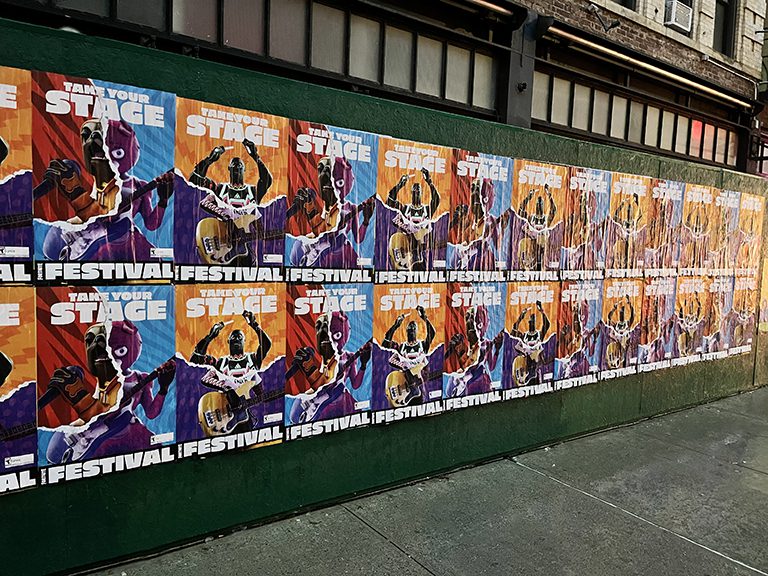
Street posters are the foundation. You design a bold image. You print it at scale. Your crew goes out at night or early morning and pastes it to construction hoarding, scaffolding planks, boarded storefronts, and plywood barriers.
The execution is more technical than it sounds. Paper weight matters. We run most street campaigns on 80 lb. uncoated text stock. It is heavy enough to survive paste application without tearing, but light enough to conform to irregular surfaces. Paste consistency is calibrated to the weather. On a 35-degree morning in February, the mix is thinner to maintain workability at low temperature. On a humid July night in Bushwick, we adjust again or we are pulling up bubbled paper before sunrise.
Location selection is where the real work happens. We scout on foot. We are looking at foot traffic patterns, sight lines, surface condition, and how a location reads from five feet, fifteen feet, and across the street. A poster on the plywood hoarding wrapping a construction site at Atlantic and 4th Ave in Brooklyn reads at a completely different scale than the same poster on a ground-floor storefront gate on Orchard Street.
2. Stencil and Chalk Art
Stencils bring a different energy. Where a street poster is an image applied to a surface, a stencil is a mark made on the surface itself. Spray paint, sidewalk chalk, or water-based paint through a cut template. The visual result looks hand-made in a way a printed poster does not.
We have run stencil campaigns on sidewalks along the High Line approach on West 14th Street where foot traffic is dense and consistent. We have activated stairwells in major transit stations. We have stenciled loading dock floors in the Meatpacking District and alley walls in Logan Square in Chicago.
Water-based formulas are the standard. They weather off naturally. The visual payoff during the campaign period is strong: fresh, graphic marks on concrete read as intentional, which creates curiosity. People photograph them. That secondary distribution is part of what makes stencil programs worth running.
3. Projection Marketing
Projection campaigns use high-lumen projectors to beam imagery, video, or messaging onto building facades, plazas, or landmarks. The installation can go up in fifteen minutes. It can cover a twelve-story wall. And it leaves zero physical trace after the event.
We have projected onto the south face of buildings on Times Square side streets, on the exterior of warehouse walls along the Gowanus Canal, and on the face of parking structures off Peachtree Street in Atlanta during peak evening hours. The light output needed to compete with ambient city light is substantial. For a major urban projection you are looking at 20,000 to 30,000 lumens minimum. For high-ambient-light environments, significantly more.
Projection campaigns work best for launches. A new album drop, a product reveal, a film release date. The temporal nature, it is there for an hour and then it is gone, creates urgency that static placements do not have. People pull out phones. They post it. The life of the campaign extends far beyond the physical duration of the projection event.
4. Street Team Activations
Street teams are the human element. Brand ambassadors deployed in target areas to distribute samples, create interactions, hand out branded materials, or simply embody a brand message through behavior and presence in the right location at the right time.
A good street team activation in New York City concentrates density. Do not spread twelve people across four boroughs. Put twelve people at one intersection for four hours. We have staged teams at the corner of Bedford Avenue and North 7th Street in Williamsburg on Saturday afternoons. We have run activations outside the Columbus Circle subway exit at rush hour. We have worked the stretch of Lower Broadway between Canal and Spring during weekend afternoons when foot counts rival midtown.
Script matters less than instinct. The best brand ambassadors are not reading from a card. They are having real conversations. A trained team reads body language and adjusts approach. They know when to engage and when to let someone pass. The conversion metric on a street team is not always a flyer accepted. Sometimes it is a photo taken. Sometimes it is a laugh. The goal is a positive brand encounter that sticks.
5. Pop-Up Installations
Pop-up installations bring the brand into three-dimensional space. These range from simple branded structures assembled in a plaza to elaborate multi-room experiential environments that take days to build.
The tactical version, what most gorilla marketing clients need, is a modular installation that assembles fast, photographs well, and creates a reason for people to stop. We have built tunnel structures branded with light and sound on Wacker Drive in Chicago. We have installed oversized product replicas in pedestrian plazas in the Flatiron District. We have done surprise activations in the middle of Barclays Center’s plaza on Atlantic Avenue that were not announced until the morning of.
The less expected the location, the stronger the reaction. That is the core mechanic. When someone encounters a brand in a context where brands do not normally appear, they pay more attention. The novelty signal is still firing. Their guard is not up. That is the window.
6. Ambient and Environmental Installations
Ambient marketing integrates a brand message into the environment itself. This is not a poster on a wall. It is a modification of the environment. A branded shadow cast through a cut shape. A drain grate turned into a visual brand moment. A crosswalk treatment that makes people look down at something they have crossed a thousand times without noticing.
These require more design and production investment. But when they work, they photograph magnificently. The generation raised on social media has a sixth sense for unusual visual moments. An ambient installation at the corner of Houston and Varick can generate more organic social content in a morning than a conventional print campaign generates in a month. The key is that the concept has to be genuinely clever, not just branded.
7. Wheatpaste Murals and Large-Format Art
Wheatpaste mural campaigns occupy a different scale from standard street posters. These are large-format images, assembled from multiple tiled panels, pasted to create a single unified visual that might cover an entire two-story exterior wall.
We have activated blank brick walls on Grand Street in Williamsburg with floor-to-ceiling image panels. We have covered exterior walls on Fairfax Avenue in Los Angeles with brand-integrated artwork that read as street art while carrying a client message. The production involves printing at high resolution on heavy-weight stock, pre-cutting panels, and applying them in register on site, usually with ladders or lifts involved for anything above standing reach height.
The result is a mural-scale brand impression at street level. These last. A quality wheatpaste mural on a well-protected brick wall can hold for months. In some neighborhoods, years, before anyone covers it with something else.
Gorilla Marketing Format Comparison
Format
Duration
Cost Level
Social Share Potential
Best Use Case
Street Posters
Days to weeks
Low to Medium
High
Launch awareness, event promotion
Stencils
Weeks to months
Low
Medium
Brand building, neighborhood presence
Projections
Hours per event
Medium to High
Very High
Launch moments, social content
Street Teams
Hours to days
Medium
Medium
Sampling, direct engagement
Pop-Up Installations
Days to weeks
Medium to High
Very High
Brand experiences, product launches
Ambient / Environmental
Variable
Medium to High
Extremely High
Viral moments, cultural campaigns
Wheatpaste Murals
Months to years
Medium to High
Very High
Long-term brand presence
Where Gorilla Marketing Works Best
Not every block is the same. We have learned over years exactly which environments produce strong results and which eat budgets without return.
New York City
New York is the gold standard for gorilla marketing. Foot traffic density is unmatched. Almost nobody drives. People walk, they stop, they look.
In Manhattan, SoHo consistently delivers. The blocks around Prince Street, Spring Street, and Broadway see concentrated foot traffic from people who are already in a discovery mindset. They are shopping, gallery-hopping, taking in the neighborhood. Their attention is more available than a commuter pushing through Penn Station.
The Lower East Side, specifically the corridor from Delancey down to Canal between Essex and Clinton, has a younger-skewing, culturally engaged audience. Orchard Street and Rivington Street walls have launched more brand moments than we can count. Williamsburg along the Bedford Avenue spine and east through Graham Avenue remains our most consistent performer in the outer boroughs for creative and fashion brand campaigns.
Los Angeles
LA requires different thinking than New York. The city is spread out. The audience does not concentrate in transit corridors the way it does in New York. Our LA campaigns concentrate on the specific walkable neighborhoods where the creative class is dense: Melrose Avenue between Fairfax and Highland, the Fairfax District from 3rd Street north, Sunset Boulevard through Silver Lake from Silverlake Boulevard to Alvarado, and Abbot Kinney in Venice from Main Street to Westminster Avenue.
The Arts District in downtown LA has matured significantly as a gorilla marketing environment over the past decade. The concentration of creative agencies, production houses, showrooms, and cultural venues creates a daytime and weekend audience of exactly the demographic that most consumer brands are targeting. Walls along the main Arts District corridors, particularly around Mateo Street and 6th Street, have become among the most photographed street art surfaces in Southern California.
Chicago
Chicago’s gorilla marketing geography centers on Milwaukee Avenue through Wicker Park and Bucktown, from North Avenue north through Damen to California Avenue. Division Street through Wicker Park is a strong secondary corridor. For campaigns targeting a broader Chicago audience, the Loop’s State Street corridor and Michigan Avenue offer high-volume placement opportunities at the cost of lower demographic precision.
Miami
Wynwood is Miami’s gorilla marketing capital. The concentration of galleries, murals, restaurants, and creative businesses on NW 2nd Avenue between NW 20th and 26th Streets creates a foot traffic network that is uniquely receptive to street-level brand presence. During Art Basel in December, the neighborhood operates as one of the highest-concentration gorilla marketing environments in the country.
AGM Field Note: City-level targeting is a starting point, not a strategy. The real location work happens at the neighborhood and block level. We have seen campaigns in “the right city” fail because the specific neighborhoods were wrong for the target audience, and we have seen campaigns in smaller markets outperform major metro campaigns because the location selection was precise enough to create genuine saturation within the actual audience footprint. Precision beats scale every time.
What Separates Professional Gorilla Marketing from Amateur Execution
The gap between a professional gorilla marketing execution and an amateur one is significant, and it shows up immediately when you look at the work in the field.
Surface knowledge. Professionals read a surface before they apply anything. They know which surfaces accept paste cleanly, which ones require surface preparation, which ones will cause adhesive failure. Amateurs apply the same technique to every surface and wonder why half the installations look poor by day two.
Weather calibration. Paste consistency changes with temperature and humidity. Ink behavior changes with UV exposure and heat. Material selection needs to match the environmental conditions of the deployment market. A professional operation has these variables mapped and accounted for before installation night. An amateur operation discovers them during installation when it is too late to adapt.
Location intelligence. The difference between a placement that reaches the target audience and one that misses them is often a single block. Professional gorilla marketing agencies invest in location scouting that produces location-specific intelligence: foot traffic patterns, audience demographics, sight lines, competitive visual context, and surface availability. Amateur operations mark a neighborhood on a map and send the crew out.
Documentation discipline. Every professional gorilla marketing campaign is fully documented at installation time, with photographs of every placement in context. This documentation is the proof of performance that allows the client to verify that the campaign ran as planned and provides the visual record for campaign reporting and case study development. Campaigns without systematic documentation cannot be verified, evaluated, or built upon.
Crew management. Street crews need to be briefed, coordinated, and held to quality standards. A professional operation has crew management systems, quality control checkpoints during installation, and a reporting process that keeps the campaign coordinator informed of progress and problems in real time. Amateur operations send crews out and hope for the best.
Planning a Gorilla Marketing Campaign: The Brief to Street Process
Understanding the full campaign process helps brands prepare better briefs and have more realistic expectations about what is achievable within a given timeline and budget.
The process starts with the strategy brief. We need to understand the target audience specifically, the geography of the campaign, the timing relative to the brand moment being supported, the creative direction, and the objective the campaign is designed to achieve. The more specific and clear the brief, the more precisely the campaign strategy can be calibrated to deliver against it.
Location scouting follows the strategy brief. Our scouts walk the target neighborhoods with a specific audience profile and objective in mind, identifying the specific surfaces, sight lines, and locations that will deliver the campaign to the target audience most effectively. We produce a ranked placement list with documentation of each location’s physical characteristics and estimated reach.
Creative review happens before production. We evaluate all creative files against street-scale specs and provide specific feedback on any elements that will not translate well to the street environment. We would rather send a design back for adjustment than produce thousands of prints that look wrong in the field.
Production is coordinated with installation timing so that materials arrive at the staging location ready to deploy when the installation window opens. For flash campaigns, this coordination is especially critical because there is no buffer for production delays.
Installation is executed by briefed, experienced crews with clear location lists, quality standards, and communication protocols. Post-installation documentation is completed at each location and compiled into the proof-of-posting package that goes to the client within 48 hours of campaign execution.
Gorilla Marketing and Social Media: Designing for the Double Audience
Every street campaign we execute today has two audiences: the people who physically encounter it and the people who see it through the social media posts of the people who physically encountered it. Designing for both audiences simultaneously is one of the most important skills in contemporary gorilla marketing, and it is one that separates agencies that understand the current media environment from those that still think about street advertising in purely physical terms.
The physical audience encounters the campaign at street scale, from varying distances and angles, in motion, often without stopping. The social audience encounters the same campaign at phone scale, in a static image, often cropped to its most visually compelling element, framed by whatever context the photographer chose to include. These are genuinely different viewing experiences, and they favor different design choices. Work that photographs well in a tight crop is different from work that reads at thirty feet from the natural pedestrian viewing distance. The best street campaign designs navigate this tension by using visual elements that work at both scales: bold enough to stop attention at street scale, interesting enough to share at phone scale.
Location affects the social audience more than the physical audience because the background context in social photographs matters enormously. A campaign on a wall in Bushwick, photographed against the neighborhood’s existing street art backdrop, carries visual authority that the same campaign on a blank wall in a generic commercial corridor does not. We deliberately select locations with interesting visual contexts that add production value to the social photography generated by the campaign. The location is set dressing for the social content even when it is also a placement for the physical campaign.
Gorilla Marketing ROI: How to Think About Returns on Street Campaigns
Return on investment in gorilla marketing is real and measurable, but it requires measurement frameworks that go beyond the impression-counting metrics borrowed from digital advertising. A brand that tries to evaluate its street campaign solely through estimated impression reach is using the wrong tool for the job and will consistently undervalue the campaign’s actual impact.
The most relevant ROI metrics for gorilla marketing campaigns are brand recall lift in the target neighborhoods, organic social content generated without paid distribution, earned media coverage triggered by the campaign, and for brands with retail distribution in the target markets, point-of-sale velocity changes during and after the campaign window. These are all measurable. They require specific measurement frameworks to be put in place before the campaign launches, which is why we make measurement planning part of every campaign brief rather than an afterthought at the reporting stage.
The cumulative ROI of sustained gorilla marketing programs, campaigns run consistently in specific markets over quarters and years rather than as one-time events, grows non-linearly because brand familiarity compounds over time. The first campaign creates initial recognition. The second campaign reinforces it. By the fourth or fifth campaign in the same neighborhood, the brand has become part of the visual fabric of the community in a way that no single campaign, regardless of its quality, could achieve on its own. Brands that commit to sustained street presence in their target markets consistently outperform brands that run occasional campaigns on every measure of long-term brand health.
Frequently Asked Questions
Is “gorilla marketing” the same thing as “guerrilla marketing”?
Yes. “Gorilla marketing” is an alternate spelling of “guerrilla marketing” that is widely used in search and common conversation. The concept, tactics, and execution are identical regardless of spelling. Both terms refer to unconventional, street-level marketing approaches that create brand presence through physical presence and creative execution rather than traditional media spend.
What budget is required to run a gorilla marketing campaign?
Gorilla marketing works across a wide budget range. A stencil program in one neighborhood might run $2,000 to $5,000. A comprehensive multi-format poster campaign across a major city might run $15,000 to $40,000. A projection campaign or large-format mural program can run $20,000 to $100,000 depending on scale. We work with clients to build campaigns that maximize impact within the available budget rather than scaling down a generic package.
How do you measure the impact of gorilla marketing?
We track impression estimates using foot traffic data for each location. We monitor social media for organic posts, shares, and tagged content related to the campaign. We document earned media coverage. For campaigns integrated with digital, we track lift in search volume, social following, and direct site traffic during and after the campaign period. For retail-adjacent campaigns, we correlate campaign geography with point-of-sale data where the client can provide access.
Do you work in cities outside New York?
Yes. We have active crew networks in Los Angeles, Chicago, Miami, Atlanta, Austin, Boston, Philadelphia, Houston, Seattle, Denver, Nashville, and other major markets. For markets where we do not have a standing crew, we have a vetted partner network and quality-control processes that bring our production standards to any city where a client needs to run.
How far in advance should I book a campaign?
For a standard street poster campaign, three to four weeks is workable. For a projection campaign or pop-up installation, six to eight weeks minimum is realistic to allow for design, production, and crew coordination. For complex multi-city campaigns, eight to twelve weeks gives us room to do the work right. Tighter timelines are sometimes possible depending on market and format; discuss your specific window with us at the start of the brief process.
Can gorilla marketing work for B2B brands?
Yes, with smart location targeting. If your audience concentrates in specific physical areas, a gorilla marketing campaign can reach them there. Financial district placements for fintech brands. Convention center perimeter campaigns timed to industry events. Office corridor and transit activations near concentrations of your target industry. The principle is the same: put your brand in front of the right person in a context they do not expect it. The target audience is different; the mechanics are identical.
What kind of creative works best for street campaigns?
Bold, simple, high-contrast. One dominant image. Minimal copy. A clear brand signal. The person reading your poster has a second of attention and may be twenty feet away. The work has to communicate instantly. Type-heavy, detail-rich designs do not translate to street environments. We push our clients toward the simplest, strongest version of their message, and every client who has taken that direction has been glad they did.
What makes American Guerrilla Marketing different from other agencies?
A decade of real execution. Not strategy decks. Not concepts that never leave the conference room. We have been on the street with paste buckets, projectors, and trained crews in every major market. We know what works because we have done it. We know what fails because we have fixed failures at 5 AM before the client’s launch morning. Strategic planning, creative production, and boots-on-the-ground execution under one roof. Most clients have worked with agencies that do two of those three. We do all three.
How do I start a gorilla marketing campaign with AGM?
Contact us at (646) 776-2770 or [email protected] with your basic campaign parameters: market, timing, target audience, and objective. We will schedule a brief call to gather the information we need to produce a campaign proposal, typically within three to five business days of the initial conversation.