Gerilla Marketing: What It Is, How It Works, and Why Brands Use It
Whether you spell it gerilla, guerilla, or guerrilla, the principle is the same: use unconventional tactics to reach your audience in the real world in a way they did not expect and will not forget.
The most common search misspellings for guerrilla marketing are gerilla marketing and guerilla marketing. If you searched for gerilla marketing, you are looking for information about guerrilla marketing, which is the correct spelling. The term comes from the Spanish word for guerrilla warfare, which refers to small-scale, unconventional tactical operations that achieve outsized results through surprise and precision rather than force or scale.
That military analogy maps cleanly onto marketing. Guerrilla marketing achieves outsized brand results through creative intelligence and precise targeting rather than large media budgets. It reaches consumers in their physical environment in unexpected ways. It creates encounters that feel more like discoveries than advertisements. And it generates the kind of organic word-of-mouth and social amplification that paid media cannot buy.
At American Guerrilla Marketing, this is the work we do every day. We plan and execute guerrilla marketing campaigns in cities across the United States. This guide covers what guerrilla marketing is, how it works in practice, what the major formats look like, and why brands at every size and budget level use it to reach audiences that conventional advertising cannot effectively capture.
What Gerilla Marketing (Guerrilla Marketing) Actually Is
Guerrilla marketing is a category of advertising strategy that uses unconventional, often unexpected tactics to reach consumers in public spaces. The definition has expanded considerably since Jay Conrad Levinson coined the term in 1984, but the core principle has not changed: use creative intelligence and environmental specificity to create a brand encounter that surprises the audience, creates a strong memory impression, and generates organic word-of-mouth or social amplification.
The contrast with conventional advertising is instructive. Conventional advertising buys attention in defined media slots: a 30-second television commercial, a display ad on a website, a sponsored post in a social media feed. Guerrilla marketing does not buy attention. It earns attention by placing something unexpected in a space where the audience already is, creating an encounter that the audience values enough to pay attention to voluntarily.
That distinction has significant practical implications. Conventional advertising competes with every other advertiser for the same defined media slots. Guerrilla marketing operates in the physical environment, which has no formal competition for advertising slots because it was not designed as an advertising medium. This is both the format’s core advantage and its core challenge: the absence of defined slots means that the campaign must earn its impression through the quality and precision of the encounter it creates.
The History of Gerilla Marketing
The term guerrilla marketing was introduced by Jay Conrad Levinson in his 1984 book of the same name. Levinson’s original concept was focused on small businesses that could not afford conventional media buys. His argument was that smaller budgets could achieve competitive brand results by using creativity, precision, and unconventional tactics rather than media spending power.
The principles Levinson articulated in 1984 remain the foundation of how guerrilla marketing works: understand the audience precisely, choose tactics that reach them in their specific environment, and create encounters that are more memorable than anything a paid media slot can deliver.
As the format developed through the 1990s and 2000s, larger brands adopted it alongside small businesses because they recognized that guerrilla tactics could generate cultural credibility and organic media coverage that money alone could not buy. A well-executed guerrilla campaign in the right neighborhood generates press coverage, social media attention, and word-of-mouth that persists long after the physical campaign ends.
The rise of social media in the 2010s transformed the economics of guerrilla marketing significantly. Before social media, a guerrilla campaign’s reach was limited to the people who physically encountered it. After social media, organic documentation of a guerrilla campaign by consumers in the area can generate exposures that exceed the direct placement reach by orders of magnitude. This social amplification dynamic is now a central strategic consideration in every guerrilla campaign we plan.
The Major Forms of Gerilla Marketing
The guerrilla marketing category encompasses dozens of specific tactics. Here are the ones that we use most frequently and the contexts where each works best.
Street-Level Poster Campaigns
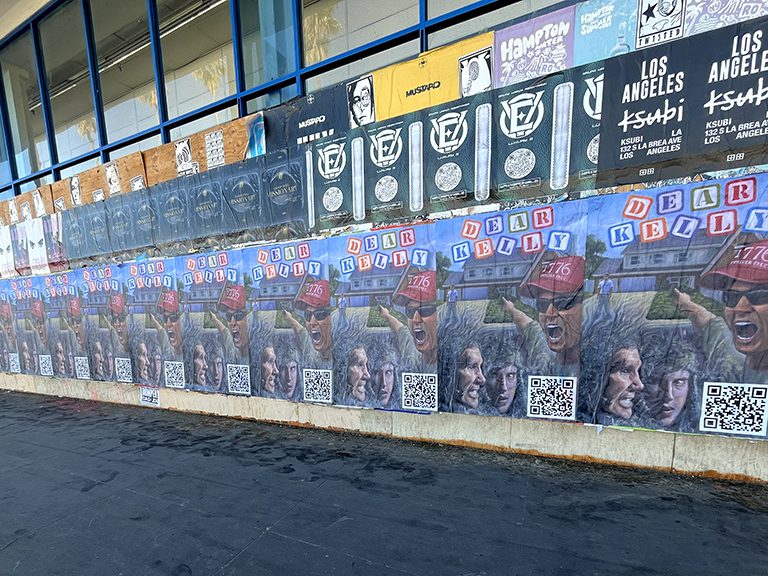
Large-format paper poster placements in high-traffic urban locations are the most widely used guerrilla marketing format. They are relatively cost-effective, highly visible at pedestrian scale, and compatible with the visual tradition of urban street culture in most major cities. Quality of print and quality of creative are the primary determinants of performance. A poster campaign with mediocre creative in a great location will underperform a campaign with excellent creative in the same location.
Ambient Installations
Ambient installations transform elements of the physical environment into brand moments. They use the existing architecture, infrastructure, or visual context of a specific location to create a brand encounter that feels specific to that place. The best ambient installations could not be placed anywhere else because their entire effect depends on their relationship with the specific environment they occupy.
Projection Events
Building and surface projections create large-scale, temporary visual spectacles on urban architecture. They are particularly effective for campaign launches, product announcements, and cultural events because they generate strong documentation impulses in the audience: people see a projection on a building and immediately reach for their phones. That documentation creates the social content that extends the campaign’s reach.
Ambassador programs deploy trained brand representatives at specific, high-value locations to create direct human encounters with the target audience. They are the most interactive format in the guerrilla marketing toolkit and the one most capable of generating immediate consumer response: a conversation, a sample, a sign-up, or a purchase decision that no static format can motivate.
Vehicle Wraps
Branded vehicle wraps create mobile exposures across the geography of a city or region. They work best in combination with static placements because they extend the campaign’s geographic reach while the static placements provide the depth of impression in specific target zones.
Guerrilla Format
Impression Type
Social Potential
Minimum Budget
Street-level poster
Visual, repeated exposure
Medium-High
$3,000-$8,000
Ambient installation
Surprising, high-quality single encounter
Very High
$15,000-$40,000
Projection event
Spectacular, time-limited
Very High
$20,000-$50,000
Ambassador program
Direct human interaction
Medium
$5,000-$15,000
Vehicle wrap
Repeated mobile exposure
Low
$3,000-$8,000
Why Gerilla Marketing Works: The Psychology
Guerrilla marketing works for psychological reasons that are well-supported by research in consumer behavior and memory science. Understanding those reasons helps explain why the format continues to outperform conventional advertising in specific contexts even as media options multiply.
The first psychological mechanism is surprise. When something unexpected happens in a familiar environment, the brain pays attention at a higher level than it does when processing expected stimuli. A person walking down a familiar block who encounters an unexpected brand installation will process it more deeply than the same person scrolling past a sponsored post in a familiar digital feed. That deeper processing creates a stronger memory trace.
The second mechanism is context coherence. When a brand appears in the physical environment of a neighborhood that its target audience identifies with, the contextual association between the brand and the neighborhood’s identity transfers to the brand. A brand that shows up on the walls of Williamsburg earns a Williamsburg association. That association is worth significantly more than any explicit brand attribute claim the campaign could make.
The third mechanism is social proof through documentation. When consumers photograph and share a brand encounter, they implicitly endorse the brand by making it part of their public social identity. This endorsement is more credible and more persuasive than any advertising the brand could buy because it comes from a peer rather than from the brand itself.
The core advantage of guerrilla marketing: Conventional advertising interrupts the consumer’s experience to deliver a brand message. Guerrilla marketing creates an experience that the consumer wants to be part of. That difference in the consumer’s relationship to the encounter is what generates the memory quality and organic amplification that makes the format valuable for brands across every category and budget level.
Gerilla Marketing for Different Brand Sizes
Small Brands and Startups
Guerrilla marketing is particularly well-suited to small brands and startups because it rewards creative intelligence and strategic precision over spending scale. A small brand with a tight budget can run a focused single-neighborhood campaign in the right location and reach its target audience more effectively than a larger budget spread across conventional media channels. The format’s low minimum entry point and its potential for organic amplification make it one of the most efficient strategies available to early-stage brands.
Mid-Size Brands
Mid-size brands typically use guerrilla marketing as a component of a broader integrated campaign, using street-level physical presence to create cultural credibility and social amplification that their overall media mix cannot achieve alone. The combination of guerrilla tactics with digital retargeting creates a particularly effective compound effect: the street encounter creates brand familiarity that improves the response rate to subsequent digital touches.
Large Brands
Large brands use guerrilla marketing to generate press coverage, cultural credibility, and organic social content that their advertising budgets cannot simply buy. Major consumer brands, entertainment companies, and technology firms all run guerrilla campaigns as part of broader marketing programs because the format creates a quality of brand encounter and organic amplification that conventional media cannot replicate regardless of budget size.
Gerilla Marketing vs. Traditional Advertising: A Direct Comparison
Understanding when to use guerrilla marketing versus conventional advertising requires understanding what each format does well and what it does not.
Conventional advertising offers predictable reach and measurability. You know exactly how many people a television spot or a digital buy reaches, and you can measure response at the individual level in many digital formats. What conventional advertising cannot reliably deliver is surprise, cultural credibility, or organic amplification. Audiences are accustomed to being advertised to and have developed strong habitual defenses against conventional advertising messages.
Guerrilla marketing offers genuine surprise, cultural credibility, and organic amplification potential. What it does not offer is the predictable reach and granular measurability of digital advertising. The impression volumes from a guerrilla campaign are estimated rather than precisely measured. The organic amplification is real but unpredictable in its exact magnitude.
The right strategy for most brands combines elements of both: use guerrilla marketing to create a strong, memorable physical presence in the audience’s environment, and use conventional digital advertising to follow up with targeted messaging to the audience that has been exposed to the guerrilla component. The combination creates a cumulative effect that neither approach delivers independently.
The modern guerrilla marketing formula: Physical surprise plus digital follow-up creates the strongest possible compound impression. The physical encounter creates brand familiarity and positive association. The digital follow-up captures the demand that encounter creates. Neither works as well without the other.
Running a Gerilla Marketing Campaign: What the Process Looks Like
A gerilla marketing campaign does not start with tactics. It starts with a brief that defines the target audience with enough specificity to make meaningful location and format decisions. The audience definition should include not just demographics but behavioral patterns: where do they live, where do they work, which neighborhoods do they move through during a typical week, what events do they attend, what brands and cultural markers do they respond to? That behavioral picture is what makes location strategy possible.
From the audience definition, we build a location strategy. Location strategy in gerilla marketing is the translation of audience behavioral patterns into specific addresses, blocks, and surfaces where the target audience will actually encounter the campaign. The right locations are not necessarily the most famous or most photographed. They are the locations that most efficiently intercept the target audience in the context where they are most receptive. A streetwear brand may get more value from a single well-positioned placement on the approach to a skate park than from a dozen placements on a commercial strip that the target audience walks past without noticing.
Once locations are confirmed, format selection follows. The format must suit the location’s physical characteristics and the viewing conditions the audience will experience. A location where the audience is stationary for extended periods rewards more detailed creative. A location where the audience is moving at speed requires a simpler message that reads in a brief encounter window. A location where the audience is large and dense favors size and impact. A location where the audience is small but highly targeted favors precision over scale.
AGM Field Note: We ran a gerilla marketing campaign for a music client launching a debut album in Brooklyn. The location strategy targeted four specific blocks in Bushwick and Williamsburg where the target audience, independent music fans aged 18 to 34, moved in concentrations that no other medium could match at any similar budget level. The installations went up in a single overnight run and generated social documentation within 24 hours from audience members who had found them organically. That kind of earned amplification does not happen by accident. It happens when the location strategy puts the right creative in front of the right people at the right time.
What to Budget for a Gerilla Marketing Campaign
Gerilla marketing campaigns operate across a wide budget range because the format options range from low-cost stencil work to high-production mural installations to full multi-city coordination programs. The right budget level depends on the market, the format, the duration, and the geographic scope of the campaign.
Entry-level gerilla campaigns using stencil work or street poster placements in a single city can be executed for $2,500 to $7,500. This budget tier delivers meaningful street-level presence in a specific neighborhood or district and is appropriate for local brand launches, event promotions, and community-focused campaigns. Every dollar at this tier goes directly into location placement and documentation, with no budget wasted on media overhead.
Mid-range gerilla campaigns combining multiple formats, such as stencil work with a mural installation or poster placements with a street team component, in a single major market typically run $10,000 to $35,000. This budget tier delivers sustained, multi-format presence across a broader geographic footprint and generates stronger social documentation potential through format variety. The multi-format approach creates audience exposure in different contexts and different attentional modes: a pedestrian who encounters the brand as a mural on a building and again as a stencil on the sidewalk and again through a street team interaction has had three distinct exposures that reinforce each other in a way that a single-format campaign cannot produce.
National multi-city gerilla campaigns with coordinated deployments in three or more major markets and multiple format types run from $35,000 to $150,000 depending on city count, format mix, and campaign duration. These campaigns require the most lead time and the most coordination infrastructure but deliver unified national brand presence at a fraction of what equivalent broadcast reach would cost.
The key principle across all budget levels: the efficiency of gerilla marketing comes from precise targeting, not from spending more. A focused $5,000 campaign in exactly the right locations reaching exactly the right audience outperforms an unfocused $25,000 campaign spread across locations that do not match the audience profile. Budget discipline starts with audience clarity. Before any format is selected or any location is booked, the audience definition should be tight enough that you could stand on a specific corner at a specific time and recognize the people you are trying to reach. If the audience definition is that specific, the budget works efficiently. If it is vague, no amount of spending fixes the targeting problem.
Call us at (646) 776-2770 or email [email protected] to discuss what a gerilla marketing campaign looks like for your specific audience, market, and budget. We build custom proposals and we can usually turn around a campaign concept within 48 hours of receiving a clear brief.
Frequently Asked Questions About Gerilla Marketing
Frequently Asked Questions
What is gerilla marketing?
Gerilla marketing (correctly spelled guerrilla marketing) is an unconventional advertising strategy that places brands in public spaces through surprising, often low-cost tactics designed to create a strong impression with the target audience. It uses the element of surprise and the physical environment of cities to reach consumers in ways that traditional advertising cannot.
How is gerilla marketing spelled?
The correct spelling is guerrilla marketing, derived from the Spanish word for guerrilla warfare. Gerilla marketing and guerilla marketing are common misspellings of the same term. All three refer to the same category of unconventional advertising strategy.
What are examples of gerilla marketing?
Examples of guerrilla marketing include large-format poster campaigns in cultural neighborhoods, building projections on urban facades, brand installations in pedestrian areas, flash activations at public events, vehicle wraps on branded fleets, and brand ambassador programs at transit hubs.
Why do brands use gerilla marketing?
Brands use guerrilla marketing because it creates a quality of brand impression that conventional advertising cannot match. By reaching consumers in their physical environment in an unexpected way, guerrilla marketing creates a genuine encounter rather than a passive advertising exposure, producing stronger memory exposures and higher organic sharing.
How much does gerilla marketing cost?
Guerrilla marketing campaigns range from $5,000 for a focused single-neighborhood activation to $150,000 or more for comprehensive multi-city campaigns. The format rewards creative intelligence over media spending power, and a well-conceived small campaign often outperforms a larger, less focused one.
What is the history of gerilla marketing?
The term guerrilla marketing was coined by Jay Conrad Levinson in his 1984 book of the same name. Levinson drew the analogy between guerrilla warfare tactics and unconventional small-business marketing strategies that achieve outsized results through surprise and precision rather than force.
Does gerilla marketing work for large brands?
Yes. Large brands use guerrilla marketing to generate cultural credibility, social media amplification, and press coverage that conventional advertising spend cannot produce. The format works for brands of all sizes because it rewards strategic thinking and creative quality rather than budget scale.
Contact American Guerrilla Marketing at (646) 776-2770 or [email protected]. We plan and execute guerrilla marketing campaigns in New York, Los Angeles, Chicago, Miami, and cities across the US.