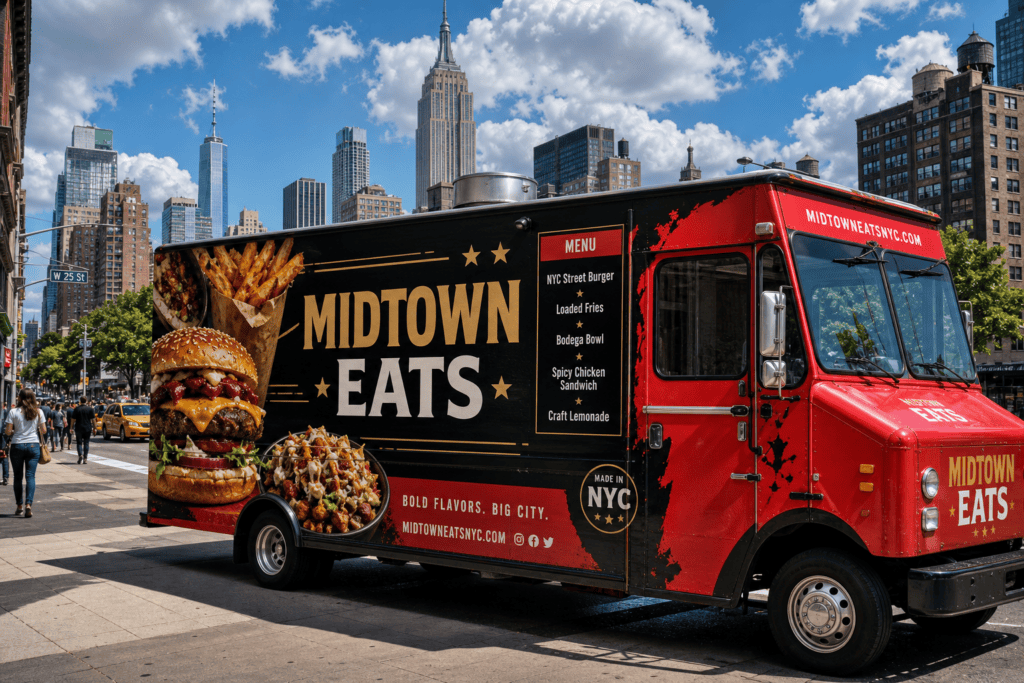
A branded food truck that stops people and delivers a great experience is one of the most cost-effective sampling and engagement tools in consumer marketing. Here is how to do it well.
Food trucks occupy an unusual position in brand marketing. They are simultaneously one of the most accessible formats and one of the most frequently done poorly. The accessibility comes from the existing food truck infrastructure in every major US city — trucks, operators, commissary relationships, health permits. The execution gap comes from brands that treat the food truck as a delivery mechanism for a product or a sample rather than as a complete brand experience platform.
When a food truck promotion is built correctly, it generates something that few other marketing formats can: a genuine reason for consumers to stop, wait briefly, and engage. People stop at food trucks because they want what the truck is offering. A brand that converts that stopping behavior into a brand experience — not just a transaction — creates the consumer relationship that makes the promotion worth the investment.
We have planned and executed food truck promotions for brands in food and beverage, personal care, retail, and technology. This guide covers the formats, the logistics, the locations, and the things that make these campaigns work or fail.
A food truck promotion is any marketing campaign that uses a food truck — custom-built or co-branded with an existing operator — to distribute samples, create brand experiences, or drive consumer engagement. The food element is the hook. People are drawn to the truck because food is being offered. The brand experience is what happens in the 60 to 90 seconds of that transaction.
Food truck promotions can take several structural forms. A brand can build or commission a custom-branded truck from scratch, operating it independently as a full brand experience vehicle with food or beverage as the activation mechanic. A brand can partner with an existing food truck operator for a co-branded promotion, where the truck’s menu is adapted to incorporate or feature the brand’s product. A brand can sponsor an existing food truck’s presence at a specific event or location, adding brand presence and sampling to an established food operation without modifying the truck itself.
Each approach has different economics, timelines, and creative possibilities. The right structure depends on the brand’s objective, the product category, and the budget available for the program.
Food Truck Promotion Formats
Custom Branded Truck
A custom-branded truck is built or fully wrapped and fitted to express a specific brand identity. The menu, the packaging, the staff uniforms, the truck design, and the consumer interaction are all brand-designed. This is the highest-investment format and the one with the most creative control. A custom-built food truck for a beverage brand might feature the brand’s drinks prepared in branded cups with an experience designed around the brand’s positioning. Every element of the consumer experience is controlled.
Custom trucks are the right format for brands running extended multi-week or multi-month campaigns where the amortized cost of the build justifies the investment, or for brands where the food element is actually central to the product identity (a food brand launching a new product line, for example).
Co-Branded Partnership
A co-branded partnership places the brand inside an existing food truck operator’s vehicle and operation. The truck operator handles the food production, health compliance, vehicle operation, and existing location relationships. The brand provides the product concept, the branding elements, and the campaign direction. Menus are created that feature or incorporate the brand’s product — a sauce brand partnering with a taco truck to create a limited menu item, a snack brand partnering with a food truck for a branded dessert item, a coffee brand partnering with a breakfast truck for a custom drink.
Co-branded partnerships are faster to execute than custom builds (no fabrication lead time), less expensive, and benefit from the food truck operator’s existing operational knowledge. The tradeoff is less creative control over the full consumer experience.
Sponsored Truck Presence
A sponsored presence puts the brand alongside an existing food truck at a specific event or location without modifying the truck’s menu or operation. The brand provides samples, staffing, and branded materials adjacent to the truck. This is the lightest-touch approach — quick to execute, lower cost — but generates less brand-to-consumer integration than a co-branded approach.
The single most underused mechanic in food truck promotions is the line. People waiting for food at a truck are a captive audience for 2 to 5 minutes. Brand ambassadors who work the line — sampling, engaging, explaining the brand while people wait — consistently generate more consumer interactions per hour than ambassadors who wait passively at the truck window. The line is not a logistics problem. It is a brand opportunity.
Location Strategy for Food Truck Promotions
Food truck location strategy is a precise discipline. The general principle — go where the target consumer is — sounds simple. Executing it well requires understanding how foot traffic patterns work at different location types and matching the location to the specific consumer profile the brand needs to reach.
Urban Business District Lunch Corridors
Urban business districts at lunch hours (11am to 2pm) are the highest-density consumer opportunity for food truck promotions targeting working professionals. In dense cities like New York, Chicago, and San Francisco, financial district and midtown Manhattan corridors generate enormous foot traffic from a demographic that is receptive to quality food options and has discretionary spending power. Food trucks in these locations can serve hundreds of consumers in a three-hour lunch window.
Permit requirements for urban business district food truck operations vary significantly. New York City’s food truck vending permits are extremely limited and competitive on public property. Many successful urban business district food truck promotions operate on private property — building plazas, parking lots, corporate campus yards — through private property agreements rather than public street permits.
College Campuses
College campuses provide a highly concentrated young adult audience that is receptive to food truck formats. On-campus food truck promotions are popular with beverage brands, snack brands, and food brands targeting the 18 to 24 demographic. Most universities require advance approval for commercial food operations on campus. The approval process typically involves the campus student affairs or events office and requires health permit documentation and compliance with campus food service exclusivity arrangements where they exist.
Residential Neighborhoods and Parks
Residential neighborhood operations reach consumers in a more relaxed environment. Evening food truck promotions in residential areas, weekend operations near parks, and neighborhood-level events create a community context that generates word-of-mouth among neighbors. These locations generate lower absolute foot traffic than urban business corridors but often generate higher quality consumer interactions because the audience is not in transit and has more time to engage.
Events and Festivals
Food truck presence at events and festivals combines the high-traffic advantage of the event environment with the food truck’s natural consumer draw. At most events, food trucks are welcomed because they solve a consumer food need. The food truck promotion that is present at an event as a food vendor earns consumer engagement naturally — people seeking food or beverages will find the truck as part of the event experience.
Menu Design for Brand Alignment
The menu served from a food truck promotion is a brand communication tool, not just a food product. The flavors, the names, the portion sizes, the packaging, and the presentation should all be consistent with the brand’s identity and the product category.
A premium brand running a food truck promotion that serves mediocre food communicates something the brand does not intend. A brand known for quality, freshness, or craftsmanship must apply those same standards to the food truck menu. A brand known for fun, energy, or accessibility should design a menu that communicates those values through the food experience.
Menu design also needs to account for the operational realities of food truck service. Items that take too long to prepare create lines that become frustratingly long and turn consumers away. Items that are easy to hold and eat while walking fit the mobile consumer behavior of the target audience better than items that require a table and cutlery. Portion sizes should feel generous enough to communicate brand generosity without being operationally burdensome to produce at volume.
Staffing Food Truck Promotions
Food truck promotion staffing typically involves two categories of staff: the food preparation and service team (who operate the truck kitchen and service window) and the brand ambassador team (who work the line, distribute samples, engage consumers, and drive brand messaging).
For co-branded partnerships and sponsored presences, the food team is provided by the truck operator. The brand team is provided separately. The coordination between these two groups — making sure the brand experience and the food service experience reinforce each other rather than running in parallel — is the staffing management challenge that gets underestimated in planning.
Brand ambassadors at food truck promotions should be briefed not just on the brand and the product but on the food itself. A brand ambassador who does not know what is in the food, how it is made, or how it connects to the brand’s story cannot deliver the brand experience effectively. The food is the entry point for the brand conversation. The staff need to be equipped to use it that way.
Brand seeding, new product trial, neighborhood-level campaigns
Multi-city tour
4 to 12 weeks
Multiple cities
National product launches, seasonal programs, multi-market brand campaigns
Event circuit
Seasonal
Festival and event schedule
Brands with festival sponsorships, seasonal consumer brands
What Makes Food Truck Promotions Fail
Food truck promotions fail in predictable ways. The most common is a product that does not justify a stop — a sample that is too small or too forgettable, a menu item that has no connection to the brand, or a food experience that is delivered with the same energy and quality as a vending machine dispenses a snack. The food truck creates the opportunity. The food has to be worth stopping for.
Poor location selection is the second common failure. A food truck parked in a low-traffic location because permits were easier to get there generates fewer consumer interactions than one parked on a busy corner in a competitive permit environment. The permit challenge is real, but the solution is to do the permit work, not to accept a poor location.
Under-staffing is the third common failure. A truck with one brand ambassador trying to serve food, manage the line, conduct brand interactions, and document the day simultaneously accomplishes none of these well. Staff the promotion at the level needed to do each job well, not at the minimum level that makes the budget work on paper.
Menu Development for Co-Branded Food Truck Programs
When a brand co-creates a menu with a food truck operator, the menu development process requires genuine collaboration between the brand’s product team and the food truck operator’s culinary team. The brand brings the product specification, the flavor profile requirements, and the brand story. The operator brings the culinary execution knowledge, the equipment limitations, and the operational reality of producing menu items at speed and volume in a truck kitchen.
Menu items that feature the brand’s product should showcase the product in a way that is genuinely appetizing, not just technically present. A sauce brand that creates a menu item where its sauce is a minor component of a dish that is otherwise dominated by other flavors is not creating a compelling product trial. A sauce brand that creates a dish where the sauce is the star — where the menu description leads with the sauce and the preparation is designed to make the sauce’s flavor profile the consumer’s central experience — is using the menu as effective product marketing.
Menu pricing should reflect the promotional nature of the activation. Food truck co-branded promotional items are typically offered at below-market prices or as free samples specifically because the brand subsidy is covering the cost difference. Below-market promotional pricing generates higher consumer volume and higher trial reach than standard market pricing. The brand’s investment in subsidizing menu pricing is the mechanism that converts the food truck format from a food service operation into a consumer trial program.
Social Proof and Word-of-Mouth from Food Truck Promotions
Food truck promotions generate strong social proof dynamics because the visible queue of people waiting is itself a brand endorsement signal. A food truck with a line communicates to passersby that something worth waiting for is being offered. A food truck with no line communicates the opposite. Managing consumer flow to maintain a visible queue — typically 5 to 15 people — without allowing the queue to become discouraging (more than 20 to 25 people) is an active operations management task that affects the activation’s ability to attract organic passerby engagement.
Consumer word-of-mouth about food truck promotions travels quickly in urban environments. A product sample that is genuinely excellent generates organic conversation — consumers who receive it tell the people they are with, who tell the people they encounter later. This word-of-mouth is among the highest-quality brand communication available because it comes from trusted peer sources rather than the brand itself. Investing in the quality of the sampling experience — excellent product, excellent presentation, excellent brand ambassador interaction — is the foundation of the word-of-mouth that food truck promotions can generate.
Managing Health and Safety in Food Truck Activations
Food truck promotions are subject to health department oversight that most other marketing formats are not. Commercial food preparation and distribution requires health department permits, food handler certifications, and compliance with food safety regulations specific to the county and city where the activation operates. Non-compliance is not merely a regulatory risk — it is a brand risk. A food truck activation that is shut down by a health inspector creates a highly visible negative brand moment that can generate media attention and consumer concern.
Health and safety management for food truck promotions covers: ensuring the operator holds a valid mobile food facility permit for each activation jurisdiction, confirming that all food handling staff hold current food handler certifications, maintaining proper product temperature throughout the activation day, following safe food handling practices for sampling preparation and service, and disposing of waste appropriately. These are not optional considerations — they are non-negotiable operating requirements that should be confirmed before the first activation day, not discovered as problems during it.
Food Truck Promotions for New Product Launches
New product launches represent one of the most strategic uses of food truck promotions. A new product that needs to generate consumer trial quickly, across multiple consumer segments in multiple locations, benefits from the food truck format’s ability to reach high volumes of consumers in different geographic contexts within a single market over a short campaign period.
The launch food truck program can be designed to reach different consumer segments on different days: a business district lunch crowd on weekday lunches, a fitness-adjacent crowd at morning hours, a festival or farmer’s market crowd on weekends. Each consumer segment receives the new product trial in a context appropriate to that segment’s lifestyle and daily pattern. The cumulative trial across diverse consumer segments builds broad initial awareness at a level that a fixed retail location or traditional advertising campaign cannot achieve in the same compressed timeframe.
Documentation from a well-executed launch food truck program also provides the visual content for the launch’s social and PR campaign. Consumer reactions captured on camera, the vehicle in evocative urban settings, staff interactions that communicate brand energy — these images and videos serve as the launch’s content assets well beyond the in-person campaign duration.
Building Relationships with Food Truck Operators
The food truck operator community in major US cities is a specific professional network with its own culture and communication norms. Brands that want to develop ongoing food truck promotion capabilities benefit from building genuine relationships with operators rather than treating each engagement as a transactional one-off. Operators who have worked well with a brand in the past are more likely to accommodate the brand’s scheduling needs, adapt menus creatively for co-branded programs, and provide the operational quality that makes campaigns successful.
Identifying operators whose brand is compatible with the marketing brand is the starting point for relationship building. An artisanal food truck that prides itself on premium ingredients and craftsmanship is the right operator for a premium food brand. A high-energy, colorful truck with a young audience is the right operator for an active lifestyle or youth-targeted brand. Mismatched operator aesthetics create friction in the co-branding process and produce activations that feel inconsistent to consumers who are familiar with either brand.
Operator compensation should be fair and transparent. Food truck operators earn their living from their trucks. A co-branded promotion that requires a significant menu change, brand ambassador co-staffing, and extensive photographing during service creates real operational overhead for the operator. Compensation that reflects this overhead creates goodwill and produces higher quality operational cooperation. Underpaying operators creates resentment that shows up in low-effort execution and reluctance to prioritize the brand’s needs during operation.
Seasonal and Event-Driven Food Truck Campaigns
Some of the most effective food truck promotions are built around seasonal occasions or specific events that create natural consumer interest in the campaign’s product category. A spiced hot beverage brand launching a fall flavor extension can time its food truck campaign to coincide with the peak of fall consumer interest in warming seasonal flavors. A sports nutrition brand can time its food truck program to the spring marathon season when its target consumer is most actively seeking performance nutrition products.
Event-driven food truck campaigns use existing consumer gatherings — farmers markets, outdoor concerts, community festivals — as the context for the food truck promotion. Rather than the brand needing to create consumer draw from scratch, the event provides the audience and the food truck captures attention from within that pre-qualified audience. The brand pays for the operator partnership and the staffing without bearing the full cost of creating consumer traffic independently.
Frequently Asked Questions
What is a food truck promotion?
A food truck promotion is a branded marketing campaign that uses a food truck — custom-built or existing — to distribute food or beverage samples, create brand experiences, or drive consumer engagement at high-traffic locations or events.
Do you need to own a food truck for a food truck promotion?
No. Brands frequently partner with existing food trucks for co-branded promotions. The brand provides the product concept or co-branding, the food truck operator provides the vehicle, kitchen, permits, and operational infrastructure. This approach is faster and less expensive than building a custom vehicle.
What are the best locations for food truck promotions?
High-foot-traffic lunch corridors in urban business districts, college campuses, transit hubs, farmers markets, and event venues are consistently strong locations for food truck promotions. The target consumer profile should determine location priority, not just general foot traffic volume.
What permits are required for a food truck promotion?
Food truck operations require health department permits, mobile vendor licenses, and in most cities, location-specific vending permits or approvals from property owners. The specific requirements vary by city and venue type. AGM handles permit coordination for all food truck promotion campaigns we manage.