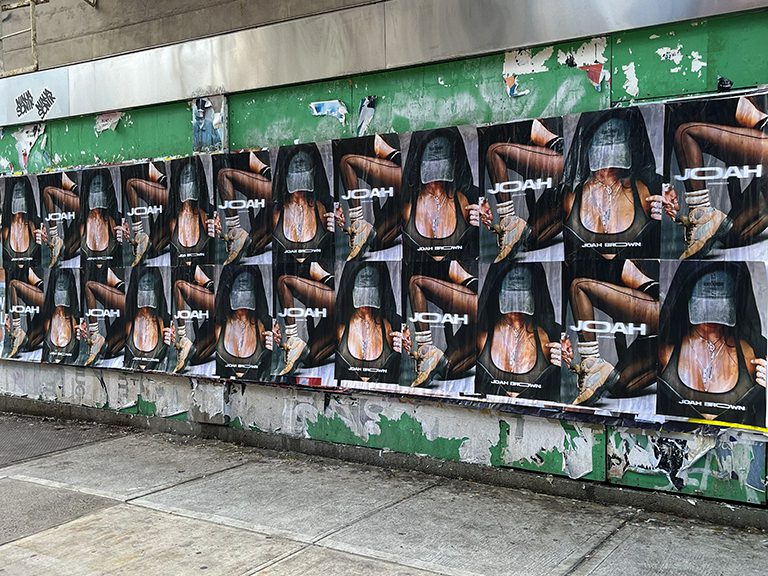
Paste, paper, and the right wall in the right neighborhood — flyposting is the oldest form of mass media that still earns genuine street credibility in 2026.
Flyposting has been on the walls since long before digital advertising existed. It predates radio, television, and every other broadcast medium. Brands and artists have been using paste and paper on urban surfaces to reach audiences for centuries, and the format has not been displaced by any of the media that came after it. It has evolved. It has professionalized. But the core of it remains: put your message at eye level on the walls your audience walks past, and make it worth looking at.
We run flyposting campaigns across the United States and internationally. Our teams work the walls of Williamsburg and the Lower East Side in New York, Fairfax and the Arts District in Los Angeles, Wicker Park in Chicago, Wynwood in Miami, and a dozen other markets. Every campaign produces operational knowledge that compounds over time. This guide shares what we have learned about the format: how it works, who uses it, what the materials look like, how location strategy actually gets built, and what a well-executed campaign delivers.
Flyposting is the practice of adhering printed paper posters to outdoor surfaces using paste. The paste most commonly used is wheatpaste, a flour-and-water mixture that bonds paper to concrete, brick, wood, and other porous surfaces and dries into a weather-resistant installation. The format is used globally across a range of names: fly posting, postering, bill posting, and wheatpasting all describe variations of the same activity.
The defining characteristic of flyposting as an advertising format is its physical integration into the urban environment. Unlike a billboard mounted above traffic or a transit advertisement displayed behind glass, a flyposted poster exists at street level in the same physical space as the people looking at it. There is no frame, no glass, no elevated position. The poster is on the wall you are walking past, at the height your eyes naturally fall, sharing physical space with the environment you are moving through.
This integration is what makes the format work. When the creative is strong and the location is well-chosen, a flyposted poster reads as part of the street’s visual culture rather than as an interruption of it. It earns its place on the wall instead of demanding attention through size or illumination. That distinction matters in an advertising environment where audiences have developed sophisticated reflexes for tuning out paid media.
The Cultural History of Flyposting
The practice of posting paper to public surfaces to communicate publicly goes back to the earliest days of printing. By the seventeenth century, the streets of major European cities were covered in posted paper: broadsides, announcements, political pamphlets, and theatrical advertisements. The practice was so widespread that governments in England and France attempted to restrict it, largely unsuccessfully, even then.
In nineteenth-century Britain, bill posting became a formal commercial industry with dedicated companies, professional crews, and established posting territories across every major city. The walls of London, Manchester, and Birmingham were blanketed with commercial posting in a visual density that contemporary cities would find striking. American cities followed the same pattern as urbanization accelerated through the late 1800s. Theater circuits, circus companies, and consumer goods manufacturers all used bill posting as a primary advertising channel before radio or television existed to serve the same function.
The format took on new cultural dimensions in the 1970s, when independent music scenes in New York, London, Los Angeles, and other cities built their visual culture around flyposting. Bands, clubs, and promoters put their own posters on walls, utility poles, and construction barriers in the neighborhoods where their audiences lived. The aesthetic was raw and immediate. A hand-lettered poster for a show at CBGB or the 100 Club on a telephone pole outside a venue was a piece of genuine cultural communication, not a paid media placement. That energy gave flyposting associations with authenticity and street credibility that have carried forward across decades.
By the 1990s, major entertainment and consumer brands had adopted the format at scale. Professional installation crews with commercial paste formulations and organized location networks replaced the DIY approach of earlier decades. The format became more sophisticated in its execution while retaining the cultural associations it had accumulated. Today, flyposting occupies a position as both a professional advertising format and a cultural signifier of genuine street presence. Those two things coexist because the format has earned them separately over time.
AGM Field Note: The cultural credibility flyposting carries is not manufactured. It was built over decades by artists, musicians, and promoters who used the format because they had no other option. That history is the reason flyposting still signals authenticity in a way that no amount of budget can fabricate. Brands that understand this use the format accordingly. Brands that treat it as simply another media buy miss the point entirely.
Who Uses Flyposting and Why
The client mix for flyposting campaigns is broader today than it has ever been. The format has moved beyond its roots in independent music promotion to serve a wide range of industries and organizational types.
Music: The Foundation
Music remains the primary use case for flyposting by volume. Major labels, independent labels, distributors, and self-releasing artists all use the format for album releases, tour announcements, and single launches. The reason goes beyond habit. In music, flyposting carries a credibility signal that no other advertising format can replicate at the same cost. A poster campaign on the walls of Williamsburg or Fairfax communicates that an artist is embedded in the street-level culture of a place, not simply promoted through it. For artists who want to be perceived as culturally genuine rather than commercially manufactured, flyposting is part of the brand language.
Fashion: Location as Positioning
Fashion brands use flyposting to associate their identity with specific urban corridors and the cultural profiles those corridors carry. A brand placing posters on Fairfax Avenue in Los Angeles, on Orchard Street in New York, or on Brick Lane in London is making a statement about who the brand is and who it is speaking to. The location selection is itself a communication act. This makes flyposting particularly effective for fashion brands at the intersection of streetwear culture and luxury, where cultural positioning matters more than raw reach metrics.
Film and Entertainment
Studios and streaming platforms run flyposting campaigns for film and series launches. The teaser format, which places minimal-information posters weeks before a full campaign breaks, is one of the most effective uses of the format for entertainment clients. A striking image with a date and nothing else creates exactly the kind of public curiosity that press coverage and social conversation can build on. The format allows entertainment campaigns to create physical mystery in the street environment at a moment when digital advertising has largely foreclosed the possibility of genuine surprise.
Consumer Brands
Consumer packaged goods companies, beverage brands, tech platforms, and wellness companies have all significantly increased their use of flyposting over the last decade. The format delivers something digital advertising cannot: genuine physical presence in the neighborhoods where your audience actually lives and moves. For brands that have built an identity around urban culture, health and wellness, or creative communities, being visibly present on the walls of those communities creates a dimension of brand presence that no screen-based format can replicate.
Nonprofits and Advocacy
Organizations running awareness campaigns, community organizing, and public interest advocacy use flyposting for its grassroots cultural associations and its ability to reach audiences in the physical spaces where they spend time. For cause-based organizations, physical street presence communicates organizational commitment to the neighborhoods they work in, not just to the media environments where they run digital ads.
Flyposting Materials: What Goes Into a Professional Campaign
Material quality is not a secondary variable in flyposting campaigns. The materials determine how long the campaign holds, how good it looks at street scale, and how it performs across different surface types and weather conditions. Campaigns that cut costs on materials almost always end up paying for it in the field.
Paper Selection
The standard weight range for flyposting paper is 60 to 80 lb text weight. This provides adequate durability for most campaign windows, bonds efficiently with paste, and holds color saturation without excessive cost. Lighter paper below 50 lb tears more easily during wet paste application and degrades faster in outdoor conditions. Heavier paper at 90 to 100 lb is more durable but requires more care during application to avoid air pockets between paper and surface.
Coating matters for both color fidelity and weather resistance. Matte coatings are preferred for most flyposting applications because they read clearly across variable outdoor lighting and absorb paste more evenly than gloss finishes. Gloss finishes create distracting reflections in direct sunlight and reduce legibility from certain angles. For campaigns expected to run three weeks or more, UV-resistant matte coating significantly extends visual quality across the campaign window.
Paste
Wheatpaste is the traditional adhesive: flour and water cooked to a thick gel that bonds paper to porous surfaces and dries into a semi-permanent installation. It is water-soluble before drying, which makes application easy, and creates strong adhesion on concrete, brick, and untreated wood. After curing, it resists light weather but re-softens with sustained rain or repeated wet exposure.
Methyl cellulose paste is the professional-grade alternative. It mixes to a consistent viscosity, has a longer working window before setting, and performs reliably across non-porous surfaces like painted concrete and metal where wheatpaste adhesion is unreliable. We adjust paste formulation for each campaign based on surface type, temperature at install time, and the weather forecast for the first 24 to 48 hours after installation.
Flyposting Format Comparison
Format
Size
Primary Surface
Best Use
Effective Viewing Distance
Snipe / Handbill
11″ x 17″
Poles, fences, doors
Dense area saturation
5–10 feet
Standard Poster
24″ x 36″
Walls, barriers, fences
Music, events, brand launches
10–25 feet
Large Format
48″ x 72″
Wide walls, construction barriers
Brand presence, tour campaigns
25–50 feet
Supersized
60″ x 90″+
Building sides, long hoardings
Major launches, event campaigns
40–100 feet
Multi-Panel Mural
Custom
Full building facades
Immersive brand moments
Full street width
Location Strategy: How We Build a Placement Plan
Location strategy is where flyposting campaigns succeed or fail. Every other variable, creative quality, print quality, installation quality, is a multiplier on the underlying quality of the location plan. A great campaign in the wrong neighborhood is a great campaign that nobody who matters sees.
Audience-First Geography
We start every location plan from the audience, not from a list of well-known posting corridors. The question is not “where do brands put posters?” The question is “where does this specific audience concentrate in this specific city?” Those two questions have different answers, and confusing them is the most common location strategy mistake we see in campaigns that come to us after failing elsewhere.
In New York, the answer for streetwear and youth culture audiences is Williamsburg and Bushwick, not Midtown. For indie music, the Lower East Side and Williamsburg. For arts and design professionals, Soho, the Meatpacking District, and parts of Dumbo. For the South Asian creative community, Jackson Heights and parts of the Bronx are growing corridors. Each of these is a distinct location plan, and they do not interchange.
In Los Angeles, youth culture and streetwear concentrate on Fairfax and parts of Melrose. Creative industries run through the Arts District and Silver Lake. The wellness and design audience concentrates in Venice, Brentwood, and parts of Culver City. The hip-hop and R&B audience has distinct geographic anchors in Inglewood, Compton, and Crenshaw that differ entirely from the indie rock or fashion corridors. Knowing these distinctions is the work that makes location strategy valuable.
Surface Assessment Protocol
Beyond neighborhood, we assess individual surfaces before committing them to a placement plan. The assessment covers surface texture and adhesion potential, current posting activity and likely turnover rate, orientation relative to pedestrian flow, height and sight line from the primary walking axis, and proximity to high-traffic destinations.
A wall that faces into approaching foot traffic on a corner with cross-street exposure outperforms a mid-block wall of three times the size that faces the direction pedestrians are moving away from. These are the kinds of distinctions that experienced location scouts identify and inexperienced ones miss. We have been doing this long enough that the differences are immediately legible when we walk a corridor, and they are not visible on a satellite map.
AGM Field Note: We scout every campaign before installation regardless of how familiar we are with the market. A building that was an ideal posting surface last year may have been painted, fenced, or converted since then. A corridor that was quiet may have become the city’s new hotspot. The only way to know what a wall looks like today is to go look at it today. That is what we do before every campaign we run.
Campaign Pricing and Scale
Flyposting campaigns scale across a wide range of size and budget. The right scale for any given campaign depends on the goals, the market, and the audience concentration in the target geography.
Focused single-market campaigns work well for neighborhood campaigns, event launches, and artists running targeted campaigns in specific corridors. Precision placement matters more than quantity. Contact AGM to scope the right package for your campaign.
Mid-scale campaigns covering multiple neighborhoods provide citywide presence. Music campaigns, consumer brand launches, and film promotions in a single major market typically operate at this scale. Contact AGM for package pricing based on your market and volume.
Large campaigns of 200 to 500 placements, single or multi-city, are project-specific. Pricing depends on markets, formats, production specifications, and coordination requirements. Contact us directly at (646) 776-2770 to discuss your brief. Multi-city campaigns require four to six weeks of lead time for planning, production coordination, and crew scheduling across markets.
Installation: The Overnight Process
All AGM flyposting installation happens between midnight and 5 AM. The reason is practical: overnight hours provide quieter conditions that allow crews to work at a pace that prioritizes installation quality. During daytime installation, foot traffic, deliveries, and general street activity create interruptions that compromise quality. Overnight installation produces cleaner, better-documented placements that hold longer because the paste has adequate time to cure before weather or physical contact can disturb it.
How the Crew Works
A typical flyposting crew operates in pairs or small teams with a clear division of roles. One crew member prepares the surface with a base layer of paste, a second applies the poster while the paste is still wet, and a third smoothes the paper from center to edges to eliminate air pockets and then applies a top coat of paste to seal the paper and prevent edge lifting. For large format or multi-panel installations, crew coordination is more complex: alignment must be maintained across panels, and the sequence of paste application and paper placement must move quickly enough to prevent partial drying before the full installation is complete.
Every placement is photographed immediately after completion while the paste is still wet and reflective in the photo. GPS coordinates are recorded for each placement. These records form the basis of the post-campaign documentation report delivered to the client within five days of installation completion.
Multi-Night and Multi-City Staging
Larger campaigns or campaigns spanning multiple neighborhoods stage installation across two to three nights to maintain quality across the full placement count. A crew forced to move too fast at the end of a long night will produce placements that look noticeably different from the ones placed at the beginning, and that inconsistency shows in documentation and in how placements hold over time. Staging across nights keeps the quality level consistent.
For multi-city campaigns, we coordinate installation windows across markets to fall within the same 48-hour period. This creates a unified campaign moment that aligns with press coverage, social announcements, and digital campaign timing. Coordinating print shipping, crew scheduling, and market-specific timing across multiple cities requires the four to six weeks lead time we always specify for multi-market work.
Creative Requirements for Flyposting
Creative quality is the variable that most directly determines whether a flyposting campaign earns attention or disappears into the visual noise of the street. We review creative for every campaign before it goes to print, specifically checking for the qualities that determine street-level performance.
Contrast at Street Scale
Outdoor lighting is not controlled. It varies by time of day, weather, season, and the specific orientation of the wall the poster is on. Creative that depends on subtle tonal variation or nuanced color differentiation loses legibility in the field. High-contrast design, black on white, white on black, bright yellow on black, is the baseline for street-readable creative. Everything more nuanced than this needs real-world proof testing before a full print run.
Type Size and Reading Distance
People read flyposted posters at walking pace from 10 to 20 feet away. The type hierarchy must be legible at that distance and pace without requiring the viewer to stop. Primary headline type on a 24×36 poster should be no smaller than 120 points. Supporting information can be set smaller but must still communicate at arm’s length, not at reading distance. Any copy that requires the viewer to walk up to the poster and read carefully will not be read by the large majority of people who encounter the placement.
Single Primary Message
The most consistently high-performing flyposting creative communicates one thing. A name. A date. A product. An image. Campaigns that try to communicate five things on one poster communicate none of them at street scale. The discipline of reducing a campaign to its single most important communicative act is hard. It requires trust in the visual and trust in the audience. The campaigns that earn that trust consistently outperform the ones that hedge with additional information.
AGM Field Note: We have run campaigns for major music artists that used nothing but an image, a name, and a date. No social handles. No website. No explanation. People photographed them and shared them in the first hours after installation. The absence of information was the point. The poster created a question, and people went looking for the answer. That is how strong creative multiplies the effect of a flyposting campaign beyond the physical placements themselves.
Documentation: What Every Campaign Should Deliver
Post-campaign documentation is not an optional extra. It is how you verify that the campaign was executed as planned, confirm the quality of the installation, and build a geographic record of where your brand appeared in the street environment.
Every AGM campaign delivers geo-tagged photos of every placement taken immediately after installation. These photos show the placement in the context of its surroundings, at the moment when the installation is fresh and the paste is still wet. They confirm placement quality, location accuracy, and the visual presence of the campaign across its full footprint.
The campaign summary report organizes placement documentation by neighborhood and market. For multi-city campaigns, each market receives its own documentation section. The report gives your team a complete record of where the campaign ran, what the placements looked like, and what the street environment around each placement looked like at the time of installation. This record is useful both for internal reporting and as a baseline for location decisions on future campaigns.
How Flyposting and Digital Advertising Work Together
Flyposting and digital advertising are not competing channels. They address different parts of the audience attention cycle and different dimensions of brand presence, and they are most effective when planned together rather than in parallel.
Street placements create physical brand presence in the spaces where your audience actually lives and moves. Digital campaigns extend reach to audiences who did not walk past your posters. But the more interesting interaction is the reverse: people who encounter your flyposting campaign and photograph it become a distribution channel for the campaign in digital environments. A well-designed poster in a high-traffic location in Williamsburg or Fairfax will be photographed and shared by the people who walk past it. That organic digital extension of a physical campaign is real and measurable, and it amplifies the street placements without any additional media spend.
When digital and street campaigns are synchronized, the effect compounds further. A digital campaign that breaks at the same time as street placements go up creates multiple touch points in quick succession. A person who sees your poster on their way to work and then sees a digital advertisement during their lunch break has encountered the campaign in two distinct contexts and registers it more deeply as a result. This is why we encourage clients with larger budgets to coordinate their street and digital timing rather than treating them as independent campaigns.
Frequently Asked Questions
What does flyposting mean?
Flyposting refers to the practice of affixing printed paper posters to outdoor surfaces using paste. The format is one of the oldest forms of street advertising and is used globally by music artists, brands, and organizations to reach audiences in the physical urban environment.
Is flyposting the same as wheatpasting?
Yes, essentially. Wheatpasting describes the adhesive method: a flour-and-water paste applied to bond paper to surfaces. Flyposting describes the broader practice of placing posters on outdoor urban surfaces. Flyposting campaigns use wheatpaste or professional methyl cellulose adhesive depending on surface type and campaign requirements.
How much does a flyposting campaign cost?
Poster campaigns are priced by package and market. Standard poster campaigns (24×36) start at $4,500 for 100 posters (two-week run) and $5,500 for 200 posters. Large format (48×72) campaigns start at $10,500 for 100 posters and $13,500 for 200. An optional two-week maintenance extension is $3,500. Contact AGM at (646) 776-2770 for a custom quote based on your market and objectives.
What poster sizes are used in flyposting?
The standard workhorse is 24×36 inches, which reads well from across a street and fits most wall and barrier surfaces. Large format 48×72 is used for high-impact presence on wide walls and construction hoardings. Snipe posters at 11×17 are used for high-density saturation in competitive posting zones.
How long does a flyposting campaign hold?
In most urban environments with proper installation, a flyposting campaign holds for two to four weeks. Active posting corridors with high turnover may cycle faster. Less competitive walls can hold placements for five to six weeks. Weather, surface type, and paste quality are the primary longevity variables.
What cities does AGM run flyposting campaigns in?
AGM runs flyposting campaigns in New York City, Los Angeles, Chicago, Miami, Austin, Nashville, and other major US markets. We also coordinate international campaigns. Contact us at (646) 776-2770 to discuss your target markets.
What documentation do I receive after a flyposting campaign?
Every AGM campaign delivers geo-tagged placement photos taken immediately after installation, plus a campaign summary report covering all placements by location. This gives you a complete record of the campaign’s physical footprint.
Can flyposting campaigns be run across multiple cities at once?
Yes. AGM coordinates multi-market campaigns with synchronized installation windows across cities. We stage all installations to fall within the same 48-hour period and deliver unified post-campaign documentation. Multi-city planning requires four to six weeks lead time.
What neighborhoods are best for flyposting in LA?
The most productive flyposting corridors in Los Angeles include Fairfax Avenue between Melrose and Beverly Hills, the Arts District around Traction and Mateo, Melrose between La Brea and Fairfax, Abbott Kinney in Venice, and parts of Silverlake and Echo Park. Best location depends on your target audience.
How much lead time does a flyposting campaign need?
Standard campaigns need two to three weeks from creative approval to installation. Rush timelines can compress to 10 to 14 days when files are ready. Multi-city campaigns require four to six weeks minimum for planning, production, and crew coordination across markets.