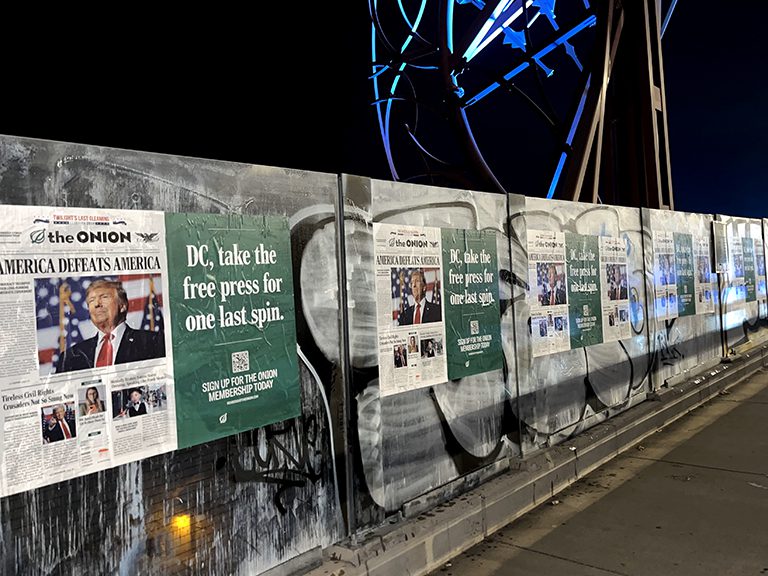
Washington DC runs on foot traffic. The Metro system deposits thousands of commuters into walkable, commercially dense neighborhoods every day, and those neighborhoods are where flyposting DC campaigns land with maximum visibility. From U Street’s music history corridor to the dense retail blocks of Columbia Heights, the city offers a layered canvas of walls, construction barriers, and mixed-use building faces that function as a continuous outdoor gallery when a campaign is executed properly.
Our team has run wheat paste poster campaigns across DC for years. The city rewards specificity. A campaign that understands which neighborhood maps to which audience will consistently outperform a broad scatter approach. This guide breaks down how we plan, execute, and document flyposting campaigns in DC, including which surfaces perform, which neighborhoods deliver what demographic, and what the full campaign lifecycle looks like from brief to photo report.
If you are planning a product launch, a brand awareness push, a music release, or a political awareness campaign in Washington DC, the surface map below is the starting point. We deploy across 50+ U.S. markets from our base at Industry City, Brooklyn, NY and manage all DC campaigns with crews that know the city’s blocks, permit landscape, and enforcement patterns.
Why Wheat Paste Poster Campaigns Work in DC
Digital advertising saturation is acute in Washington DC. The city’s professional population, its transient student base, and its enormous tourist volume all share one thing: they spend significant time on foot in densely layered urban environments. Wheat paste poster campaigns reach those people where digital ads cannot, in the physical environment, at eye level, integrated into the visual texture of the neighborhood itself.
The format also benefits from the city’s architecture. DC’s mixed-use corridors, construction wrap opportunities, and the prevalence of building-side surfaces in neighborhoods like Columbia Heights and Shaw create strong placement environments that are both high-visibility and contextually appropriate for bold creative executions.
Audience Quality in DC’s Walkable Corridors
The audiences moving through DC’s creative neighborhoods are not passive. U Street draws culture-forward adults aged 25 to 40. Columbia Heights skews younger, with a dense Gen Z and millennial mix shaped by its proximity to Howard University and DCUSA retail. H Street NE delivers the young professional demographic that has driven that corridor’s restaurant and bar scene over the past decade. These are high-intent audiences for entertainment, lifestyle, consumer goods, and brand awareness campaigns.
The Permanence Advantage Over Digital
A well-placed wheat paste poster in a DC neighborhood stays visible for days to weeks. It cannot be scrolled past, blocked, or skipped. Passersby encounter it repeatedly on daily commutes and weekend walks. That repetition drives recall in a way that single-exposure digital impressions do not. When combined with street team activations or LED billboard truck campaigns, the cumulative brand presence becomes difficult to ignore.
Where Campaigns Run in DC: Neighborhood by Neighborhood
Every DC flyposting campaign starts with a surface map built around the client’s target audience. Below is a breakdown of the primary campaign neighborhoods, the audiences they deliver, and what executions perform best in each zone.
U Street Corridor
The U Street Corridor is DC’s most storied entertainment district, running from 9th to 16th Street NW along U Street itself. The corridor anchors a dense cluster of music venues, bars, restaurants, and retail that draws a consistent after-dark crowd alongside steady daytime foot traffic. Campaigns targeting 25- to 40-year-old culture consumers, music fans, and food and beverage audiences perform strongly here. The building faces along the corridor, particularly on secondary streets like V Street, W Street, and the alley networks adjacent to the main drag, offer strong placement surfaces with sustained visibility.
Columbia Heights
Columbia Heights is one of DC’s highest-density retail corridors north of downtown. DCUSA and the surrounding blocks generate constant pedestrian volume across a diverse demographic including families, young professionals, students, and a substantial Spanish-speaking community. Campaigns targeting consumer goods, food and beverage, entertainment, and fashion perform well in this zone. The neighborhood’s density and mixed-use building stock provide abundant surface options, particularly along 14th Street NW between Columbia Road and Irving Street.
Adams Morgan
Adams Morgan is DC’s perennial nightlife hub, but daytime foot traffic is also substantial along 18th Street NW. The neighborhood’s international character and late-night economy attract a diverse 21- to 45-year-old crowd. Campaigns for music, nightlife, alcohol brands, food and beverage, and fashion work consistently in Adams Morgan. The concentration of independent retail and restaurant frontage along 18th Street creates a natural visual competition environment where standout creative earns repeat attention.
Shaw and Howard University Area
Shaw sits between U Street and downtown DC, and the neighborhood’s transformation over the past decade has created one of the city’s most interesting campaign environments. The Howard University campus draws a large student and academic population, and the surrounding blocks have developed a dense mix of bars, restaurants, and boutique retail. Campaigns targeting college-aged audiences, young professionals, and culturally engaged adults perform strongly across Shaw and the immediate Howard University vicinity.
H Street NE (Atlas District)
H Street NE is DC’s fastest-changing corridor, running from 3rd to 15th Street NE. The Atlas District anchors the western end with the Atlas Performing Arts Center and a cluster of bars and restaurants that have made H Street a major destination for DC’s under-35 professional demographic. Campaign surfaces along H Street itself and the adjoining blocks offer strong visibility for entertainment, consumer goods, and lifestyle brands. The neighborhood also provides access to Capitol Hill’s residential overspill, extending reach into a politically engaged, high-income residential population.
Capitol Hill and Barracks Row
Barracks Row along 8th Street SE is Capitol Hill’s primary commercial corridor, offering a more neighborhood-scaled campaign environment compared to the larger corridors further north. The area delivers a high-income, professionally employed residential audience with strong purchasing power. Campaigns targeting upscale consumer goods, financial services, real estate, and entertainment perform well here. The neighborhood’s stable foot traffic pattern, driven by the resident population rather than commuter flow, creates extended dwell time for poster installations.
The Operational Reality of a Professional DC Campaign
Running guerrilla marketing campaigns in DC requires crew coordination, surface pre-scouting, and permit awareness. Our team handles all of this before the first poster goes up. The operational flow for a standard flyposting DC campaign looks like this:
Pre-Campaign Surface Scouting
Before installation, our crew scouts the target neighborhoods to identify active, high-visibility surfaces, confirm surface conditions, and rule out any problematic locations. This step ensures the campaign budget is deployed on placements that will perform rather than surfaces that will be obscured, removed, or otherwise compromised within days of installation.
Print Specifications
DC’s weather, including humidity in summer and freeze-thaw cycles in winter, affects poster longevity. We specify paste-ready prints on appropriate stock for the season and surface type. Standard sizes for DC flyposting campaigns run from 24×36 inches to 48×72 inches, with larger formats reserved for construction barriers and building-side placements where scale creates maximum impact.
Installation Execution
Our crews install during optimal hours and prioritize the highest-visibility positions within each neighborhood. All installations are recorded with GPS-stamped photography at the moment of placement. Client reports include street-level photography, GPS coordinates, and neighborhood mapping so you know exactly where every poster is positioned.
What Good Reporting Looks Like
Every flyposting DC campaign we run includes a complete documentation package. This is not an afterthought. Documentation is what transforms a street-level activation into brand content, press material, and proof of performance that extends the campaign’s value well beyond the initial installation period.
Our standard report includes GPS-tagged installation photos organized by neighborhood and address, estimated impression counts based on pedestrian traffic data for each corridor, campaign overview mapping showing full coverage across the target area, and final condition photos showing poster status at campaign close.
Clients use these reports for internal campaign reviews, press releases, social media content, and as supporting documentation for campaign ROI analysis. When combined with mobile billboard advertising or sidewalk stencil campaigns, the documentation packages build a cohesive multi-format story.
How Long Do Posters Last in Washington DC?
Poster longevity in DC depends on surface type, neighborhood foot traffic density, weather, and competitive visual environment. On average, professionally installed wheat paste posters in DC’s primary campaign neighborhoods last between two and four weeks. High-competition surfaces like U Street and Columbia Heights see faster turnover due to the volume of competing campaigns running simultaneously. Lower-traffic residential surfaces in neighborhoods like Capitol Hill tend to hold longer.
Factors That Affect Longevity
Surface material matters significantly. Brick, plywood, and painted concrete hold paste better than glass, metal, or treated surfaces. Seasonal weather is also a factor: DC’s summer humidity accelerates paste degradation, while fall and spring conditions are ideal for maximum poster life. Our crew’s application technique, including paste concentration, overlap method, and top-coating, directly affects how long a poster maintains readable condition in field.
Campaign Planning Timeline for DC Flyposting
Most flyposting DC campaigns move from confirmed brief to installed campaign in 7 to 14 days. Rush timelines are possible at 5 to 7 days with confirmed print-ready files and expedited production. Here is the standard sequence:
- Day 1-2: Brief confirmation, neighborhood selection, and surface pre-scouting
- Day 3-5: Print production and quality review
- Day 6-8: Installation across target neighborhoods
- Day 8-9: Photo documentation compiled and delivered to client
- Day 14-28: Mid-campaign condition check (optional, included in extended packages)
For campaigns timed around events, releases, or political moments, our team coordinates installation timing to land within 48 hours of the activation window. Washington DC’s political calendar, concert schedule, and event density create strong amplification opportunities when campaign timing is precise.
Understanding the Investment for DC Campaigns
Flyposting DC campaigns are priced by scope: number of placements, neighborhoods covered, poster size, and campaign duration. A focused single-neighborhood campaign targeting 50 to 100 placements typically starts around $2,500 to $4,000 including print, installation, and documentation. Multi-neighborhood campaigns covering three to five DC corridors with 150 to 300 placements range from $5,000 to $8,000. Extended campaigns with mid-campaign refreshes and condition reporting are available on request.
These costs compare favorably to digital advertising at equivalent reach within the same audience segments, with the added benefit that physical placements generate social sharing and press attention that extends total campaign reach far beyond the placements themselves.
Creative Optimization for DC Street Posters
The creative that performs best in DC’s flyposting environment shares several characteristics. High contrast between background and foreground. Minimal copy. A visual that communicates at 10 feet in under two seconds. Bold typography that reads at speed. And a clear brand identifier that does not require explanation to register.
Format Considerations by Neighborhood
U Street and Adams Morgan reward bolder, culture-forward creative with minimal text. Columbia Heights performs better with slightly more information given the retail shopping context and longer dwell time during shopping trips. Construction barriers on H Street NE allow for larger format formats that function as mini-billboards when the creative is scaled correctly. Our team reviews creative before installation and provides format recommendations based on the target surface inventory.
Photography and Social Extension
Well-executed DC flyposting campaigns generate organic social sharing when the creative earns it. Striking work on a recognizable DC street corner gets photographed by passersby and posted to Instagram without any additional paid media investment. We advise clients on how to structure creative for social photographability and can coordinate professional campaign photography alongside the standard documentation package for use in owned media.
Frequently Asked Questions
How much does flyposting in DC cost?
A professional flyposting DC campaign typically ranges from $2,500 to $8,000 depending on poster count, neighborhood coverage, and campaign duration. Pricing includes printing, installation, GPS documentation, and photo reporting.
How long do wheat paste posters last in Washington DC?
In most DC neighborhoods, professionally installed wheat paste posters last 2 to 4 weeks. High-traffic zones like U Street and Columbia Heights can see faster turnover due to the density of competing visual content.
What neighborhoods are best for flyposting in DC?
The strongest performing neighborhoods for flyposting DC campaigns are U Street Corridor, Columbia Heights, Adams Morgan, Shaw, H Street NE, and Capitol Hill’s Barracks Row. Each offers a distinct demographic profile and foot traffic pattern.
Is flyposting legal in Washington DC?
Flyposting regulations in DC vary by surface type and ownership. Our team works with permitted surfaces and private property owners to ensure compliant placements. We handle all site coordination as part of campaign management.
How do you document a DC flyposting campaign?
We provide GPS-stamped installation photos for every placement, organized by neighborhood and street address. Clients receive a complete photo report within 24 hours of campaign completion.
Can you run flyposting campaigns in DC for a product launch?
Yes. Product launches are one of the most common campaign types we run in DC. We target neighborhoods by demographic alignment, time installations around launch date, and provide post-campaign documentation suitable for press and social amplification.