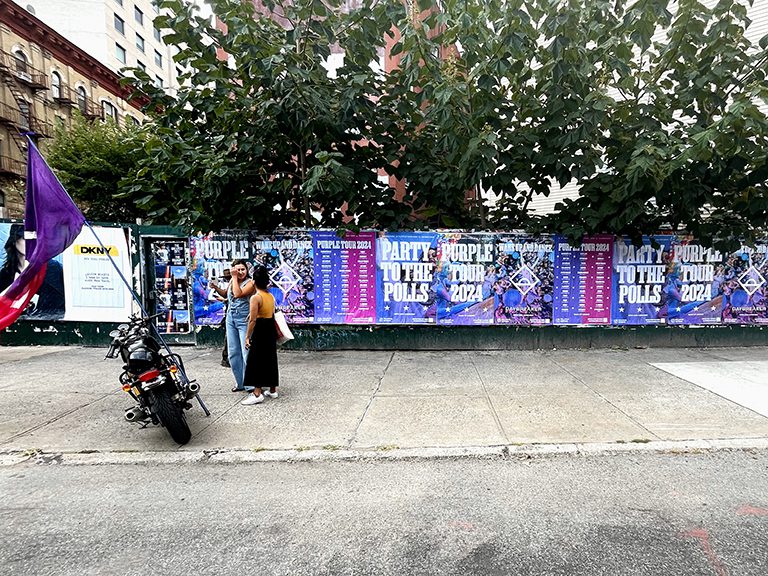
College towns are among the strongest environments for flyposting campaigns in the country, and the reason is structural. Student populations are dense, young, brand-curious, and highly walkable. They move through the same corridors repeatedly on daily routines between campus, housing, and the commercial districts immediately adjacent to university grounds. They have historically been among the most receptive audiences for street-level advertising because the campus environment has normalized physical posting culture in a way that urban professional neighborhoods have not: students see posters on every bulletin board, utility pole, and community wall as a standard part of how they learn about what is happening around them. A wheat paste campaign in the right college market reaches this audience where their attention is genuinely open.
Our team runs wheat paste poster campaigns across major college markets including Austin, Boston and Cambridge, Ann Arbor, Chapel Hill, Madison, and dozens of other university towns across our 50+ market network. We know which neighborhoods in each college market deliver the highest student density, when the optimal campaign windows fall relative to the academic calendar, and how to coordinate campaigns across multiple college markets simultaneously for brands executing national campus marketing programs. This guide covers the full college town flyposting playbook.
We operate from Industry City, Brooklyn, NY. Brands targeting college audiences at street level benefit from our direct market knowledge and the speed of our print-to-installation pipeline. Contact our team at (646) 776-2770 to discuss a college market campaign, or read through the guide below to understand the strategy.
Why College Towns Are Exceptional Flyposting Markets
The structural characteristics of college towns create a near-perfect environment for street poster campaigns. Population density is extreme relative to the geographic footprint. Student housing concentrates the target audience within walking distance of campus. The commercial districts adjacent to campus carry constant foot traffic across all dayparts as students move between classes, housing, food, and entertainment. And the academic calendar creates predictable high-density windows, from fall move-in to finals season to spring graduation, that allow campaigns to be timed around the moments of maximum audience concentration and minimum competing noise.
College students are also particularly valuable from a brand-building perspective. They are forming brand preferences during a life stage when habits are most malleable. A brand that establishes recognition and positive association with a student in their sophomore year of college retains the benefit of that early positioning for decades. College town flyposting campaigns are not just short-term impression generators. They are investment in the long-term brand relationship with the demographic cohort that is moving through the university and entering the consumer economy with full purchasing power.
The Academic Calendar as Campaign Architecture
The academic calendar is the primary timing framework for college town flyposting campaigns. Different points in the calendar create different audience sizes, mindsets, and campaign objectives. Understanding which window is right for which campaign type is the starting point for building an effective college market plan.
September move-in and orientation week is the highest-value window. New students arrive in an intense brand discovery state, exploring their new neighborhood, building commercial habits, and encountering the city’s business landscape for the first time. A wheat paste campaign running in the week before and during orientation reaches the maximum number of new students in the maximum brand receptivity moment of their college tenure. This is the window to establish brand recognition before the competition for the same student audience accelerates through the fall semester.
College Town Profiles: Where Campaigns Run
Each college market has a distinct geographic structure, a distinct audience profile based on the university type, and a distinct set of neighborhood and surface environments that define where campaigns should run. Below is a breakdown of the primary college markets where our team executes flyposting campaigns.
Austin, Texas (University of Texas)
Austin’s college market is anchored by the University of Texas at Austin, with over 50,000 students on a campus that sits in the heart of the city’s urban fabric. The West Campus neighborhood north and west of the main campus is one of the densest student housing concentrations in the country, with high-rise apartment towers alongside older residential streets that hold tens of thousands of students within a walkable campus perimeter. The Drag along Guadalupe Street is the commercial spine of the campus district, running along the western edge of campus with a continuous strip of independent retail, food, and services targeted to the student population. Campaigns along The Drag, through West Campus, and into the Hyde Park neighborhood to the north reach UT’s student audience in their primary living and commercial environment. For more detail on Austin campaign geography, see our guide to flyposting Austin more broadly.
Boston and Cambridge (Harvard, MIT, BU, Northeastern)
The Boston and Cambridge college market is uniquely dense, with dozens of universities concentrated in a compact walkable geography that makes it possible to reach a massive aggregated student audience across multiple institutions with a single multi-neighborhood campaign. Allston is the primary student neighborhood for Boston University students and the broader young adult creative community. Cambridge’s Central Square and Harvard Square serve Harvard, MIT, and the broader Cambridge student ecosystem. Mission Hill and Roxbury Crossing serve Northeastern and MassArt students. A comprehensive college town campaign in the Boston market covers all of these zones under a single brief, reaching an audience that collectively represents one of the largest university populations in the country.
Ann Arbor, Michigan (University of Michigan)
Ann Arbor is one of the most classic American college towns, where the University of Michigan campus and the surrounding commercial district function as an integrated urban environment centered on State Street, South University Avenue, and the Main Street commercial district. The student population of 47,000 is extraordinarily concentrated in a compact geographic area, creating exceptional pedestrian density in the campus-adjacent neighborhoods. The South University corridor between campus and the residential neighborhoods south of campus carries intense student foot traffic throughout the day and evening. State Street connects the campus to downtown Ann Arbor’s commercial district, providing a natural campaign corridor from campus through the full range of student commercial activity. Ann Arbor is a high-value college market because the university-to-town ratio is extreme: the student population is a dominant share of the total city population in a way that creates very high campaign efficiency per placement.
Chapel Hill and Durham, North Carolina (UNC and Duke)
The Research Triangle’s college market spans Chapel Hill, home of UNC, and Durham, home of Duke University, with a connecting corridor that also passes through research park employment centers. Chapel Hill’s Franklin Street is the commercial spine of the UNC campus area, providing campaign surfaces in the highest-traffic student commercial zone in the market. Durham’s Ninth Street district serves Duke’s young faculty, graduate students, and the broader Durham arts and food scene that has grown dramatically in the past decade. Campaigns targeting both UNC and Duke student populations in a single buy require coverage in both Chapel Hill and Durham, with connecting zones along the 15-501 corridor that links the two campuses.
Madison, Wisconsin (University of Wisconsin)
Madison is one of the country’s most politically engaged and culturally active college markets. The University of Wisconsin campus sits on an isthmus between two lakes, creating a distinctive geographic environment where the campus and the downtown State Street entertainment district are directly connected by a single pedestrian corridor. State Street, running from the UW campus to the State Capitol, is one of the most concentrated pedestrian commercial streets in any college market in the country. A flyposting campaign along State Street reaches the entire spectrum of the Madison student and young professional audience in a single corridor. The density of bars, restaurants, and retail along State Street and the surrounding blocks creates consistent foot traffic across all dayparts throughout the academic year.
Coordinating Multi-College-Town Campaigns
Brands executing national campus marketing programs benefit from our ability to coordinate flyposting campaigns across multiple college markets simultaneously from a single brief. Multi-market college town campaigns are among the most operationally complex programs we run, requiring market-specific surface maps, coordinated print production and shipping, synchronized installation windows, and unified documentation across all markets in a single post-campaign report.
The efficiency of centralized multi-market coordination is significant: brands that attempt to coordinate individual college market campaigns with local vendors in each market typically pay more per market, get inconsistent documentation quality, and lose the ability to make cross-market comparisons that inform which college markets deserve increased investment.
Academic Calendar Alignment Across Markets
Multi-college-town campaigns must account for the fact that academic calendars are not perfectly synchronized across institutions. Move-in dates vary by one to two weeks across markets. Homecoming weekends are market-specific. Spring break timing differs significantly between the Southeast, Midwest, and Northeast university systems. Our team maps the academic calendar for every college market in the campaign plan and adjusts installation timing to optimize the campaign window for each specific market rather than applying a single national installation date that is optimal for none of them.
Combining Flyposting with Other College Town Formats
Flyposting college town campaigns perform best when combined with complementary formats that extend reach and create additional touchpoints. Street team programs on campus and in the adjacent commercial districts create direct student engagement alongside the visual presence of the poster campaign. Brand ambassador programs at campus events, dining halls, and residence halls create live brand presence that amplifies the awareness built by the poster campaign. Sidewalk stencil campaigns on high-traffic campus pedestrian paths create additional visual touchpoints at ground level that catch student attention in a different way than eye-level poster placements.
For brands launching college market programs for the first time, we recommend beginning with a two- to three-market pilot focused on the highest-priority college markets for the specific audience target. The pilot provides direct performance data that informs the expansion to a broader college market network without the risk of scaling a campaign approach across dozens of markets before it has been validated in the field.
Frequently Asked Questions
Why do flyposting campaigns work well in college towns?
College towns are extremely effective flyposting environments because student populations are dense, walkable, and highly receptive to street-level advertising. Students encounter the same campaign surfaces repeatedly on their daily campus-to-neighborhood routines, building brand recall through frequency of exposure.
What are the best college towns for flyposting campaigns?
The strongest college town flyposting markets are Austin (University of Texas), Boston and Cambridge (Harvard, MIT, BU, Northeastern), Ann Arbor (University of Michigan), Chapel Hill and Durham (UNC, Duke), Madison (University of Wisconsin), and Gainesville (University of Florida).
When is the best time to run flyposting campaigns in college towns?
The highest-value windows are September move-in and orientation week, the October-November fall semester peak, February-March spring semester, and April graduation season. Fall semester launch is the single highest-impact window. Summer campaigns run against reduced audience since many students return home.
How much does a college town flyposting campaign cost?
College town campaigns in smaller markets like Ann Arbor or Chapel Hill typically range from $1,500 to $4,000 for a focused single-market campaign. Boston and Austin, as larger metros with higher operational costs, typically run $2,500 to $7,000 for comparable coverage.
Can flyposting campaigns target specific university campuses?
Yes. Our college town campaigns are built around the specific campus geography of the target university, covering the off-campus commercial areas adjacent to campus, the transit corridors connecting campus to surrounding neighborhoods, and the bar and restaurant districts where students congregate.
How do you run flyposting campaigns across multiple college towns simultaneously?
Multi-college-town campaigns are coordinated from a single brief under our centralized campaign management system. We manage crew coordination, print production and shipping, and installation timing across all target markets simultaneously. Unified documentation is delivered as a single post-campaign report.