Augmented reality is reshaping tourism marketing — not as a novelty technology demonstration but as a practical tool for creating the immersive, shareable, emotionally resonant destination experiences that drive modern travel decision-making. Tourists who discover a destination through AR-enhanced content before travel are more likely to visit, more likely to stay longer when they arrive, more likely to engage more deeply with attractions, and significantly more likely to create and share social content that amplifies destination marketing to their networks. For tourism businesses of every type — destinations, hotels, attractions, restaurants, and tour operators — AR tourism represents a practical competitive differentiation opportunity that is accessible at reasonable investment levels and generates measurable business outcomes.
American Guerrilla Marketing integrates AR elements into street-level and experiential campaigns for destination marketing, event tourism, and urban brand activations. We operate out of Industry City, Brooklyn, NY, and work with tourism-oriented brands across major U.S. markets. The intersection of physical campaign execution — outdoor campaigns, experiential activations, ambassador programs — with AR-enhanced digital engagement creates the physical-digital tourism marketing integration that modern visitors expect and that competitors without AR capability cannot replicate.
How AR Transforms Visitor Experience
Traditional tourism marketing tells visitors about a destination. AR tourism lets them experience it before, during, and after the visit in ways that transform passive observation into active discovery. The psychological and behavioral differences between these modes of engagement are significant — and directly affect the business metrics that tourism operators care about most: visitor satisfaction, dwell time, repeat visitation, and word-of-mouth advocacy.
Historical Reconstruction and Cultural Storytelling
One of the most compelling AR tourism applications is historical reconstruction — overlaying digital images of historical periods on their modern physical locations so visitors can see what a landmark, neighborhood, or battle site looked like during the period that makes it historically significant. Colonial Williamsburg in Virginia, the Roman Forum, Gettysburg battlefield, and dozens of other historically significant sites have deployed AR historical reconstruction applications that dramatically increase visitor engagement and dwell time by transforming the sightseeing experience from passive observation of empty historical spaces into active exploration of visually recreated historical moments.
Multilingual Content Delivery
For destinations attracting international visitors, AR applications that deliver multilingual audio and visual content triggered by physical location scanning solve a significant visitor experience problem — providing rich cultural context in each visitor’s native language without requiring multilingual human staff at every attraction point. A single physical installation with a QR trigger can deliver content in 20+ languages through an AR application, creating an inclusive visitor experience that builds positive destination perception across international visitor segments.
Gamified Exploration
AR-enabled destination games — scavenger hunts, collection mechanics, challenge completion sequences that require physical exploration of a destination — transform sightseeing into active discovery and dramatically increase the amount of a destination that visitors actually experience. Disney parks have used gamified AR extensively to increase dwell time and engagement depth. Natural history museums have deployed scavenger hunt AR applications that lead visitors through collections they would not spontaneously seek out. Urban destinations have used city-wide AR exploration games that encourage visitors to discover neighborhood-level attraction clusters beyond the main tourist corridors.
AR Marketing for Destination Attraction
Beyond the in-destination visitor experience, AR is a powerful pre-travel marketing tool — allowing potential visitors to experience destination highlights before making travel decisions.
Virtual Destination Previews
AR destination preview experiences — accessible through smartphone apps, social media filters, or web AR — allow potential visitors to virtually explore hotel rooms, restaurant environments, attraction highlights, and natural landscapes from anywhere in the world. This pre-visit virtual access reduces booking hesitation for first-time visitors to unfamiliar destinations and creates the emotional anticipation that converts destination awareness into travel bookings. Hotel brands that offer room preview AR consistently report higher booking conversion rates for virtual-preview-exposed leads compared to photograph-only experiences.
Social-Sharing-Ready AR Filters
Destination-branded AR filters on Instagram and Snapchat — filters that frame famous landmarks in branded visual design, apply destination-themed overlays to visitor selfies, or simulate destination experiences for non-visitors — extend destination marketing reach through organic social sharing by visitors and aspirational non-visitors. A filter that makes the user appear to be standing at a famous destination viewpoint, dining at a renowned restaurant, or experiencing a distinctive cultural moment creates shareable content that reaches the filter user’s entire social network with a compelling destination experience message.
AR for Hotels and Restaurants
The hospitality sector has specific AR applications that create competitive differentiation beyond the destination marketing level.
Hotel AR Applications
Hotels use AR to: provide virtual room previews that reduce booking hesitation for premium room categories (showing the actual view, room layout, and amenity quality through AR removes uncertainty that drives visitors toward budget alternatives), create in-room AR concierge experiences that provide local recommendation, service ordering, and entertainment through smartphone AR in the room environment, and develop hotel brand AR filters that guests use to create and share social content from distinctive hotel spaces, amplifying the hotel’s social media presence through guest-generated content.
Restaurant AR Menu and Experience
Restaurant AR applications include: dish visualization that allows diners to see a 3D rendering of menu items before ordering (consistently associated with higher average check values as customers select dishes they can visualize rather than relying on descriptions), table AR entertainment that extends the dining experience with interactive content, and brand storytelling experiences that contextualize the restaurant’s cuisine within the cultural or culinary tradition it represents.
Integrating AR Tourism with Outdoor Marketing Campaigns
The most effective tourism marketing integrations combine outdoor advertising presence with AR-enhanced digital engagement — creating physical-digital campaign connections that extend OOH impression into interactive discovery.
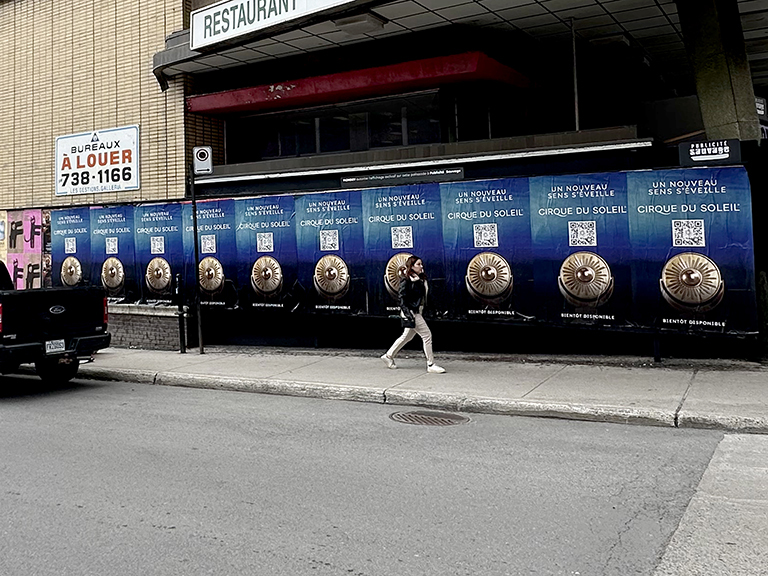
QR codes on outdoor destination advertising that trigger AR destination preview experiences create a measurable engagement bridge from the OOH impression to sustained digital interaction. AR-enhanced wayfinding posters in tourism districts guide visitors between attractions while delivering contextual information about each location. Location-based AR experiences that activate when visitors reach featured destinations create the discovery moments that social sharing amplifies far beyond the original campaign audience.
Our guerrilla marketing campaigns for tourism-oriented brands regularly integrate AR elements into sidewalk stencil installations and street-level presence that trigger AR experiences through smartphone scanning. These physical-digital integrations create campaign touchpoints that passive OOH cannot achieve — converting physical brand encounters into interactive digital engagements that visitors choose to pursue and share.
Frequently Asked Questions: AR Tourism
What is AR tourism and how does it work?
AR tourism uses augmented reality technology to enhance visitor experiences at destinations and attractions — overlaying digital content (historical information, interactive storytelling, wayfinding, gamified experiences) on physical environments through smartphone cameras. It transforms passive sightseeing into interactive discovery, increasing satisfaction, dwell time, and social sharing.
How can tourism businesses use AR to attract more visitors?
Through AR-enhanced pre-visit destination previews, distinctive AR in-destination experiences that differentiate from competitors, AR wayfinding that reduces visitor friction, AR historical and cultural storytelling creating unique discovery, and AR social content mechanics that extend marketing reach through visitor-generated sharing.
What are the most effective AR tourism applications?
Historical reconstruction showing landmarks in past periods, cultural storytelling layered over physical spaces, gamified city exploration, AR wayfinding with attraction context, multilingual content delivery through physical triggers, and social-sharing-ready branded AR filters that extend destination marketing through visitor social media.
How does AR marketing work for hotels and restaurants?
Hotels use virtual room previews, in-room AR concierge experiences, and branded guest AR filters. Restaurants use dish visualization before ordering, table entertainment experiences, and brand storytelling through AR at the table. Both create differentiated experiences that drive social sharing and competitive differentiation.
What is the business ROI of AR tourism investment?
ROI comes through visitor satisfaction improvement, extended dwell time, reduced friction, social sharing amplification, and differentiation-driven visitor acquisition. AR experiences that generate social content create marketing reach far exceeding the direct visitor audience — visitor-generated AR social content is among the most credible and cost-efficient form of destination marketing available.
How does AR tourism integrate with outdoor and guerrilla marketing?
Through QR codes on outdoor advertising triggering AR destination previews, AR-enhanced wayfinding posters, location-based AR tied to tourism OOH campaigns, and destination-branded AR filters for landmark photography. These integrations create physical-digital campaign connections that extend OOH engagement into interactive digital experiences visitors choose to share.
Frequently Asked Questions
What is exploring the possibilities of ar tourism for your business 2?
American Guerrilla Marketing provides exploring the possibilities of ar tourism for your business 2 services across 50+ U.S. markets. Every campaign is planned, scouted, executed, and GPS-documented by our field teams. We work with regional brands and Fortune 500 companies on campaigns that require real street-level execution and documented proof of performance.
How does AGM approach business 2?
Our process starts with a market consultation to understand your goals, target audience, and budget. We then scout locations, handle any required permissions or permits, coordinate production and installation with our local crews, and provide a full GPS-tagged photo report after the campaign runs.
What markets does American Guerrilla Marketing cover for business 2?
We operate in 50+ U.S. markets including New York, Los Angeles, Chicago, Miami, Houston, Atlanta, Seattle, Denver, Boston, and dozens of secondary markets. Contact us to confirm availability and pricing for your specific market.
How much does a business 2 campaign cost?
Campaign pricing depends on market, format, quantity, and duration. We work with budgets ranging from targeted single-market runs to national rollouts across multiple cities. Use our RFP Builder or contact us directly for a custom quote based on your specific campaign requirements.
How do I get started with business 2 through AGM?
The fastest way to get started is to submit your campaign details through our RFP Builder at americanguerrillamarketing.com, or contact us directly at [email protected] or (646) 776-2770. Our team typically responds within one business day with availability and initial pricing.