Retail has been called dying for fifteen years. Mostly by people who misunderstand what retail actually does. Retail doesn’t just facilitate transactions. At its best, it creates experiences. Apple stores don’t primarily sell phones. They create an environment where people want to spend time with Apple products and the Apple brand. Lush stores don’t primarily sell cosmetics. They create a sensory experience that makes their products feel different from every other beauty brand on the market. Nike flagship stores don’t just display inventory. They create a physical expression of the brand’s identity that no e-commerce site can replicate.
An experiential retail agency helps brands create environments and moments at the point of sale that do more than close a transaction. They build brand identity, create loyalty, and generate the kind of customer relationship that keeps people coming back when they could buy the same product online with two clicks. The experiential layer is what turns retail from a distribution mechanism into a brand building tool.
At American Guerrilla Marketing, we work on the activation and outdoor side of retail marketing. We drive traffic to retail locations through street campaigns, we support retail launches with outdoor brand presence in surrounding neighborhoods, and we create in-store activations and pop-up experiences that connect brands to their retail audiences in memorable ways. This guide covers the full picture of experiential retail and how to do it effectively.
Experiential retail means designing the shopping environment or the shopping moment to create an emotional or memorable experience rather than just a functional transaction. The experience can happen inside a store, outside a store, or in a pop-up setting that functions as a temporary retail environment.
Key characteristics of experiential retail include sensory engagement, interactive product encounter, brand storytelling, community elements, and service moments that go beyond basic transaction processing. When any of these elements are present and well-executed, the shopper doesn’t just buy a product. They have an encounter with the brand that stays with them after they leave the store.
The business case for experiential retail is clear. Stores that invest in experience consistently outperform transactional-only stores on revenue per square foot, repeat visit rates, and average transaction value. The shopper who feels something in your retail environment spends more than the shopper who feels nothing. Experience is a revenue strategy, more than a brand building exercise.
Types of Experiential Retail Programs
Program Type
Description
Best For
Pop-Up Retail
Temporary branded spaces that create limited-time shopping experiences
Branded vehicles or movable retail units deployed in consumer locations
Brand tours, market expansion, sampling at scale
The Outdoor Campaign to Retail Conversion Model
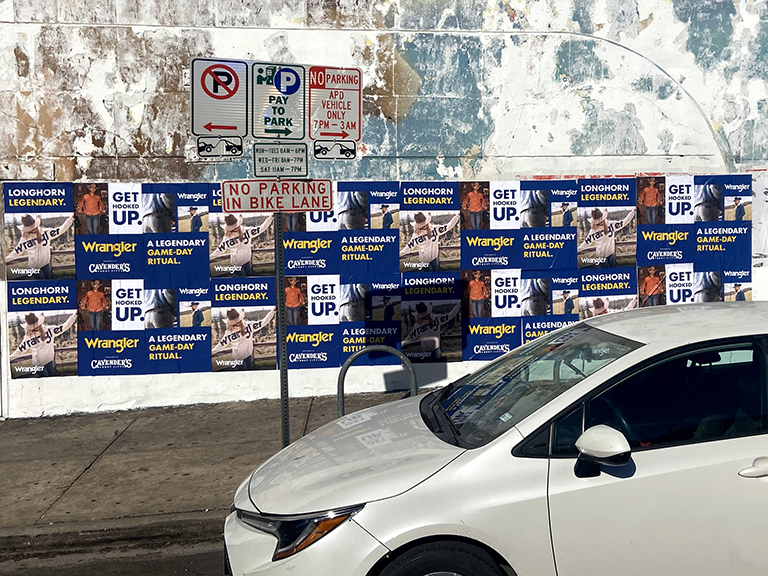
One of the most underused strategies in retail marketing is the deliberate connection between outdoor marketing in a neighborhood and the retail location serving that neighborhood. Brands invest enormous amounts in in-store experience but often leave nothing happening outside the store to drive foot traffic to that experience.
We build campaigns that connect outdoor presence to retail conversion. Here’s how the model works.
We map the key retail locations the brand cares about. We then identify the pedestrian corridors within a reasonable radius of those locations where the brand’s target audience concentrates. We deploy outdoor creative, street teams, or sampling programs in those corridors during the weeks leading up to a retail launch or campaign. The outdoor presence builds brand awareness in the same neighborhoods where the retail locations are waiting to serve that audience.
In Manhattan, this might mean outdoor presence on Spring Street in SoHo, two blocks from a key retail account on Prince Street. In Brooklyn, it might mean street team presence on Bedford Avenue in Williamsburg, three blocks from a boutique retailer on North 7th Street. In Chicago, it might mean outdoor creative on Milwaukee Avenue in Wicker Park, near a lifestyle retailer on Damen Avenue.
The shopper who encounters your brand on the street and then walks into a store where the product is waiting doesn’t experience that sequence as two separate marketing events. They experience it as a single coherent signal that the brand is real, present, and worth their attention. That coherence drives conversion more reliably than either channel alone.
The most powerful retail marketing connects the outdoor experience to the in-store experience. The street drives the traffic. The store converts it. Both sides of that equation need to work.
Pop-Up Retail Campaigns: How We Build Them
Pop-up retail is one of our strongest services because it sits at the intersection of outdoor presence, brand activation, and retail conversion. A well-executed pop-up creates an environment where people choose to engage with a brand on their own terms, in a space that feels temporary and therefore special.
The planning process for a pop-up retail activation starts with location selection. We evaluate candidate locations for pedestrian traffic volume, demographic alignment with the brand’s audience, proximity to the brand’s other retail or distribution points, and the physical characteristics of the space. A location that looks beautiful in a photo but delivers low foot traffic is a waste of money. A less photogenic location with excellent pedestrian traffic often outperforms it dramatically.
Creative development for a pop-up has to solve for multiple simultaneous objectives: visual impact from the exterior to drive curiosity and entry, interior experience that delivers on the promise the exterior creates, and shareable moments that extend the campaign through earned social media. All three of these objectives require distinct creative thinking and they don’t always point in the same direction. The best pop-up creative balances all three without sacrificing any one of them.
Staffing is often the part of pop-up retail that brands underinvest in. The people in the space represent the brand. They create the experience that determines whether a visitor leaves thinking positively about the brand or neutrally. Excellent pop-up staff don’t just answer questions. They tell the brand story, create moments, and make visitors feel like insiders. That’s a specific skill set that requires specific hiring and training.
Retail Activation in Key Markets
New York City Retail Activation
New York has the most sophisticated retail activation market in the country. The concentration of premium retail in SoHo, the boutique retail network in Williamsburg and the Lower East Side, and the mass market retail corridors of Midtown give brands access to virtually any consumer profile they want to reach. We’ve run retail activations across all of these zones, driving foot traffic through outdoor campaigns and street teams to retail partners waiting to convert that traffic.
The SoHo retail corridor around Prince Street and Broadway is the highest-value retail activation zone in New York for fashion, beauty, and lifestyle brands. That’s where major brands choose to open their flagship retail experiences because the foot traffic is extraordinary and the audience is concentrated with exactly the kind of consumer who values brand experience alongside product quality.
Los Angeles Retail Activation
Los Angeles retail activation requires neighborhood specificity. The Fairfax District, particularly the stretch of Fairfax between Melrose and Beverly, is the most concentrated street-level retail activation zone in LA for youth culture and fashion brands. Abbot Kinney in Venice is the premier zone for premium lifestyle and wellness retail. Melrose Avenue’s boutique corridor from La Brea to Cahuenga serves a broad fashion audience.
LA pop-ups need to account for the city’s car culture. Unlike New York, where pop-ups benefit from pedestrian density, LA pop-ups need strong signage and parking accessibility or they miss the majority of the potential audience. We design LA retail activations with this in mind, prioritizing locations that are accessible by foot from high-traffic pedestrian zones but not dependent on walk-by traffic alone.
Chicago Retail Activation
Chicago’s retail activation opportunities concentrate in Wicker Park, where Milwaukee Avenue and Damen Avenue give excellent pedestrian access to the city’s most active independent retail community. Andersonville, River North’s gallery district, and the Pilsen arts community add distinct retail activation zones with different audience profiles.
Measuring Experiential Retail Success
Measurement in experiential retail requires thinking beyond traditional retail metrics. Sales volume is important but it’s not the only thing to measure. Here’s a framework for evaluating experiential retail program performance.
Metric
What It Tells You
Foot traffic (visitors per hour)
Whether the location and outdoor presence generated attendance
Conversion rate (buyers / visitors)
Whether the in-store experience converted interest to purchase
Average transaction value
Whether experience drove higher-value purchases
Social media posts generated
Earned media reach beyond physical attendees
Email or community sign-ups
Long-term audience capture from the activation
Return visit rate
Whether experience created loyalty sufficient for repeat visits
Net Promoter Score (post-activation survey)
Likelihood of participants to recommend the brand
Measuring a pop-up only by sales is like measuring a concert only by merchandise revenue. The experience creates value beyond the transaction. Build the measurement framework to capture all of it.
Common Experiential Retail Mistakes and How to Avoid Them
After building and supporting retail activations across dozens of campaigns, we see the same mistakes repeat themselves. Understanding them saves you from learning the hard way.
Choosing the wrong location. A pop-up in a low-traffic neighborhood because the rent is cheap is a pop-up that nobody visits. Location is the single most critical variable in retail activation success. Pay for the traffic. It pays for itself in conversion.
Underestimating the importance of exterior creative. Most shoppers make the decision to enter a pop-up based on what they see from outside. If the exterior doesn’t generate curiosity and communicate value quickly, the interior experience never gets a chance to work. Design the outside-in, not the inside-out.
Running too short a duration. Word of mouth needs time to build. A two-day pop-up rarely has enough time for organic social sharing and peer recommendation to drive meaningful foot traffic. We generally recommend a minimum of five days for any pop-up retail experience, and two to three weeks for maximum word-of-mouth impact.
Failing to capture contact information. Everyone who walks through the pop-up door is a warm audience member. If you don’t capture their email, phone number, or social follow during the visit, the relationship ends when they walk out. Every pop-up should have a clear, frictionless mechanism for audience capture that the visitor feels positive about providing.
Not connecting the pop-up to ongoing retail distribution. A pop-up that drives purchase interest but has no connection to ongoing retail availability is a marketing investment that dead-ends. Before you run the pop-up, ensure that the product is available for continued purchase through channels the audience can find after the temporary experience has closed.
Retail Partnerships and Co-Branded Activations
Some of the strongest experiential retail campaigns don’t live in a brand’s own space. They happen inside a retail partner’s existing environment. A beauty brand running a sampling event inside a Sephora. An athletic wear brand taking over a section of a Dick’s Sporting Goods for a launch week activation. A food brand staging a tasting day at a Whole Foods location in a key market.
These co-branded activations work because they put the brand in front of an audience that’s already in a shopping mindset and already trusts the host retailer’s curation. The retailer’s implicit endorsement adds credibility. The brand’s activation adds energy and differentiation to the retailer’s floor. Both sides win.
Getting retail partners to agree to in-store activations requires a clear value proposition. You have to show the retailer what’s in it for them. Usually that means foot traffic: your campaign is going to drive people into their store who might not have come otherwise. That conversation is a lot easier when you can point to an outdoor campaign and street presence you’re planning in the surrounding neighborhood as part of the same program.
We help brands build those retail partnership conversations. We come in with a media plan that shows where outdoor presence will run relative to the retailer’s locations, what the street team deployment will look like in the surrounding blocks, and how social content will direct audiences to the retailer’s locations. That plan makes the retail partner feel like they’re getting a marketing campaign aimed at their door, more than a vendor asking for floor space.
In cities like New York and LA, independent boutique retailers are often the most strategic co-branding partners. A placement in a respected Nolita boutique or a Fairfax District shop carries cultural weight that a department store placement can’t match. These smaller retailers are selective. Getting into the right ones signals taste and community connection. We know the boutique retail environment in our key markets and can help brands identify the right partnership targets.
Why American Guerrilla Marketing Approaches Retail Experientially
We came to retail activation from the street. Our roots are in outdoor marketing: getting a brand’s physical presence into the neighborhoods where its audience lives. That foundation shapes how we think about retail, because we’ve always understood that the moments happening outside a store shape what happens inside it.
When we build a retail launch campaign, we don’t start inside the store. We start on the street. We ask: where does the brand’s audience walk before they walk into this store? What do they see? What are they thinking about? How can we build outdoor presence that makes the walk to this store feel like the natural next step for someone who’s already noticed the brand?
That outside-in thinking produces campaigns that connect outdoor presence to retail conversion in ways that purely inside-out thinking can’t achieve. The result is retail activation campaigns that don’t just look good inside a pop-up space. They build real pipelines of awareness and intent that turn into real foot traffic and real sales.
Frequently Asked Questions
What is an experiential retail agency?
An experiential retail agency creates shopping environments and retail moments that go beyond transactional product sales. Services include pop-up retail design and execution, in-store event activation, outdoor-to-retail traffic driving campaigns, product demonstration programs, and mobile retail experiences. The goal is transforming the retail encounter from a pure transaction into a memorable br
How does experiential retail differ from traditional retail marketing?
Traditional retail marketing focuses on promoting products and driving transactions. Experiential retail focuses on the quality of the shopping encounter itself. It treats the retail environment as a brand communications medium, more than a distribution channel. Experiential retail asks: what do we want people to feel when they’re in this space? Traditional retail asks: how do we sell more product
What formats fall under experiential retail?
Pop-up retail experiences, flagship store experience design, in-store activation events, product demo and sampling days, outdoor campaigns that drive retail traffic, mobile retail activations, and limited-edition retail collaborations all fall under the experiential retail umbrella. The common thread is that the retail moment is designed to be memorable and emotionally engaging, more than function
How do you drive foot traffic to a retail activation?
We drive foot traffic through outdoor street campaigns in the neighborhoods around the retail location, street team deployments at nearby transit exits and pedestrian corridors, social media content that generates awareness and creates urgency, and email or SMS campaigns to existing brand audiences. The combination of physical presence near the location and digital amplification consistently produ
How much does a pop-up retail activation cost?
Pop-up costs vary significantly with complexity. A simple branded pop-up using a temporary retail space runs $5,000 to $20,000 including design, production, and staffing. More elaborate builds with custom fabrication, interactive elements, and multi-week duration run $25,000 to $150,000 or more. Outdoor traffic-driving campaigns add to the budget but typically pay for themselves in increased foot
What makes a pop-up retail experience successful?
Location with genuine pedestrian traffic. Creative that creates a photo moment and generates organic social media. Staff who genuinely represent the brand and create individual memorable interactions. A clear brand story that’s communicated through the environment itself. A mechanism to capture contact information from visitors for post-activation follow-up. And enough duration that word of mouth
How far in advance should I plan an experiential retail activation?
Pop-up retail activations need four to eight weeks of lead time at minimum. Complex builds requiring custom fabrication need eight to sixteen weeks. Finding and securing good retail pop-up spaces in major cities can take two to four weeks on its own. Start planning early. The best locations in high-traffic neighborhoods go quickly, especially during peak retail seasons like holiday and back-to-sch