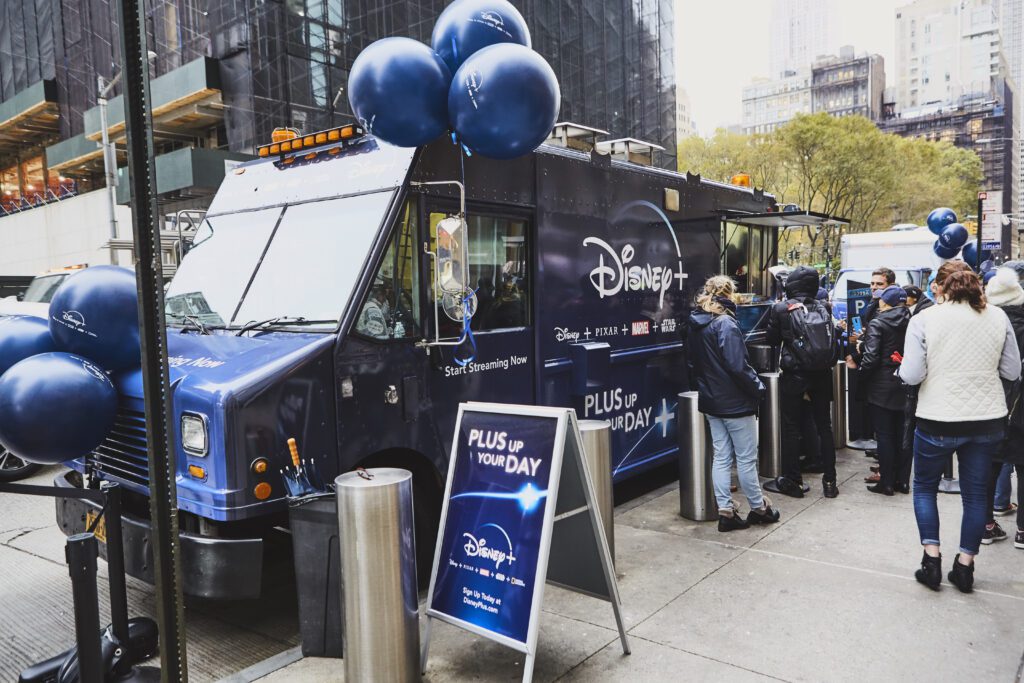
Event marketing vehicles take brand activation to the consumer instead of asking consumers to find it. From wrapped step vans to purpose-built touring platforms, the right vehicle program reaches target audiences across multiple markets with direct brand contact at scale.
Event marketing vehicles are among the most versatile tools in experiential marketing. They remove the geographic limitation of fixed activations — the consumer has to come to you — and replace it with a mobile program that can be in a different neighborhood each morning and a different city each week. The vehicle is the activation platform, the billboard during transit, and the brand environment when deployed.
The category covers a wide range of vehicle types, from cargo bikes and branded carts for hyper-local urban programs to large custom-built trailers for national touring campaigns. The right vehicle for a specific program depends on the brand, the product, the markets, the activation format, and the production investment available.
Understanding what each vehicle type is optimized for helps in selecting the right platform for a specific program.
Cargo Bikes and Branded Carts
For densely urban markets where vehicle parking is difficult and foot traffic in bike or pedestrian lanes is high, cargo bikes and branded carts are often more efficient activation platforms than full-size vehicles. A well-branded cargo bike with two product-carrying staff can work a neighborhood like SoHo in New York or Wicker Park in Chicago with a flexibility that a step van cannot match. The format is inherently human-scale and approachable — it does not signal corporate presence the way a large vehicle does.
Branded Vans and Step Vans
Wrapped vans and step vans are the standard format for street-level sampling and distribution programs. They provide storage, transport, and product staging capacity that small-format vehicles cannot match, at a cost that allows most brands to run multi-day programs without prohibitive vehicle investment. A well-wrapped step van is a mobile billboard during transit — particularly valuable in high-traffic urban corridors where the vehicle is visible to the same commuter population for multiple days.
Box Trucks with Activation Panels
A box truck with side-access panels or a fold-down serving window creates a serving station that is more visible, more stable, and more capable than a van setup. The larger format also allows for greater interior customization: refrigeration for temperature-sensitive products, built-in display fixtures, digital screens, and audio systems. Box truck activations are the standard format for mid-tier food and beverage programs that need product serving capability in the field.
Custom Converted Trailers
Trailers allow for full interior design: brand-built environments, premium product display, premium serving infrastructure, comfortable consumer interaction spaces. The trailer format is the most designable vehicle format because the interior is essentially a blank canvas constrained only by the trailer’s dimensions. A well-built brand trailer becomes a traveling brand installation — a designed environment that communicates the brand’s premium positioning through the quality of its physical details.
Specialty Vehicles
Some programs call for inherently attention-generating vehicle formats: vintage vehicles that create nostalgic association, uniquely branded specialty vehicles (ice cream trucks, coffee carts, airstream trailers) that carry cultural associations aligned with the brand’s positioning, or custom-built vehicles that are designed specifically as brand experiences rather than adapted from existing formats. These specialty formats generate organic attention and social sharing just by virtue of their presence, creating earned media value that a standard wrapped van cannot.
Vehicle Type
Urban Maneuverability
Activation Depth
Production Level
Best Format
Cargo bike / cart
Excellent
Light
Low
Hyper-local sampling
Wrapped van
Good
Light – Medium
Low – Medium
Street distribution, multi-stop
Box truck with panels
Moderate
Medium
Medium
Serving-based sampling, demo
Converted trailer
Low
High
High
Premium brand experience
Specialty / custom vehicle
Varies
Medium – High
High
Earned media, brand story
Vehicle Wrap Design and Brand Integration
The vehicle wrap is the most visible element of a mobile marketing vehicle program. The design should communicate the brand clearly at a distance — legible brand name and key visual from 100 feet — while being visually compelling enough to attract attention in the specific urban contexts where the vehicle will be deployed.
The wrap design brief should account for: how the vehicle looks in motion (partial visibility from the side at street speed), how it looks stationary in a deployment location (full coverage at consumer distance), and what it communicates in the social content that consumers will generate when they photograph it. Many brands under-brief the social content angle of their vehicle wrap design, which produces wraps that are visually adequate in person but read poorly in phone camera photos.
A vehicle wrap should be designed for the phone camera, not the printing proof. The way a brand reads at 3 meters in a phone photo is how it will appear in the majority of consumer-generated content from the program. We test wrap designs at phone-camera resolution before finalizing, because a wrap that looks strong in a full-resolution design file often has legibility or visual impact problems at phone-camera resolution in real-world lighting conditions.
Vehicle Program Logistics
Mobile vehicle programs have logistics requirements that fixed-location programs do not. These are the most common logistics challenges and how to address them.
Parking in dense urban markets. Parking a large vehicle in downtown Manhattan, Chicago’s Loop, or Santa Monica’s Third Street Promenade requires pre-arranged permissions or relies on finding available loading zones. We research parking options for each deployment location in advance, have contingency locations identified, and manage vehicle positioning to maximize dwell time in the target location while maintaining compliance with local regulations.
Power supply for refrigeration and electronics. Vehicles with refrigeration, audio systems, and digital displays need power. Options include vehicle engine idling (regulated in many urban areas and disruptive), generator power (noise and exhaust management required), or battery/inverter systems for shorter deployments. We spec the power solution for each program based on the vehicle’s requirements and the deployment environment.
Cross-market vehicle transport. Multi-market programs require a vehicle transport plan between cities. Drive time between markets, transport logistics for equipment inside the vehicle, and vehicle maintenance on multi-week tours all need to be built into the program timeline.
Event Marketing Vehicle Program Strategy: Beyond the Wrap
The vehicle wrap is the most visible element of an event marketing vehicle program, but it is not the most important one. The most important elements are the deployment strategy — where the vehicle goes, when, and why — and the interaction quality of the staff who execute the program from the vehicle. A beautifully wrapped truck deployed to low-value locations with undertrained staff produces low program performance regardless of the visual design quality.
Location Intelligence for Vehicle Programs
Event marketing vehicle programs that achieve strong performance are almost always running from a specific, data-backed understanding of where the target consumer is concentrated at specific times. The brand that knows its 25-to-35 female professional target is most concentrated at the Saturday morning farmers market in Lincoln Park Chicago, or on the blocks around the Equinox on the Upper West Side in New York between 6 and 9am on weekday mornings, or at the Friday afternoon food truck cluster outside the tech company campus in Austin — that specific knowledge is the difference between a productive deployment and an expensive drive around.
Consumer movement data, combined with direct neighborhood observation, is how this deployment intelligence is developed. For programs we manage, we conduct location-specific reconnaissance before deploying vehicles — physically visiting candidate deployment locations at the planned activation hours to assess traffic volume, demographic composition of actual pedestrian flow, competitive activation presence, and physical logistics (parking, access, sight lines). That direct observation validates or challenges the data-based assumptions and produces deployment plans that reflect how locations actually perform rather than how they appear to perform in demographic mapping data.
The Interaction Quality Multiplier
Vehicle programs reach consumers through two channels simultaneously: the visual brand impression from the vehicle itself (which communicates to every person who sees the vehicle, whether they interact with the staff or not) and the direct brand interaction created by the staff (which communicates more specifically to each person who engages). Both channels matter, but the direct interaction channel produces dramatically stronger per-consumer brand impact.
A consumer who sees a branded vehicle and keeps walking has been reached. A consumer who stops, talks to a staff member, tries the product, and leaves with a specific story about the interaction has been engaged. The ratio of reached-but-not-engaged to fully-engaged consumers in most vehicle programs is heavily skewed toward the former. The use point for program ROI improvement is increasing the engagement rate — the percentage of people who see the program and stop — and the conversion rate — the percentage of those who stop and take the desired action.
Both rates are primarily determined by staff quality and interaction protocol. The staff member who is positioned at the vehicle’s engagement point (the door, the serving window, the step-down platform), who makes eye contact with approaching consumers, who has the physical energy and genuine warmth to invite engagement without pressure, and who can lead an efficient 60-to-90-second conversation that delivers the brand’s core message and asks for the desired action — that staff member is the most important determinant of program performance. Better staff equals better program, regardless of the vehicle’s production quality.
Vehicle Programs as Multi-Day Media Buys
A branded event marketing vehicle operating in a specific market corridor over multiple consecutive days functions as a mobile media placement in that corridor. The commuters and residents who walk or drive past the vehicle multiple times during a week receive repeated brand exposure that functions similarly to out-of-home media, but at a cost structure that is typically more efficient for targeted programs in defined geographic areas.
When the vehicle is positioned in a location where the same consumer passes it multiple times over the program’s duration, the cumulative brand exposure creates a frequency effect that single-encounter activations cannot match. The consumer who sees the branded vehicle on their morning commute route three days in a row has received three brand exposures before any direct staff interaction. When they finally stop to engage on day three, the interaction benefits from the familiarity of those prior visual exposures — the brand is not entirely unknown. The interaction is a conversation with a brand they have already noticed, not a cold introduction.
Reporting on Event Marketing Vehicle Programs
Client reporting for event marketing vehicle programs should connect the program’s activity data to the business objectives it was deployed to serve. The most common reporting error in vehicle programs is presenting activity metrics (contacts, samples distributed, miles driven) without connecting them to outcome metrics (purchase intent, brand consideration change, retail velocity impact).
A well-structured vehicle program report includes: daily contact counts by location with conversion rate per location, total program contacts and conversions with cost-per-conversion calculation, content generated (photos and social posts from the program), geographic coverage documentation (photos confirming deployment at each location, route maps showing coverage), and any consumer feedback data captured during the program. For programs that include a post-program survey component, the brand sentiment data in the program market versus a control market provides the most direct evidence of program impact on brand outcomes.
Selecting the Right Event Marketing Vehicle for Your Program
Vehicle selection for an event marketing program is a strategic decision that affects program aesthetics, logistics, capacity, and consumer experience. The right vehicle depends on the program’s specific requirements across several variables that should be evaluated before any vehicle is sourced.
Product serving requirements: Does the program need to serve prepared food or beverages? Does the product require refrigeration or a specific serving temperature? Does the product need to be demonstrated or assembled at the vehicle? Products with complex serving requirements need vehicles with appropriate infrastructure — commercial kitchen equipment, refrigeration systems, preparation space. Products that can be distributed from storage need less complex vehicle infrastructure.
Consumer interaction scale: How many consumers does the program target per hour? High-volume programs that target 50 to 100 interactions per hour need vehicles with multiple serving windows or wide accessibility from multiple approach angles. Programs targeting deeper, longer interactions with fewer consumers can work from vehicles with a single interaction point.
Market accessibility: In dense urban environments with limited parking and tight street widths, smaller vehicles have significant logistical advantages. A cargo bike or branded cart can access locations that a full-size truck cannot, and can move quickly between locations in a way that a large vehicle’s parking requirements prevent. In suburban or festival environments where vehicle size is not a logistical constraint, larger formats are available.
Brand aesthetic requirements: The vehicle should communicate the brand’s positioning through its format and design. A premium brand should not deploy in a standard step van with a basic wrap if the brand’s visual identity communicates luxury. A vintage brand should not deploy in a modern vehicle format if the brand’s heritage is central to its positioning. Vehicle selection is brand communication.
Event Marketing Vehicle Wrap Design: Principles for Maximum Impact
The vehicle wrap is simultaneously a mobile billboard, a brand environment signal, and a consumer engagement invitation. Designing it to serve all three functions requires specific decisions about hierarchy, legibility, and visual impact at different viewing distances and in different environmental contexts.
The most important principle in vehicle wrap design for event marketing programs is legibility at speed. The consumer who sees the vehicle from a car or while walking at a normal pace will process the wrap for 2 to 5 seconds at most. The brand name, the primary visual, and the key product or offer must be legible within that window. Typography that requires close reading, visual elements that require context to understand, and cluttered designs that compete for attention all fail the speed-legibility test.
The second principle is visual distinctiveness in context. The vehicle operates in an environment of other vehicles, storefronts, signage, and visual noise. A wrap that uses the same visual language as the surrounding environment disappears into it. A wrap that creates genuine visual distinctiveness — through an unexpected color choice, a scale of graphic that commands attention, or a visual concept that is surprising in the context of a vehicle — creates the pause response that precedes engagement.
The third principle is brand consistency with the activation. The vehicle wrap should look like it belongs with the brand’s broader marketing materials, social media aesthetic, and packaging. A consumer who encounters the brand’s vehicle and then encounters the brand’s products should have an immediate sense of visual coherence. Wraps that are designed independently of the brand’s visual system undermine the brand recognition they are meant to build.
Managing Vehicle Program Quality Across Multiple Crews
Programs deploying multiple vehicles simultaneously face a quality consistency challenge: each vehicle’s staff team creates a somewhat different brand experience, and the difference between a good team and a mediocre team is visible in the day’s conversion data. Managing for quality consistency across multiple crews requires the same systems as managing quality consistency across multiple markets — standardized training, daily briefings, field monitoring, and real-time performance tracking that identifies which crews are underperforming before the program’s total outcomes are determined.
We assign a field supervisor who is responsible for visiting each vehicle crew at least once during a deployment day for multi-vehicle programs. The supervisor’s role is performance coaching in real time — reinforcing the protocol elements that are working, addressing specific issues in staff interaction technique, and maintaining the energy and engagement quality that determines conversion rate. Programs with field supervision consistently outperform programs without it on both conversion rate and staff retention over multi-day programs.
Making Experiential Programs Work for Your Brand’s Specific Situation
Every brand faces a unique combination of objectives, consumer targets, market conditions, and budget constraints. The principles discussed throughout this article apply universally, but their specific application requires calibration to your brand’s unique situation. Here is a framework for that calibration.
Start with an honest assessment of your brand’s current consumer relationship. Are you building awareness from near-zero, converting aware non-trialists, deepening loyalty among existing customers, or defending against competitive encroachment? The answer determines which experiential format is most efficient: awareness programs need scale and content generation, trial conversion programs need context precision and conversation quality, loyalty programs need community creation and exclusivity, and competitive defense programs need direct product comparison and quality demonstration.
Then assess your current live consumer touchpoint quality. Where does your brand currently have direct physical encounters with consumers? How good are those encounters? Are they creating genuine brand exposures or simply processing consumers transactionally? The most efficient starting point for experiential investment is almost always improving the quality of existing touchpoints before creating new ones. A brand that has poor quality encounters at its existing touchpoints will create poor quality encounters at new ones unless the design discipline that determines quality is applied consistently across all of them.
Finally, build the measurement infrastructure before the first program runs. Define success with specificity. Establish baselines against which success will be measured. Specify the data that will be collected and how it will be collected during the program. Identify the analysis that will connect the data to the success definition after the program ends. This measurement discipline is the difference between a program that teaches you something and a program that just happens. The program that teaches you something produces compounding value — each program generates learning that makes the next one better. The program that just happens produces no such compounding effect.
AGM is a full-service experiential marketing and brand activation agency headquartered in New York, operating nationally. We bring the strategy, creative, production, staffing, content, and measurement capabilities that experiential programs require to every market we serve. The best time to start the conversation about your brand’s experiential program is before the next product launch, the next market entry, or the next competitive challenge puts you in a position where the program needs to happen faster than it should be planned. Contact us to discuss what the right program looks like for your brand’s specific objectives.
Working With AGM on Your Experiential Marketing Program
AGM has spent years building the field capability, market knowledge, and production infrastructure that produces experiential marketing programs that actually work. Our approach starts from the consumer and the objective, not from a preferred format or a standard program template.
When we engage with a new program brief, we spend the first phase asking the questions that most agencies skip: what specifically do we need to change in the consumer’s behavior or belief, and what is the specific encounter design most likely to produce that change for this consumer in this market? The answers to these questions drive every decision that follows — the format, the location, the physical design, the staffing approach, the content strategy, and the measurement framework.
We produce complete post-program reports that connect every program’s activity data to the specific objectives set before the program launched. We measure what changed, not just what happened. We deliver honest analysis of what worked and what would be done differently, because the brands we work with use that analysis to make every subsequent program better than the last.
Our primary markets are New York, Los Angeles, Chicago, Miami, and Austin, with national program execution capability across the United States. Our programs span formats from street-level sampling operations with conversation protocols to large-scale immersive installations to multi-market touring programs. We are a full-service partner from brief development through post-program reporting.
If you are planning an experiential marketing program — whether you are running your first activation or your fiftieth — we would be glad to have a conversation about your specific objectives and what the right approach looks like for your brand. The conversation starts with your brief. The clearer and more specific that brief is, the more useful the conversation will be. We can also help you develop the brief if you are still in the objective-clarification stage. Either way, the right time to start is before the pressure of an imminent launch date compresses the planning window.
Key Takeaways for Brands Evaluating This Program Type
Regardless of the specific program format, scale, or market, the brands that consistently produce strong experiential marketing outcomes share a few foundational practices that are worth summarizing as actionable takeaways.
Define the outcome before the format. The format should serve the objective, not the other way around. Every program decision — venue, staffing, content strategy, timing — should be evaluated against whether it serves the specific outcome the program was designed to produce. When decisions are made for reasons unrelated to the program objective (the venue was available, the format is one the agency knows well, the timing was convenient), program quality suffers.
Invest in staff quality as a primary creative decision. The physical environment is the context. The staff are the experience. In every direct interaction program, the conversion rate is determined primarily by the quality of the human encounter, not the production quality of the environment. Under-investing in staff selection and training while over-investing in physical production is the most common budget allocation mistake in experiential marketing. The correction is treating the staff brief with the same rigor and investment as the production brief.
Design content before designing the environment. Specify the hero photograph. Specify the 30-second video clip. Specify the social-first moments. Then evaluate the physical design against these content specifications before fabrication begins. Content that is designed into the activation from the start is more specific, more visually compelling, and more useful across more channels than content that is improvised on the activation day.
Measure outcomes, not just activities. Attendance counts, contacts made, samples distributed — these are activity metrics. Brand consideration lift, purchase conversion rate, content reach, retail velocity improvement — these are outcome metrics. The program that produces high activity and low outcomes is failing. The measurement infrastructure to distinguish between the two requires pre-program baselines and post-program outcome measurement that most brands do not currently have in place for their experiential programs. Building this infrastructure is the most valuable investment available for brands that want to improve their experiential marketing ROI over time.
Frequently Asked Questions
What are event marketing vehicles?
Event marketing vehicles are branded mobile platforms — trucks, trailers, vans, bikes, or custom-built units — that deploy to consumer locations to deliver product sampling, brand experience, and product demonstrations. The vehicle itself serves as a mobile billboard during transit and a brand activation platform when stationary.
What vehicle format is right for my brand activation program?
The right format depends on the product, the activation footprint needed, the market’s accessibility, and the budget. Cargo bikes and branded carts work for tight urban environments. Step vans work for street-level distribution programs. Converted trailers work for premium brand experiences. Custom-built vehicles work for flagship touring programs with high production requirements.
How does mobile vehicle marketing compare to fixed-location activations?
Vehicle programs offer geographic flexibility and multi-location reach within a single day. Fixed-location activations offer greater design depth and dwell time. The choice depends on whether scale or depth is the priority for the specific program objective.
Does AGM provide event marketing vehicles and crews?
Yes. AGM sources vehicles, manages the wrap and customization process, recruits and trains crew, plans routes, manages logistics, and executes the deployment across your target markets.