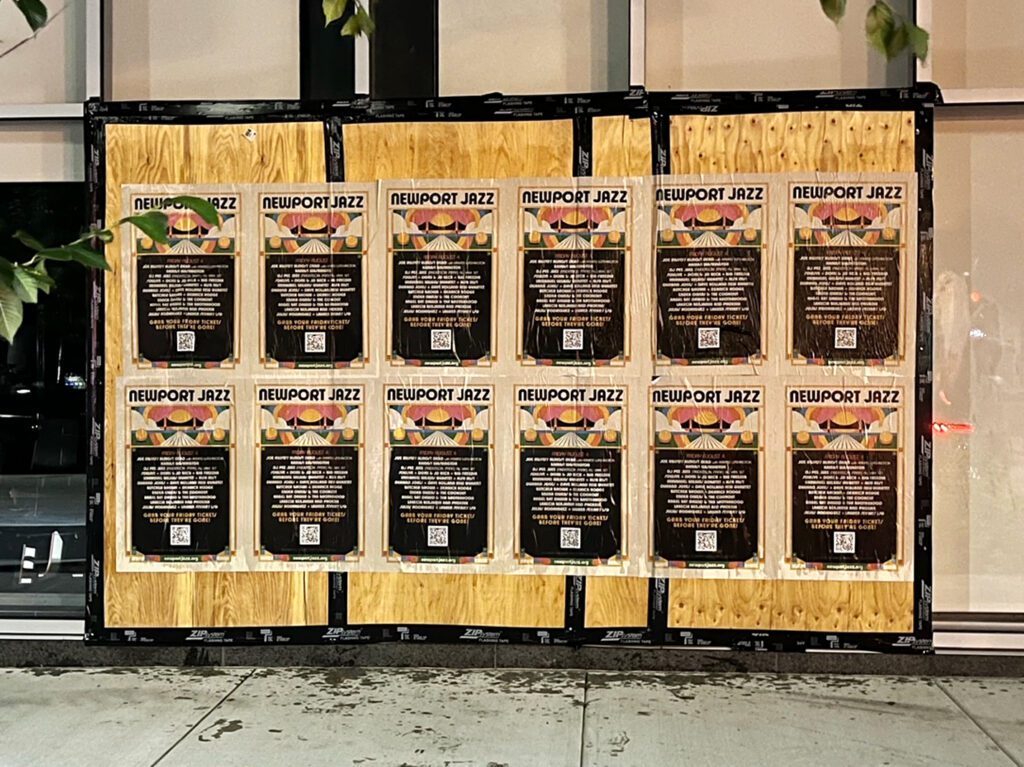
Entertainment venue marketing has a problem that most digital-first marketers overlook: the people most likely to buy a ticket to a live show are often the hardest to reach online. They use ad blockers. They tune out Spotify pre-rolls. They do not follow venue pages on platforms that throttle organic reach. But they walk the same streets, use the same transit, and hang out in the same bars every week. Street-level marketing reaches them where digital advertising fails.
Our team has executed marketing campaigns for venues across multiple markets — from 200-capacity independent clubs to 5,000-seat theaters. What drives ticket sales in this category is not complicated: repeated, well-placed brand impressions in the physical corridors where the target audience already moves, delivered close enough to the event date to create purchase urgency. The tactics that accomplish this consistently are poster campaigns, street team distribution, sidewalk stenciling, and LED truck placements. This guide covers how to deploy each one effectively and how to sequence them for maximum impact in the weeks before a show or series.
Whether you manage a single-venue calendar or run marketing for a multi-venue entertainment group, the framework below gives you a practical, market-tested approach to driving ticket sales through street-level channels that most of your competitors ignore.
Why Street Marketing Works for Entertainment Venues
Live entertainment is inherently local and social. The decision to buy a ticket to a show happens because someone heard about it from a friend, saw it on a wall they walk past every morning, or encountered it on the street through someone promoting it. These are not digital discovery mechanisms. They are social and physical ones — which is precisely why street marketing over-indexes for entertainment campaigns relative to its budget share.
Cultural Credibility Through Physical Presence
A poster on a wall in a nightlife district communicates something that a Facebook event cannot: that this show belongs to this neighborhood. Physical materials, placed in the right locations, create cultural legitimacy. A band or performer that has coverage across the key walls in a music district feels like part of the scene rather than an import. For independent venues and emerging artists, this cultural credibility is the most valuable output of a street marketing campaign — worth far more than equivalent digital impressions.
Reaching Non-Digital Ticket Buyers
A significant portion of live entertainment audiences — particularly older demographics, working-class audiences, and communities with lower social media penetration — rely heavily on physical marketing materials for event discovery. For venues with diverse programming that spans age ranges and community demographics, street-level marketing is often the only reliable way to reach portions of the potential audience that digital-only campaigns miss entirely.
Poster and Wheatpaste Campaigns for Entertainment Venues
The concert poster has been the foundational marketing tool for live music for over 70 years. Its longevity is not nostalgia — it is effectiveness. A well-designed poster in a high-traffic location generates thousands of impressions per day for weeks at a cost that no digital format approaches. Our team manages wheatpaste and poster campaigns for entertainment venues across markets, placing materials on permitted surfaces in the neighborhoods and corridors where venue audiences live and move.
Location Strategy for Entertainment Poster Campaigns
The best poster locations for entertainment venues are within 1 to 3 miles of the venue, concentrated in the nightlife and arts districts that the target audience frequents. Transit station adjacencies — walls near subway exits, bus stops, commuter parking lots — deliver high-frequency impressions to the commuter audience most likely to make evening entertainment plans. University-adjacent locations work for shows with strong student and young adult demographics. Coffee shop and bar adjacencies reach the social decision-makers who drive group ticket purchases.
Multi-Wave Poster Timing
Our team typically structures entertainment venue poster campaigns in two waves: a first wave 4 to 6 weeks before the event to build awareness and create the ambient sense that “this show is happening,” and a second wave in the final 7 to 10 days to drive last-mile ticket purchase urgency with the remaining availability. The two-wave approach keeps materials visually fresh and avoids the weathering and overlay damage that accumulates on posters over multi-week windows.
Street Team and Flyer Distribution for Ticket Sales
A trained street team distributing show flyers at the right locations converts browsing audiences into ticket buyers through direct personal engagement. The key to making street teams work for venues is placement precision: not handing flyers to random pedestrians, but targeting the specific venues, events, and transit nodes where the exact audience for the show already congregates.
Complementary Venue and Event Targeting
The highest-ROI street team placement for entertainment venue marketing is outside complementary events in the days before the target show. If you are promoting a hip-hop show on Friday, deploying street teams outside hip-hop shows on the preceding Tuesday and Wednesday puts materials directly in the hands of people who have already demonstrated willingness to purchase tickets for exactly that genre. This is the difference between spray distribution and targeted field marketing.
Transit Nodes and University Campuses
Major transit stations — subway exits, bus terminals, commuter rail stations — in neighborhoods with high entertainment venue density generate thousands of passersby per hour. Street teams at these nodes during evening commute windows (5:00pm to 7:30pm) reach audiences in a decision-making mindset — people planning their evening or weekend who are receptive to entertainment discovery. University campuses are equally effective for shows with strong student demographics, particularly when combined with campus bulletin board placements and flyer distribution in dining halls and student unions.
Sidewalk Stencils for Entertainment Venue Awareness
Sidewalk stencils are one of the most cost-effective awareness formats in street marketing for entertainment. A stencil placed on the sidewalk outside a venue and in the surrounding entertainment district generates continuous impressions for every person who walks through that corridor — with no media cost after the initial stenciling labor. Our team deploys sidewalk stencil campaigns for entertainment venues with messages that include show name, date, and a QR code linking directly to the ticket purchase page.
Venue Entrance and Approach Corridors
The most impactful placement for entertainment venue sidewalk stencils is on the approach corridors to the venue itself — the streets and sidewalks that people walk on the way to the building. These placements prime the audience for the show they are about to attend and create directional brand presence that reinforces every other marketing touchpoint. Stencils that include a specific call to action (scan for tickets, tonight’s lineup, limited seats remaining) perform better than pure awareness messaging.
LED Billboard Trucks for High-Impact Pre-Show Promotion
For major show announcements, sold-out event marketing, and festival promotions, LED billboard trucks provide mobile, large-format visual presence that fixed media cannot deliver. An LED truck circulating through entertainment districts, bar corridors, and transit nodes in the 48 to 72 hours before a major event creates a moving campaign that follows the target audience through their daily movements.
Pre-Show Night Deployment
Deploying an LED truck in the entertainment district on the night before and the day of a major show creates a final push awareness moment when ticket purchase urgency is highest. The truck can carry dynamic creative that updates in real time — remaining ticket counts, lineup additions, show time changes — making it a functional informational tool as well as a brand awareness vehicle. For festival promotions where multiple shows are happening across a weekend, LED trucks provide the mobile presence to cover the entire entertainment district geography that fixed media cannot.
Campaign Timing and Sequencing
The biggest mistake in entertainment venue marketing is launching street campaigns too late. Poster campaigns need 3 to 6 weeks to generate sufficient cumulative impressions to move audiences from awareness to purchase intent. Street teams in the final week convert warm audiences. LED truck deployments in the final 48 hours create urgency. Understanding how these tactics work together in sequence is what separates campaigns that drive ticket sales from campaigns that create visible presence without measurable commercial output.
Six-Week Campaign Sequence
Week 6 to 4: Wheatpaste and poster installation in the target corridors. Create ambient awareness that the show is coming. Week 4 to 2: Flyer distribution at complementary events and transit nodes. Start driving people from awareness to active consideration. Week 2 to show date: Sidewalk stenciling near venue and in the entertainment district. Final week: Street team deployment at high-concentration locations and LED truck in the entertainment corridor on show day and the preceding day.
Urgency Messaging in Final Days
Creative messaging shifts as the campaign progresses toward the event date. Early materials focus on the show itself — artist, date, venue, atmosphere. Final-week materials shift to urgency: tickets available, selling fast, tonight’s show, last chance. This messaging transition is what turns ambient awareness into active ticket purchase behavior. Our team builds this messaging sequence into creative briefs upfront so the shift happens without a gap in campaign presence.
Measuring Entertainment Venue Marketing ROI
Street marketing for entertainment venues generates real, measurable commercial outcomes when the attribution mechanism is built into the campaign from the start. QR codes on posters, flyers, and stencils that link to campaign-specific landing pages or ticketing URLs allow direct attribution of ticket purchases to specific campaign elements. Promo codes included on street team materials allow channel-specific response tracking.
Ticket Sales Attribution
Working with the venue’s ticketing platform, we set up campaign-specific UTM parameters on all QR code links and track conversion from scan to ticket purchase. This data shows which materials and locations drove the most direct ticket purchase activity — allowing optimization of future campaign placements toward the highest-performing zones and materials.
Social Amplification Tracking
Entertainment venue marketing generates organic social content — concert-goers photographing posters they think are cool, sharing stencil discoveries, posting LED truck sightings. Monitoring this content through brand mention tracking and location tag monitoring provides a secondary measure of campaign reach that extends beyond the direct ticket attribution data.
Frequently Asked Questions
What are the most effective street marketing tactics for entertainment venues?
The most effective street marketing tactics include poster and wheatpaste campaigns in nightlife and arts districts, street team distribution near transit and universities, sidewalk stencils near the venue and entertainment corridors, LED billboard trucks in high-traffic areas, and targeted flyer distribution at complementary events.
How far in advance should entertainment venue marketing campaigns launch?
For major shows and events, street marketing campaigns should launch 3 to 6 weeks before the event date. Poster campaigns run 4 to 6 weeks out for awareness, with a second wave of flyer and street team distribution in the final 7 to 10 days to drive last-mile ticket purchase urgency.
Do entertainment venue marketing campaigns need permits?
It depends on the tactic. Wheatpaste and poster campaigns require permitted surfaces or private property agreements. Sidewalk stenciling with washable chalk-based materials is generally permit-free. Street team distribution on public sidewalks is legal without permits in most cities. Our team handles all permitting logistics as part of campaign execution.
What is the cost of a street marketing campaign for an entertainment venue?
A mid-scale street marketing campaign — including poster installation, street team distribution, and sidewalk stenciling — typically runs $3,500 to $12,000 depending on the market, campaign duration, and tactical mix. LED truck additions range from $1,500 to $4,000 per day per market.
How do street marketing campaigns drive ticket sales for venues?
Street marketing drives ticket sales by creating repeated brand exposure in the neighborhoods and transit corridors where the target audience moves daily. Physical materials create cultural relevance that digital advertising does not replicate. QR codes allow direct attribution of ticket purchases to specific campaign elements.
Can street marketing work for small and independent venues?
Yes. A $2,500 to $5,000 poster and street team campaign for a 500-capacity venue in a target neighborhood is cost-competitive with digital advertising for the same audience and often more effective for building the cultural credibility that drives ticket sales for independent shows.