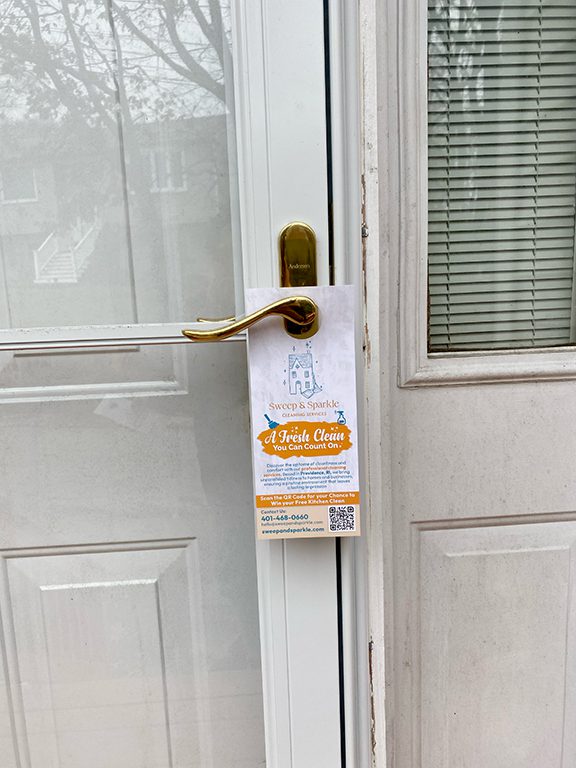
Chicago’s residential geography is one of the most favorable environments in the country for door hanger distribution. Unlike New York City, where high-rise apartment buildings with secured lobbies create significant access barriers, Chicago’s neighborhood fabric is built around bungalows, two-flats, greystones, and walkup apartment buildings that allow distributors to move efficiently from door to door without security systems or locked vestibules blocking access.
Our team has run door hanger campaigns across the North Side, Northwest Side, Southwest Side, and suburban Chicago — and the results vary significantly by neighborhood type, building density, and offer design. This guide covers the Chicago-specific geography that makes door hanger campaigns work, which zones deliver the best cost-per-impression, what professional distribution logistics look like, and how to structure a campaign that generates measurable responses rather than just pieces delivered.
Whether you are a restaurant launching in Lincoln Park, a home services company targeting the bungalow belt, or a national brand testing direct-to-door in the Chicago market, this breakdown gives you the field-level detail to plan and execute an effective campaign.
Chicago’s Residential Fabric and Why It Favors Door Hangers
Chicago is one of the few major American cities where low-rise residential development dominates even in dense inner neighborhoods. The two-flat, the greystone, and the Chicago bungalow — a sturdy single-story brick home built between 1910 and 1940 — define the residential character of most neighborhoods beyond the central business district.
The Bungalow Belt
The Chicago Bungalow Belt stretches across the Northwest Side (Irving Park, Jefferson Park, Portage Park, Norwood Park) and the Southwest Side (Bridgeport, Brighton Park, Marquette Park, Beverly). These neighborhoods contain an estimated 80,000 bungalow homes — a concentrated band of owner-occupied residential properties where door hangers land directly in the hands of homeowners. For home services, landscaping, HVAC, and local retail campaigns, the bungalow belt delivers the most direct access to homeowner decision-makers in any major American city.
North Side Two-Flats and Walkups
Lincoln Park, Lakeview, Roscoe Village, Bucktown, and Wicker Park mix two-flats, greystones, and three-story walkup apartment buildings with accessible front doors and unlocked vestibules. Population density here is high — many of these buildings house 2 to 6 units — which means a single building yields multiple door contacts per stop. These neighborhoods skew toward 25- to 40-year-old renters and young homeowners with household incomes above the metro average, making them high-value targets for food, fitness, retail, and entertainment campaigns.
Suburban Chicago Access
The immediate suburbs — Evanston, Oak Park, Berwyn, Cicero, Skokie — offer single-family home density even higher than Chicago proper. Access is straightforward, properties are well-maintained, and homeowner tenure is longer (meaning repeat exposure over time). For brands with service areas extending into the suburbs, combining Chicago neighborhood distribution with targeted suburban routes maximizes coverage without duplicating audience.
Best Chicago Neighborhoods for Door Hanger Campaigns
Not all Chicago neighborhoods work equally well for door hanger distribution. The best zones combine residential density, accessible building types, audience demographics that match the campaign target, and route geometry that allows efficient crew movement.
Logan Square and Humboldt Park
Logan Square is one of Chicago’s highest-growth neighborhoods: a mix of longtime Latino and Eastern European residents alongside a newer wave of younger professionals. Building types are predominantly two-flats and three-flats with open vestibules. The commercial corridors on Milwaukee Avenue and Kedzie Avenue create natural geographic anchors for route planning. Humboldt Park to the east offers similar building types at lower campaign costs given slightly less competition for consumer attention.
Pilsen and Little Village
Pilsen and Little Village are densely populated Mexican-American neighborhoods on the Lower West Side with excellent residential access. Two-flats and single-family homes line well-maintained residential streets. For brands targeting bilingual or Spanish-primary households, these neighborhoods offer concentrated distribution with high receptivity to direct-mail formats, particularly for food, financial services, and home improvement offers.
Hyde Park and South Shore
Hyde Park, anchored by the University of Chicago, mixes high-rise residential with walkup apartments and older single-family homes. South Shore and Woodlawn offer single-family and two-flat density at lower distribution costs. For education, healthcare, and community-focused campaigns, these South Side neighborhoods provide access to an engaged, educated residential audience.
Distribution Logistics: What Professional Door Hanger Campaigns Look Like
Our team approaches door hanger distribution in Chicago the same way we approach any field campaign: with route mapping, crew management, documentation, and quality control baked in from day one. The difference between professional distribution and informal flyer campaigns shows up in the completion rate, geographic accuracy, and proof of delivery.
Route Mapping and Crew Sizing
Before any crew hits the street, we map the target zone at the block level using census residential unit counts and street network data. A typical Chicago distribution crew of two people covers 800 to 1,200 doors per hour in a walkable neighborhood. For a 10,000-piece campaign across a defined area, we size the crew for 1 to 3 days depending on geographic spread. Route segments are assigned at the crew level so no block is missed and no block is doubled.
GPS Tracking and Photo Documentation
Every distribution crew carries GPS-enabled devices that log route completion in real time. Supervisors review completed routes against the target zone daily. Photo documentation — timestamped images of completed streets and representative door placements — is compiled into a delivery report provided to the client within 48 hours of campaign completion. This is the documentation standard our team holds to on every campaign.
Quality Control for Chicago’s Building Types
Chicago’s mix of building types creates specific access considerations. In buildings with secured entry, distributors place door hangers on mailbox clusters or exterior door handles as permitted by property management. In gated or no-solicitation properties, our crew flags the address and moves on. Single-family homes with fenced yards are approached via the gate where accessible. The result is a completion rate that reflects actual accessible units, not a blanket estimate.
Print Specs for Chicago Door Hanger Campaigns
The physical quality of a door hanger affects response rates as much as the distribution quality does. Thin, poorly printed materials communicate low-quality brand positioning before the consumer reads a word. Our team specifies durable stock that survives a full day of outdoor handling.
Recommended Specs
Standard door hangers run 3.5 inches by 8.5 inches or 4.25 inches by 11 inches with a die-cut hole sized for residential door knob hardware. Stock should be minimum 80# cover for rigidity; 100# cover is preferred for campaigns that need the material to stay on the door through wind and rain. Full-color printing on both sides is standard. For high-visibility front-side design, UV coating on the exterior face adds durability and visual pop without significant cost increase.
QR Codes and Tracking
Including a QR code linked to a campaign-specific landing page allows direct attribution of web traffic to the distribution campaign. Unique phone numbers per zone or per campaign wave work for phone-response businesses. Promo codes tied to the campaign are the most reliable tracking mechanism for e-commerce and delivery-focused offers.
Campaign Costs and ROI Framework
Door hanger distribution in Chicago is one of the lowest cost-per-door advertising formats available. Understanding the full cost structure — printing, labor, and overhead — allows brands to set realistic response expectations and budget accordingly.
Cost Components
Distribution labor in Chicago runs $0.25 to $0.50 per door including crew management and GPS tracking. Print costs add $0.08 to $0.20 per piece at standard run quantities. Minimum campaigns typically start at 5,000 pieces; 10,000 to 25,000 piece campaigns allow zone coverage broad enough to generate statistically meaningful response data. An all-in budget of $2,500 to $6,000 typically covers a 10,000-piece Chicago neighborhood campaign with full documentation.
Response Rate Expectations
Response rates for door hanger campaigns range from 0.5% to 5% depending on offer strength, audience match, and creative quality. A restaurant delivering 10,000 hangers in its immediate trade area with a 20% off first visit offer should realistically target 150 to 400 redeemed offers. Home services campaigns targeting homeowner neighborhoods with a free estimate offer often hit the higher end of this range. Building the campaign math around a 1% to 2% response rate is a conservative, defensible baseline.
Combining Door Hangers with Broader Chicago Street Campaigns
Door hanger distribution is highly effective on its own for local and neighborhood-scale campaigns. Combined with other guerrilla marketing services, it becomes part of a layered strategy that reaches consumers across multiple touchpoints in the same market.
Door Hangers Plus Street Team Engagement
Deploying a brand ambassador team in the same neighborhood zones as a door hanger campaign on the same day creates a surround-sound effect. Consumers receive the hanger on their door and then encounter the brand again on the street during the same timeframe. The repetition strengthens recall and creates the perception of significant market presence even from a modest campaign investment.
Door Hangers Plus Sidewalk Stencils
For campaigns in walkable neighborhoods like Wicker Park or Logan Square, sidewalk stencils in the commercial corridors that serve those residential zones extend brand visibility from the door to the street environment where consumers make in-the-moment purchase decisions.
Frequently Asked Questions
How much does door hanger distribution cost in Chicago?
Door hanger distribution in Chicago typically runs $0.25 to $0.50 per door including labor. Print costs add another $0.08 to $0.20 per piece. A neighborhood-scale campaign covering 5,000 doors can run $1,500 to $3,500 all-in depending on geography and turnaround time.
Which Chicago neighborhoods work best for door hanger distribution?
Lincoln Park, Wicker Park, Logan Square, Bridgeport, and the bungalow belt neighborhoods on the Northwest and Southwest Sides offer the best combination of residential density and access. These areas have high proportions of single-family and two-flat buildings that allow efficient building-by-building distribution.
Is door hanger distribution legal in Chicago?
Yes. Placing door hangers on private residential doors is legal in Chicago. Distributors must not trespass on posted no-soliciting properties and must avoid placing materials in mailboxes. Professional distribution crews are trained on these requirements.
How do you track door hanger distribution in Chicago?
Our team uses GPS-tracked distribution routes with timestamped photo documentation at regular intervals. Clients receive a delivery report showing the streets covered, pieces distributed per zone, and photo verification of completed routes.
What is the typical response rate for door hanger campaigns?
Response rates typically range from 1% to 5% depending on offer strength, neighborhood targeting, and creative quality. Restaurant and local service offers with a strong incentive consistently outperform generic awareness pieces.
How long does it take to distribute door hangers across a Chicago neighborhood?
A trained two-person crew can distribute 800 to 1,200 door hangers per hour in a walkable Chicago residential neighborhood. A 10,000-piece campaign across a defined zone typically takes 1 to 3 days depending on geographic spread and crew size.