Custom Mobile Marketing Vehicles: Builds, Costs & Campaign Uses (2026)
A custom mobile marketing vehicle is more than a truck with a logo. It is a moving brand environment built to engage consumers at street level, generate content, and drive awareness across multiple markets. Here is how we build and deploy them.
A custom mobile marketing vehicle starts with a chassis and ends as a complete brand experience. Everything between those two points is a design decision. What does the exterior look like? What happens when someone approaches the vehicle? What can be deployed from it at a stop? What does the interior support? How does it move between markets?
We work on the planning and execution side of custom mobile marketing vehicles. We have built campaigns around vehicles that function as sampling stations, demo environments, photo activation platforms, and moving billboards at the same time. We know what works, what costs more than it should, and what clients consistently underestimate when they first see the concept.
This guide covers the build process, what different vehicle configurations cost, how we plan deployments, and what separates a custom vehicle campaign that generates real results from one that just looks impressive in the pitch deck.
In the mobile marketing context, a custom vehicle is any vehicle built or configured specifically for brand activation purposes beyond a simple wrapped exterior. The customization starts with the body but extends into the functional capability of the vehicle at the activation level.
A standard wrapped box truck is not a custom marketing vehicle. It is a moving billboard. A custom marketing vehicle has structural modifications, interior buildouts, deployable elements, technology integrations, or experiential features that transform it from a vehicle into a brand activation platform.
Custom features can include fold-out side walls that create a shaded activation zone adjacent to the truck, deployable awnings that extend the usable space around the vehicle, interior buildouts that convert the cargo area into a brand experience room, exterior LED display integration, sound systems, product dispensing systems for sampling campaigns, charging stations or interactive screens for tech brand campaigns, or custom paint and bodywork that goes beyond standard vinyl wrapping.
The distinction matters for budget planning. A vinyl wrap on a rented truck costs a few thousand dollars. A custom vehicle build with structural modifications, electrical systems, and interior buildout can cost $50,000 to $200,000 or more depending on scope. Both are legitimate options, but they serve different campaign objectives and different budget realities.
Types of Custom Mobile Marketing Vehicles
The range of what a custom vehicle can be is wide. Here are the configurations we work with most frequently.
Wrapped Box Truck with Interior Activation
The entry-level custom build. A standard box truck with a full exterior wrap and a basic interior configuration, typically a sampling counter or display shelf setup. This is achievable for campaigns with a $20,000 to $40,000 build budget. The vehicle looks custom from the outside, and the rear activation area functions as a clean sampling or demo space. It does not have structural deployable features, but it gives you exterior billboard coverage and a functional interior activation area at a reasonable build cost.
Side-Opening Activation Vehicle
A step up in build complexity. One or both sides of the vehicle are modified to open outward, either on hinges or as fold-down panels that extend the footprint of the activation. When open, the side reveals a branded bar, sampling station, or display setup. When closed, it seals up and the truck drives to the next location. These builds require custom fabrication of the opening mechanism, weatherproofing, and interior finishing. Build costs typically run $40,000 to $90,000 depending on materials and the complexity of the opening system.
Trailer-Based Brand Environment
A custom trailer gives you significantly more interior space than a box truck and can be finished to a higher quality level. Trailers used for brand activations often have flooring, climate control, custom millwork, branded finishes, and full lighting systems that make the interior a genuine consumer experience environment rather than a campaign tent. A well-built custom trailer can cost $80,000 to $200,000 depending on finish level and the complexity of the interior. The trade-off is mobility. Trailers require a focused tow vehicle and are slower to deploy and reposition than a self-driving box truck.
Double-Decker or Elevated Platform Vehicle
Some campaigns call for an elevated consumer viewing platform, a brand activation zone accessible from a second level above the truck. These builds require significant structural engineering and are typically built on heavy-duty commercial chassis with custom bodywork. They are high-impact and highly visible in dense urban environments. Build costs for a well-engineered double-deck activation vehicle start at $150,000 and go significantly higher for finished, consumer-safe buildouts.
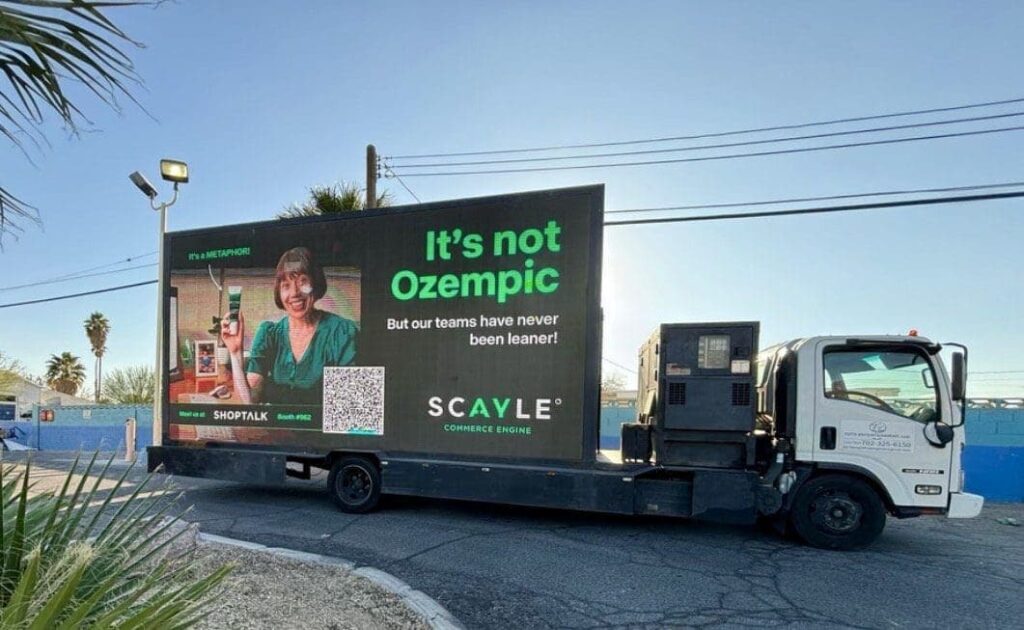
LED-Integrated Custom Activation Truck
Combining a full LED display with a custom activation buildout gives you a vehicle that functions as both a media unit and a consumer engagement platform. The LED panels cover the exterior while the interior or deployable activation area serves as the physical experience zone. These are typically the highest-cost builds, starting around $150,000 for a moderate-scale configuration and scaling to $300,000 or more for premium builds with full LED coverage and high-finish interiors.
Field note: The most common mistake we see in custom vehicle planning is scoping the build for the best-case scenario and then operating it in every scenario. A vehicle designed to deploy its side panels and activation area needs a parking space large enough to accommodate the full deployed footprint. Many street locations do not have that clearance. Design for the locations you will actually use, not the idealized photo shoot setup.
Planning the Deployment: How We Use Custom Vehicles in the Field
The build is only one part of the investment. How the vehicle gets deployed determines whether the build cost translates into campaign results.
We plan deployments around event calendars, foot traffic windows, and neighborhood character. A custom sampling truck deployed on the west side of Central Park at the 72nd Street entrance on a Saturday morning in June is positioned in front of exactly the foot traffic a lifestyle brand wants to reach. The same truck parked in a low-traffic commercial district on a Tuesday afternoon generates a fraction of the exposure.
We document every deployment with GPS logs, field photography, estimated impression counts, and consumer contact records. For campaigns with sampling or interactive elements, we track engagement counts per stop and per day. This data informs both real-time routing decisions and post-campaign analysis.
The content opportunity is significant with custom vehicles. A well-designed custom marketing vehicle is inherently photogenic, and we treat every deployment as both a consumer engagement opportunity and a content production session. The footage and photography captured at deployments become campaign assets that extend the reach of the vehicle beyond the physical exposures it generates on the street.
Deployment insight: We have found that the most effective custom vehicle deployments happen during two-hour windows at peak foot traffic moments, rather than all-day parked deployments. Moving through high-traffic areas for two hours before an event and then parking for a two-hour activation window often generates more total consumer contacts than a full six-hour static deployment at a single location.
Who Uses Custom Mobile Marketing Vehicles
The brands that get the most out of custom mobile marketing vehicles share a few common characteristics. They have a product or experience that benefits from direct consumer interaction. They are launching in a new market or introducing a new product where street-level awareness matters. And they have a budget that supports both the build cost and the operational costs of running the vehicle across multiple markets or for an extended campaign window.
Consumer packaged goods brands use custom vehicles for product launches and sampling campaigns. Automotive brands use them for test drive programs and vehicle reveals. Tech companies use them for product demonstrations. Entertainment properties use them for film and show premieres. Sports leagues and teams use them for fan engagement activations around major games and events. Beverage brands use them for bar and retail trade marketing programs.
The common thread is a need for direct consumer contact at scale, in specific markets, with a physical brand environment that can be deployed repeatedly.
Staffing and Operating a Custom Mobile Marketing Vehicle
A custom vehicle does not run itself. The team that operates it determines how well the campaign performs at the street level. We staff custom vehicle campaigns with a driver, a team lead who manages the activation and consumer interactions, and a content creator who captures photo and video at every stop. For vehicles with complex deployable elements, a focused setup and breakdown crew member is also necessary.
The team lead is the most critical hire. This person manages the consumer-facing activation, briefs the supporting team at each stop, handles any issues that arise in the field, and communicates with the central campaign team throughout the day. A strong team lead running a modest vehicle can outperform a weak team lead running a premium build. We have seen this pattern consistently across campaigns.
Training matters. Every team member who operates the vehicle or runs the activation needs to understand the brand, the product, and the specific interaction goals of the campaign before the first deployment. We run pre-campaign brand briefings for all staff and conduct a dry run deployment before the campaign launch to catch operational issues in a low-stakes environment. A dry run that reveals a setup problem is a success. The same problem discovered during a live deployment is a failure.
Calculating the ROI of a Custom Mobile Marketing Vehicle Campaign
Custom vehicle builds require a larger upfront investment than most other campaign formats. Understanding how to evaluate that investment against campaign returns helps brands make sound decisions about whether a vehicle build is the right choice for their specific situation.
The first ROI calculation is exposures-based. A custom vehicle deployed for eight hours in a dense urban market on a high-traffic route generates anywhere from 30,000 to 150,000 vehicle and pedestrian exposures per day, depending on the specific market and route. At a campaign rate of $3,000 per day in operating costs (crew, fuel, logistics), the cost per thousand exposures runs between $20 and $100. Compared to transit advertising at $15 to $40 CPM or digital display at $5 to $20 CPM, the vehicle’s street-level exposures are somewhat more expensive per impression. But they are also significantly more memorable. Studies on attention and recall consistently find that three-dimensional, physical brand encounters produce 2 to 5 times higher recall than equivalent passive advertising exposures.
The second ROI calculation is direct engagement-based. A sampling vehicle that distributes 500 product samples per day and achieves a 15 percent trial-to-purchase conversion among recipients is generating 75 direct sales per day from the sampling interaction. If the product sells at $25 and has a margin of 60 percent, each day of sampling generates $1,125 in direct margin contribution. At a campaign operating cost of $3,000 per day, the direct contribution does not cover the operating cost. But the conversion model does not account for repeat purchase, word of mouth, or the long-term customer acquisition value of a converted trialer. When those factors are included, the economics of sampling campaigns via custom vehicles are strongly positive for most consumer goods brands.
The third ROI calculation is content-based. A custom vehicle that generates high-quality social content assets over a multi-week campaign gives the brand video and photography that it would otherwise need to produce through a separate content shoot. That content has market value beyond the campaign itself. When that saved content production cost is subtracted from the vehicle campaign total, the effective cost of the campaign decreases meaningfully.
Renting vs. Building a Custom Vehicle
Custom vehicles can be rented from experiential marketing companies and event production specialists. Renting gives you access to a pre-built vehicle without the capital investment. The trade-off is that the vehicle was not designed specifically for your campaign. The existing configuration may need modification to match your brand’s requirements, and modifications to a rented vehicle are typically limited.
Building your own vehicle makes sense when the campaign is long enough and frequent enough to justify the capital cost, or when your brand’s specific requirements cannot be met by available rental inventory. We help clients evaluate this trade-off based on their campaign calendar and deployment frequency.
Frequently Asked Questions
How long does it take to build a custom mobile marketing vehicle?
Build timelines range from 2 to 4 weeks for a wrapped box truck with interior setup to 10 to 20 weeks for a premium trailer or double-decker build.
What is the minimum campaign length that justifies a custom vehicle build?
For a $40,000 to $90,000 build, we recommend a minimum 4-week campaign across two to three markets. Shorter campaigns are better served by renting existing inventory.