Convention Center Marketing | Field Campaigns at Major Convention Centers | AGM
The convention center is the physical anchor of any major event. Tens of thousands of professional attendees move through its surrounding district every day of the event: from hotels to the venue in the morning, between breakout locations at midday, from the venue to restaurants and bars in the evening. This movement creates a defined, concentrated, repeating audience flow through the public spaces around the building. Convention center marketing that operates in those spaces reaches the audience outside the official perimeter, where almost no other brand is competing for attention. At American Guerrilla Marketing, based in Industry City in Brooklyn, we build convention center marketing programs in the surrounding district at major venues across the country. Contact us at [email protected] or call (646) 776-2770.
The Convention Center District as a Marketing Environment
Understanding why convention center marketing outside the hall works requires understanding how convention center districts function during major events. The convention center itself is the official event environment: everything inside is managed, branded, and sold by the event organizers. The district surrounding it is a different environment: public streets, hotel lobbies, restaurant corridors, pedestrian crosswalks, and outdoor surfaces that are open to any brand willing to plan and execute a field campaign in that space.
During a major event, the convention center district becomes a temporary high-density audience environment. A convention center that normally sits in a relatively standard commercial neighborhood becomes, for three or four days, a location through which tens of thousands of professional decision-makers move on predictable schedules through predictable routes. The morning arrival window from 7:30 to 10:00 AM is the highest-density period, with the full incoming attendee population concentrated on the approach routes from the hotel cluster to the venue entrance. This is the window when outdoor advertising in the convention center district creates the most audience exposure per hour of deployment.
Convention Center Marketing Formats and Positions
Mobile Billboards on Convention Approach Routes
Mobile billboard trucks, particularly full-color LED displays, on the primary pedestrian and vehicular approach routes to the convention center during the morning arrival window create the highest-impact brand presence available in the convention center district. An LED truck positioned at the primary pedestrian crosswalk from the main conference hotel to the convention center entrance, running from 7:30 to 10:00 AM on each event day, delivers the full incoming attendee population to a full-motion brand display that is impossible to miss at point-blank street level.
Mobile billboard routing for convention center marketing considers both the primary pedestrian corridors and the vehicular routes used by taxi and rideshare arrivals, which often diverge from the walking routes. Full-day deployments that cycle between the morning pedestrian approach, the afternoon break period foot traffic, and the evening departure routes maximize the daily audience reach of the format across the full event schedule.
Poster Campaigns in the Convention District
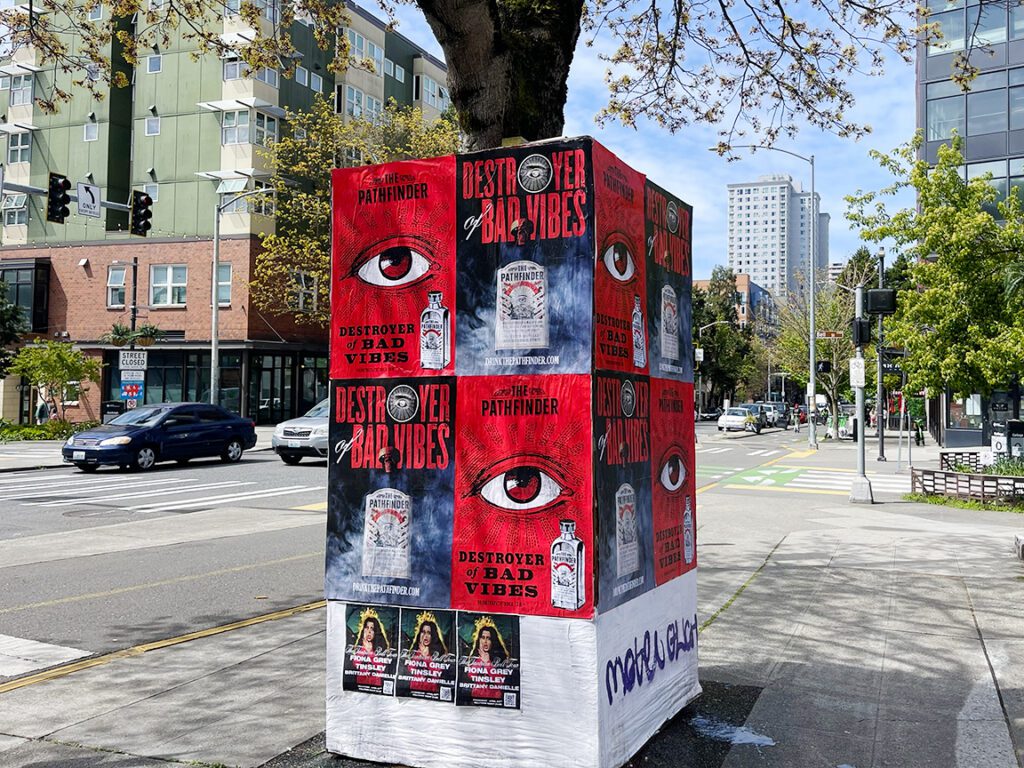
Poster campaigns on approved surfaces in the blocks surrounding the convention center create persistent visual presence that accumulates over the full event duration. A poster installed the evening before the event opens is seen by every attendee who walks past that surface every day of the event. For a four-day convention, an attendee staying at a hotel on the same route may encounter the same poster eight to twelve times across the event, creating a frequency of exposure that no temporary single-deployment format can match.
Convention district poster campaigns are installed on approved walls, construction hoardings, and other approved surfaces in the blocks surrounding the convention center. Installation is photographed before and after. Posters are maintained throughout the event and removed or left according to the installation surface agreement. Campaign documentation includes placement photos, geo-tags, and post-campaign removal or expiration confirmation.
Sidewalk Stencils at Convention Center Entrances
Sidewalk stencils applied at the primary entrance crosswalks and pedestrian bottlenecks of the convention center create ground-level brand presence that reaches every single attendee who uses those approach routes. Applied with water-soluble compounds in the early morning before the event opens, documented with field photos, and washed away cleanly after the final session. The ground position is distinctive because it cannot be avoided: every person who walks through that crosswalk encounters it, regardless of whether they look at the billboard truck or notice the wall poster.
Ambassador Teams in the Hotel Zone
Ambassador teams in the hotel zone during morning departure create the qualifying interactions that outdoor advertising cannot generate. A team of four well-briefed ambassadors in the primary conference hotel lobby during the 7:30 to 9:30 AM departure window can generate 80 to 120 qualified contacts per shift in the highest-quality audience environment available in the convention center district. Every shift is documented with structured interaction logs.
Building a Convention Center Marketing Program
Convention center marketing programs begin with a geographic analysis of the specific convention center and the event it is hosting. We map the hotel cluster locations relative to the venue, the primary pedestrian approach routes, the key intersections and bottleneck positions, the available surfaces for poster installation in the surrounding blocks, and the evening social geography for projection campaigns. This mapping is the foundation for the deployment plan.
Site-approval planning follows the geographic analysis. Each tactical element in the convention center marketing program requires specific site approvals that depend on the host city, the specific surfaces or positions involved, and the planned execution approach. We manage site-approval planning as a core part of every program, starting the process early enough that all approvals are in place before the event opens. Site-approval timelines vary by market and by tactic; this is why programs require six to twelve weeks of lead time.
Creative development for convention center marketing is built around a message that is specific to the professional audience at the specific event. The convention center district is not a mass consumer environment where broad brand awareness messages generate value. It is a professional conference environment where specificity to the audience’s industry context and professional role is the variable that determines whether a campaign earns attention or gets ignored.
Convention Center Marketing for Non-Exhibiting Brands
Convention center marketing in the surrounding district requires no official relationship to the event. Any brand can execute a convention center marketing program in the public spaces around the venue during an event. Non-exhibiting brands use this to reach conference audiences without the cost of floor space, official sponsorship, or any other official event participation expense.
The call to action for non-exhibiting brand convention center marketing programs directs attendees to a meeting link, an off-site event in a nearby hotel or restaurant, a product demonstration at a suite in the conference hotel, or any other destination that serves the brand’s conference strategy. All outdoor advertising and ambassador tactics are available to non-exhibiting brands in the public spaces of the convention center district.
Understanding the Convention Center District During Major Events
The convention center district during a major event is a temporary marketing environment with characteristics that make it unlike any permanent urban advertising location. In normal conditions, the streets and spaces around a convention center are a standard commercial district with diverse, dispersed foot traffic. During a major event, those same streets become a concentrated channel of the entire target audience moving through a defined geography on a predictable schedule for three to five days.
That transformation creates the strategic opportunity that convention center marketing exploits. The same outdoor surfaces and positions that generate modest general audience exposure during normal conditions generate highly targeted professional audience exposure during an event. The same hotel lobby that normally sees a mixed general public clientele becomes a concentrated professional audience gathering point during the event. The same corner intersection that normally sees diverse pedestrian traffic becomes the convergence point of the entire incoming attendee population during the morning arrival window of a major convention.
Convention center marketing programs that are designed with this transformation in mind allocate resources to the positions and timing windows where the audience concentration is highest during the event, not where general foot traffic is highest in the location’s normal condition. The morning arrival window at the primary pedestrian bottleneck between the hotel cluster and the convention center entrance is worth more during the convention than any permanent outdoor advertising position in the same geography is worth on a normal business day. Understanding this is the foundation of effective convention center marketing planning.
Convention Center Marketing for Brand Launches and New Market Entry
Convention center marketing programs are particularly valuable for brands launching new products or entering new professional markets. A product launch at a major industry convention typically involves significant investment in the official event environment: booth construction, show floor demonstrations, official advertising inventory, hospitality events. Convention center marketing in the surrounding district adds the pre-floor awareness layer that makes all of those official event investments more productive.
An attendee who has seen the new product’s billboard on the convention approach route before entering the hall arrives at the official launch booth with prior awareness of the product name and a rough sense of the category claim. That prior awareness means the booth team can skip the introduction phase and move directly to the demonstration or the qualifying conversation. The time saved per visitor translates directly into more visitors processed per show day and a higher proportion of qualified conversations in the total booth traffic.
For brands entering a new professional market where they are not yet well known to the conference audience, convention center district marketing creates initial awareness in the professional community that official event marketing alone cannot efficiently generate. The combination of outdoor advertising visibility in the district and direct ambassador interactions in the hotel zone creates first exposures with the professional audience at scale before the booth team ever has a chance to engage them directly on the show floor.
Seasonal and Venue-Specific Considerations for Convention Center Marketing
Convention center marketing programs must account for venue-specific and seasonal conditions that affect outdoor advertising execution. Las Vegas conventions in the summer months require weather adaptations for outdoor ambassador and sampling deployments due to extreme heat. Chicago’s McCormick Place in winter requires different outdoor advertising approach than in summer given the pedestrian patterns in extreme cold. San Francisco’s Moscone Center district has specific surface availability and site-approval characteristics that differ from other West Coast markets. Orlando’s Orange County Convention Center has its own geography of hotel-to-venue pedestrian corridors along International Drive that require specific routing and position planning.
AGM accounts for venue-specific and seasonal conditions in every convention center marketing program. Programs at venues and in markets where we have prior operational history benefit from direct experience with those specific conditions. Programs at new venues include a geographic analysis phase that identifies the specific conditions that will affect outdoor advertising execution before the campaign plan is finalized. No convention center is the same as any other, and no convention season is the same as any other. Convention center marketing programs that treat all venues as interchangeable consistently underperform programs that are designed for the specific geography and conditions of the target venue and season.
Convention Center Marketing Measurement and Reporting
All convention center marketing programs we execute are documented with field photography, deployment logs, and interaction reports. QR codes on outdoor materials track scan volume and link to campaign-specific landing pages. Ambassador shift logs capture contact counts and qualifying interaction rates by position and shift. Post-campaign, all documentation is compiled into a performance report that covers the complete campaign activity and supports cost-per-contact and attribution analysis.
Format
Primary Metric
Documentation Type
LED Billboard Truck
Audience exposure by position
Timestamped route logs, field photos
Poster Campaign
Placement count, exposure duration
Installation photos, geo-tags, campaign duration
Sidewalk Stencil
Pedestrian traffic at placement position
Installation photos, foot traffic estimates
Ambassador Team
Contact count, qualifying rate
Structured shift logs
Projection
Surface coverage, deployment hours
Field photos, deployment logs
Convention Center Marketing and the Audience Decision Window
The most important concept in understanding why convention center marketing in the surrounding district works is the audience decision window. Every professional attendee at a major convention makes the decisions that determine their show floor behavior in a specific 90-minute to two-hour window each morning before the official event opens. During that window, in the hotel lobby and on the walk to the venue, the attendee is forming their floor visit plan, making scheduling decisions, and allocating the mental bandwidth that determines who they will seek out on the show floor.
Convention center marketing programs that reach the audience during this window operate at the moment of maximum influence. The same brand message that generates moderate attention at 2:00 PM on the show floor, surrounded by hundreds of competing exhibitor presentations, generates disproportionate attention at 8:00 AM in the hotel lobby during the quiet window before the floor opens. The ambient competition for attention is orders of magnitude lower. The audience’s receptiveness is orders of magnitude higher. Designing convention center marketing programs around the decision window means concentrating ambassador team positions, LED truck deployment timing, and handout material distribution in the 7:30 to 10:00 AM morning arrival window. The morning arrival window is not one of several equally valuable windows. It is the window with the most direct impact on show floor behavior.
Convention Center Marketing Program Continuity and Annual Investment
The most effective convention center marketing programs are not one-time campaigns. They are annual investments at the same events that build cumulative recognition in the professional community over time. A brand that runs a convention center marketing program at the same major industry event for three or four consecutive years builds a reputation in the professional community for consistent market presence, which is itself a brand signal that improves the reception of every individual campaign element.
The practical benefits of annual convention center marketing program continuity compound as well. The planning team accumulates institutional knowledge of the specific convention zone geography, the audience movement patterns, and the site-approval planning requirements for the specific market. Production timelines become more efficient as the process is repeated. Staffing quality improves as the agency develops a network of qualified ambassadors who have been successfully briefed for the specific professional audience at this show. Each successive program benefits from the documented performance data of all prior programs, allowing continuous optimization that a first-time program cannot access.
Annual convention center marketing programs are not necessarily larger than single-event programs. They are better calibrated, better staffed, and better positioned than single-event programs can be. The investment per program may actually decrease over multiple years as the planning efficiency improves, while the performance per program increases as the optimization compounds. For brands with consistent annual presence at major industry events, convention center marketing annual programs are one of the most efficient brand-building investments available in professional markets.
Ready to Launch Your Campaign?
What is convention center marketing outside the event?
Convention center marketing outside the event includes all brand campaigns deployed in the public spaces around the convention center during an event: outdoor advertising on approach routes, ambassador programs in hotel lobbies, poster campaigns in the surrounding district, sidewalk stencils at entrances, and any other branded presence that reaches the convention audience in the convention zone.
What convention centers does AGM work around?
AGM executes convention center marketing programs at all major convention centers in the United States, including the LVCC in Las Vegas, McCormick Place in Chicago, Moscone Center in San Francisco, Orange County Convention Center in Orlando, Javits Center in New York, and other major venues.
What formats are used in convention center marketing?
LED billboard trucks on convention approach routes, wheatpasted poster campaigns in the convention district, sidewalk stencils at venue entrances, brand ambassador teams in the hotel zone, product sampling at high-traffic positions, and projection advertising on convention center building surfaces at night.
How does convention center marketing reach non-exhibitors?
Non-exhibiting brands can run full convention center marketing programs in the public spaces around the venue without any official event relationship. The call to action directs attendees to off-site events, meeting links, or other brand destinations.
How is convention center marketing measured?
Through field photo documentation, QR scan tracking on outdoor materials, ambassador shift interaction logs, and post-campaign performance reporting compiled into a report delivered to the client.
What lead time is needed for convention center marketing?
Six to twelve weeks for multi-format programs at major convention centers. Single-format programs in markets with established AGM operational relationships may be possible in four to six weeks.
How does convention center marketing complement in-booth strategy?
Convention center marketing creates brand presence in the approach zone before attendees reach the show floor, so that in-booth encounters begin with existing brand recognition rather than a cold start. Pre-floor touchpoints increase dwell time and qualified lead conversion rates in the booth.
What is the typical cost of a convention center marketing program?
Costs vary based on format mix, event duration, market, and deployment scope. Contact AGM for a program-specific estimate after sharing the target convention center, event dates, and campaign objectives.
Convention center marketing in the surrounding district is a discipline that rewards planning investment and penalizes compressed timelines. The brands that run the best convention center marketing programs are the ones that begin planning early, develop their format mix and deployment strategy with the benefit of full site-approval options, and build their field teams with enough lead time to recruit and brief qualified candidates against the specific professional audience profile of the target show. The brands that start planning three weeks before the show open the conversation after most of their format options have already been foreclosed by site-approval timelines, surface availability constraints, and staffing lead times. The difference in program quality between these two planning approaches is significant and is directly reflected in the qualified contact outcomes that each approach produces.
AGM builds convention center marketing programs in the surrounding district at major events nationwide. The brands that run the most effective convention center marketing programs are the ones that start planning early, brief the agency with specificity about their professional audience and campaign objectives, and commit to measuring the program outcomes with the same rigor they apply to any other marketing investment. The ones that run the least effective programs are the ones that decide to add a convention zone component three weeks before the show opens, brief the agency without a clear call to action, and evaluate the program based on field team enthusiasm rather than documented qualified contact counts. The planning and measurement discipline is what separates the two outcomes. The investment in convention center marketing is not an alternative to in-hall marketing. It is the element that makes in-hall marketing more productive by creating awareness, recognition, and qualified intent before the show floor opens. For brands that have been exhibiting at major events without an outside-the-hall program, adding a convention center marketing component to the existing trade show budget almost always produces a measurable improvement in qualified lead counts and show floor encounter quality. Contact our team at [email protected] or call (646) 776-2770 to discuss what a convention center marketing program would look like for your next major event, and what it would take to build it in the time available before the show opens.
American Guerrilla Marketing is based in Industry City, Brooklyn. We build convention center marketing programs at major events nationwide. Contact us at [email protected] or call (646) 776-2770.
Convention center marketing in the surrounding district is one of the most consistently underutilized marketing investments available in professional B2B markets. The brands that discover it and invest in it with planning discipline and field team quality regularly report that it outperforms their expectations relative to the in-hall marketing investments they have been making for years at the same events. The discovery usually starts with a conversation. Contact us at [email protected] or call (646) 776-2770 to start that conversation for your next major event.