Chicago Marketing Company | Street-Level Campaigns That Work
We’ve run campaigns on the Mag Mile, in Wicker Park, along the Riverwalk, and in the neighborhoods the big agencies never bother with. This is what a Chicago marketing company looks like when it actually knows the city.
Chicago is not one city. It’s 77 neighborhoods with different cultures, different foot-traffic patterns, and different rules for what gets noticed and what gets ignored. A campaign that works on North Michigan Avenue does not automatically work in Logan Square. What works on Wabash near the L does not work the same way on Milwaukee Avenue in Bucktown. If your Chicago marketing company doesn’t know the difference, you’re spending money guessing.
We’re American Guerrilla Marketing. We run street-level campaigns in Chicago and across the country. We’ve scouted surfaces in the Loop, placed street teams along the Riverwalk, executed outdoor campaigns in Lincoln Park and Pilsen, and worked with brands doing activations around United Center and along the concert corridors feeding into Millennium Park. We know this city the way people who actually work in it do.
This guide is for brands trying to figure out what kind of Chicago marketing company they actually need. We’ll cover the formats we run, the neighborhoods where each format works best, how we approach campaign planning in this specific market, and what to expect from a realistic street-level campaign budget.
Why Chicago Requires a Different Approach Than Other Markets
Chicago’s physical layout shapes how outdoor marketing performs in ways that matter. The city’s grid is ruthlessly flat. Sightlines on major corridors like North Michigan Avenue, State Street, and Wacker Drive are long and open. That’s good for outdoor visibility. But the same physical openness means brands compete hard for attention because everything is visible at once. Standing out on the Mag Mile requires more than just being present.
The L changes everything too. Chicago’s elevated train system puts pedestrians in motion at specific street-level points that create natural concentration zones: Belmont, Clark and Division, Chicago and State, Lake and Wabash. These stops dump commuter traffic at predictable times into specific street corridors. If you know when and where those flows hit, you can place a street team or an outdoor installation with genuine precision. If you don’t, you’re guessing.
Weather is the other Chicago-specific variable. The city earns its winters honestly. February in Chicago means wind chill off the lake that limits how long people stand still on sidewalks. Campaign tactics that require sustained pedestrian engagement need to account for that. Summer on the other hand, particularly around the lakefront from Memorial Day through Labor Day, generates the kind of relaxed, slow-moving pedestrian behavior that’s ideal for experiential work and sampling campaigns. We build that seasonality into every Chicago campaign plan we write.
What We Run in Chicago: Our Core Format Stack
We operate across five primary format categories in Chicago. Each serves a different campaign goal, a different budget level, and a different type of audience interaction. The right mix depends on what you’re trying to do.
Street Team and Brand Ambassador Campaigns
Street teams are our most flexible Chicago format. Our crews work the city regularly. We know which corners and corridors have the volume and the demographics to justify deployment for a given brand. For a streetwear drop, we staff the blocks around Wicker Park and Milwaukee Avenue on release day. For a CPG product sampling push, we work the Riverwalk and Navy Pier on summer weekends. For a music act playing the United Center, we hit the transit corridors feeding the venue in the hours before showtime.
We don’t hand out flyers randomly. Every street team deployment starts with a conversation about target audience, target geography, and what the crew is there to do. Product samples, promotional cards, QR code activations, direct engagement conversations, we plan the crew brief before anyone hits a corner.
Outdoor Poster and Guerrilla Print Campaigns
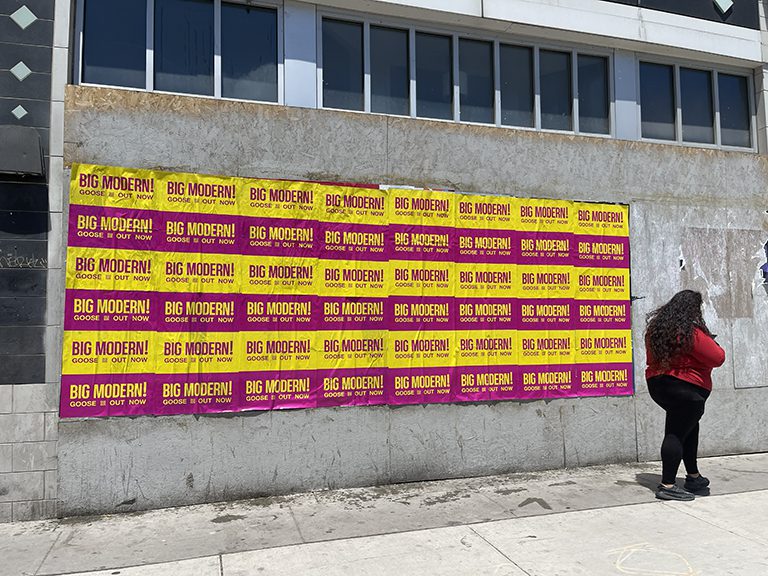
Poster campaigns in Chicago work best in the high-density residential and retail corridors: Wicker Park, Bucktown, Lincoln Park, Pilsen, and Logan Square. These neighborhoods have surface inventory that generates genuine visual concentration, the kind of clusters that turn a printed campaign into a real street presence rather than a scattered handful of placements.
We scout locations before we pitch them. What we’re looking for: high pedestrian flow, good sightlines, surfaces that hold prints cleanly, and proximity to the target audience’s natural movement patterns. On Damen Avenue between Milwaukee and North, you get a retail and dining corridor where a campaign placed with density reads like a cultural statement, more than advertising.
Stencil and Street Art Applications
Sidewalk stencil campaigns and reverse graffiti work in Chicago on the same principle as everywhere else: the surface conditions matter, the location matters, and the design needs to work at ground level. Chicago’s sidewalks in the Loop and on the Mag Mile carry enough accumulated surface depth to make reverse graffiti viable. The contrast between cleaned and uncleaned sections comes through sharply on the older concrete around the State and Lake L stop and on the approach pavement to United Center on event nights.
LED Truck and Mobile Billboard Campaigns
LED billboard trucks are an increasingly strong format in Chicago for specific campaign moments: album release weeks, product launch days, event dates. We run LED trucks on the circuit from the Loop along North Michigan Avenue, back through River North, and through the entertainment corridors in Wrigleyville on game days. The format is visible from a distance, can carry video creative, and the truck movement means the same vehicle covers multiple impression contexts in a single deployment day.
Experiential and Brand Activation
Larger brand activations in Chicago often anchor in Millennium Park, Navy Pier, or the plaza spaces around major Loop office towers. These locations have event infrastructure, pedestrian volume, and media adjacency that make them appropriate for the kind of live brand moment that generates content and press coverage alongside exposures. We handle site coordination, brand buildout, staffing, and documentation for activations in these spaces.
Chicago Neighborhoods: Which Format Works Where
Neighborhood
Best Formats
Why It Works
The Loop / Mag Mile
LED trucks, street teams, outdoor media
Highest foot count in the city; business and tourist mix
Wicker Park / Bucktown
Poster campaigns, street teams, stencils
Dense, walkable, culturally engaged audience; strong for fashion and music
Lincoln Park
Street teams, sampling, outdoor
Affluent residential and retail; strong for CPG and lifestyle brands
Pilsen / Bridgeport
Mural, stencil, poster campaigns
High street art density; receptive to visual brand work; growing demographics
Logan Square
Poster, street team, sampling
Young adult creative class; strong for tech, food/bev, entertainment brands
High dinner and nightlife traffic; premium demographic mix
Navy Pier / Lakefront
Sampling, experiential, street teams
Summer tourist volume; family and visitor demographics
Campaign Planning: How We Actually Build a Chicago Campaign
Every campaign we build starts with three questions. Who is the target audience? Where do they move in Chicago? What do we want them to do after the interaction?
The answers to those three questions determine everything else: which neighborhoods we work in, which formats we recommend, what the crew brief says, and how we measure the result. We don’t start with a format and then try to find a use case for it. We start with the campaign goal and work backward.
For a music label dropping an artist’s debut album during a tour date at the Chicago Theatre on North State Street, the plan looks like this: LED truck running State Street and Wabash on the two days before the show. Street team at the Chicago and State L stop during evening commute hours on show day, distributing physical promo cards with streaming links. A cluster of print placements in Wicker Park in the two weeks before the show targeting the audience that listens to this genre in the neighborhoods they live in.
For a CPG brand launching a new drink product with broader demo targeting, the plan shifts. Summer weekends on the Riverwalk, Navy Pier approach, and the lakefront paths north of Oak Street Beach. Product sampling crew with branded gear. Documentation of interactions for social content. A 30-day campaign window covering the peak summer traffic window from mid-June through mid-August.
The planning is specific because the city is specific. Generic campaign structures produce generic results.
Field note: Chicago’s lakefront and park system creates some of the highest-density recreational foot traffic in any American city during summer months. Brands that plan campaigns around the June-August Lakefront Festival calendar, from Taste of Chicago through Lollapalooza and the neighborhood festival circuit, can reach very large audiences with relatively modest field team deployments. We maintain a standing event calendar for Chicago and use it in every summer campaign plan we write.
Chicago Marketing Budget Ranges: What Different Spend Levels Get You
We don’t publish fixed rate cards because every campaign is different. But we can tell you what realistic budget ranges produce in the Chicago market.
Budget Range
What It Covers
Typical Duration
$3,000 – $7,500
Single neighborhood street team (1 day), poster campaign (25-50 placements), or sidewalk stencil activation
1-3 days
$7,500 – $20,000
Multi-neighborhood street team, moderate poster campaign citywide, or LED truck (1-2 days)
1-2 weeks
$20,000 – $50,000
Multi-format campaigns: street team + outdoor + LED truck, multi-neighborhood coverage, 3-4 week window
3-4 weeks
$50,000+
Full citywide campaign: all major neighborhoods, multiple formats, experiential components, full documentation
4-8 weeks
What Sets a Good Chicago Marketing Company Apart
The honest answer is field knowledge. Chicago is a city where the map is not enough. You need to know that the pedestrian flow on the east side of North Michigan Avenue runs heavier than the west side in the late afternoon because of the shadow from the Tribune Tower block. You need to know that Damen Avenue in Wicker Park has different foot traffic character on Thursday night versus Saturday afternoon, and that those differences matter for a street team deployment. You need to know that the blocks immediately south of Wrigley Field on Clark Street before a Cubs game are worth three times the foot count of anything a block east or west.
That knowledge comes from being in the market and running campaigns there, not from reading demographics reports. We’ve built it from working in Chicago consistently over time. It shows in the locations we recommend, the timing we propose, and the results we deliver.
The other factor is honesty about what works and what doesn’t. We’re not a company that sells you a format because it looks exciting in a deck. We tell you if a format doesn’t fit your campaign goal or your budget. We’d rather work on a tighter project that produces real results than an inflated scope that produces a document trail and a disappointing outcome.
Our approach: We scout every Chicago location before it goes into a campaign proposal. We’re not recommending corners we haven’t stood on. When we tell you a specific block on North Damen Avenue is right for your poster campaign, we’re telling you because we’ve been there, counted the foot traffic, assessed the surface, and confirmed the sightlines. That’s the standard we hold ourselves to.
Our Chicago Campaign History
We’ve run campaigns for music labels timed to show dates at the Chicago Theatre and the Riviera. We’ve executed product launches for CPG brands targeting the city’s young professional demographic in Lincoln Park and River North. We’ve supported fashion and streetwear brands with poster and street team campaigns in Wicker Park and Bucktown. We’ve placed LED trucks on North Michigan Avenue for entertainment clients doing Chicago-specific pushes during album release weeks.
We don’t name clients publicly unless they’ve given us clearance to do so, but we’re happy to discuss campaign types and outcomes in a direct conversation. Our portfolio is the real thing: real campaigns, real locations, real results, not case study documents built to impress pitch decks.
Chicago Seasons and What They Mean for Street Marketing
Chicago marketing has a hard seasonality that most people who haven’t run campaigns here underestimate. The city’s outdoor street-level formats work across different windows depending on the time of year, and ignoring this produces campaigns that launch at the wrong moment for the audience and the environment.
April through October is the core outdoor campaign season. This is when pedestrian activity on Chicago’s commercial strips is at its highest. Street teams, poster campaigns, chalk stencil work, and sidewalk activations all perform best during this window. Lollapalooza in late July, Taste of Chicago in early July, and the city’s dense neighborhood street festival calendar in June, July, and August all create concentrated audience opportunities within this outdoor season.
November through March is the indoor and transit-focused window. Chicago winters limit outdoor pedestrian activity significantly. The consumer retreats indoors. Effective winter marketing in Chicago leans into indoor venues, transit advertising, and digital campaigns that meet the consumer where they actually are during cold months. Attempting to run the same street team or outdoor poster strategy in February that you ran in August is a waste of money. The audience is not there in the same volume or the same mindset.
The spring and fall shoulder seasons, March to April and September to October, are transition windows where outdoor campaigns can begin or extend with careful attention to timing. Early April in Chicago can still see late-season cold, and a campaign that launches before the outdoor foot traffic fully returns will underperform relative to the same campaign launched two weeks later.
We plan all Chicago campaigns around this seasonal reality. It is one of the most important market-specific factors that separates effective Chicago marketing from generic national campaigns applied without local knowledge.
Street-Level Marketing in Chicago: The Neighborhood Intelligence Advantage
Every well-executed Chicago campaign starts with the same foundation: genuine knowledge of how specific neighborhoods function as marketing environments. This knowledge cannot be acquired from demographic data alone. It comes from actual field presence: knowing that the lunch window on North Michigan Avenue produces different foot traffic than the same window on South Michigan Avenue, knowing that Wicker Park’s weekend afternoon traffic peaks differently than its Thursday evening foot traffic, knowing which specific blocks in the West Loop produce the highest density of Amazon and tech worker engagement during the midday hours.
This is what separates Chicago marketing companies and agencies that have done real work in the city from those that plan Chicago campaigns the same way they plan campaigns in other markets: by applying generic foot traffic models and demographic averages to a city whose neighborhood-by-neighborhood reality does not match the averages. Chicago is a city of specific neighborhoods with specific cultures, and the brands that win in Chicago are the ones that respect that specificity in every format they run.
The intelligence advantage also applies to Chicago’s events calendar. The Taste of Chicago in Grant Park brings one million people over five days in July. Lollapalooza in August adds 100,000 per day to Grant Park and the surrounding neighborhoods for a four-day window. The Chicago Jazz Festival, the Chicago Blues Festival, and the Chicago Gospel Music Festival each concentrate specific demographic audiences at the lakefront in specific summer weekends. The Milwaukee Avenue Arts Festival, the Wicker Park Fest, and the Logan Square Farmers Market each create neighborhood-level concentration moments that savvy brands use as anchors for activation work. Knowing these calendar moments and having the operational capability to deploy into them is the difference between a reactive Chicago presence and a proactive one.
Physical marketing in Chicago also benefits from the city’s strong neighborhood identity culture. When a brand activates in Pilsen with a mural that references the neighborhood’s mural tradition, or runs a street team in Boystown with creative that acknowledges the neighborhood’s LGBTQ culture, or shows up in Hyde Park with an activation that engages the university community’s intellectual character, it is telling the neighborhood: we know you, specifically. That specific knowledge is received as respect, and it earns a quality of brand engagement that generic campaigns cannot achieve regardless of budget.
The practical implication for brands is that investing in physical marketing in Chicago is not just about the direct contact numbers a campaign generates. It is about building the kind of brand familiarity that makes Chicago consumers, who are sophisticated, locally loyal, and skeptical of brands that show up without understanding where they have landed, feel that the brand understands their city. That feeling is the foundation of brand trust in Chicago’s market, and it is built through consistent physical presence in the right places over time rather than through a single large campaign that appears and disappears.
Campaign Architect — American Guerrilla Marketing
Frequently Asked Questions
What types of marketing campaigns does AGM run in Chicago?
We run street team and brand ambassador campaigns, guerrilla poster campaigns, sidewalk stencil and reverse graffiti installations, LED truck and mobile billboard campaigns, and experiential brand activations. We recommend a format mix based on your campaign goal and budget, not on what’s easiest to
Which Chicago neighborhoods do you work in?
We work citywide. Our most frequent Chicago territories include the Loop, River North, North Michigan Avenue, Wicker Park, Bucktown, Lincoln Park, Logan Square, Pilsen, and the lakefront corridor. We also work event-specific locations around United Center, Wrigley Field, and the Chicago Theatre dist
How far in advance do I need to book a Chicago campaign?
For a standard street team or poster campaign, two to three weeks of lead time is workable. For LED truck campaigns or experiential activations with site coordination, four to six weeks is more appropriate. Event-adjacent campaigns around major Chicago dates book faster, so earlier notice helps on t
What’s the minimum budget for a Chicago street marketing campaign?
Meaningful single-format campaigns in Chicago typically start around $3,000 to $5,000. Below that threshold, the scope becomes too limited to generate real impression volume. We’re happy to tell you honestly if a budget won’t produce the outcome you’re looking for.