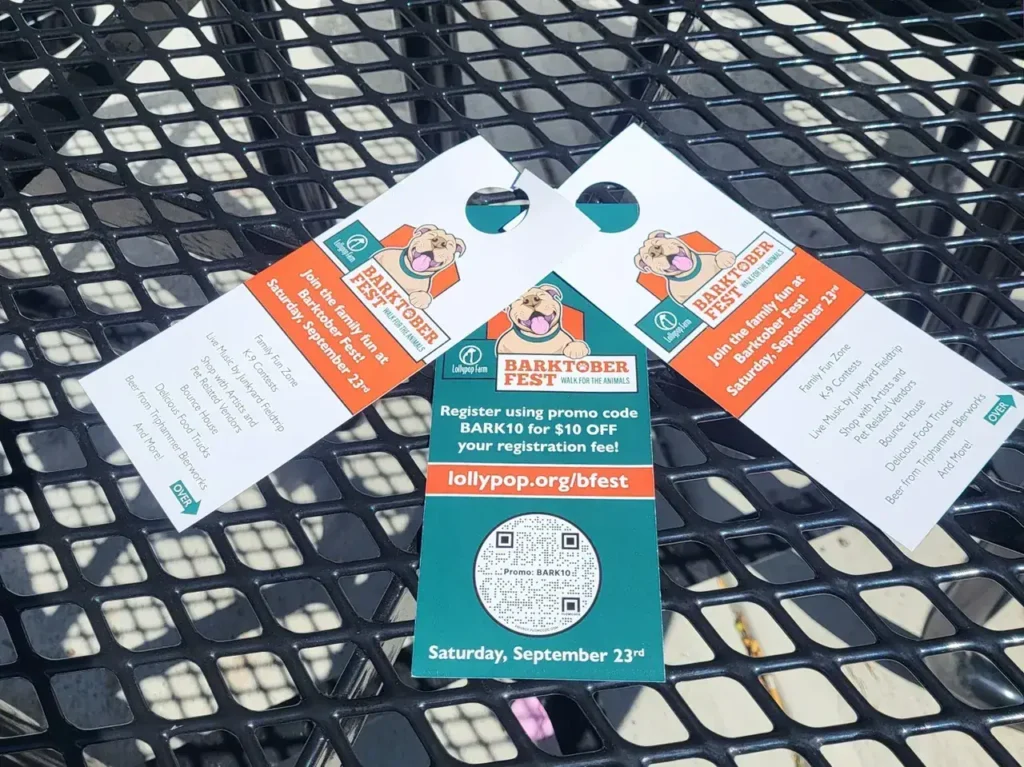
Door hanger advertising delivers a physical marketing message directly to a specific address, no inbox to compete with, no algorithm filtering your reach. A door hanger placed on a residential doorknob gets picked up by virtually every person who enters that home. We’ve run door hanger distribution campaigns for service businesses, restaurants, real estate professionals, and consumer brands across Florida, New York, California, and throughout the Southeast, and when the targeting is right and the design is executed well, the format consistently delivers response rates that outperform digital direct response at comparable cost-per-impression.
Why Door Hanger Marketing Works in 2026
Digital saturation has created an unexpected opportunity for physical direct marketing. The average American adult receives hundreds of digital ads per day and has developed sophisticated filtering mechanisms, ad blockers, scroll behavior, inbox rules, that deflect most of that volume before it’s consciously processed. A door hanger placed on a residential doorknob encounters none of those filters. It must be physically picked up, and it’s visible at the exact moment of home arrival when the recipient’s attention is transitioning from outside to inside.
Response rates for well-targeted door hanger campaigns in relevant categories (home services, food delivery, local retail, healthcare services) consistently run 1–5% per distribution run, significantly higher than typical digital display response rates for cold audiences. The key phrase is “well-targeted”: blanket distribution without audience relevance performs much worse than targeted drops in neighborhoods with high concentrations of your actual customer profile.
Door Hanger Printing: What It Costs in 2026
Door hanger printing is genuinely cost-effective at the standard quantities used for neighborhood campaigns:
| Quantity |
Standard 4.25×11″ (full color, both sides) |
Cost Per Piece |
| 500 pieces |
$75–$120 |
$0.15–$0.24 |
| 1,000 pieces |
$100–$160 |
$0.10–$0.16 |
| 2,500 pieces |
$175–$280 |
$0.07–$0.11 |
| 5,000 pieces |
$280–$450 |
$0.056–$0.09 |
| 10,000 pieces |
$450–$700 |
$0.045–$0.07 |
Standard door hanger dimensions are 4.25×11 inches with a die-cut hole punch at the top. 14pt cardstock with UV coating on the front face is the standard substrate for outdoor durability. Rush production (2–3 business days) typically adds 15–25% to base printing costs. Standard turnaround is 5–7 business days from art approval.
Distribution Costs
Printing is the smaller cost component for most door hanger campaigns. Distribution, the labor of physically hanging thousands of pieces on residential doorknobs, is where budgets are most often underestimated.
- Professional distribution crews: $35–$60 per hour per crew member, or $25–$50 per 1,000 units distributed depending on neighborhood density and accessibility
- Urban dense neighborhoods (apartment buildings, row homes): Faster per-hour distribution due to close proximity; 500–800 units per crew member per hour
- Suburban neighborhoods (single-family homes with significant walking distances): Slower distribution; 150–300 units per crew member per hour
- GPS-tracked distribution: Add $5–$15 per 1,000 units for GPS verification showing that each address was actually visited
A typical 5,000-piece distribution in a suburban neighborhood requires 2–3 crew members over a full day. Total distribution cost for that campaign runs $400–$900. Combined with printing, a 5,000-piece campaign with professional distribution typically costs $700–$1,400 all-in, roughly $0.14–$0.28 per household reached.
Designing Door Hangers That Drive Response
The Doorknob Position Determines the Design
Door hangers are read from the top down, the die-cut hole goes over the doorknob, and the reader sees the top third of the hanger first before the middle and bottom sections. Your strongest message, biggest headline, and most compelling visual must occupy the top third. An offer that appears at the bottom of the door hanger after three paragraphs of body copy will get skipped by most recipients who glance at the top section and set the piece aside.
One Offer, One Call to Action
Door hangers that try to communicate multiple offers, multiple phone numbers, multiple social handles, and a website URL communicate nothing clearly. The most effective door hangers have a single compelling offer (a specific discount, a free consultation, a limited-time promotion) and a single primary call to action (call this number, visit this URL, bring this in). Everything else is secondary and can appear in smaller type if needed, but the primary message must be impossible to miss.
Make the Offer Time-Limited
Door hangers without urgency mechanics sit on countertops and get thrown away without action. “Call anytime” generates far fewer responses than “Call before July 31 for 20% off.” A specific expiration date creates the decision pressure that converts casual interest into actual contact. The expiration should be genuine, extending it indefinitely defeats the purpose.
Targeting Door Hanger Campaigns Effectively
The most common door hanger mistake is untargeted mass distribution in a geographic area without regard for audience relevance. A lawn care company distributing door hangers in apartment complexes with no yards is generating zero-ROI impressions. A high-end kitchen remodeling company distributing in a neighborhood with median home values well below their project minimums is wasting every piece.
Effective targeting uses a combination of:
- Housing type selection: Single-family homes vs. apartments vs. condos, choose based on which housing type your customer actually lives in
- Neighborhood income data: USPS Every Door Direct Mail (EDDM) tools allow selection of carrier routes by median household income, average home value, and demographic density
- Distance from your location: Service businesses with geographic coverage limits should restrict distribution to routes within their actual service radius
- Competitive proximity: Distributing near your own locations and away from competitor-dense areas increases relevance
AGM’s Door Hanger Services in Florida and Beyond
American Guerrilla Marketing runs door hanger distribution campaigns throughout Florida, Miami-Dade, Broward, Palm Beach, Orange, Hillsborough, Duval, and other counties, as well as in markets throughout the Northeast, Southeast, and Midwest. We handle printing coordination, targeted route selection using EDDM mapping tools, GPS-tracked professional distribution, and photo documentation of campaign execution.
Our door hanger campaigns are coordinated with larger guerrilla and OOH initiatives for clients running multi-format local campaigns. A door hanger distribution in a specific neighborhood combined with sidewalk stenciling on the commercial corridors nearby and LED truck coverage of the major arterials creates layered local saturation that significantly outperforms any single format alone.
Neighborhood Selection: Where Door Hangers Actually Pull
Cheap printing is not the real lever in a door hanger campaign. Neighborhood selection is. A lawn-care company does not need 10,000 mixed addresses across an entire metro; it needs the 2,500 addresses most likely to own a yard, have the budget for recurring service, and sit within a service radius that keeps crews profitable. We map campaigns by housing stock, home value bands, route density, and distance from the advertiser’s location. That targeting work is what makes a 2,500-piece campaign outperform a sloppy 10,000-piece drop.
For restaurants, the targeting logic is different. The strongest routes are usually dense single-family blocks and apartment communities inside a 1.5–3 mile delivery radius, especially those with weak direct line-of-sight visibility to the storefront itself. For med spas, dentists, and home services, the right routes are usually owner-occupied neighborhoods with household income high enough to match the service price point. A badly chosen route wastes every penny of the print budget.
Operational Reality: How Distribution Gets Managed
Professional distribution matters more than most owners expect. In suburban neighborhoods, one crew member may only cover 150–300 homes per hour because of walking distance, setbacks, gates, and cul-de-sacs. In denser townhome or apartment environments, that number can rise to 500–800 units per hour. We plan crews based on actual neighborhood form, not just unit count.
We also recommend GPS verification on any campaign large enough to matter. Clients should not have to guess whether the full route was actually completed. GPS logs, timestamped route images, and a simple completion report make the campaign defensible internally and repeatable when the results are good.
Door Hanger Offer Structures That Convert
The strongest offers are specific and time-bound: 20% off first cleaning, free estimate plus same-week scheduling priority, buy-one-get-one meal offer valid through Sunday, or seasonal service bundles with a clear expiration date. Vague “call today” messaging underperforms because it gives the household no reason to act now. We advise clients to match the offer to the purchase cycle of the category, immediate for restaurants, short-window for service quotes, and slightly longer for considered purchases.
Extended FAQ
Should I use glossy or matte door hangers?
Glossy or UV-coated stock usually performs better for outdoor durability, especially in humid or rainy markets. Matte can look more premium in boutique categories, but it scuffs and absorbs moisture more easily.
Can AGM print and distribute nationally?
Yes. We coordinate printing, route selection, and distribution in major US markets and many secondary markets through local field networks and print partners.
How often should I repeat a door hanger campaign?
For local awareness, one distribution rarely does enough. Most service brands benefit from 2–4 repeated drops into the same routes over 60–120 days because repetition is what turns awareness into action.
Creative Layout Rules for Door Hangers
The top third of the hanger does almost all the work. That is the part a homeowner sees first when the piece is hanging on a doorknob. We recommend putting the strongest headline, one clear visual, and the core offer in that zone. The middle third should explain why the offer matters. The bottom third should hold contact information, code, QR, or booking instructions. When advertisers reverse this and bury the offer near the bottom, response rates suffer because many recipients never get far enough into the piece to understand what is being offered.
We also recommend one offer and one CTA. If the hanger tries to sell six services at once, it usually sells none. The businesses that get the best results pick the one thing they most want the neighborhood to do: book a quote, scan a code, call before Friday, or bring the hanger into the store. Focus beats breadth every time in this format.
Florida, Texas, and Northeast Distribution Differences
Door hanger logistics change by region. In Florida, humidity and rain make UV coating worth the added cost. In Texas suburbs, route efficiency matters because block lengths and driveways reduce units-per-hour sharply in some neighborhoods. In the Northeast, multifamily housing and tight street grids can make dense apartment or rowhouse routes far more efficient than suburban detached-home drops. The same 5,000-piece budget behaves differently in Miami, Dallas, and Long Island. Good planning adapts the route strategy to the built environment rather than treating distribution as a generic labor line.
AGM Pricing Snapshot
| Item |
Typical Range |
| Graphic setup / adaptation |
$150–$500 |
| 1,000 printed hangers |
$100–$160 |
| 5,000 printed hangers |
$280–$450 |
| Dense route distribution / 1,000 |
$35–$50 |
| Suburban route distribution / 1,000 |
$50–$70 |
| GPS verification / 1,000 |
$10–$20 |
Extended FAQ Continued
What size door hanger works best?
The standard 4.25×11 inch format is usually the best balance of cost, readability, and ease of distribution. Larger formats can feel more premium but cost more to print and are sometimes harder to keep stable on the doorknob.
Should a small business use a QR code?
Yes, if the landing page is mobile-ready and the offer is simple. QR works especially well for restaurants, booking-based services, and event promotions where the next action can happen immediately.
How do I know if the campaign paid back?
Track a unique code, phone number, or landing page. Door hanger campaigns are highly measurable when the response mechanism is isolated.
Frequently Asked Questions
Cheap Door Hanger Printing: A High-Impact Local Marketing Strategy generates better results when placement, timing, creative, and local execution all work together in California, Florida. These questions cover the details brands usually need before launch, during rollout, and while evaluating performance.
For door hanger in California, Florida, the strongest campaigns usually come from tight geographic targeting, message discipline, and enough repetition to be remembered. Market conditions, neighborhood flow, event calendars, commuter behavior, and production logistics all change how the tactic performs, so the planning details matter as much as the idea.
Is door hanger advertising legal?
Yes, door hanger distribution on residential doorknobs is legal in virtually all US jurisdictions. Some municipalities have ordinances against placing materials in mailboxes (mailboxes are federal property under USPS rules) or leaving unsolicited materials inside screen doors or attached to private property beyond the doorknob. We review local ordinances before executing campaigns in any market.
How many door hangers should I print for a local campaign?
For a neighborhood launch, 2,500–5,000 pieces typically covers a meaningful geographic radius. For a city-wide saturation campaign, 25,000–100,000+ pieces across multiple carrier routes. Most new campaigns benefit from starting with a smaller test distribution (1,000–2,500 pieces) in the highest-relevance zone to validate response rates before committing to full-market volume.
What response rate should I expect?
Response rates for relevant, well-designed door hanger campaigns in appropriate neighborhoods typically run 0.5–3%. A 2,500-piece distribution with a 1% response rate generates 25 direct contacts, which in a high-ticket service business represents significant ROI on a $350–$600 total campaign cost.
How does AGM handle door hanger campaigns in Florida?
We coordinate printing, route selection using EDDM targeting tools, crew recruitment and training, GPS-tracked distribution, and photo documentation across Florida markets including Miami, Fort Lauderdale, West Palm Beach, Orlando, Tampa, Jacksonville, and surrounding areas. Contact us at americanguerrillamarketing.com/contact for a Florida-specific quote.
Can door hangers be combined with digital marketing?
Yes, and this combination significantly increases response rates. Geofencing the neighborhoods where you’re distributing door hangers and running mobile ads to devices in that area creates a physical-digital surround that exposes the same households to your message across multiple touchpoints. The combination consistently outperforms either channel alone in our campaign data. Cheap Door Hanger Printing: A High-Impact Local Marketing Strategy becomes much stronger when the article moves past surface level advice and into route logic, timing, crew decisions, and what buyers should expect before launch. That is where most campaigns win or lose. Good ideas are common. Clean execution in the right place at the right time is not. In practice, the first move is narrowing the audience into a physical map. That means identifying the streets, retail corridors, campus edges, transit entrances, event approaches, or nightlife clusters where attention piles up. Once that map is clear, the next step is deciding which format fits the movement pattern. Posters work best where people have a second to read. Snipes work when repetition matters. Stencils and decals are strongest where pedestrians slow down, wait, or make a decision about where to go next. Teams that skip that planning step usually spend money on visibility without building enough repetition to create recall. Teams that plan carefully can get more from the same budget because they are buying concentration, not just volume. That is the real difference between activity and impact. Every market has its own map of useful surfaces and high value foot traffic. In downtown cores, the best routes are usually the blocks between transit stops and the place people are actually trying to reach. Around campuses, it is the edge streets, dorm approaches, coffee runs, late night food corridors, and the walk between parking and class. Around events, it is the window from arrival through line formation, then the exit path where people are still talking about what they just saw. That is why local detail matters so much. A good plan names corners, not just cities. It names venue approaches, not just districts. It defines morning traffic, lunch traffic, post game traffic, and late night traffic as separate moments because they behave differently. When brands treat all movement as one audience, the campaign gets blunt. When they map those flows correctly, the same media spend starts to feel much larger. AGM usually builds this out with a route first, then layers creative on top of it. That order protects the campaign from a common mistake: falling in love with the visual before making sure the audience can actually encounter it often enough to remember it. When a page like this feels light, the missing pieces are almost always the same. Add named locations, examples of which formats fit those locations, the quantity needed to make the campaign visible, and the operational limits that buyers should know before launch. Add a realistic budget section. Add a stronger FAQ that answers the practical objections a client will raise on the phone. Those additions do not pad the page. They make it useful. That is also where trust is built. Readers can tell when a page only gestures at a topic. They can also tell when the writer understands the field side of the job. Specifics about route density, production timing, weather risk, crew count, proof photos, QR tracking, and refresh windows make the content stronger because they come from real execution questions. If a brand is using this topic to compare partners, those specifics matter even more. They make it easier to judge whether a vendor is selling a real plan or just a good sounding idea. Pricing depends on format, timing, print specs, route length, and how many placements a campaign needs to make a real impression. For street level media, brands usually do better when they fund enough placements to own a specific route instead of buying a thin layer across too much ground. A small run can look busy in a deck and still disappear on the street. AGM publishes fixed pricing for several core services. 24×36 wheatpaste posters are $4,500 for 100 and $5,500 for 200. 48×72 wheatpaste posters are $10,500 for 100 and $13,500 for 200. 9×12 snipes are $4,500 for 400 and $5,500 for 800. 11×14 jumbo snipes are $6,500 for 400 and $7,500 for 800. Sidewalk stencils are $2,855 for 5, $3,231 for 10, $3,989 for 20, $6,982 for 50, and $11,999 for 100. Sidewalk decals are $2,904 for 5, $3,404 for 10, $4,998 for 20, $8,709 for 50, and $14,466 for 100. LED billboard trucks are $250 to $300 per hour with an 8-hour minimum. For any other quantity, market, or setup, contact AGM for pricing. If the project needs a custom mix, AGM usually points brands to the RFP Builder so scope, city count, and production details line up before pricing is locked. That matters because the wrong quantity is often more expensive than the right format. A cheap campaign that is too small to be seen is not efficient. It is just forgettable.
How do I know if this topic is worth turning into a real campaign?
Start with audience location, not creative ideas. If you can name the blocks, venues, campus gates, stations, or event windows where attention is concentrated, the campaign can usually be built into something measurable. If the audience is vague, the spend drifts and results get fuzzy fast.
What usually makes a street campaign feel too small?
The most common issue is spread. Brands buy a handful of placements across too many neighborhoods instead of owning one route. A tighter footprint with stronger repetition beats a scattered footprint almost every time, especially for event promotion, launches, and local service awareness.
Should the message focus on awareness or action?
That depends on the traffic environment. Fast moving traffic calls for a short awareness message with one visual anchor. Slow pedestrian traffic can support a QR code, a stronger offer, and more direct response copy. The format should match the pace of the audience, not the other way around.
How long should a campaign stay up?
For event driven pushes, the best window is often the 7 to 14 days before the date. For evergreen brand building, two to four weeks works better because repetition does the heavy lifting. Weather, removals, and local conditions still matter, so timing should always be part of the plan.
What should be tracked besides impressions?
Use QR scans, coupon redemptions, landing page traffic, geofenced audience lift, survey responses, and direct field photos. Street work is easier to defend when the campaign is built with proof from day one instead of trying to backfill measurement after the fact.
Related Pages and Articles