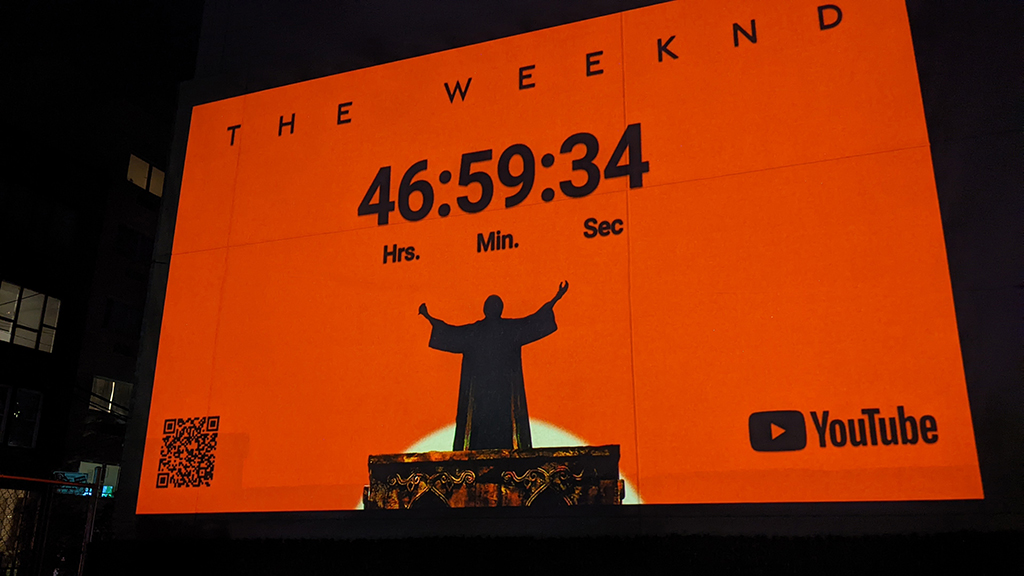
Building Projection Marketing: Case Studies and Best Practices
A building facade is the largest canvas in any city. Building projection lets brands claim that canvas for hours at a time, in neighborhoods their audience actually inhabits. Here is how we plan and execute campaigns that work.
Building projection is the practice of using high-lumen commercial projectors to place visual content directly onto the exterior surface of a building. The building becomes a temporary display surface. The projection is visible at night from significant distances, creates a visual presence that dwarfs any portable display format, and turns architecture that people walk past every day into something they stop to look at, photograph, and share.
We have executed building projection campaigns across New York, Los Angeles, Chicago, Miami, and other major US markets. The format is one of the most operationally demanding things we do, and it is also one of the most effective. When a building projection works, it works at a scale and with a visual authority that almost nothing else in the guerrilla marketing toolkit can match. When it does not work, it is usually because something in the planning or content production process was left to assumption rather than confirmed in field conditions. This guide covers both what makes building projection powerful and what it takes to execute it correctly.
We will walk through the mechanics of how building projection works, what building types and surfaces perform best, how to select locations that serve campaign objectives rather than just technical requirements, how to plan content for the format, and what the full campaign planning process looks like from initial brief to post-campaign documentation. We will also cover pricing, logistics, and how building projection fits within a broader guerrilla marketing campaign strategy.
A building projection uses a projector with sufficient lumen output to throw light onto a building surface at distance. The projector is positioned across the street, on a rooftop, in a van, or at another position that gives it a clear sightline to the target surface and the throw distance needed to fill the area of the facade. Content plays from a media server or laptop connected to the projector. A generator provides power where grid access is not available, which is the case for most street-level projector positions.
The key technical variables in any building projection are lumen output, throw distance, and surface quality. Lumen output determines how bright the projection appears at the target surface. Throw distance determines how large the projected image can be, based on the lens ratio in use. Surface quality, meaning the color, texture, and reflectivity of the building’s exterior material, determines how cleanly the projected image reads. All three variables interact, and miscalculating any of them produces a projection that underperforms relative to what field testing would have confirmed.
For a projector positioned 100 feet from a building, a 20,000-lumen unit can produce a bright, high-contrast projection on a light-colored concrete or stucco surface. For a building 200 feet away, or for a darker-colored surface, the same projector produces a noticeably dimmer result and a 40,000 or 60,000-lumen unit is required. These are not guesses we make from photographs. They are confirmed through site surveys conducted at the same hour and ambient light conditions as the campaign itself.
Building Types and Surface Characteristics
Not all buildings make equally good projection surfaces. Understanding what to look for in a building surface is one of the most important pieces of knowledge we apply in location scouting, because the right surface in the wrong neighborhood is less useful than a good surface in the right one, and a building in exactly the right neighborhood with a surface that cannot hold projection is a wasted opportunity.
Best Surface Types for Building Projection
Light-colored concrete, stucco, and painted brick are the best surface materials for building projection. They reflect light evenly, produce accurate color representation, and do not introduce unwanted texture into the projected image at the distances we typically work with. A smooth white or cream-colored concrete facade at 100 feet will produce a projection that looks close to the content as it appears on screen in production. That predictability is what allows us to spec content with confidence before the campaign night.
Painted brick and painted concrete with light neutral finishes also work well. The brick texture adds a subtle grain to the projection that does not distract from the brand imagery at street viewing distances. The texture becomes more apparent in close-up photography, which is worth factoring into content decisions if tight-crop photography is part of the campaign documentation plan.
Surfaces That Create Challenges
Dark-colored facades absorb rather than reflect light, requiring significantly higher lumen output to achieve adequate brightness. A dark gray or brown brick building at 150 feet requires substantially more projector power than a white concrete building at the same distance. Dark surfaces are workable but they increase equipment costs and in some cases produce results that are still less bright than a light surface with smaller equipment.
Buildings with heavy fenestration, meaning a high ratio of glass to solid facade, break up the projection surface and create visual gaps in the image. In some cases a highly glazed building can still work if the solid spandrel panels between windows are large enough to carry the core visual, but this requires careful content design that accounts for the window positions. Buildings with deep ornamental relief, projecting cornices, or structural elements that create significant shadow at street level can also interfere with projection clarity.
Location Selection Strategy
Location selection for building projection campaigns is a two-variable problem: the building surface must be technically suitable, and the location must be strategically relevant to the brand and campaign. We have seen campaigns waste strong projections on technically ideal buildings in neighborhoods where the target audience does not spend time. We have also seen campaigns succeed beyond expectations because the building choice was a precise strategic statement about the brand’s relationship to a specific neighborhood or cultural community. The best campaigns solve both variables at once.
High-Traffic Nighttime Locations
Building projection is a nighttime medium. The foot traffic and vehicle traffic patterns at night differ substantially from daytime patterns in most urban neighborhoods. A block that is quiet at 9pm may be highly active at 11pm, or vice versa. We scout locations at campaign operating hours rather than during the business day because daytime scouting produces inaccurate assessments of the actual campaign environment.
Restaurant and entertainment districts, nightlife corridors, event venue neighborhoods, and transit-adjacent pedestrian zones tend to have strong nighttime foot traffic that supports building projection campaigns. We look for locations where people are moving at street level and where there is a natural stopping point, a crosswalk, a queue, a sidewalk dining zone, or a park that gives bystanders a reason to stop and take in the projection rather than simply passing by.
Culturally Relevant Neighborhoods
For brands that want to make a cultural statement rather than simply an advertising statement, neighborhood selection is as important as building selection. A projection in SoHo, in the Fairfax District in Los Angeles, in Wicker Park in Chicago, or in Wynwood in Miami carries a cultural context that a projection in a generic commercial corridor does not. The neighborhood communicates something about what the brand values and where it belongs, and that communication happens independent of the content of the projection itself.
AGM Field Note: We have had clients ask us to find the brightest building, meaning the most technically ideal surface, in a given city, as their primary location criterion. We push back on this approach every time. The right building is the one that is technically suitable and culturally positioned in a neighborhood that serves the brand’s campaign objective. Technical suitability without strategic positioning produces a technically successful projection that nobody who matters sees. We always start with the neighborhood that serves the campaign, then find the best technical surface within it.
Equipment and Crew Configuration
Our standard building projection setup uses a 20,000-lumen projector with a high-brightness laser light source, a generator for power independence, a full electronics bundle including media server and redundant content storage, a mobility unit for equipment transport and positioning, and a crew of two technicians who manage setup, operation throughout the campaign window, and full breakdown at the close of the session.
For larger surfaces, longer throw distances, or locations with high ambient light competition, we scale to higher-output projectors. The equipment configuration is confirmed after the site survey, not before, because the site conditions determine the correct equipment spec. Brands that arrive at the site survey with a fixed equipment budget before the site conditions are known are accepting risk that the equipment may not be optimally configured for the actual location.
Building Height
Recommended Lumen Output
Typical Throw Distance
Crew Size
2 to 4 stories
20,000 lumens
50 to 100 feet
2 technicians
4 to 8 stories
30,000 to 40,000 lumens
100 to 150 feet
2 to 3 technicians
8 to 12 stories
40,000 to 60,000 lumens
150 to 250 feet
3 to 4 technicians
12+ stories
60,000+ lumens
250+ feet
4+ technicians
Content Development for Building Projection
Content for building projection requires a different approach than content developed for digital screens, print, or standard outdoor advertising. The rendering environment is fundamentally different, and content that has not been tested in projection conditions frequently underperforms despite looking strong in production review on a standard monitor.
The most common content mistake is designing at the wrong aspect ratio for the confirmed building surface. Every building face has a specific proportion determined by its width and the height of the area to be projected. Content must be designed and rendered at that specific proportion, not at a standard 16:9 or 4:3 ratio, unless the building surface happens to match one of those proportions. We provide the confirmed surface dimensions to content teams as soon as the site survey is complete, and content production should not finalize until those dimensions are in hand.
High contrast between the primary visual and the background is essential. Building facades in city environments compete with streetlights, neon, and lit windows for visual attention. A projection with a dark background and a bright foreground element will stand out. A projection with a medium-value background and a slightly lighter foreground element will wash into the ambient environment and lose its visual impact.
Motion increases the effective range at which a projection draws attention. A static projection is noticed by people who are already close enough to see it clearly. An animated projection with movement catches peripheral vision from greater distances and draws people toward it. Even a slow, subtle animation on a primary static graphic significantly increases the projection’s ability to attract attention from across an intersection or from a block away.
Documentation and Social Amplification
A building projection that is not documented is a projection that exists only in the memory of the people who happened to be at the site that night. Documentation transforms the campaign from a single-location event into a content asset that can be shared, published, and used in brand marketing materials for months or years after the night itself. Documentation is not an afterthought. It is part of the campaign plan from day one.
We strongly recommend engaging a professional photographer for every building projection campaign. A professional photographer with the right equipment for night photography produces images that are categorically better than those captured by phones, regardless of phone camera quality. The professional images become press assets, case study documentation, client-facing deliverables, and the brand’s primary record of the campaign. The cost of professional photography for one evening is small relative to the overall campaign investment and produces materials with ongoing value.
For campaigns where social media amplification is a priority, we recommend coordinating the projection timing with the brand’s social media publishing calendar so that campaign posts from the brand’s channels go live while the projection is running. When followers see the brand posting about a live projection and then search social platforms to see what others are saying, they find user-generated content from people at the site alongside the brand’s own posts. That combination of branded and organic content creates a social presence around the event that a single post alone cannot achieve.
AGM Field Note: We have seen building projection campaigns generate organic social documentation that reached audiences hundreds of times larger than the live street audience. This happens when the projection creative is strong, the location is in a neighborhood with high social media activity, and the brand coordinates its own content publishing with the projection window. None of those elements require additional cost. They require coordination and planning, which is why we push for early briefing conversations that cover the social strategy alongside the physical execution plan.
Building Projection Pricing
Our building projection campaigns in New York City are priced at $6,500 per projector per night. For markets outside of New York City, the rate is $7,500 per projector per night. Each package includes a 20,000-lumen projector, generator, electronics bundle, mobility unit, and two technicians covering setup, operation, and breakdown. Projections begin at dusk and typically run four to six hours. Multi-night campaigns are available at the same per-night rate.
We offer two location types: pre-scouted locked placements where a specific building wall is identified and confirmed before the campaign date, and guerrilla-style placements that allow for flexible positioning based on conditions on the night. For campaigns requiring a specific architectural backdrop, we recommend locked placements and factor in additional lead time for site confirmation. We recommend identifying one primary location and one backup for each projector unit in the campaign.
Campaigns involving multiple projectors in multiple cities scale at the per-projector, per-night rate for each market. A two-projector campaign running simultaneously in New York and Los Angeles would be priced at $6,500 for the New York unit and $7,500 for the Los Angeles unit, each per night. We provide fully itemized proposals before any commitment is made.
Building Projection in the Campaign Context
Building projection works best as an anchor element within a campaign that uses multiple formats in coordination. A projection running on a single night without supporting activations generates live street contact and some organic social documentation. A projection that is the centerpiece of a campaign that also includes a neighborhood poster run, a street team presence, and coordinated social media publishing generates a brand moment that compounds across channels and sustains attention before, during, and after the projection night.
The optimal campaign structure places building projection at a key moment in the campaign timeline, typically at launch or at a major campaign milestone, and surrounds it with formats that build audience familiarity before the projection and sustain brand presence in the neighborhood afterward. Street-level posters installed in the two weeks before the projection night build visual recognition of the campaign creative in the community. LED truck routes on the projection night create a mobile complement to the static building presence. Street teams deployed in the neighborhood on projection night generate live audience engagement in the proximity of the building. Each element reinforces the others.
Building Projection vs. Other Guerrilla Marketing Formats
Building projection is one tool in a broader guerrilla marketing toolkit, and understanding how it compares to other formats helps brands make informed decisions about when to use it and when to pair it with other approaches.
Building Projection vs. Street-Level Poster Campaigns
Street-level poster campaigns distribute brand visuals across multiple surfaces throughout a neighborhood, building ambient frequency over a period of days or weeks. Building projection creates a single high-impact visual event at one location for a defined window of hours. The two formats serve complementary objectives: posters build sustained visual presence and familiarity, while projection creates a dramatic event moment that anchors the campaign at a specific time and location. We consistently recommend combining both when the campaign budget supports it, with posters going up in the neighborhood two to three weeks before the projection night to build audience familiarity with the campaign creative before the high-impact event.
Building Projection vs. LED Truck Advertising
LED trucks carry a mobile digital display through a defined route, reaching multiple neighborhoods and generating brand visibility across a wider geographic area than a single building projection. Building projection stays in one location but creates a substantially larger and more architecturally commanding visual presence than a vehicle-mounted screen. LED trucks reach more geography per dollar. Building projection delivers more visual impact per contact in the location it runs. We often run LED trucks to extend a projection campaign’s geographic reach on the same night, with the building projection serving as the high-impact anchor location and the LED truck route covering adjacent neighborhoods during the projection window.
Frequently Asked Questions
What is building projection?
Building projection uses high-lumen projectors to display brand imagery, campaign visuals, or animated content on the exterior surface of a building. The projection runs at night and turns architecture into a temporary brand canvas visible from significant distances across a city block or more, depending on building size and projector output.
What types of buildings work best for projection?
Light-colored, flat or gently curved facades with minimal window interruptions work best. Concrete, stucco, and painted brick surfaces reflect projection light well. Buildings with deep window recesses, heavy ornamental detail, or dark-colored exterior finishes create challenges that require higher equipment output or careful content design to work around.
How large can a building projection be?
With 20,000 to 60,000-lumen projectors and appropriate throw distances, building projections can cover surfaces six to twelve stories high or wider. The practical limits are set by available throw distance from the projector position, projector output, and ambient light levels at the site. We confirm scale through site surveys rather than estimates.
Does AGM handle location scouting for building projections?
Yes. We conduct site surveys at campaign operating hours to assess building surface quality, throw distance, ambient light, power access, and positioning options before confirming a location. We identify both primary and backup locations for every campaign and do not rely on daytime surveys for nighttime campaigns.
How much does a building projection campaign cost?
Building projection in New York City runs $6,500 per projector per night. Outside NYC the rate is $7,500 per projector per night. Each includes a 20,000-lumen projector, generator, electronics bundle, mobility unit, and two technicians for setup, operation, and breakdown throughout the campaign window.
How long does a building projection run?
Projections start at dusk with a typical run time of four to six hours. Multi-night campaigns are available at the same per-night rate. Setup requires two to three hours before the projection window opens, and breakdown follows at the close of the session.
Can building projections run in multiple cities on the same night?
Yes. We coordinate multi-city building projection campaigns with field teams in each market. Simultaneous projections in New York, Los Angeles, Chicago, and other cities are a standard structure for national brand launch campaigns where a single market projection would not achieve the desired geographic reach.
What content formats work for building projection?
MP4 (H.264) for animated or video content and high-resolution PNG for static imagery. Content must be spec’d to the confirmed surface dimensions, not a standard screen aspect ratio, unless the building surface happens to match. High-contrast graphics with minimal fine detail perform best at building scale and in city ambient light conditions.
How do I book a building projection campaign with AGM?
Call (646) 776-2770 or email [email protected]. Share your target market, preferred dates, and campaign objective. We will confirm location options, equipment configuration, and deliver a detailed proposal with itemized costs within a few business days of our initial conversation.