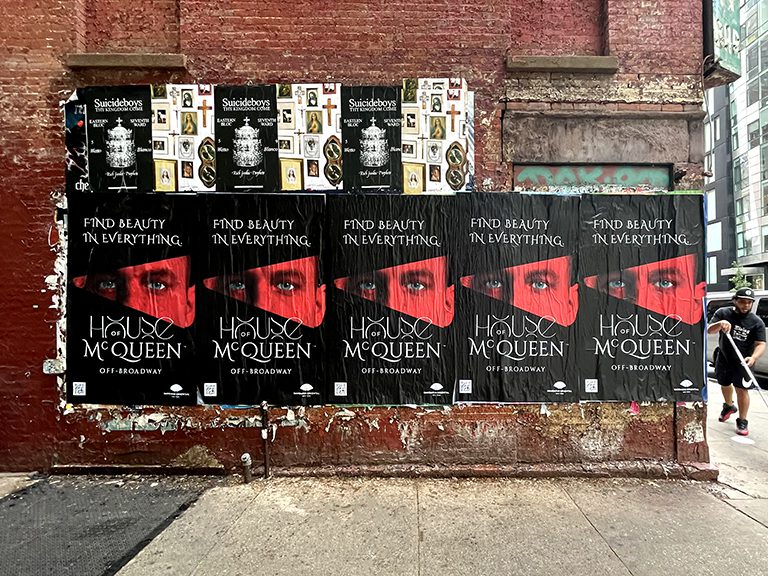
When a Broadway production goes on tour, the real marketing challenge is not national awareness , most shows have that. The challenge is making each city feel like opening night. Every market on the tour schedule needs its own ground-level campaign, its own physical presence, its own local push that makes the show feel urgent and alive in that specific place. That is what we build at American Guerrilla Marketing, operating out of Industry City, Brooklyn. See also: Tour Marketing.
Touring theater runs on ticket sales. And ticket sales run on visibility. We put the show’s imagery in the streets, in commuter pathways, in the neighborhoods around the venue, and in front of the audiences most likely to buy. Our guerrilla marketing approach turns blank city walls and sidewalks into show-specific advertising that runs in the weeks before opening night.
The Street Marketing Challenge for Touring Productions
Broadway touring productions have a compressed window in each market. Unlike a New York run that can build over months, a tour stop might last one to four weeks. That means the marketing machine needs to hit hard, fast, and in the right places from the moment the production rolls into town. See also: Festival Marketing.
National digital campaigns handled by the production’s marketing office get people generally aware. But it is the local street presence that converts awareness into ticket purchases. When someone walks past a dramatic poster of the show on their morning commute, then gets handed a card by a brand ambassador outside the venue on Thursday, and sees an LED truck circling the downtown core on Saturday, they buy tickets. That sequence of real-world touchpoints is what we engineer.
We have run theater campaigns in New York, Los Angeles, Chicago, San Francisco, Boston, Washington DC, Philadelphia, Seattle, Dallas, Atlanta, and dozens of mid-market cities that host touring productions. Each city gets a tailored ground campaign that respects the local landscape while staying on-brand with the production’s national creative.
Wheatpasting for Touring Theater Campaigns
Theater key art is built for large-format display. The bold imagery, the dramatic typography, the recognizable iconography of major productions , all of it is designed to stop people in their tracks. Wheatpasted posters take that imagery and put it on the walls of the city at a scale that commands attention.
We source approved placement locations in each tour market, prioritizing walls near the performance venue, in cultural and entertainment districts, around transit stops frequented by the show’s target audience, and along pedestrian corridors in the urban core. For a major Broadway tour, we might place 20 to 60 poster locations in a single market, creating a saturation effect that makes the show’s presence feel inescapable in the weeks before opening.
Poster sizing varies based on wall availability and budget, but larger formats , 40×60 and above , create the most visual authority in competitive street advertising environments. We coordinate printing, shipping to each market, and installation through our vetted network of local crews.
Street Teams at Venue Perimeters and Entertainment Districts
Our brand ambassadors work the physical perimeter of the theater market in ways that digital campaigns simply cannot reach. We position street teams at the theater venue itself in the run-up to performances, at nearby hotels where visitors stay, at restaurants and bars in the entertainment district, and at transit stops that route into the venue area.
Brand ambassadors for Broadway tour campaigns typically distribute glossy show cards, discount offer cards tied to a promo code, and printed schedules of performance dates. They are trained to engage in a friendly, non-aggressive way that reflects the prestige of the production. They do not push. They invite.
For shows with broader popular appeal, we also deploy street teams at high-pedestrian-traffic locations outside the immediate theater district , shopping corridors, farmers markets, college campuses , to reach audiences who might not think of themselves as theater-goers but would absolutely enjoy the specific show being promoted.
LED Billboard Trucks for Opening Week Impact
Few tools create opening-night energy in a city like a moving LED billboard truck displaying full-color show imagery and ticket call-to-action through downtown streets. We deploy LED trucks on opening day and the weekend before, running timed loops through the entertainment district, past convention hotels, and along major pedestrian corridors.
The format is especially effective for shows with strong visual identity , musicals with iconic costumes, productions with recognizable source material, shows that have already generated cultural conversation. The truck carries that energy into the streets and generates social sharing when passersby photograph or video the display.
We program LED trucks with multiple creative rotations: show key art, performance schedule, QR code to purchase, and any early-buyer promotions the production is running. Drivers follow a route we optimize for maximum pedestrian impression per hour.
Sidewalk Stencils Near the Venue
On high-traffic sidewalks near the performance venue, sidewalk stencils create an additional layer of street presence at ground level. Water-based chalk stenciling with the show’s title, logo, and venue directional arrow guides foot traffic toward the theater and keeps the production top of mind for pedestrians who pass through the area repeatedly.
This tactic is particularly useful in markets where the venue is slightly off the main entertainment corridor and could benefit from wayfinding in addition to advertising. The stencils wash away naturally after rain and leave no permanent mark.
Multi-City Tour Coordination
Tour marketing managers are managing a lot. They are coordinating with local promoters, handling media buys, working with the production office, and managing a different vendor in every city. Our goal is to be the easiest part of that operation.
When we take on a Broadway tour campaign, we assign a single project manager who serves as the point of contact for the entire tour run. That person coordinates with local vendors in each city, manages creative asset logistics, confirms site approval acquisition, briefs street teams, and delivers post-deployment documentation. The marketing manager gets one set of updates, not fifteen.
We have run simultaneous campaigns in multiple cities during the same week. When a major tour has overlapping market launches, our network handles both without either suffering. We maintain relationships with ground crews in every significant touring market and vet them to meet AGM’s standard before we put them on any production campaign.
Aligning Street Campaigns with Digital and Media Buys
Street marketing does not replace the digital campaign. It multiplies it. When a potential ticket buyer sees the show’s Instagram ad in the morning, notices the wheatpaste poster on their lunchtime walk, and gets handed a discount card by a brand ambassador outside the theater district on Friday afternoon, the cumulative effect far exceeds any single-channel campaign.
We time our deployments to align with the production’s media schedule. If a local morning show segment is running on Wednesday, we have street teams at transit hubs near that network’s primary viewership corridor on Tuesday and Thursday. If a radio spot launches Monday, the wheatpaste goes up over the weekend. Coordination with the media plan makes every component of the campaign work harder.
Audience Targeting by Production Type
Not every Broadway tour appeals to the same audience, and our street campaigns reflect that. A family-friendly musical gets street team activity near schools, family recreation areas, and shopping centers frequented by parents. A drama with adult themes gets deployed in arts districts, upscale dining corridors, and hotel zones frequented by business travelers who might purchase tickets for an evening out.
We use the production’s audience data and box office demographics to guide where we deploy. If a show has a strong subscriber base in a market, we concentrate efforts on lapsed subscribers and new-to-theater audiences rather than over-saturating existing ticket buyers who already know about the show.
Reporting and Post-Campaign Documentation
Every campaign we run generates a documentation package. Street team supervisors photograph each deployment with geotagged images and distribution counts. LED truck logs record route, hours, and impression estimates by neighborhood. Wheatpasting crews provide before-and-after photos of each wall placement.
Tour marketing managers receive a post-campaign report for each market that includes all deployment documentation, impression estimates, and any notable field observations. This feeds into the production’s overall campaign analytics and helps inform strategy for remaining tour stops.
What Makes AGM the Right Partner for Theater Tour Campaigns
We understand live entertainment marketing. We understand that the audience for a touring production is different from the audience for a consumer product launch. We understand that theater key art has specific creative requirements and that how it is displayed matters for the production’s brand.
We also understand urgency. Tour stops have hard deadlines. The show opens on a specific date, and the street campaign needs to be at full saturation before that date , not on it. Our team operates with the timeline discipline that live entertainment demands.
Producers and tour marketing managers who work with us find that we are predictable, documented, and accountable. We say what we will do, we do it, and we show you proof. In an industry where a lot of vendors overpromise, that track record is our best marketing tool.
Frequently Asked Questions
What is Broadway tour marketing?
Broadway tour marketing covers all promotional activity for touring theatrical productions , from national Broadway tours to regional theater runs , across multiple cities. It includes street-level media, outdoor advertising, brand ambassadors, and coordinated launch campaigns in each market.
How do street teams support Broadway tour ticket sales?
Street teams distribute show materials at high-traffic locations near performance venues, hotels, transit hubs, and cultural districts. Face-to-face outreach creates direct connections with potential ticket buyers and drives on-the-spot interest in a way digital ads cannot.
What OOH formats work best for theater tour promotions?
Wheatpasted posters, LED billboard trucks, and sidewalk stencils are all high-performing formats for theater tours. Bold imagery of the show’s key art in high-visibility locations near the venue creates consistent exposure in the lead-up to opening night.
How early should Broadway tour street marketing begin?
We recommend launching street-level activities three to four weeks before opening night in each market. This allows enough runway for multiple impression cycles before ticket purchase windows close.
Can AGM handle multi-city Broadway tour campaigns simultaneously?
Yes. We manage coordinated campaigns across multiple markets at the same time using our national vendor network. Each city gets a localized execution plan while staying on-brand with the production’s national campaign.
Does AGM work with theater producers and tour marketing managers?
For more on this, explore our experiential marketing.
Yes. We work directly with tour marketing managers, general managers, producers, and in-house theater marketing teams. We slot into existing campaign structures as the ground-level execution partner.