The right branded trailer is a capital asset that pays for itself across multiple campaigns. Build it right, route it smart, and it becomes one of the most cost-efficient tools in experiential marketing.
A brand activation trailer is a mobile, self-contained brand experience unit. More permanent than a tent, more flexible than a fixed retail space, and more visible on the road than almost any other branded surface, the trailer format has become one of the most effective vehicles — literally — for brands that need to reach consumers across multiple markets. When it is built right and deployed with a clear strategy, a branded trailer program can generate more direct consumer contact per dollar than almost any other format in the experiential marketing toolkit.
The trailer format has several specific advantages that make it well-suited for certain types of brand activation programs. The first is scale: a well-built trailer can accommodate a full brand experience in 400 to 800 square feet of usable space — enough for product displays, sampling stations, interactive elements, and staff areas. That is more than enough to create a meaningful brand environment.
The second advantage is mobility combined with permanence. Unlike a pop-up tent that needs to be assembled and disassembled at every stop, a trailer arrives pre-built and can be opened and operational in 30 minutes. That operational efficiency dramatically reduces the labor cost and time required at each stop, making it possible to hit more markets in a given program window without proportionally increasing operational overhead.
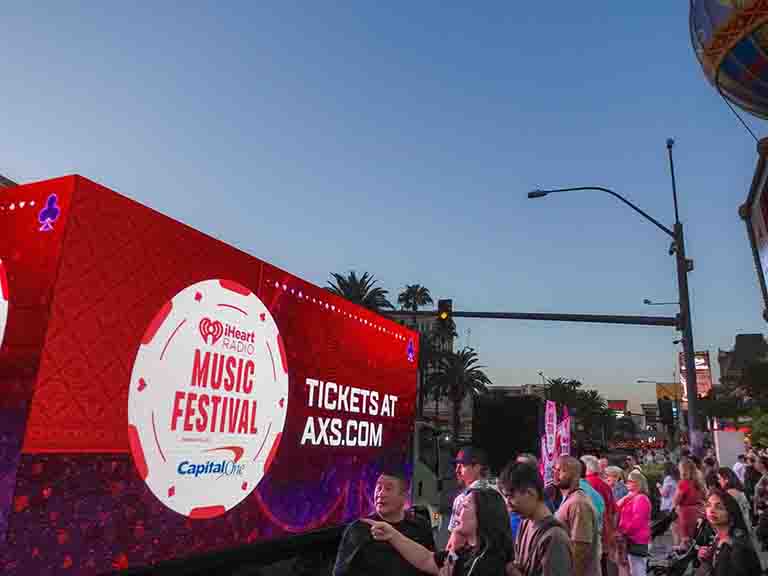
The third advantage is the visual impact of the trailer itself in transit. A well-designed branded trailer on the highway, in a parking lot, or parked on a street is a moving billboard that generates attention before it is even opened. The visual presence of the trailer at stops — parked in a prominent location with a compelling exterior design — creates ambient awareness that extends well beyond the consumers who actually step inside.
The fourth advantage is weather resilience. Unlike outdoor tents and pop-up structures that are vulnerable to wind, rain, and temperature extremes, a trailer is a permanent structure that provides weather protection for both staff and consumers. That opens the calendar for trailer programs in markets and seasons where outdoor tents would be impractical.
A branded trailer that is well-built and consistently maintained is a capital asset. It depreciates slowly, can be redesigned and rebranded for different campaigns, and generates lower per-stop costs the more it is deployed. Think of it as infrastructure, not just an activation tool.
Types of Brand Activation Trailers
Trailers come in several configurations that serve different activation purposes. The most common for brand activation work are the gooseneck or fifth-wheel trailer (towed by a large truck, highest internal volume), the smaller bumper-pull trailer (towed by a standard pickup, more flexible but less internal space), and the converted step van or box truck (self-contained, no tow vehicle required, better for urban environments with limited parking for tow vehicle combinations).
The interior configuration depends on the activation’s goals. Sampling-focused trailers prioritize product display and distribution stations, with staff positioned to engage with consumers during the sample interaction. Experience-focused trailers create a brand environment that consumers enter and spend more time in, with multiple zones for product interaction, brand storytelling elements, and potentially customization or personalization activities.
Exterior design is the primary driver of visual impact and is worth significant investment. A trailer with a weak exterior design will look like what it is — a trailer — regardless of how impressive the interior experience is. The exterior needs to communicate the brand compellingly at highway speed, at parking lot distances, and at close range when consumers are deciding whether to approach.
Build Quality and Its Implications
Trailer builds are capital investments that should be treated accordingly. A trailer that is built to handle 50 deployments over three years of use represents a very different investment decision than a trade show booth that is used once. The quality of the build — the structural integrity, the quality of interior finishes, the electrical system, the climate control, the durability of branded surfaces — determines the total cost of ownership over the life of the asset.
AGM builds trailers to last. That means proper structural engineering for travel loads (the trailer is not just a display case; it is a vehicle that takes real physical stress at highway speeds), durable interior finishes that can handle thousands of consumer interactions without looking worn, and exterior graphics systems that hold up to weather, sun exposure, and the minor abrasions of regular operation.
Maintenance planning is part of the build brief at AGM. We design systems that are easy to maintain in the field and specify components that are easy to replace when needed. A program that encounters a minor maintenance issue and cannot continue because the repair requires factory-specific parts is a poorly designed program. Field serviceability is an engineering requirement.
Routing and Deployment Strategy
A branded trailer is only as effective as the routing strategy that puts it in the right places at the right times. Random or convenience-based routing produces inconsistent results. Routing built around consumer density maps, event calendars, retail partnership opportunities, and geographic efficiency produces programs that consistently reach the target audience with the minimum logistical overhead.
AGM’s routing planning for trailer programs starts with consumer behavior data: where does the brand’s target consumer live, shop, work, and spend leisure time? From that starting point, the routing identifies specific stops — parking lots, retail adjacencies, event venues, street locations — that put the trailer in front of the right consumer at the right moment.
The rhythm of the program matters too. Back-to-back stops with minimal travel time between them maximize consumer touchpoints per day. Stops that require long repositioning drives reduce the program’s efficiency significantly. The routing needs to account for the full operational day — setup, activation hours, breakdown, and transit — to produce realistic stop counts that do not overextend the crew.
Trailer Type
Interior Space
Best Use
Key Consideration
Gooseneck / fifth-wheel
600-800 sq ft
Full brand experience, high volume
Requires large tow vehicle
Bumper-pull trailer
200-400 sq ft
Sampling, smaller experience
More flexible parking
Converted step van / box truck
300-500 sq ft
Urban markets, no tow vehicle needed
Self-contained, higher mobility
Custom-built trailer
Variable by design
Brand-specific experiences
Longest lead time, highest cost
Documentation and Program Performance
Trailer programs generate consistent, comparable data across stops that allows for genuine program optimization. Each stop is documented with photos, staff logs, and consumer touchpoint records. Over a 20-stop or 30-stop program, the documentation creates a detailed picture of which markets, which locations, and which stop types generate the most consumer engagement, and what conditions at a given stop — neighborhood, time of day, day of week, nearby events — correlate with higher or lower performance.
That documentation is used to optimize subsequent programs. AGM reviews stop performance data after every program and uses it to refine routing, timing, and location selection for future deployments. The brand benefits from the accumulated operational knowledge of every previous deployment in that market or with that consumer profile.
Planning, Timing, and the Strategic Calendar
Campaign planning in experiential marketing requires building the timeline backward from the activation date rather than forward from when the brand is ready to start. The date the brand wants to activate determines the date by which fabrication must be complete, which determines the date by which design must be approved, which determines the date by which the brief must be finalized. Working this sequence forward — starting with the brief and estimating the production timeline from there — consistently underestimates the lead time required and creates compressing deadlines that force compromises in quality.
A realistic production timeline for a high-quality activation builds in review cycles between stages rather than treating design, fabrication, and logistics as sequential tasks with no overlap. Design review with the client takes time. Revisions after the review take time. Pre-production material procurement has lead times that are outside the production team’s control. These are known variables that need to be in the timeline from the beginning, not surprises discovered when they cause delays.
The strategic calendar — the brand’s broader marketing calendar and the external events that create activation windows — needs to be part of the planning conversation from the start. An activation planned for a specific neighborhood during a specific season needs to account for what else is happening in that neighborhood and city at that time. Competing brand activity, local events that either complement or compete with the activation, and seasonal patterns in consumer behavior all affect what the activation can accomplish in its specific window.
Lead time investment pays a disproportionate return. The activation planning process that starts six months before the event date has dramatically more flexibility to respond to site survey discoveries, client feedback cycles, and vendor constraints than one that starts six weeks out. The same budget invested with adequate planning time produces a better result than the same budget rushed through an abbreviated timeline.
The brand ambassadors who represent the brand during an activation are not a logistics commodity — they are the primary driver of the consumer experience quality. A beautifully fabricated activation space with mediocre staff will underperform a simpler space with excellent staff, every time. The investment in identifying, training, and managing the right people for a specific activation is one of the highest-return investments in the activation budget.
Identifying the right staff for a specific activation requires defining what “right” means for that specific brand, that specific consumer audience, and that specific cultural context. The staff member who is perfect for a premium fragrance brand activation in a Soho pop-up is not the same person who is right for a high-energy sampling program at a summer music festival. The hiring criteria need to be written for the specific activation, not for a generic brand ambassador profile.
Training needs to go beyond product knowledge to include brand story, consumer profile, and the specific goals of the activation. A staff member who knows the product but does not understand why the brand is activating in this specific neighborhood at this specific time cannot make the judgment calls that distinguish excellent consumer interactions from adequate ones. Context knowledge enables performance that knowledge of facts alone cannot produce.
On-site staff management during the activation itself is a specific production function. The person managing the activation on the ground needs authority to make real-time decisions — adjusting staff positioning as consumer flow patterns emerge, managing wait times, handling unexpected situations, maintaining team energy through long shifts. This is a leadership role, not just a supervisory one, and it needs to be filled by someone with the judgment and authority to act decisively.
Post-Campaign Learning and Program Iteration
Every activation generates data and observations that should inform the next one. The challenge is capturing those learnings systematically rather than relying on individual team members’ memories of what worked and what did not. A formal post-campaign review process — covering what was planned, what happened, and what the team would do differently — is the mechanism by which campaigns improve over time rather than repeating the same mistakes or missing the same opportunities.
The post-campaign review should be structured around the original brief’s objectives rather than around general exposures of how the activation went. Did the activation accomplish what it was designed to accomplish? If yes, what specifically drove that success, and how can it be replicated or scaled? If no, what gap existed between the plan and the reality, and what does that gap reveal about either the brief or the execution?
Documentation from the activation — the photos, the staff logs, the consumer interaction records — is the evidence base for this review. Teams that document activations rigorously have more to work with in the post-campaign review than those that rely on memory and impression. The documentation investment is also an investment in the quality of future campaigns.
AGM conducts post-campaign reviews for all programs and shares the findings with clients in a format that informs future planning. The learnings from a Sacramento activation in September become part of the strategic input for the Sacramento program the following spring. The patterns across markets — which location types consistently outperform, which staffing approaches produce the best consumer interactions, which timing windows generate the most organic documentation — accumulate into operational knowledge that improves the quality of every subsequent program.
Building Consumer Relationships Through Repeated Activation
The consumer who encounters a brand once in an experiential context and then never encounters it again forms a weak relationship. The consumer who encounters it three, five, or ten times across different contexts — a street activation in their neighborhood, a sampling program at a market they attend regularly, a sponsored moment at an event they go to every year — develops a cumulative relationship with the brand that is qualitatively different from any single interaction could produce.
This is the argument for activation programs as opposed to individual activations. A program that deploys the brand across multiple touchpoints, contexts, and occasions over an extended period builds the kind of familiarity that changes how consumers make purchase decisions. When a brand has established genuine presence in a consumer’s life — not through media saturation but through real physical encounters in contexts the consumer chose for other reasons — it earns a different kind of consideration than brands that exist only in advertising.
The operational investment in sustained presence is not proportionally larger than the investment in individual activations. After the first activation in a market, many of the setup costs — vendor relationships, staff relationships, venue familiarity, operational knowledge of specific locations — carry forward and reduce the cost and friction of subsequent activations. The first activation is the highest-cost learning event. Everything after it benefits from what was learned.
Program documentation compounds in value over time. A brand that has three years of activation documentation in a specific market has a different quality of strategic insight into that market than one working from a single activation’s data. The patterns — which locations perform best at which times of year, which consumer profiles respond most strongly to which activation formats, which seasonal and cultural calendar moments create the most productive activation windows — emerge only from comparative data across multiple programs.
The Brief as the Foundation of All Activation Success
The quality of the brief that initiates an activation campaign is the single greatest determinant of the quality of the campaign’s results. A brief that is specific about the target consumer, precise about the behavioral goal, honest about the budget, and clear about the success criteria creates the conditions for excellent creative and strategic work. A brief that is vague, aspirational, and internally inconsistent produces concepts that may be visually compelling but are strategically adrift.
Writing a genuinely useful brief requires the brand team to have genuine clarity about what they are trying to accomplish — clarity that is often harder to achieve than it appears. “We want to build brand awareness” is not a brief; it is a category of goal. “We want to convert consumers in the 25-to-35 demographic who are familiar with our brand but have never purchased, in the Seattle and Portland markets, by creating a physical encounter that demonstrates the product’s primary point of difference before the holiday retail season” is a brief. The specificity of the second version allows every downstream creative and production decision to be tested against a clear standard.
AGM’s briefing process is designed to extract this specificity even from clients whose initial brief is vague. The questions we ask in the briefing process are designed to surface the specific consumer behavior the brand is trying to influence, the specific market context it is operating in, and the specific constraints — budget, timeline, operational requirements — that the campaign needs to work within. Getting to a genuine brief before any creative work begins is not a bureaucratic step; it is the work that makes excellent creative possible.
The brief also needs to be shared fully with everyone involved in the campaign’s execution, not just the strategic and creative leads. Staff who know only what they are supposed to do, without knowing why the brand is activating in this specific place at this specific time for this specific consumer, cannot bring the judgment and context-awareness to their work that makes consumer interactions genuinely excellent rather than merely adequate.
Technology and Data in Modern Brand Activations
The integration of technology into brand activations has moved from novelty to baseline expectation in many categories. QR codes, registration systems, NFC interactions, digital screens, interactive displays, and social sharing mechanics are now standard elements that consumers encounter in brand activation contexts and have formed expectations around. The brands that use these tools effectively are the ones that integrate them in service of the consumer experience rather than in service of the brand’s data collection needs.
The consumer’s willingness to engage with technology at a brand activation is governed by the same value exchange principle that governs all experiential marketing: they will do it if there is something genuinely valuable on the other side. A QR code that leads to an interesting brand story, a limited offer, or a personalization experience will be scanned. A QR code that leads to a generic product page will be ignored. The technology integration is only as strong as the experience it connects to.
Data collection at activations has become more sophisticated as brands have recognized the direct relationship between their physical consumer touchpoints and their digital marketing programs. Registration flows that capture consumer information accurately and connect it to the brand’s CRM system allow the activation to be the beginning of a consumer relationship rather than a one-time encounter. This integration requires technology planning that is part of the activation brief from the start, not a bolt-on after the physical experience is designed.
Frequently Asked Questions
Why use a trailer rather than a pop-up tent for a brand activation tour?
Trailers arrive pre-built and can be operational in 30 minutes, compared to the multi-hour setup time for a comparable tent structure. They provide weather protection that tents cannot match. They are more durable for extended programs. And the visual impact of a well-designed trailer — both on the road and at stops — is significantly greater.
How long does it take to build a custom brand activation trailer?
A custom-built trailer from concept to completion typically takes 10 to 16 weeks depending on complexity. Simpler builds can be completed faster. The lead time needs to be planned into the program calendar — a trailer build cannot be rushed without quality compromises.
What is the typical lifespan of a well-built brand activation trailer?
A properly built trailer with good maintenance can serve a brand for five to ten years. The exterior graphics are typically refreshed every two to three years, and interior elements may be updated for new campaigns, but the structural shell should last much longer.
How do you plan the routing for a trailer activation program?
Routing starts with consumer behavior data — where the target consumer lives, shops, and spends time. From there, we identify specific stop opportunities and build a routing plan that maximizes consumer touchpoints while accounting for the full operational day including setup, activation hours, breakdown, and transit.
Can AGM design, build, and run a trailer program end to end?
Yes. AGM handles concept, design, fabrication, routing strategy, staffing, on-site management, and post-program documentation for trailer activation programs. We treat the program as an integrated campaign, not as separate design, build, and run phases.