Brand activation is one of those terms that gets used by every agency with a deck and a logo, but the execution varies wildly. Some agencies call a table at a convention center a brand activation. Others coordinate multi-city street campaigns, product sampling operations, and mobile media deployments that put a brand in front of tens of thousands of targeted consumers across multiple markets simultaneously. The difference is not branding. It is operational infrastructure.
This guide explains what a professional brand activation agency actually does, what the planning and execution process looks like from brief to post-campaign report, and what separates agencies that deliver results from those that deliver invoices.
Our team at American Guerrilla Marketing, headquartered in Industry City, Brooklyn, NY, has executed activation campaigns for major entertainment companies, consumer brands, food and beverage groups, tech startups, and professional organizations. This is how the work actually gets done.
What Brand Activation Actually Means
Brand activation is marketing that creates direct physical contact between a brand and its target consumer. Not an impression, not a click. An actual human moment where someone encounters the brand in the real world through a format designed to produce a specific behavioral response.
The Formats That Deliver Brand Activation
Brand activation is not a single format. It is a category that includes wheat paste poster campaigns that saturate a neighborhood’s visual environment, brand ambassador and street team programs that put trained people in direct conversation with consumers, LED billboard trucks that bring dynamic media to event corridors and target neighborhoods, sidewalk stencils that intercept pedestrians at eye-to-ground level, and product sampling operations that put a brand directly in a consumer’s hands. The format selection depends on the objective, the audience, the market, and the timeline.
What Brand Activation Is Not
Brand activation is not a trade show booth you rented. It is not a sponsored Instagram post. It is not a banner ad on a street-facing digital screen. These formats create passive exposure. Activation creates active contact. The distinction matters because activation campaigns are designed around behavioral outcomes, not impression tallies.
The Strategy Phase: Building an Activation Architecture
Every activation campaign starts with a strategy phase that defines the architecture before a single crew member is briefed or a single surface is booked.
Objective Setting: Behavioral, Not Atmospheric
The first thing a professional agency does is push the client to define a behavioral objective. Not “raise awareness,” but “drive 1,000 app installs from 22-to-35-year-olds in Brooklyn and Lower Manhattan during the three-week launch window.” Not “create buzz,” but “generate 500 product trial moments at Lollapalooza with documented consumer feedback.” Specific objectives produce specific campaigns. Atmospheric objectives produce activity without accountability.
Audience Profiling at Street Level
Brand activation strategy requires knowing where your target audience actually moves. This is different from knowing their demographic profile. A 28-year-old creative professional in Brooklyn and a 28-year-old finance associate in Midtown have the same demographic profile but entirely different street-level movement patterns. Activation strategy maps the target to the locations where they are physically present and in a mental state to receive a brand message.
Market Selection and Coverage Planning
Market selection should be driven by audience concentration and campaign objective, not by market familiarity or convenience. For national brands, we recommend identifying two to four high-concentration markets for a launch phase before committing to broad national coverage. Testing in concentrated markets produces data that makes national-scale campaigns more efficient.
Format Selection: Matching Tools to Objectives
Format selection is one of the most consequential decisions in brand activation planning. The wrong format deployed in the right market still misses the audience. The right format in the wrong market still wastes the budget.
Wheat Paste Poster Campaigns
Wheat paste is the flagship format for creating neighborhood-level visual saturation. A well-executed wheat paste campaign across Williamsburg, SoHo, or the Wynwood Arts District in Miami turns the brand into part of the visual landscape of those neighborhoods for the campaign window. This format excels for entertainment launches, fashion brands, and any brand where the visual environment of the campaign mirrors the target consumer’s own aesthetic world. Our guerrilla marketing services team scouts and secures surfaces in advance of every deployment.
Brand Ambassador Programs
Brand ambassadors add the human element that no format can replicate. A trained brand ambassador at a product sampling moment creates a personal encounter that drives trial, generates feedback, and builds brand memory at a neurological level that passive exposure cannot match. Ambassador programs are most effective when staff is deeply trained on brand messaging and authorized to speak with authority about the product, not just hand it out.
LED Billboard Trucks
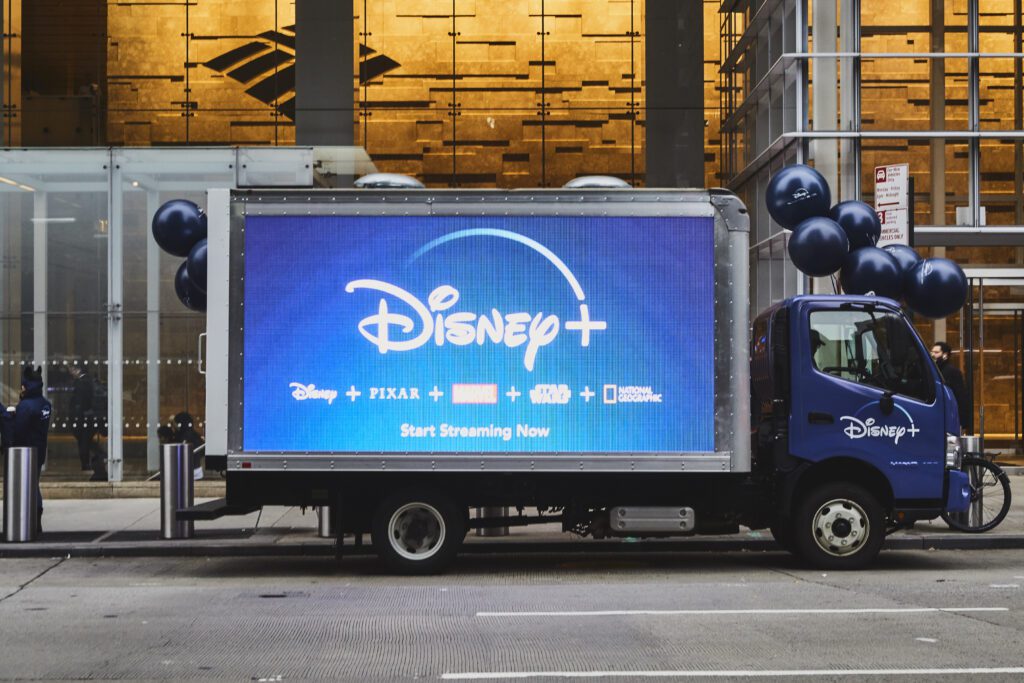
Mobile LED trucks deliver high-impact dynamic media to the exact location where your audience is concentrated. For event-adjacent campaigns, concert venue corridors, convention center perimeters, or sports venue approaches, LED trucks turn proximity into impressions. For neighborhood saturation campaigns, truck routing patterns can achieve market-wide coverage in a single day. Our LED billboard truck fleet operates across all major U.S. markets.
Sidewalk Stencils
Sidewalk stencils work best as a precision targeting tool. The objective is to place your brand message directly underfoot on the exact route your target consumer walks. Near university campuses, gym entrances, transit station exits, or retail corridors, stencils interrupt the pedestrian’s habitual gaze pattern with unexpected brand contact. Our sidewalk stencil programs use removable chalk-based materials in compliance with local regulations.
Staffing: The Crew Behind the Campaign
Brand activation is a people business. The quality of the crew executing in the field is the single largest variable in campaign outcome outside of strategy and format selection.
What Professional Crew Recruitment Looks Like
Professional agencies maintain talent pipelines in every market they operate in. Our team has established crew relationships in 50+ U.S. markets built over years of campaign execution. When we deploy in Atlanta, Denver, or Seattle, we are not scrambling for local talent. We are activating vetted crews who have executed campaigns with us before and know our documentation and compliance standards.
Training Before Every Activation
Crew training is not optional. Every crew member deployed on a brand activation campaign receives a pre-campaign brief covering the campaign objective, the brand standards they are representing, the compliance requirements for the market and format, the documentation standards they must meet, and the escalation process for field problems. Undertrained crews produce inconsistent execution and create compliance and brand risk.
Crew Lead Accountability
Every market operating in a campaign has a designated crew lead who maintains direct communication with the campaign manager throughout the activation. Problems identified by a crew lead in Chicago at 2 a.m. reach a campaign manager who can authorize solutions immediately. Accountability chains that loop back to the office on the next business day are not accountability chains for field operations.
Site Scouting and Surface Management
The surfaces a campaign runs on are as strategic as the creative that appears on them. Site scouting is one of the highest-value services a professional brand activation agency provides.
What Our Scouting Process Evaluates
When our team scouts a market, we evaluate foot traffic volume and pattern by time of day, surface condition and preparation requirements, legal access or landowner permission requirements, visual competition from adjacent brands, proximity to target audience concentration points, and photography angle for documentation quality. This evaluation happens before any surface is committed to a campaign plan.
Surface Preparation and Quality Control
A wheat paste poster on a poorly prepared surface degrades faster and photographs worse than a poster on a clean, prepped surface. Our crews prepare surfaces before installation, and we conduct post-installation quality checks before leaving each location. This commitment to surface quality is why our documentation packages demonstrate consistently high production standards across every market.
Compliance, Permits, and Legal Execution
Compliance is not a peripheral concern. It is central to professional brand activation execution. Our approach to compliance is straightforward: we operate within the legal framework in every market, we secure necessary permissions before deploying, and we train crews to recognize and respect compliance boundaries in the field.
Permit Requirements Vary by Format and Market
Street team distribution on public sidewalks is generally legal in most U.S. cities but may require notification or permit in some business improvement districts. Wheat paste requires surface-owner permission or designated legal surfaces. Sidewalk stencil regulations vary by material and municipality. LED truck operation requires local traffic and parking coordination. We manage all permit and permission requirements as part of campaign execution, not as an afterthought.
Compliance Briefing for Every Crew
Crew compliance briefing is a mandatory step before any deployment. Every crew member knows what they are authorized to do and, as importantly, what they are not. Written site-level briefing documents accompany every crew. If a compliance question arises in the field, the crew lead escalates immediately rather than improvising.
Campaign Execution and Real-Time Management
Once the campaign is live, the agency’s role shifts to real-time management: monitoring field operations, managing exceptions, tracking documentation, and responding to emerging opportunities or problems.
Overnight Installations for Wheat Paste Campaigns
Most wheat paste campaigns install overnight, typically between midnight and 5 a.m. This timing provides surface access without pedestrian interference and produces fresh installations visible to morning commuter and daytime foot traffic. Our crews operate professionally in overnight windows and maintain communication with campaign management throughout the install.
Real-Time Monitoring and Adjustment
Campaigns with multi-day or multi-week windows require ongoing monitoring. We schedule field check visits for campaigns running more than one week to verify poster condition, assess surface competition, and identify any needed maintenance or replacement. Real-time social monitoring tracks organic brand documentation generated by the campaign footprint and surfaces high-value organic content for amplification.
Documentation and Reporting: The Proof of Performance
Documentation is not administrative overhead. It is the deliverable that justifies the investment and drives the conversation about the next campaign. Professional brand activation agencies deliver documentation that stands up to scrutiny.
GPS-Tagged Installation Photos
Every installation in our campaigns is documented with GPS-tagged photography. GPS metadata proves location and enables independent client verification of placement geography. This level of documentation accountability is a standard we hold ourselves to because we have seen how much it matters to clients who need to justify spend to internal stakeholders.
Impression Estimates with Documented Methodology
Impression estimates for activation campaigns are based on foot traffic data for specific corridors, exposure duration per passing consumer, and surface count and quality. We provide the methodology alongside the estimate. Unsupported impression numbers are not professional reporting. Methodologically documented estimates demonstrate accountability and build long-term client trust.
Post-Campaign Summary and Recommendations
Every campaign closes with a post-campaign summary that covers documented deliverables, impression estimates, notable organic social amplification, any operational exceptions and how they were handled, and recommendations for optimizing the next campaign. This summary is the foundation for a multi-campaign relationship, not just a receipt for a completed job.
Frequently Asked Questions
What does a brand activation agency do?
A brand activation agency designs and executes physical brand experiences that create direct consumer contact with a product or brand. This includes strategy development, format selection, site scouting, crew staffing, field execution, GPS-documented reporting, and post-campaign analysis. The goal is to generate a specific behavioral response from the target audience at street level.
What is the difference between brand activation and experiential marketing?
Brand activation is the broader category: any marketing activity designed to bring a brand to life through direct engagement. Experiential marketing is a subset focused specifically on immersive consumer experiences. Brand activation also includes product sampling, street teams, wheat paste campaigns, LED truck media, and sidewalk stencils, many of which create brand contact without requiring immersive experience design.
How much does a brand activation campaign cost?
Entry-level single-market activations typically start at $5,000 to $10,000. Multi-market or multi-format campaigns range from $15,000 to $75,000 or more depending on format mix, staffing, duration, and market count. American Guerrilla Marketing builds custom quotes based on specific brief parameters. Contact our team to discuss your campaign scope.
What industries use brand activation agencies?
Entertainment, consumer packaged goods, food and beverage, fashion, technology, healthcare, financial services, and real estate are the most common categories. Any brand that needs to build physical presence in a target market or demographic corridor can benefit from street-level activation. We have executed campaigns for startups, Fortune 500 brands, nonprofits, and political organizations.
What should I look for when hiring a brand activation agency?
Look for documented field experience across multiple markets, clear compliance and permitting practices, professional documentation and reporting standards, crew training and quality control processes, and client references from campaigns at a similar scale to yours. An agency that cannot show you documentation from past campaigns should not be executing yours.
How long does it take to launch a brand activation campaign?
Standard lead time is 2 to 4 weeks from approved brief to launch. Multi-market, high-volume, or event-dependent campaigns may require 6 to 8 weeks. Rush timelines are available in most markets at additional cost. The more lead time you provide, the better the surface selection and crew preparation.
Does American Guerrilla Marketing handle brand activations nationwide?
Yes. American Guerrilla Marketing executes brand activations in 50+ U.S. markets with in-market crews, established surface networks, and centralized campaign management. Multi-city campaigns launch on coordinated timelines with consolidated reporting. Call us at (646) 776-2770 or contact us online to discuss your campaign.