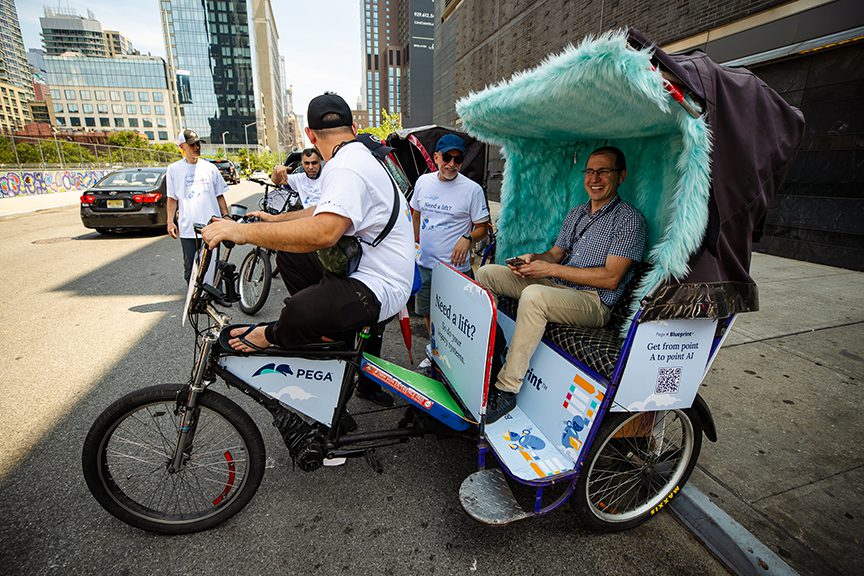
Bicycle ads are the intersection of creative design and urban mobility. The ad has to work in two seconds on a moving bike in a visually busy environment. The deployment has to put that ad in front of the right people at the right time in the right location. Get both right and a bicycle ad campaign generates brand recognition in premium urban environments at a cost that most other outdoor formats cannot match for the quality of access they provide.
We are American Guerrilla Marketing. We design, produce, and deploy bicycle ads in cities across the United States. We bring creative discipline and strategic route planning to every bicycle ad campaign we run. We know what bicycle ads look like when they work and what they look like when they fail, and the difference comes down to a handful of specific decisions that most brands get wrong the first time without guidance. This guide covers those decisions comprehensively.
A bicycle ad is not a standard print advertisement scaled to fit a panel on a bike. It is a distinct format with its own creative requirements, its own production specifications, and its own strategic logic. Understanding what makes it different is the foundation of every effective bicycle ad campaign we plan.
The most important distinction is time. Every other print advertising format, a billboard, a bus shelter panel, a transit ad, gives the viewer a relatively extended viewing opportunity. Someone standing at a bus stop can look at the same ad for minutes. Someone walking past a billboard sees it for five to ten seconds. A bicycle ad passing in the opposite direction on a bike path gives the viewer one to three seconds. That is not much time. The creative has to function in that window or it does not function at all.
The second distinction is context. A bicycle ad operates in environments where the viewer is typically in a relaxed, receptive state: in a park, at a market, on a greenway. This is a genuinely different mental context than the distracted, overstimulated state of most urban commuting environments. The viewer who sees a bicycle ad in a park setting may be more open to the brand message than they would be in almost any other outdoor advertising context. Designing for that context means not fighting for attention with aggression. It means being striking, memorable, and clear.
Bicycle Ad Creative: The Principles That Work
We have reviewed hundreds of bicycle ad designs and deployed enough campaigns to have strong, data-informed opinions about what works. Here are the principles we apply consistently.
The Five-Word Rule
Five words is the absolute maximum for a bicycle ad. Not five lines. Five words. Total. The brand name plus a four-word message. The brand name plus a two-word tag. The brand name alone. Every word above five adds confusion and reduces recall. This is not a creative preference. It is a function of the viewing time window. We enforce this standard on every bicycle ad we produce.
Logo Dominant
The logo is the most important element on a bicycle ad. It should be the largest, most prominent element in the composition. If someone walks away from a bicycle ad encounter knowing the brand name but not the copy, that is a success. The copy can be forgotten. The brand cannot. Every bicycle ad we approve has the logo sized to dominate the panel.
Color Does the Heavy Lifting
Color is the primary differentiator for bicycle ads in the field. A bold, high-contrast color combination registers faster and from further away than any other design element. Black on yellow. White on red. Yellow on navy. Color choices for bicycle ads should be made based on field visibility, not brand guide aesthetics. We test color choices at full scale before production.
Single Visual Element
One strong visual element supports the logo and copy. Not a collage of product images. Not a complex illustration. One thing. A product shot. A portrait. A symbol. A background color field. The single visual element should enhance the logo, not compete with it for attention.
No Fine Print
Fine print on a bicycle ad is invisible. It wastes production space and creates visual noise that reduces the legibility of the elements that actually matter. We do not include fine print, disclaimers, footnotes, or secondary contact information in bicycle ad creative. Everything below the main message threshold should be absent from the design.
AGM Field Note: The most common request we receive from brands reviewing bicycle ad creative is to add more information. The most common thing we say in response is that more information will reduce the effectiveness of the information that is already there. In this format, the creative direction is subtraction. Every time we remove an element from a bicycle ad design and the brand agrees to it, the ad performs better in the field than the previous version. Simplicity is not a compromise. It is the strategy.
Bicycle Ad Formats: What Goes on the Bike
Bicycle ads come in multiple physical formats depending on the type of bike mounting system and the campaign’s creative approach. Here is a breakdown of the main format options.
Standard Double-Sided Panel
A rigid printed panel mounted vertically to the bicycle frame via a professional mounting system. Double-sided so the ad is visible from both sides of the bike’s direction of travel. Panel dimensions typically range from 24 by 36 inches to 36 by 48 inches. This is the standard format for most bicycle ad campaigns: accessible, effective, and easy to produce.
Oversize Single Panel
A larger single-sided panel, sometimes running to four feet wide by five or six feet tall, mounted on a bicycle with a reinforced frame and mounting system. Oversize panels generate more visual presence at distance but require more careful rider training and route planning because the added size creates wind resistance and maneuverability considerations. Best for high-density environments where greater visibility justifies the logistical complexity.
LED Electronic Panel
An electronic display panel showing video, animation, or rotating static frames. LED panels require power, typically from a battery pack mounted on the bicycle. They generate significantly more attention than printed panels because of the light and motion effect. LED panels are best for launches, events, and campaigns where the brand wants organic social media documentation from bystanders.
Custom Form Formats
Three-dimensional branded displays mounted to bicycle frames, replica product displays, brand-shape cutouts, and other custom formats are possible for campaigns with the creative ambition and budget to pursue them. Custom form bicycle ads generate the highest level of organic attention and social sharing when they are visually distinctive. They also require the most production lead time and the most careful field deployment logistics.
Format
Visibility at Distance
Production Lead Time
Maneuverability
Standard double-sided panel
Good
5-7 business days
High
Oversize single panel
Very good
7-10 business days
Medium
LED electronic panel
Excellent
7-14 days
Medium
Custom form display
Excellent
14-21 days
Variable
Planning Bicycle Ad Routes: The Strategic Framework
Where a bicycle ad operates determines who sees it. Route planning is the most consequential strategic decision in any bicycle ad campaign, and it is the area where most brands need the most guidance because they have not done the work of mapping their target audience’s physical geography in the target market.
Audience Geography First
Before any route planning begins, we need to know where the target audience spends time in the target market. Not where they live in aggregate, but where they actually go: which parks, which corridors, which markets, which events. This mapping is the foundation of every route we build. A route that puts the bicycle ad in front of the wrong audience on the right street is not a successful deployment.
Time-of-Day Optimization
The audience that uses a particular park or corridor varies dramatically by time of day. Morning park users in New York skew toward runners, dog walkers, and early-rising professionals. Afternoon park users skew toward families, students, and leisure-focused consumers. Weekend morning users skew toward active lifestyle demographics. We build routes around the specific windows when the target audience is present, not around general traffic density at any time of day.
Event Calendar Integration
Major outdoor events in the target market create massive temporary concentration of specific demographics. A farmers market, a charity run, a community festival, a concert in the park: these events offer deployment opportunities where the target audience density is multiples of a typical day’s baseline. We build event windows into campaign calendars as priority deployment dates.
Multi-Bike Coordination
When a campaign uses multiple bicycle ads in the same market, we coordinate their routes to create a sense of brand pervasiveness in the target area without simply having multiple bikes riding the same path at the same time. The goal is for a consumer in the target area to encounter the brand bike more than once during their time in the area, which drives significantly stronger brand recall than a single encounter.
The Best Cities and Environments for Bicycle Ads
Bicycle ads perform at different levels in different markets depending on the cycling infrastructure, the park system, and the cultural openness to the format. Here is our market-by-market assessment.
New York City
New York is the premier market for bicycle ads in the United States. The combination of a massive park system, extensive cycling infrastructure, concentrated demographics in specific neighborhoods, and a population that is culturally accustomed to creative street-level marketing makes New York the most productive bicycle ad environment in the country. Central Park, the Hudson River Greenway, Prospect Park, and the major Brooklyn waterfront corridors are our highest-performing deployment zones in the market.
Chicago
Chicago’s Lakefront Trail and the city’s park system are strong bicycle ad environments from late spring through early fall. The cycling-friendly culture along the lakefront, the high-density weekend crowds at Millennium Park and Grant Park, and the strong neighborhood character of the North Side commercial corridors make Chicago one of our most productive secondary markets for the format.
Los Angeles
The coastal corridor from Santa Monica through Venice Beach is the strongest bicycle ad environment in Los Angeles. The combination of year-round warm weather, extreme pedestrian density on the Strand and boardwalk, and a consumer base that is culturally in tune with active outdoor lifestyle branding makes this corridor highly productive for any consumer brand targeting that demographic.
Miami
Miami’s South Beach and Design District corridors offer year-round bicycle ad deployment capability in a market with extreme pedestrian density during peak tourist season. The flat terrain and warm climate make Miami one of the most operationally consistent bicycle ad markets in the country, with fewer weather-related deployment interruptions than northern markets.
AGM Field Note: We evaluate bicycle ad performance differently in different markets. In New York, success metrics center on park and greenway corridor coverage during high-density windows. In Miami, we focus on beach corridor saturation and event adjacency. In Los Angeles, we focus on coastal neighborhood concentration. One framework does not fit all markets. Local knowledge of audience geography is the most valuable planning asset in bicycle ad campaigns.
Bicycle Ads in Integrated Campaigns
Bicycle ads deliver their best results as part of coordinated campaigns that use multiple formats to reach the same target audience across different touchpoints. Here is how they integrate with other elements.
A bicycle ad operating in a park or neighborhood corridor generates brand recognition in the physical environment. A digital campaign running simultaneously to the same demographic in the same geography reinforces that recognition in the digital environment. When the consumer sees the brand on their phone later the same day they saw it on a bike in the park, the second encounter benefits from the established recognition of the first. The two channels amplify each other.
Similarly, a street team operating in the same zone as a bicycle ad converts the awareness the bicycle has generated into direct consumer interactions. The bicycle covers broad territory. The street team handles depth of engagement at specific points. Combined, they create a brand experience that covers both breadth and depth in the target area.
Start Your Bicycle Ad Campaign
We build bicycle ad campaigns from strategic brief through creative review, production, route planning, field deployment, and post-campaign reporting. We know the format well enough to tell you exactly what to expect from a bicycle ad campaign in your specific market and with your specific creative before you commit to it.
Bicycle Ads in the Current Urban Marketing environment
Urban marketing has become significantly more competitive and more cluttered over the past decade. Transit advertising, digital out-of-home displays, app-based geo-targeted advertising, and brand activations of all kinds compete for the attention of urban consumers who have become increasingly sophisticated at filtering commercial messages from their perceptual environment. Bicycle ads offer something genuinely different: presence in the physical environments where the most valuable urban consumers spend their leisure time, with essentially zero competitive advertising pressure from any other mobile format.
This competitive positioning is not theoretical. When we deploy bicycle ads in Central Park on a weekend morning, we are the only mobile branded presence in that environment for the duration of the deployment. The competitive advertising environment inside Central Park is zero. The audience is in the hundreds of thousands. The advertising pressure they experience from our bikes is measured against the absolute baseline of the park itself rather than against a saturated advertising environment. That dynamic is increasingly rare in any advertising format.
Brands that recognize this value and build bicycle ads into their ongoing urban marketing mix as a consistent format, rather than a one-off experiment, develop a genuine competitive advantage in the premium access environments where their target consumers are most concentrated and most open. We have seen this compound effect in recall data from markets where we have run sustained programs: each successive deployment cycle builds on the brand recognition established by previous ones, producing compounding awareness gains that single-activating programs cannot achieve.
Integrating Bicycle Ads with Digital Marketing Campaigns
Bicycle ads and digital marketing campaigns are most effective when they are planned together rather than as parallel siloed programs. Here is specifically how we recommend integrating the two channels for maximum combined impact.
Geo-targeted digital advertising running simultaneously in the same ZIP codes where bicycle ads are deployed creates a two-channel brand presence that reinforces each contact point. A consumer who sees the bicycle ad on a Saturday morning in the park and then sees a digital ad for the same brand on their phone that afternoon registers the second contact as a confirmation rather than a first introduction. The familiarity that the first contact established in the physical environment makes the digital contact meaningfully more effective than it would be without the physical priming.
This priming effect works in both directions. A consumer who has seen a brand’s digital advertising on their phone and then encounters the same brand on a bicycle in their neighborhood feels the brand as a more established presence than one who encounters the bicycle ad without any prior brand exposure. Coordinating the timing of digital campaigns and physical bicycle ad deployments to run concurrently in the same markets creates a alignment that neither channel achieves independently.
Retargeting campaigns that specifically target consumers who have scanned a QR code on a bicycle ad extend the campaign’s impact beyond the immediate geographic reach of the physical deployment. A consumer who scanned the bike ad QR code in the park on Saturday can be retargeted with related digital content throughout the following week, extending the campaign’s reach from a momentary outdoor encounter to a sustained digital presence that follows the consumer through their weekly digital behavior.
The Brief That Sets Bicycle Ad Campaigns Up for Success
We receive briefs for bicycle ad campaigns in every level of quality and specificity. The most effective campaigns we have executed started with briefs that gave us clear answers to five specific questions.
First: what specifically should a consumer know, feel, or do after encountering this bicycle ad? A campaign designed to drive awareness is designed differently from one designed to drive trial, which is designed differently from one designed to drive foot traffic to a specific location. The objective shapes every creative and deployment decision.
Second: who specifically is the target consumer and where do they spend time in the target market? Not a demographic range but a specific description detailed enough to know which park, which market, which neighborhood, and which time of day they are there. The more specific this description, the more precisely we can design routes that reach them.
Third: what is the creative saying and does it work in the bicycle ad format? We review every creative submission before production and we do not produce creative that fails our legibility and clarity standards. A brief that includes the creative direction or draft creative allows us to identify issues early rather than after production.
Fourth: what budget is available? Not a minimum but an honest range that allows us to design a program that fits the budget and achieves the objective. Programs designed around a dishonestly low budget representation are either too small to be effective or require renegotiation that wastes everyone’s time.
Fifth: what is the timeline? Fixed dates drive everything else. If there is a specific event, a launch date, or a campaign window that the bicycle ad program needs to hit, that date defines the production schedule, which defines when the brief needs to be finalized, which defines how soon we need to start the conversation.
Extending the Program: Multi-City and Multi-Season Execution
The field marketing programs that deliver the strongest long-term brand results are the ones that run consistently across multiple markets and multiple seasons rather than concentrating all of the investment in a single activation window. Here is why sustained programs outperform single-burst activations and how we structure multi-city and multi-season programs.
Brand recognition builds through repeated exposure. A consumer who encounters a brand in the field once may or may not retain the brand. A consumer who encounters the brand in the field three times over the course of a month in the same neighborhood or the same set of environments is significantly more likely to retain the brand and to recognize it in a retail context where the purchase decision is made. The compound awareness effect of repeated field contacts is one of the most consistent findings in our program performance data.
Multi-city programs amplify this effect across markets simultaneously. A national consumer brand that maintains field presence in its top five markets simultaneously creates a brand momentum that single-market programs cannot generate. The social sharing from each market reinforces the brand’s presence in the others. The retail velocity lift from sampling programs in multiple markets generates stronger national distribution data than single-market programs can produce. And the brand’s sense of presence, the feeling that it is everywhere at the same time, builds the kind of market credibility that concentrated single-market programs cannot create.
We manage multi-city programs with centralized coordination and local execution expertise. Creative standards, team training protocols, and reporting frameworks are consistent across all markets. Local market knowledge, route planning, and audience geography expertise are market-specific. The combination produces programs that are nationally consistent in quality and locally optimal in execution, which is the standard that delivers results across a national or regional program portfolio.
For brands considering their first field marketing program, we recommend starting with one market executed at the highest possible quality level rather than spreading a limited budget across multiple markets at reduced quality. A program that delivers genuine results in one market builds the internal case for expanding to additional markets. A program that spreads a limited budget across too many markets at too thin a quality level delivers mediocre results everywhere and makes it harder to build the case for continued investment in the format.
Next Steps: Building Your Program with AGM
Field marketing programs start with a conversation. Call us at (646) 776-2770 or email [email protected] and we will schedule a direct discussion about your brand, your target market, your campaign objectives, and your timeline. We will ask specific questions about the program you need and give you honest answers about what the right approach looks like for your situation.
From that initial conversation, we build a program recommendation that reflects genuine strategic thinking about how to achieve your specific objective in your specific market with your specific target consumer. We do not deliver a one-size-fits-all proposal and invite you to pick the package that is closest to what you need. We design programs from the ground up based on what each client’s situation actually requires.
Our production timelines are realistic. We tell you what we need from you at each stage of production and when we need it. We tell you what the program will cost before we begin. We execute to the plan we have agreed to and we communicate transparently when real-world conditions require any adjustment to that plan. We deliver the program report within five business days of the final deployment day.
We are a team of people who care about field marketing done right. Not because it is a job, but because we have seen what well-executed guerrilla and field marketing programs accomplish for the brands we represent and we take pride in being the team that delivers those results. We invite you to experience that difference directly. Call us today.
Frequently Asked Questions
How long should a bicycle ad campaign run to build brand recognition?
For neighborhood awareness in a specific area, a minimum of five to seven consecutive days is needed for enough repeated encounters to form genuine brand recognition. For event-specific campaigns, one to three days timed around the event is appropriate. For ongoing market presence programs, weekly or biweekly deployment cycles work well over an extended campaign period.
Can I run a bicycle ad campaign with a single bike?
Yes. A single bike on a well-chosen route in a high-density environment can be effective for small or highly localized campaigns. For campaigns with broader geographic objectives or saturation goals, multiple bikes operating coordinated routes deliver meaningfully stronger results. We recommend at least two bikes for most awareness campaigns and more for major market deployments.
What is the best way to include a call to action on a bicycle ad?
The most effective call to action elements on a bicycle ad are a short, memorable URL (one that is easy to recall from memory after a two-second encounter) or a QR code that is large enough to scan when the bike is stationary. Include only one call to action mechanism. Attempting to include both a URL and a QR code and a phone number divides attention and makes it harder for the viewer to act on any of them.
Do bicycle ads need any permits?
In most cases, no separate permits are required for a bicycle operating with a mounted advertising display on public streets and paths. Bicycles follow standard bicycle traffic rules. Certain venues, events, and private property may have their own policies regarding advertising displays, which we research for every deployment. We manage all compliance questions for markets we deploy in.
Can bicycle ads be used at night?
Yes. LED display bicycle ads are highly effective at night because the display is more visually dominant when ambient light is low. Static panel bicycle ads can also operate at night with appropriate lighting accessories, though they are less effective in darkness than LED formats. We add lighting to static panel bikes deployed in evening environments to ensure both visibility and rider safety.
How do we target a specific neighborhood with bicycle ads?
We map the target neighborhood and build routes that concentrate deployment time in the highest-density zones within it, at the times when the target audience is most present. For neighborhood campaigns, we supplement the bicycle with a street team operating at specific key locations within the same area to ensure the campaign covers both broad territorial awareness and direct consumer contact.
What is the most important design decision for a bicycle ad?
Logo size and placement. The logo is the single most important element on a bicycle ad because brand recognition is the primary goal of the format. The logo should be sized to be immediately readable from 30 to 50 feet away and positioned as the dominant visual element in the composition. Everything else in the design is secondary to the logo’s visibility and legibility.
How do bicycle ads compare to flyer distribution for brand awareness?
Bicycle ads generate passive brand awareness from everyone within visual range without requiring any direct interaction. Flyer distribution generates brand awareness only from people who accept and look at a flyer. Bicycle ads are more efficient for broad awareness; flyers are more effective for delivering detailed information. In an integrated campaign, the bicycle ad generates the initial brand recognition that makes a subsequent flyer encounter from a street team more meaningful.