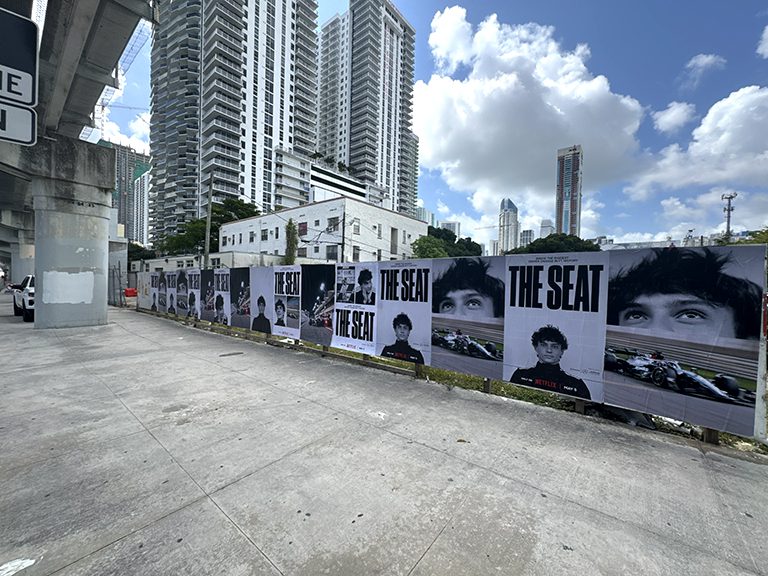
Street advertising puts your brand directly in the path of real people moving through real neighborhoods, earning attention that no algorithm can replicate.
Advertising in the street is the oldest form of brand communication and one of the most powerful still in use. Before the internet, before television, before radio, brands put messages on walls, handed things to people in public spaces, and created spectacles that gathered crowds. The fundamental human dynamic has not changed. People walking down a street are present in a way that people scrolling a feed simply are not. They are in their bodies, in their neighborhood, moving through a physical world that has context and meaning to them. Brand messages encountered in that world hit differently than messages encountered through a screen.
We have been executing street advertising campaigns for over a decade. We know every block of SoHo, the whole Sunset Strip, the Milwaukee Avenue corridor in Chicago, the Wynwood grid in Miami. We know which surfaces hold posters through a winter in Minneapolis and which materials survive August humidity in Houston. This guide covers everything about advertising in the street: the formats, the strategy, the execution city by city, and the measurement approaches that actually tell you whether the campaign worked.
In a world where most marketing investment has shifted to digital channels, street advertising has become relatively less competed for and relatively more impactful per impression. The number of brands running serious street campaigns has not kept pace with the number of brands shifting budgets to digital. That creates an opening.
Attention quality is higher on the street. A person walking down their neighborhood block is not managing dozens of competing stimuli the way a person scrolling social media is. They are physically present in an environment. Their attention, while distributed across everything in the environment, is available in a more relaxed and receptive way than the attention they bring to a phone screen. A striking piece of street advertising captures a quality of attention that most digital advertising never reaches.
Ad fatigue does not apply. Digital consumers have developed sophisticated ad-avoidance behaviors. They install blockers, skip pre-rolls, scroll past promoted posts without registering them. Street advertising bypasses these defenses entirely because it exists in the physical world where no skip button exists. The person walking past your poster has to look at the wall. They cannot choose not to.
Context alignment creates relevance. Street advertising in the right neighborhood is inherently contextually relevant. A food and beverage brand advertising on the blocks surrounding its retail distribution is reaching consumers who are geographically close to the purchase opportunity. A fitness brand advertising on the running paths near its retail locations is reaching consumers in the exact mindset where the brand message is most relevant. That geographic specificity is something digital advertising can approximate but never fully replicate.
Social amplification extends reach far beyond the physical footprint. Good street advertising gets photographed and shared. A striking mural, a clever stencil, a dramatic installation in an unexpected location generates social content that travels far beyond the immediate geographic footprint of the campaign. The street reach and the digital reach multiply each other, and the organic social content carries credibility that a paid digital ad never has.
The competitive environment has thinned out. Ten years ago every major brand was investing in outdoor street advertising as a baseline channel. The shift to digital has reduced that competition substantially. A brand running a quality street campaign in the right neighborhoods today faces less visual competition than it would have a decade ago, meaning its campaign stands out more clearly against the environment.
The Full Range of Street Advertising Formats
Format
Typical Duration
Cost Range
Best Applications
Postering / Wheatpaste
Days to weeks
Low to Medium
Event promotion, launches, brand awareness
Stenciling
Weeks to months
Low
Brand building, neighborhood saturation
Murals
Years
Medium to High
Premium brand positioning, community integration
Sampling and hand-to-hand
Hours to days
Medium
Trial generation, product launches
Street team activations
Hours to days
Medium
Brand engagement, direct consumer contact
Ambient and surface advertising
Variable
Medium
Brand surprise, creative brand moments
Pop-up installations
Days to weeks
Medium to High
Brand moments, launch events, PR generation
Projection campaigns
Hours per activation
Medium to High
High-impact social content, announcements
Postering: The Foundation of Street Advertising
Postering is the most widely used form of street advertising and for good reason. It is fast to deploy, scalable across multiple locations, and capable of creating significant visual presence in a neighborhood quickly. A well-executed postering campaign can blanket a target area in a matter of hours and create brand awareness through repeated exposure across daily commute routes and neighborhood walks.
Effective postering requires attention to three elements: design quality, material quality, and placement precision.
Design quality determines whether the poster stops attention or blends into the visual noise of the street environment. Bold, high-contrast designs with minimal text read best at pedestrian speeds. Large headlines that communicate the core message in under two seconds. A visual element that is interesting enough to photograph. Type that looks good on a laptop screen will often disappear at thirty feet on a textured brick wall. We push every creative through a street-scale review before production.
Material quality determines how long the poster maintains its visual impact. We run most campaigns on 80 lb. uncoated text stock. It is heavy enough to survive paste application without tearing but light enough to conform to irregular surfaces. Weather-resistant materials with quality inks hold up through rain, sun, and urban wear. Cheap materials that fade, peel, or crack within days reflect poorly on the brand and waste the initial production investment. In LA’s UV environment, we add a UV-resistant coating as standard.
Placement precision determines who sees the poster and how often. We map poster placement to the daily movement patterns of the target demographic, concentrating on the commute routes, neighborhood hangout spots, and commercial corridors where they spend time. A poster in the wrong location at the wrong height seen by the wrong demographic is a wasted spend regardless of how good the design is.
AGM Field Note: Postering works through repetition. A single poster on a single block is a brand encounter. Twenty posters on twenty blocks along the same commute route is a brand experience. The density of coverage, concentrated in the right geography, is what creates the impression of brand ubiquity that drives recognition. We typically recommend a minimum of 30 placements within a target zone to create the saturation effect that makes a poster campaign feel like a real presence.
Stencil Advertising: Permanence at Street Level
Stencil advertising creates brand marks directly on street surfaces. Unlike posters, which are applied and then eventually covered or removed, stencil marks are part of the surface itself. They persist longer than posters and weather with the surface rather than peeling from it. They also read differently to the consumer. A stencil mark feels more permanent, more embedded in the neighborhood identity than a posted paper advertisement.
Stencil campaigns work particularly well for building brand presence over time in a specific neighborhood. The marks accumulate over multiple deployment rounds. The consumer who sees the same stencil mark on their daily walk develops a familiarity with the brand that builds with each encounter without requiring the formal advertising recognition that triggers defensive processing. The brand becomes part of the environment before it registers as advertising.
We have run stencil campaigns on sidewalks along the High Line approach on West 14th Street in New York, in alley walls in Logan Square in Chicago, and on loading dock floors in the Meatpacking District. Water-based formulas are the standard. They weather off naturally without leaving a permanent mark. The visual payoff during the campaign period is strong: fresh, graphic marks on concrete read as intentional, which creates curiosity and drives social photography.
Good stencil design is simple, bold, and legible at pedestrian scale. Complex imagery and small text fail as stencils because the medium does not hold fine detail well. The best stencil designs are reducible to a strong shape or a clear text mark that communicates the brand identity unambiguously. If the design does not read immediately from five feet on a textured surface, we simplify before we cut.
Mural Advertising: Long-Duration Street Presence
A commissioned mural is the highest-investment, highest-impact format in street advertising. A great mural creates years of brand presence in a single location. It becomes part of the neighborhood’s visual identity. People photograph it, use it as a backdrop, and share it on social media indefinitely. The earned exposures generated by a great mural over its lifetime dwarf the initial production investment many times over.
Mural advertising works best when the artistic quality is genuinely high and the brand integration is authentic rather than intrusive. A mural that looks like a billboard disguised as art generates negative community response. A mural that is genuinely beautiful and genuinely connected to the neighborhood’s identity while incorporating brand elements becomes a community asset that reflects positively on the brand for as long as it stands.
We work with talented street artists to create mural campaigns that serve both the brand’s objectives and the neighborhood’s visual culture. The artist brings genuine creative vision. The brand brings the context and the investment. The result is a collaboration that neither could achieve alone, and the community receives a piece of art that had a brand make possible rather than a billboard that happened to look like art.
We have managed murals that have been standing for three or more years and are still generating social media photography and brand exposures. The per-impression cost over the lifetime of a well-placed mural is extremely low relative to any other format. The upfront investment is higher, but the return timeline extends years rather than weeks.
AGM Field Note: When scoping mural work, we always ask: what is the wall’s ownership situation, what is the natural light on the wall throughout the day, and who uses the facing sidewalk and at what times? A mural on a north-facing wall in a shadowed alley will never photograph well regardless of how beautiful the art is. Wall selection is as important as artist selection.
Sampling and Hand-to-Hand: The Highest-Conversion Format
The most direct form of advertising in the street is putting your product directly in the hands of the consumer. Sampling and hand-to-hand distribution create brand encounters that no passive advertising format can match. The consumer holds the product. They experience it directly. They make an immediate personal judgment about it without the mediation of creative, copy, or media channel.
For CPG brands, food and beverage brands, and personal care brands, sampling at street level is the single highest-conversion street advertising tactic available. The conversion rate from direct trial to purchase is dramatically higher than from any impression-based format. There is no better persuasion tool than the product itself experienced without any prior bias or expectation.
Effective sampling requires strategic location selection, quality crew selection and training, and a product experience that genuinely speaks for itself. The logistics of street sampling, including product storage, temperature control for food and beverage, crew management across multiple simultaneous locations, and consumer interaction protocols, require professional management to execute at the quality level that a brand deserves. A badly executed sampling program with poorly briefed staff creates a negative brand impression that is worse than no program at all.
We recruit sampling staff locally in every market. Local staff know the neighborhood culture, know how to read body language and adjust their approach, and have a natural conversation style that reads as authentic rather than scripted. We brief every sampling team on the product’s story, the brand’s values, and the specific questions consumers are most likely to ask. The training investment shows in the quality of the consumer interactions and the conversion rates.
City by City: How Street Advertising Differs Across Markets
Street advertising is not generic. Every city has its own culture, its own street life, and its own relationship with advertising in public spaces. The best campaigns are designed for the specific market, not adapted from a generic template.
New York City
Dense, high-energy, and visually competitive. New York rewards density and boldness. The competition for visual attention is intense, which means campaigns need to be bolder, more direct, and more visually distinctive than they would need to be in less competitive markets. The L train corridor in Williamsburg, the pedestrian zones of SoHo, the lower stretch of Broadway between Canal and Houston, and the commercial strips of Crown Heights and Bed-Stuy are the highest-priority target zones for most consumer brands. Paste consistency is calibrated to the weather, and winter campaigns require adjustments to adhesive formulas that an inexperienced team will miss. We run crews who know these details from years of working through New York seasons.
Los Angeles
More car-oriented but with dense walkable corridors in Melrose, Fairfax, Silver Lake, and Venice. The visual aesthetic is more influenced by the elaborate mural culture of the city, which creates high standards for visual quality. LA campaigns need to work harder visually to stand out against a backdrop that includes some of the most sophisticated public art in the country. The scale of the city also requires vehicle-supported deployment for comprehensive geographic coverage, and UV-resistant materials are non-negotiable given the year-round sun exposure.
Chicago
Milwaukee Avenue and the surrounding North Side corridors are the primary street advertising environment for most consumer brands. The city’s extreme weather creates material selection challenges that must be addressed in campaign planning. Winter campaigns in Chicago require materials that hold in below-zero temperatures and adhesive formulas adjusted for cold application. We have executed campaigns in Chicago in January when the temperature was below zero and know exactly what the work requires under those conditions.
Miami
Wynwood’s mural culture makes it one of the highest-profile street advertising environments in America. The neighborhood attracts tourism and media attention that multiplies the reach of every installation significantly. The year-round warm weather eliminates the seasonal material concerns that affect northern markets, but the humidity requires specific formulation attention for paste campaigns. During Art Basel in December, Wynwood becomes one of the most contested visual environments in the country for brands that want cultural credibility.
Austin
South Congress Avenue and East 6th Street carry the creative demographic that matters most for most Austin campaigns. During SXSW, the entire Sixth Street and Red River corridor becomes contested advertising space. We operate in Austin year-round and have specific knowledge of the SXSW window, including the timing dynamics that determine which brands get noticed and which get lost in the noise of the event.
Paste Consistency, Surface Reading, and the Craft of Street Advertising
There is a technical dimension to street advertising that most brands never see and that separates professional execution from amateur results. The craft details matter because they determine how good the work looks in context, and how good it looks in context determines whether it generates the organic social sharing that extends campaign reach.
Surface reading is the first skill. Not all surfaces accept paste equally. Rough, porous concrete drinks paste and produces blotchy, uneven coverage. Painted metal sheds water and needs a different adhesive formula. Plywood accepts paste well but can warp if soaked too heavily. Brick requires specific technique to get the paper to conform to the texture without bubbling. Our crews read surfaces before they apply anything, and they adjust their approach accordingly.
Paste consistency is calibrated to the weather. On a cold morning in February, the mix is thinner to maintain workability. On a humid July night in Bushwick, we adjust again or the paste sets too slowly and the paper slides. These are small details that aggregate into major quality differences between a campaign that looks professional and one that looks like it was executed by people who did not know what they were doing.
Height and placement angle matter more than most brands realize. A poster at eye level on a busy pedestrian corridor reads completely differently from the same poster at eight feet on the same wall. The sight lines of approaching pedestrian traffic, the natural reading angle of the surface, and the distance from the nearest natural stopping point all affect how the poster is encountered and how long the viewer’s attention rests on it.
AGM Field Note: We document every placement at installation time and return for follow-up photography at peak daylight hours. The installation photograph taken at 3 AM rarely captures the campaign as it actually looks to a pedestrian encountering it in daylight. The daylight documentation is what goes in client reports, and it is what gets used for case study content. Do not let your agency skip this step.
Integrating Street Advertising with Digital Campaigns
Street advertising and digital advertising work best when they are designed to work together rather than independently. The physical street presence creates the foundation. The digital campaign builds on that foundation and extends it to audiences who cannot physically encounter the street campaign.
The integration points are multiple. Street campaigns generate social content that feeds digital channels. The organic posts from passersby who photographed the campaign carry credibility that branded social posts cannot replicate. Digital campaigns can target by geography to reach people in the same neighborhoods where street campaigns are running, creating the dual-exposure effect that builds brand memory faster than either channel alone. QR codes and short URLs on posters bridge physical encounters to digital experiences when the creative concept warrants that connection.
Social media campaigns can invite the audience to find street installations and share photographs, turning a brand campaign into a community participation event. When the brand creates something genuinely worth finding and sharing, the invitation feels like an opportunity rather than a marketing ask. The best integration strategies lean into this dynamic explicitly.
The dual-exposure effect of street and digital working in the same geography is particularly valuable for brand building. A consumer who sees your brand on a poster on their morning walk and then on their Instagram feed in the evening has encountered your brand twice in one day in contexts that reinforce each other. That dual exposure creates stronger brand memory than either channel achieves independently, and the cost of achieving it through coordinated street-plus-digital is typically lower than trying to achieve the same brand memory depth through digital alone at the necessary frequency.
Measuring Street Advertising Impact
The question of measurement comes up in every brief we receive, and it is worth addressing directly. Street advertising is not unmeasurable. It requires different measurement tools than digital advertising, but those tools exist and produce real data.
Impression estimates using foot traffic data for each location give a baseline of potential exposure. These estimates are directional rather than precise, but they provide the framework for evaluating scale and comparing neighborhood-to-neighborhood efficiency.
Brand recall surveys conducted in the specific neighborhoods where a campaign ran two weeks after execution measure actual human memory of the campaign. We ask people in the target neighborhood whether they remember seeing the campaign, what they recall about the creative, and whether their perception of the brand changed. This is the measurement that actually tells you whether the investment in street presence created lasting brand exposures.
Social media monitoring during and after the campaign period tracks organic posts, shares, and tagged content related to the campaign. When people are photographing and sharing your street campaign without being asked to, that organic engagement is both a measure of impact and an amplification of reach.
For retail-adjacent campaigns, geographic point-of-sale data correlation during and after the campaign period provides the most direct commercial signal. When sales velocity in the target geography increases during and after the campaign window, the connection between the street campaign and the commercial outcome is directional evidence of effectiveness.
What to Prepare Before You Brief a Street Advertising Agency
The quality of a street advertising campaign is heavily determined by the quality of the brief that precedes it. Agencies that receive clear, specific briefs produce better work in less time and with fewer revisions. Here is what to have ready before the first conversation.
Know your audience specifically. Not “18-34 urban consumers.” Know the specific neighborhoods, daily movement patterns, and cultural touchpoints that define the person you are trying to reach. The more specific the audience definition, the more precisely the agency can select the right locations, surfaces, and neighborhood contexts.
Have a clear campaign window and timeline. Street advertising is time-sensitive in ways that digital advertising is not. Production, location confirmation, crew scheduling, and permit management all require lead time. Three to four weeks is the minimum for a well-executed single-market campaign. Multi-city campaigns require six to eight weeks. Knowing your dates before you brief means you receive a realistic execution plan rather than promises that cannot be kept.
Define what success looks like. Is this a launch awareness campaign? A sustained brand building program? An event support activation? Each objective produces different campaign recommendations. Telling the agency what success means to you before they build the proposal ensures that the proposal addresses your actual goal rather than a generic interpretation of your category.
Frequently Asked Questions
What are the main forms of advertising in the street?
The main forms include postering and wheatpaste campaigns, stencil and chalk art programs, commissioned murals, sampling and hand-to-hand product distribution, street team activations, ambient surface advertising, pop-up installations, and building projections. Each format serves different objectives, durations, and budgets. Most effective campaigns combine multiple formats to create layered brand presence across a target geography.
How much does street advertising cost?
Costs vary based on format, geography, scale, and duration. Stencil campaigns start at $2,855 for 5 stencils. Poster campaigns start at $4,500 for 100 standard posters (24×36). Mural campaigns are quoted by project scope. Sampling programs are priced by crew size, duration, and locations. Contact us at (646) 776-2770 for a custom quote.
How do you choose which streets and neighborhoods to target?
We map the target demographic to specific geographies by analyzing foot traffic data, demographic profiles of neighborhoods, retail distribution locations, event calendars, and cultural activity patterns. The goal is to concentrate street advertising where the target consumer moves at the highest frequency. We do not apply generic city-wide coverage. We apply precision targeting to the specific streets and blocks where impact will be highest for your specific audience.
How long does street advertising last?
Duration varies enormously by format. Posters typically last days to weeks before being covered or weathering. Stencils last weeks to months. Murals last years. Sampling events are immediate within their duration window. We design campaigns with duration in mind, selecting formats that match the intended campaign length and ensuring materials are appropriate for the expected exposure given local weather conditions.
Does street advertising work in smaller cities?
Yes, and often more effectively per dollar than in major metros. Smaller cities have less visual advertising noise, making well-executed street advertising more noticeable relative to the competition. Community cohesion in smaller cities also means that a brand showing up authentically generates more word-of-mouth than the same brand would in New York or Los Angeles. We operate in over 50 US markets including mid-size cities where street advertising is particularly efficient.
How does street advertising generate social media content?
Visually striking street advertising gets photographed by passersby and shared on Instagram, TikTok, and neighborhood community platforms. The more surprising, beautiful, or remarkable the physical installation, the more photography it generates and the further that photography travels through social networks. We design all street campaigns to be photogenic and to generate the organic social content that extends physical campaign reach into digital networks at no additional paid media cost.
What makes a street advertising creative work at street scale?
Bold, high-contrast design with minimal text. One dominant visual element that reads from thirty feet. A clear brand signal that communicates in under two seconds. Type that is large enough to read from the nearest natural stopping point, which is often fifteen to twenty feet away. Avoid design that looks great on a laptop screen but disappears at street scale. We review all creative files against street-scale specs before production is approved.
Can street advertising work alongside digital campaigns?
Yes, and we strongly recommend running both together. Street and digital create reinforcing exposures when deployed in the same geography. The physical encounter creates initial brand recognition. The digital encounter reinforces it. The combination builds brand memory at a rate that either channel alone cannot match at comparable cost. We design integrated campaigns that coordinate physical and digital deployment for maximum combined impact.
How does American Guerrilla Marketing approach street advertising?
We start with the objective and work backwards to tactic selection, location curation, and production spec. We do not sell you a tactic because it is what we happen to have available. We build a campaign around what actually moves the needle for your brand in your market with your audience. Every campaign includes pre-production location scouting, a detailed placement plan, professional crew deployment, geotagged documentation of every placement, and post-campaign reporting.
We operate in over 50 US markets with active crew networks. Our primary markets include New York City, Los Angeles, Chicago, Miami, Austin, Houston, Atlanta, Boston, Seattle, San Francisco, Philadelphia, Denver, Nashville, and Portland. For any market, contact us at (646) 776-2770 and we will confirm current crew availability and location inventory.