Ad Mediums: Every Advertising Channel Brands Need to Know
Every ad medium has a different mechanism for reaching people. Understanding how each one actually works is the foundation of building a campaign that does more than spend money, but earns real results.
We think about ad mediums constantly. Not in a theoretical sense, but in the practical sense that determines which medium we recommend for each client and why. The choice of ad medium is one of the most consequential decisions in any campaign plan. It determines who sees the brand message, in what context, at what level of attention, and with what capacity to respond.
This guide covers the major ad mediums, how each one works, what it costs, and when it is the right choice. We are going to be direct and specific because general descriptions of advertising channels are easy to find. What is harder to find is a clear-eyed assessment of what each medium actually delivers and what it does not.
What an Ad Medium Is and Why Choosing the Right One Matters
An ad medium is the channel through which an advertising message travels from the brand to the audience. The medium is not the message. But the medium shapes how the message is received, processed, and remembered. Two identical brand messages delivered through two different ad mediums can produce dramatically different audience responses because the medium determines the attentional context, the viewing environment, and the emotional state the audience is in when they encounter the message.
A billboard message is received by someone moving through a physical environment, often at speed. The same message as a street poster is received by a pedestrian at close range with time to stop and look. The same message as a social media post is received by someone in a scroll-and-skip mode in a digital context designed for speed. These are three fundamentally different reception experiences, and the same creative will not perform equally well across all three.
Choosing the right ad medium means understanding your audience’s physical and digital behavior well enough to know which medium intercepts them in the context most favorable to your campaign goal. That understanding is the starting point for every campaign we plan.
Outdoor Ad Mediums
Outdoor ad mediums reach people in the physical environment. They are some of the oldest advertising formats in existence and among the most resilient because the physical environments where people spend time have not been replaced by digital equivalents. People still walk through cities, ride transit, drive on highways, and move through public spaces. Those environments remain available to advertisers.
Traditional Billboards
Billboards are the largest-scale outdoor ad medium. They appear on highways, arterial roads, and high-visibility building facades in urban cores. Their primary function is brand awareness: they deliver a simple, high-contrast message to a large number of viewers over a period of weeks or months. The viewing time is extremely short, typically under five seconds for vehicle traffic, which constrains the message to a single visual and minimal copy.
Billboards work best for running brands with strong visual identities that can communicate effectively in a single glance, for campaign messages that are genuinely simple enough to work at that level of brevity, and for markets where the billboard inventory is positioned to reach the target audience’s travel patterns.
Street-Level Poster Placements
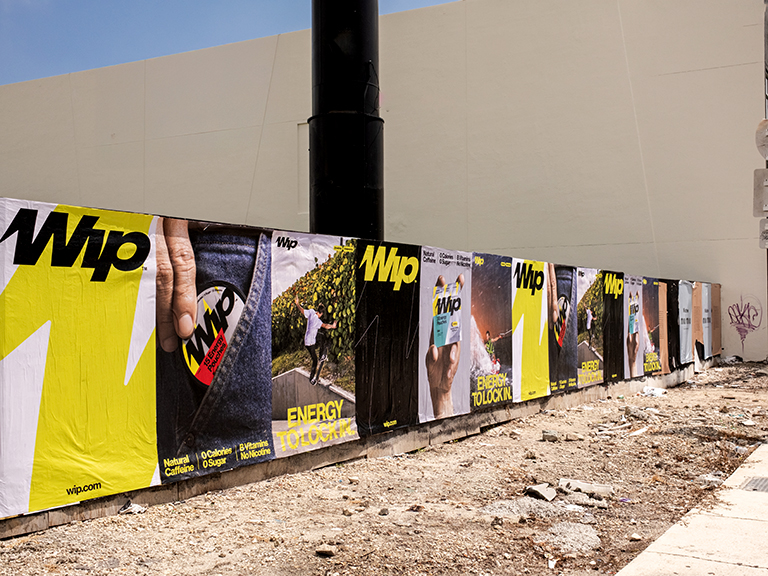
Street-level poster placements are large-format printed materials placed on permitted walls, construction hoardings, and other vertical surfaces at pedestrian height. Unlike billboards, street posters reach pedestrians at close range over a longer viewing window. A pedestrian can stop in front of a street poster and spend ten, twenty, or thirty seconds looking at it. That viewing time changes the creative possibilities entirely: street posters can carry more detailed visuals, more nuanced messaging, and more complex brand communication than billboards.
Street poster placements are particularly effective in the high-density commercial neighborhoods of major cities where the right audience is present in large numbers at street level throughout the day. In SoHo in New York, in the Fairfax District in Los Angeles, in Wicker Park in Chicago, a well-positioned street poster reaches thousands of the right people every day in a format they have the time to actually look at.
Transit Advertising
Transit advertising appears on buses, subway cars, subway stations, commuter rail, and other public transportation infrastructure. Its key advantage is captive audience time: transit riders are in a confined space with the advertising for an extended period, often five to forty minutes per ride. That captivity creates an impression opportunity that most other outdoor ad mediums cannot match in duration.
Transit advertising in high-ridership systems like the New York subway can deliver enormous impression volumes with precise geographic and demographic targeting based on which lines and stations serve which communities. The New York L train serves a dramatically different audience from the J/M/Z train, and a brand that knows which line its target audience uses can buy very precisely into exactly the right audience context.
Ad Medium
Reach
Attention Duration
Targeting Precision
Cost Level
Highway Billboard
Very High
2-5 seconds
Low-Medium
$$$
Street Poster
High (neighborhood)
5-30+ seconds
High
$$
Transit Advertising
Very High (urban)
5-40 minutes
High (line/station)
$$$
Street Furniture
High (local)
3-15 seconds
High
$$
Guerrilla Installation
Medium (targeted)
30+ seconds
Very High
$$-$$$
Building Projection
Medium-High
1-10 minutes
High
$$$
Digital Ad Mediums
Digital ad mediums reach audiences on screens across social platforms, search engines, websites, apps, streaming services, and other digital environments. They offer targeting precision and measurability that no outdoor format can match, but they compete in an attention environment where ad avoidance is high and audience engagement with branded content is generally declining.
Social Media Ad Mediums
Social media ad mediums on platforms including Instagram, TikTok, Facebook, X, LinkedIn, and Pinterest reach audiences through native formats: feed posts, stories, short-form video, and discovery placements. The targeting capabilities are extremely granular, allowing brands to reach specific demographic and behavioral profiles with precision that no traditional medium offers.
Social media ad mediums work best for campaigns with conversion goals and well-defined audience parameters, for retargeting existing website visitors or customer lists, and for distributing content that has value independent of its advertising function. Pure interruption advertising on social platforms is increasingly ineffective as audiences become more adept at identifying and skipping sponsored content.
Search Ad Mediums
Search advertising captures demand that already exists. When someone searches for a product category or brand, search advertising ensures the brand appears at the top of those results. The medium is uniquely suited to reaching consumers at the moment of active purchase intent, which makes it one of the highest-conversion ad mediums available for many product categories.
Search ad mediums do not generate awareness for brands that lack existing search demand. They capture and monetize demand rather than creating it. For brands seeking to build awareness in a new market or with a new audience, search advertising must be combined with awareness-generating mediums rather than used as the primary awareness channel.
Experiential Ad Mediums
Experiential ad mediums create direct physical encounters between brands and consumers. They include brand activations, sampling programs, interactive installations, pop-up events, and any format that requires the consumer to be physically present in a brand-created experience.
The distinction between experiential ad mediums and other formats is the audience’s role. In conventional ad mediums, the audience is a passive receiver of the brand message. In experiential mediums, the audience is an active participant in a brand encounter. That active participation creates a fundamentally different quality of impression: more engaging, more memorable, and more likely to generate word-of-mouth recommendation.
The medium determines the impression quality: Choosing an ad medium is choosing the context in which your brand will be encountered. A brand that shows up in a consumer’s physical environment through a surprising, high-quality installation is encountered differently than a brand that shows up in a digital feed. The physical encounter is harder to achieve but creates a more durable impression. For brands where that durability matters, outdoor and experiential mediums are the primary tools.
How to Build an Ad Medium Strategy
An effective ad medium strategy is not a list of channels to buy. It is a deliberate allocation of budget and attention across the mediums that most efficiently achieve each campaign goal with the specific target audience.
Start with the audience. Define who you are trying to reach with enough specificity to identify where they are physically and digitally. Not a demographic description but a behavioral description: where do they go, what routes do they take, what content do they consume, what communities do they belong to?
From that behavioral picture, identify the ad mediums that intercept the audience in the contexts most relevant to the campaign goal. If the goal is awareness in a specific urban geography, outdoor mediums in the relevant neighborhoods are primary. If the goal is conversion from a defined audience, digital targeting is primary. If the goal is cultural credibility with a specific community, guerrilla and experiential mediums that operate in that community’s physical environment are primary.
Allocate budget to mediums in proportion to their contribution to the campaign goal. Do not split budget evenly across all available mediums. Concentrate in the mediums that do the most important work for this specific campaign, and use supporting mediums to reinforce rather than duplicate.
The combination principle: Almost every effective campaign uses more than one ad medium. The primary medium creates the initial impression. A supporting medium reinforces it in a different context. The combination produces a compounding awareness effect that neither medium produces alone. We design every campaign we plan around a primary medium and a supporting medium chosen to create that compound effect.
Broadcast and Audio Ad Mediums
Broadcast ad mediums include television and radio, formats that reach mass audiences through audio-visual or audio-only content. Television advertising delivers high-production creative to viewers in a lean-back consumption state, often during premium programming that represents the most attention-engaged viewing an audience will have outside of a movie theater. Radio advertising reaches commuters, workers, and active listeners through audio that must communicate without any visual support, forcing the creative to carry the full communicative load through voice, music, and sound design.
Broadcast mediums have historically required significant minimum budgets to reach meaningful audience scale, and national campaigns on major networks have remained out of reach for most brands outside the Fortune 500. The rise of streaming audio platforms like Spotify and podcast networks has opened broadcast-style audio advertising to brands at much lower minimums with targeting capabilities that traditional radio never offered. A podcast advertising placement on a show whose audience perfectly matches a brand’s target can outperform a national radio buy at a fraction of the cost.
Streaming video platforms including YouTube, Hulu, and connected TV services now offer television-style video advertising at more accessible minimums with demographic and interest-based targeting that broadcast TV cannot match. Pre-roll video advertising on YouTube reaches specific audience segments while they are already in a video-consumption context. Connected TV advertising reaches streaming households in the living room environment that broadcast television dominated for decades, but with data-driven targeting rather than broad demographic reach.
Print Ad Mediums: Where They Still Work
Print ad mediums have contracted significantly as a share of total advertising spend over the past two decades, but declaring print dead misreads the actual market. Print advertising in highly specific, deeply relevant publications delivers impression quality that most digital formats cannot match. A reader who has paid to subscribe to a niche magazine covering their professional field or personal passion is in a fundamentally different reception state than someone scrolling a digital feed. That reader sought out the content. They are focused, receptive, and spending real time with every page.
Direct mail is the print medium that has experienced the most significant strategic rehabilitation in recent years. As inboxes became saturated and email open rates declined, physical mail became a less-competed channel with attention characteristics that digital formats have lost. A high-quality direct mail piece that arrives in a household and gets handled, not deleted with a swipe, has access to genuine consideration time that no digital format can reliably replicate. Luxury brands, financial services, and consumer goods categories with high average purchase values have returned to direct mail precisely because that attention is worth paying for.
Ambient and Unconventional Ad Mediums
Ambient ad mediums use everyday objects, spaces, and surfaces to deliver brand messages in unexpected contexts. A gym floor chalked with a brand’s campaign message. A coffee cup sleeve printed with an ad that 20 million coffee drinkers handle every morning. The tray tables on an airline route that perfectly matches the demographic profile of a brand’s target customer. Stickers on produce in grocery stores. Messages on ATM screens. Ads on the top of taxi cabs visible from above in urban buildings.
What these placements have in common is that they reach people in moments when advertising is genuinely unexpected. The surprise of the encounter creates attention that intentionally placed media cannot generate. When a consumer notices an ad in a context they did not anticipate, the cognitive engagement is higher because their pattern-recognition has been disrupted. Ambient ad mediums exploit that disruption to create an impression that outlasts what a conventional media placement would produce.
AGM Field Note: We have placed branded messages on coffee cup sleeves distributed through cafes in Williamsburg and DUMBO in Brooklyn targeting creative professionals. The cost per impression was a fraction of transit advertising, but the impression lasted the entire length of the coffee, typically 20 to 40 minutes of direct contact with the brand. Context-driven ambient placements routinely outperform their CPM numbers would suggest because the impression quality per contact is so much higher than standard digital or OOH.
Market-Specific Ad Medium Planning
The right ad medium is not the same in every market. New York City, Los Angeles, Chicago, Miami, and Austin each have distinct media environments that favor different medium choices. Understanding the specific characteristics of each market is part of what makes the difference between a campaign that performs and one that spends money without achieving its goal.
New York City is a pedestrian city with one of the highest-ridership transit systems in the world. Street-level poster placements and transit advertising are the dominant outdoor formats, reaching enormous daily audiences in the physical contexts where they spend the most time. The density of foot traffic in Manhattan, Brooklyn, and Queens makes street-level OOH more efficient here than almost anywhere else in the country.
Los Angeles is a driving city with a distributed geography and a culture of experiential discovery. Vehicle traffic and highway billboard placements reach the commuting audience, but the cultural tastemaker neighborhoods of Silver Lake, Echo Park, Fairfax, and Venice reward street-level placements with an audience that pays close attention to what is on the walls around them. Brand activations and pop-up events in LA generate outsized social media documentation compared to other markets because the audience is primed for visual discovery.
Chicago is a mix of transit density in the core and driving culture in the outer rings. The El train system reaches the urban core commuter with the captive audience time that subway advertising creates, while highway placements serve the broader metro area. Miami is seasonal with heavy tourist traffic in the winter months and a resident audience concentrated in specific neighborhoods where street-level placements and event-based marketing reach both tourists and locals with equal efficiency.
Matching the ad medium to the specific market’s physical and behavioral characteristics is not optional. It is the difference between buying exposures that reach the right people and buying exposures that reach the wrong people in the wrong context.
Frequently Asked Questions About Ad Mediums
Frequently Asked Questions
What are ad mediums?
Ad mediums are the channels through which advertisers deliver messages to target audiences. They include outdoor formats like billboards and street posters, broadcast formats like television and radio, digital formats like social media and search advertising, print formats like magazines and direct mail, and experiential formats like brand activations and guerrilla installations.
What is the most effective ad medium?
No single ad medium is universally most effective. The right ad medium depends on who you are trying to reach, where they are, what campaign goal you are pursuing, and what budget you are working with. Outdoor mediums are highly effective for reaching urban audiences in physical environments. Digital mediums are effective for conversion-oriented campaigns with precise targeting requirements.
What are outdoor ad mediums?
Outdoor ad mediums reach audiences in the physical environment outside their homes. They include traditional billboards, street-level poster placements, transit advertising on buses and subway cars, street furniture advertising on bus shelters and kiosks, digital out-of-home screens, vehicle wraps, and building projections.
How do guerrilla ad mediums differ from traditional ones?
Traditional ad mediums operate within defined media slots and reach audiences through expected channels. Guerrilla ad mediums create unexpected encounters in the physical environment that feel like discoveries rather than advertisements. The audience’s experience generates surprise, curiosity, and a stronger memory impression.
How do I choose the right ad medium for my campaign?
Start with your target audience and identify where they spend their time, both physically and digitally. Then identify the ad mediums that most efficiently reach them in those contexts. Consider the campaign goal: awareness, consideration, conversion, or cultural positioning each favor different medium choices.
What ad mediums work best for reaching urban consumers?
Urban consumers are best reached through street-level outdoor ad mediums including large-format poster placements, transit advertising, ambient installations, and building projections. These mediums reach city audiences in the physical environments where they spend significant time and create a contextually relevant brand encounter that digital advertising cannot replicate.
Can multiple ad mediums be used together?
Yes, and coordinating multiple ad mediums typically produces stronger results than any single medium in isolation. The combination of a street-level physical medium for initial brand awareness with a digital medium for targeted follow-up creates a compound impression effect that improves both recall and conversion.
We specialize in outdoor and guerrilla ad mediums: street-level poster placements, building projections, brand ambassador programs, ambient installations, and related formats that reach urban audiences in their physical environment. Call us at (646) 776-2770 or email [email protected] to discuss which ad mediums fit your campaign.