
November 24, 2026
Truck billboard advertising: How It Actually Works
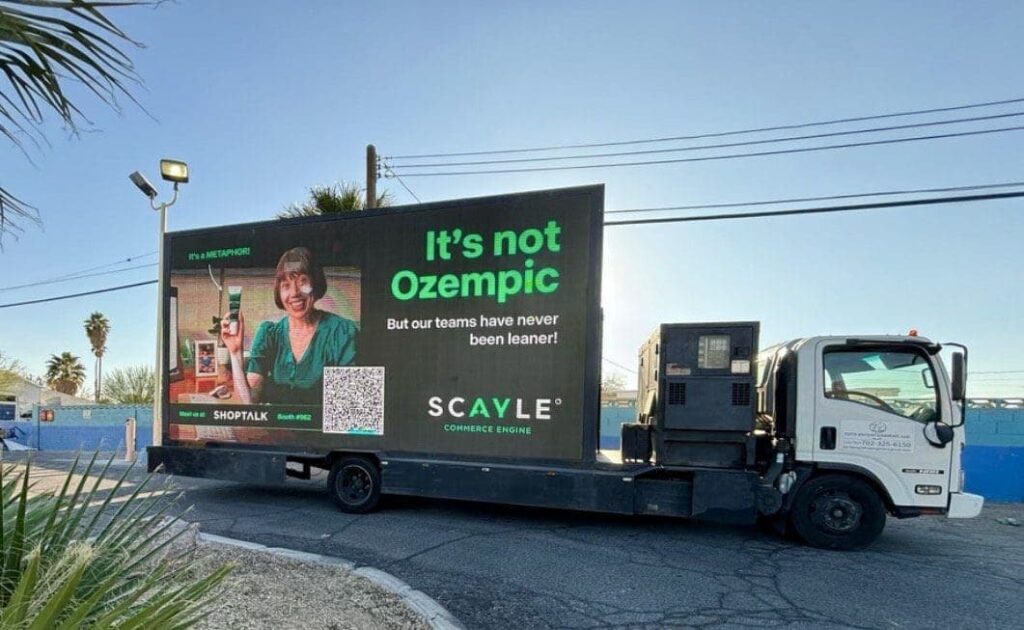
A billboard truck is a vehicle built to carry advertising faces. Two long sides and a back, either printed vinyl stretched over frames or LED screens running off an onboard player, with a generator keeping the lights or the panels alive.
That description takes ten seconds. Everything that determines whether your campaign works happens in the decisions around it. What the faces are made of. How the artwork was built. Who is driving. What happens when the generator cuts out at six in the evening in the middle of the corridor you paid for.
I have spent enough time in and behind these vehicles to have opinions about all of it. This page is about the truck itself and the production and logistics around it, because that is the part buyers almost never ask about and the part that decides what they actually receive.
If you want the route design argument, the short version is that dwell beats distance and a truck crawling through congested streets outperforms the same truck at speed on a motorway. That principle governs everything. But route planning is only useful once the vehicle and the artwork are right, and they frequently are not.
Printed vinyl or LED: the decision that changes everything
This is the first real fork and buyers often take it by accident.
Printed vinyl. Large format print on vinyl, stretched and tensioned over a frame on each face. Lit at night by onboard floods aimed at the surface. One message for the whole flight.
What it gives you is colour fidelity. A printed face reproduces a brand palette accurately and consistently, in daylight, in overcast, in every condition. Deep blacks are actually black. Fine gradients survive. If your brand has a specific colour that marketing fought over for a year, print reproduces it and a screen approximates it.
It is also physically reliable. There is nothing to crash, nothing to overheat, no software. A printed face that is correctly tensioned will look the same on day fourteen as on day one.
What it costs you is flexibility. The message is fixed from the moment it is produced. If a date changes, if something sells out, if the offer shifts, you are reprinting and refitting.
LED screens. Panels on each face, content running from an onboard player, powered by the generator.
What it gives you is change. Multiple creatives in rotation. Dayparting, so the morning commute message differs from the evening one. Mid-flight updates pushed from a laptop when something shifts. Motion, which genuinely attracts the eye.
It also gives you the night. After dusk an LED truck is the brightest object on the street, throwing light onto surrounding surfaces, very hard to ignore and extremely photogenic.
What it costs you is daylight performance and colour accuracy. In direct midday sun the screen is competing with the brightest light source available. It reads clearly and looks competent rather than commanding. Colours sit flatter than on your monitor and blacks read as dark grey.
The honest guidance I give: if your campaign is daytime-weighted, carries a single message, and depends on exact colour, printed vinyl is the stronger product. If your campaign runs into the evening, needs to change, or targets nightlife and events, LED earns its place. If the flight spans both, run a mixed fleet. There is no rule saying every vehicle on a campaign must be the same.
What the production process actually involves
For printed vinyl, this is a real manufacturing step and it drives lead time more than anything else.
We give you exact dimensions for each face, including bleed and the areas where the frame and tensioning hardware sit. Those margins matter. Artwork that runs critical content to the extreme edge loses it to the frame, and a logo positioned in a corner can end up partially wrapped.
Files need to be built at the right proportions for large format output. Images that look fine on a web page fall apart when they are enlarged to the side of a box truck. We check resolution before anything goes to print, because the moment to discover that the hero image was a small file is not after the vinyl is produced.
The vinyl gets printed, trimmed, and then fitted and tensioned on the frames. Tensioning is a craft step. Loose vinyl ripples in wind and the ripple reads from the street as a cheap finish. Correctly tensioned vinyl is flat and reads as a solid surface.
For LED, there is no physical production, which makes it faster to get live. What replaces it is testing. Content that looks correct on a monitor can be wrong on an actual panel, because panel brightness, pixel pitch and colour response differ from a desktop display. We load content onto the real screens and look at it before a flight starts. Thin type that was legible on a laptop can bloom and smear on a bright panel. Subtle dark tones can vanish entirely.
This testing step is skipped constantly by operators working at pace, and it is the most common source of a flight that technically ran correctly and looked wrong.
Artwork rules for a surface moving through traffic
The audience reads truck advertising in motion, at an angle, in uncontrolled light, frequently partially blocked by a bus or another vehicle, for a short interval, while driving or walking and thinking about something else.
Design for that and nothing else.
One idea. Not a headline plus a secondary message plus a product list.
Type large enough to read across lanes of traffic. The test I use is viewing the full artwork reduced to the size of a playing card. Anything illegible at that size is illegible on the street.
High contrast. Subtle palettes collapse outdoors.
Brand mark big enough to register in a glance. If someone takes away the message but not who said it, the impression did not do its job.
Short, memorable web addresses. Long URLs are not readable and not recallable. A campaign-specific short address doubles as your cleanest response measurement.
Be realistic about scannable codes. The viewer is often driving. A code on a moving vehicle is frequently unusable, however large. Codes work where people stand still, which on a truck campaign means the stationary and event portions of the flight rather than the driving portions.
For LED specifically, build animation so that any single frame still communicates. Viewers arrive midway through the sequence. If your content tells a story across six seconds, most people get a fragment of it.
We review artwork against all of this and we will ask for changes. That pushback is part of what you are buying. An operator who accepts any file without comment is not doing you a favour.
The vehicle, the driver and the things that break
One truck runs with one driver. That driver is simultaneously the operator, managing the generator, the screens or the floods, the route sheet, the parking decisions and the photographic documentation, while driving a large vehicle through traffic. It is more demanding than people assume.
A route day is typically six to ten hours of active running. Round the clock coverage is possible with multiple drivers and a scheduled handoff, and it is a staffing decision to be made deliberately rather than assumed into a brief.
Things that genuinely go wrong, in roughly the order I have seen them:
Generator issues. The generator powers the screens or the floods. Heat is its enemy, and an extended summer flight in a hot market stresses it. A failed generator in the middle of an evening means a dark truck driving a route, which is a wasted shift. Good operators carry the maintenance schedule seriously and have a contingency.
Vinyl damage. Road debris, branches on tight streets, contact in a loading area. A torn face has to come off. Weather degrades printed faces too, and road salt in a winter market dulls vinyl noticeably over a long run.
Screen faults. Panels can develop dead sections. A visible dead block on a face is worse than no screen at all, because it reads as neglect.
Route obstruction. Construction, closures, event road management, a parade nobody flagged. This is why routes get physically driven in advance and why a daily check matters rather than a single plan made in week one.
Weather. Heavy rain destroys visibility from the sidewalk and from other vehicles. High wind is a genuine safety concern for a tall flat-sided vehicle and there are days when the right call is pulling off a bridge-heavy route. Extreme heat dims panels and stresses generators. On flights of more than a few days we build contingency and move a day rather than burn one.
Multi-market tours and event work
Where truck billboard advertising does its most distinctive work is following something.
Event targeting is the clearest case. A conference, a stadium event, a festival, a convention, a race. You have a known crowd, a known window and known approach and egress routes. Fixed inventory near a major venue tends to be locked up far in advance and priced accordingly. A truck does not need inventory to exist. It works the approach streets, the car park routes and the departure flow, reaching a highly qualified audience at the exact moment they are thinking about the thing you are advertising.
Tours are the other case. A campaign moving between cities on a schedule, with vehicles repositioning between markets. This is a logistics exercise. Transit days between markets are not advertising days, and an honest operator builds the schedule showing you which days are productive and which are repositioning. Anyone presenting a multi-city tour where every day is a full route day is either not accounting for driving time or is not telling you about it.
The practical consequence is that tours favour either clustered markets within reasonable driving distance of each other, or longer stays in fewer cities. A schedule that bounces across a large country every two days spends most of its budget on motorway miles.
Standing still: the grey area
Buyers very often picture the truck parked in one perfect spot for hours.
Standing a large advertising vehicle in a fixed position is the part of this format most likely to attract attention from a property owner, a business, a parking officer or a local ordinance. Rules for advertising vehicles vary by municipality and frequently by district within a city. Some places regulate them specifically, some address them through general signage or vehicle codes, and enforcement is inconsistent even within one market.
It is a grey area, and I will not tell you that a given placement is legal or illegal in your city. That is not a claim any marketing operator is in a position to make for you.
What I can tell you is how we reduce the risk. We keep vehicles moving for the bulk of a route day, because a vehicle in traffic is operating as a vehicle and because motion is more productive anyway. Where a client genuinely needs a stationary placement, we secure written permission from a private property owner and park on private ground rather than relying on public curb space. We use drivers who know the market and which districts attract attention. We avoid restricted zones, school arrival and dismissal times, and any position where a large vehicle creates a real obstruction. We keep documentation with the vehicle.
And we tell clients honestly when a market has a reputation for being strict with advertising vehicles. You should hear that before you book rather than discover it mid flight.
How to judge a truck billboard operator
Since you are likely comparing options, here is what I would actually ask.
Ask whether routes are driven in advance. If the answer is vague, the route is a map exercise.
Ask what documentation you receive and how often. Timestamped, located photography and route logs should be standard, delivered during the flight rather than assembled at the end.
Ask for loop and rotation details on LED. How many creatives, how often each appears, who controls the schedule. On a dedicated truck, the whole screen should be yours.
Ask what happens when a vehicle goes down. Generator failure and mechanical issues happen. What matters is whether there is a contingency and whether lost hours are made up.
Ask how many productive hours per day, stated plainly, and on a tour, which days are repositioning.
Ask whether they will review your artwork and push back. An operator with real experience has opinions about type size.
Ask how stationary placements are handled, and listen for whether private property permission is part of the answer.
Anyone promising a precise impression count should be treated carefully. A vehicle does not know who looked at it. What is honest is documentation of where it was and when, paired with your own response measurement, a short campaign URL, a promotion code or a market-versus-control comparison.
What I talk clients out of
Motorway-weighted routes. The worst dwell environment available. Highways are how a truck gets between productive zones, not the product.
Single-truck saturation of a large metro. One vehicle can own a corridor, a district or an event. It cannot own a city. If the brief says citywide, the honest answers are more vehicles, a tighter geography, or a different format.
One LED creative for a three week flight. You paid for a capability. Build a morning version and an evening version at minimum.
Overloaded artwork. Every campaign reaches a moment where someone wants a product shot, a strapline, a legal line, a code and three logos on the same face. At distance, in motion, that reduces to noise.
Late night routes with no audience. The screens look spectacular at two in the morning. There is nobody there. We run into the evening where nightlife density justifies it and we stop when the street empties.
Small towns with no congestion. Where nothing ever slows down, a truck passes and is gone. Those markets are usually better served by ground-level formats.
A truck as the whole campaign. This is the big one. A truck is an attention format, not a persistent one. When it drives away, nothing remains on the street.
Why trucks work better with something that stays
A billboard truck gives you unavoidable presence in the moment. It gives you nothing tomorrow.
Printed street-level formats are the inverse. A poster is less arresting than a moving vehicle, but it is still on the wall next week, on the street where someone actually walks. Repetition is the mechanism that changes behaviour, and fixed placements deliver repetition cheaply.
Running both in the same tight geography over the same window is the strongest configuration we build. Someone sees the truck in traffic on the way in, then passes the same creative repeatedly on their own block over the following fortnight. Each encounter makes the others land harder. That is why [LED Trucks & Mobile Billboards](/services/led-trucks-mobile-billboards) and [Wheatpasting & Poster Campaigns] go out together on most of our serious flights.
Add [Sidewalk Decals & Stencils](/services/sidewalk-decals-stencils) for the last few feet at a door, and a crew from [Street Teams & Experiential](/services/street-teams-experiential) working beside a permissioned parked vehicle, and the attention the truck generates turns into something you can count.
Frequently asked questions
What is a billboard truck?
A vehicle built to carry large advertising faces, usually on two sides and the back, either as printed vinyl stretched over frames or as LED screens running content from an onboard player. A generator powers the screens or the night floods. One driver operates the vehicle and manages the equipment, route and documentation.
Should I choose printed vinyl or LED screens?
Printed vinyl reproduces brand colour accurately, holds up consistently in all daylight conditions and has nothing to fail electronically, but the message is fixed once produced. LED allows multiple creatives, dayparting and mid-flight changes, and dominates after dusk, while sitting flatter in direct midday sun. Mixed fleets across one campaign are perfectly normal.
How long does it take to get a truck campaign live?
LED moves faster because there is no physical production step, only content loading and testing on the actual panels. Printed vinyl adds genuine manufacturing time for printing, trimming, fitting and tensioning. Stationary placements take longest, because written permission from a private property owner needs a real person to agree.
Can a billboard truck park somewhere all day?
Standing a large advertising vehicle in one position is the highest-attention part of this format, and rules vary by municipality and district with inconsistent enforcement. It is a grey area. Where clients need a genuine stationary placement we secure written permission from a private property owner and park on private ground rather than using public curb space.
What size should truck billboard artwork be?
We supply exact dimensions per face, including bleed and the margins where framing and tensioning hardware sit, because content run to the extreme edge gets lost. Beyond dimensions, build for distance and motion. One idea, very large type, strong contrast, and a brand mark big enough to register during a traffic light.
How many trucks do I need?
It depends on geography rather than market size. One vehicle can genuinely own a corridor, a district or the approach routes to an event. It cannot cover a large metropolitan area. If the brief calls for citywide presence, the realistic options are additional vehicles, a tighter target area, or layering in a fixed street-level format.
Request a campaign quote
The useful first conversation is about geography, timing and whether your campaign lives in daylight or after dark. Those answers settle the vinyl versus LED question and the route question before anyone discusses vehicle counts.
Tell us the markets, the dates, what you are promoting and what you need people to do after they see it. We will come back with a format recommendation, a route concept built on dwell rather than distance, exact artwork specs, and an honest read on the constraints in those specific cities. If we think a ground campaign would serve your objective better than a vehicle, you will hear that from us.
Request a campaign quote and we will build the route before we talk about anything else.

Ready to Run Your Campaign?
Call us or email us. We’ll tell you exactly what we can do in your market and what it costs.
Related Services
Explore similar advertising solutions offered by American Guerrilla Marketing.
American Guerrilla Marketing — Los Angeles
Street-level campaigns in Los Angeles and nationwide. Wheatpasting, LED trucks, street teams, and more.
(646) 776-2770
Related Articles
-
Billboard companies near me: How It Actually Works
November 23, 2026
-
LED Trucks & Mobile Billboards in Boston, MA
November 23, 2026
-
Planning LED Trucks & Mobile Billboards in Savannah, Georgia
November 23, 2026
-
LED Trucks & Mobile Billboards in Madison, Wisconsin
November 23, 2026
-
LED Trucks & Mobile Billboards in Oakland, CA
November 23, 2026