
November 3, 2026
Snipe Advertising for Philadelphia Brands
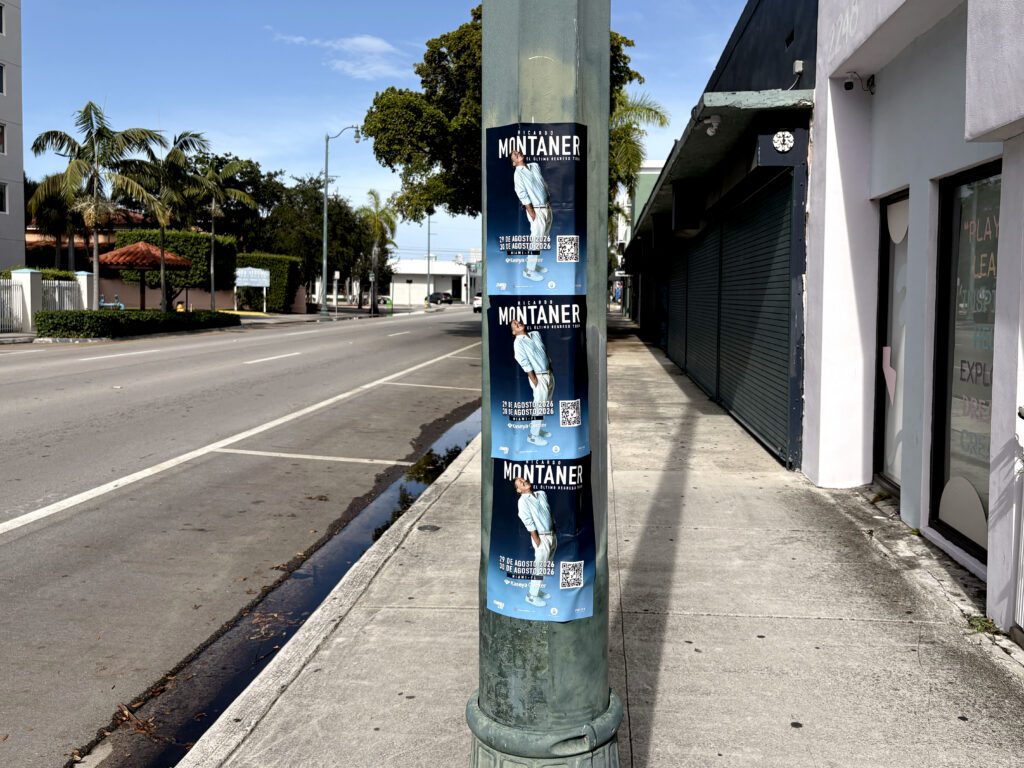
Snipe Advertising is the format people ask for by description rather than by name. Small rigid or semi-rigid signs, high count, placed along a route so the same message hits somebody four or five times on one walk.
In Philadelphia that description runs straight into a question most operators will not answer honestly, which is where the snipes actually go.
Because the obvious answer, utility poles and street lights, is the one part of this city’s code that has been actively argued over, and anybody who tells you confidently that it is fine is telling you something they cannot support.
I want to lay out how we scope snipe work for Philadelphia brands, what surfaces we build a route from, and what the weather does to small-format material in a city that never really dries out.
This is a format that lives or dies on route design. Get the corridor right and the repetition does the work. Get it wrong and you have spent a night placing material nobody passes twice.
The pole question in Philadelphia, and why we will not guess
Start here, because for snipe advertising this is the whole conversation.
Posting is a grey area in every American city. It varies by municipality, enforcement is inconsistent, and the result depends on surface ownership, local ordinance and permission. I am not giving legal advice. What I can do is tell you what sits on the public record in Philadelphia, because this city is genuinely unusual.
Philadelphia has a dedicated chapter of its code, Chapter 10-1200, titled “Posting of Signs,” which deals specifically with posting and advertising upon utility poles, street lights and other structures. That alone is not remarkable. What is remarkable is that the chapter has drawn legislative attention in both directions.
One amendment addressed revising enforcement and penalty provisions relating to posting and advertising upon utility poles, street lights and other structures. A separate measure, City of Philadelphia file 120017, was titled as amending Chapter 10-1200 by allowing the posting of temporary signs on utility poles and streetlights in certain permitted areas and in accordance with certain requirements, adding definitions and providing for penalties.
Sit with that second one. Philadelphia has at least contemplated a permitted-area, requirements-based framework for temporary signs on poles, rather than a flat prohibition. That is a meaningfully different civic posture from a city that simply bans the practice and fines it.
What I cannot tell you is where that framework stands today. Whether it was enacted, which areas were designated, and what the requirements are is something I have marked UNVERIFIED rather than guessed at. It needs confirming directly with the Department of Licenses and Inspections before any pole-based snipe work is scoped.
So our position is simple and it costs us work sometimes. We do not scope Philadelphia pole snipes on an assumption. Either a client confirms the current framework with Licenses and Inspections and we work inside it, or we build the route from surfaces where permission has a known owner.
That is not caution for its own sake. A snipe route is a high-count format. If the basis is wrong, it is wrong forty times in one night, and all of it carries the client’s brand.
One more definition worth knowing. The Property Maintenance Code section PM-311.0 on graffiti defines private property broadly, expressly including structures encroaching on any public right-of-way such as newsboxes, newsstands, dumpsters and trucks. Operators who assume a newsbox is unowned street furniture are working from the wrong map, and in a snipe route those are exactly the objects that look tempting.
Where a Philadelphia snipe route actually comes from
With poles set aside pending confirmation, the question becomes what is left. The answer in Philadelphia is better than you would expect, and it is concentrated.
Construction hoarding is the backbone. Frankford Avenue through Fishtown and Olde Kensington carries heavy ongoing redevelopment, which means a steady supply of hoarding and site perimeter. Hoarding is ideal snipe substrate: flat, new, continuous, and controlled by a specific contractor who can grant written permission for the run of the job. A hoarding line gives you repetition along a single frontage, which is exactly what the format wants.
Scaffold fascia during Center City renovations does the same job in a denser setting and with a higher-value audience.
Private commercial frontage is the third source. East Passyunk, where South Philly Italian-American culture meets contemporary drinking, is full of independent operators who own their own frontage and can say yes themselves. That is slower to assemble, because it is a conversation per building rather than one contractor for a block, but it produces a route that is genuinely defensible.
Now the corridor logic. Philadelphia’s audience splits across a small number of strongly differentiated corridors, and local nightlife guidance sorts them by scene with unusual consistency: Fishtown for live music and craft cocktails, Old City for historic bars and weekend crowds, Center City for upscale clubs and rooftops, Northern Liberties for laid-back lounges, and South Street for late-night energy.
For a repetition format, South Street is the strongest single corridor in the city. Dense, continuous low-rise retail frontage, high pedestrian volume well past midnight, and crucially a walking audience moving along a line rather than arriving and dispersing. Snipes need people to travel past a sequence. South Street is a sequence.
Frankford Avenue is second and sometimes first, depending on the brand. The gallery and live music tenancy means posted material reads as native rather than imposed, which matters more for small-format signage than people think. A snipe on a street with no visual culture of posting looks like litter. On Frankford Avenue it looks like the street.
Then the piece of Philadelphia geometry that genuinely helps. The Avenue of the Arts is South Broad Street between City Hall and South Street, the city’s main performing arts district carrying theatregoers and orchestra and opera audiences. South Broad terminates at South Street. One crew, parked once, can run the arts corridor southbound and turn directly onto the late-night corridor. For a route-based format that is a single continuous sequence across two completely different audiences.
Northern Liberties is lounge-led and pairs with a Fishtown night rather than standing alone.
Humidity, salt and how long small-format material holds here
Philadelphia is humid subtropical: hot summers, fairly mild winters, and precipitation spread fairly evenly through the year rather than concentrated in a wet season. Annual precipitation averages 41.3 inches. Annual snowfall averages 21.7 inches, with February the snowiest month at roughly 8.8 inches. The Atlantic is about 60 miles east and its influence is thermal, not corrosive, so marine salt air is not a design factor.
Evenly spread rain is harder to plan around than a wet season, not easier. There is no reliably dry quarter to aim at, so we run a rolling forecast discipline rather than a seasonal calendar.
Humidity is the specific enemy of small-format material. One dataset puts relative humidity between 71 percent in the hotter months and a peak of 77 percent in October. Another names September as the most humid month at around 71.6 percent. At those levels paper and uncoated board never fully dry and never fully harden.
For snipes that shows up as warping before it shows up as failure. A sign that is still firmly attached but has bowed, softened at the corners or started to bleed ink is a sign that is no longer doing its job. Clients tend to brief for attachment life. In Philadelphia you should brief for legibility life, and between August and October, when humidity peaks and warm-season rainfall is heaviest, those two numbers diverge sharply.
That drives material choice. In the humid window we push harder toward substrates that do not care about moisture, and we accept that this changes the look. A client who wants an uncoated paper aesthetic in September is asking for something the air in this city will take apart.
Road salt is the winter problem. With 21.7 inches of snow a year, salting is heavy, and traffic throws salt slurry onto the lower portion of every street-facing surface on a corridor like South Street. For snipes this is more consequential than for wall posters, because snipes are often mounted lower and because any metal fixing sits right in the spray. We mount above splash height wherever the surface allows and we expect accelerated corrosion on anything we cannot raise.
Freeze-thaw matters less for snipes than for pasted work, which is one honest argument in the format’s favour here. A mechanically fixed sign on hoarding does not care that the brick behind it is cycling. On old masonry in Fishtown, Kensington and South Philly, where snow melts, water enters lime mortar and refreezes overnight, pasted paper can take brick face with it. Snipes on hoarding sidestep that entirely. I do not have verified freeze-thaw cycle counts for Philadelphia and will not quote one, but the pattern is well established.
UV load is moderate and sits well down the list. Hot summers with real sun, a cloudy winter in which the sun shines around 52 percent of available daylight. Fade is a slow secondary failure here, behind moisture and behind salt.
Crew logistics, and the Philadelphia carry problem
A snipe route is a different night from a poster install. Higher count, faster per unit, more walking.
Two people is the working minimum and three is better on a long corridor. One placing and fixing, one carrying and feeding, one documenting. Documentation matters more on this format than any other, because a forty-placement route needs a record of what went where if you are going to service it or remove it properly.
Midweek between 1 a.m. and 4 a.m. is the clean window. Clear access, minimal observation. Friday and Saturday the picture changes: South Street is named for late-night energy and Old City for weekend crowds, so the street stays busy. A crew is inconspicuous in that, but it loses real time to simply getting past people, and on a high-count route lost minutes compound.
Old City needs noise discipline the other corridors do not. Heritage character and substantial residential conversion mean a crew working hardware at 2 a.m. generates complaints that the same crew would not generate in Fishtown.
Then the constraint that shapes Philadelphia snipe work more than anything else. Parking in Center City and Old City is genuinely poor: narrow colonial-era streets, limited loading access, and no realistic prospect of leaving a vehicle next to the work. Plan to carry.
That sounds like a logistics footnote. It is a design constraint. The weight and bulk of forty signs plus fixings, carried four blocks and back, sets a hard ceiling on count per corridor per night. Clients who specify heavy rigid substrate for a Center City route are, without realising it, specifying a smaller route or a second night. We would rather have that conversation at the design stage than at 2 a.m.
Fishtown and Kensington are materially easier for vehicle access, which is one more reason Frankford Avenue earns its place in most Philadelphia plans.
Specific parking regulations, loading zone rules and overnight restrictions by district are something we confirm per route rather than assume. I have not verified them citywide and will not route a crew on a guess.
Winter is an operational limit, not just a material one. Snow, salt and ice between December and February make sidewalk work slower and ladder work genuinely unsafe. Heavy campaign weight belongs in spring and autumn.
Broad Street, the Mummers, and why we install ahead of a date
Philadelphia’s calendar has one feature that overrides route planning, and it lands on January 1.
The Mummers Parade puts more than 10,000 costumed participants marching from City Hall south on Broad Street to Washington Avenue, with the Fancy Brigade Finale held indoors at the Pennsylvania Convention Center. Enormous crowds along the Avenue of the Arts corridor on New Year’s Day.
And a closed Broad Street.
That is the lesson for this city compressed into one event. Broad Street is simultaneously the highest-value corridor and the one most frequently closed for parades and processions. You cannot install into a closure, you cannot service a route during one, and you cannot get a vehicle anywhere useful. Install ahead of a date, never into it.
For a repetition format the timing point is sharper still. Snipes work by being passed repeatedly. Material that goes up two nights before a corridor fills has already been seen by the regular traffic and reads as established rather than as something that appeared for the event. Material placed the morning of reads as event clutter.
The Pennsylvania Convention Center anchors the city’s convention calendar and concentrates out-of-town audiences in Center City during show weeks. I do not have a verified show calendar, so I will not schedule against it unprompted, but if your buyer is a convention audience, confirm the dates and we will work backwards from them.
Broad Street Run, Made in America, and the Eagles and Phillies rhythms come up constantly in Philadelphia planning. I have not verified their current calendars well enough to schedule against them honestly, so if your campaign depends on one, we confirm together before committing a night.
What we talk Philadelphia snipe clients out of
Pole routes on assumption. Covered above, and it is the single most common request. Until the Chapter 10-1200 position is confirmed with Licenses and Inspections, we build the route elsewhere.
Old City volume. Old City looks ideal for a repetition format, strong weekend crowds and a walkable crawl. But heritage building stock and conservation sensibility mean private frontage opportunities are limited and owners are protective. A small permissioned presence works. Volume does not, and an operator promising volume there either has no permission or has not walked it.
Thin coverage across many corridors. This is the error that kills snipe campaigns specifically. The format depends on repetition along a path. Forty signs spread across Fishtown, South Street, Old City, East Passyunk and Northern Liberties means eight per corridor, which is not repetition, it is noise. Forty along South Street and the Avenue of the Arts is a campaign. Concentration is not a compromise in this format, it is the mechanism.
Uncoated paper stock in late summer. The humidity numbers do not support it between August and October.
Low mounting in winter on salted corridors. If the only available fixing height on a South Street frontage sits in the splash zone in January, we will tell you the material will not look good in three weeks.
Set-and-forget routes. Philadelphia material wants eyes on it. A service visit is not an upsell here, it is the climate.
And sometimes the honest answer is a different format entirely. If the real target is the Avenue of the Arts pre-show and post-show crowd in midwinter, projection does that job better than small signage. Midwinter dawn to dusk runs around 9 hours 40 minutes, so darkness arrives early and the usable window opens while South Street and Fishtown are still busy. Short days are an asset for that format, and it is worth running alongside a snipe route rather than ignoring.
What goes wrong
Three failures account for most of it.
Fixing failure on the wrong substrate. Hoarding varies enormously. Some is solid ply, some is thin and flexing, some is a mesh that nothing holds to properly. A crew that has not walked the line in daylight finds this out at 2 a.m. and improvises, which is how you get material that is gone in a week.
Route collapse. The corridor was selected on audience data rather than on surface availability, so the crew arrives and there are eleven viable placements where the plan assumed thirty. The sequence breaks, the repetition disappears, and the campaign underdelivers for reasons that had nothing to do with the creative. The fix is a daylight survey before the night, always.
Legibility loss before attachment loss. Already covered, and it is the one clients find hardest to accept because the signs are still physically there. Still there and unreadable is a failed placement.
Underneath all three is the same discipline: walk it first, document everything, agree removal up front. Permissioned surfaces can be used again. Surfaces you burned cannot.
Frequently asked questions
Can snipes go on utility poles in Philadelphia?
We do not scope pole work here on assumption. Philadelphia’s Chapter 10-1200 covers posting on utility poles and street lights, and a measure was introduced to allow temporary signs in certain permitted areas under certain requirements. The current status of that framework is unverified, so it needs confirming with the Department of Licenses and Inspections before any pole route is planned.
What surfaces do you build a Philadelphia snipe route from instead?
Construction hoarding, scaffold fascia and private commercial frontage. Frankford Avenue through Fishtown and Olde Kensington carries heavy redevelopment and therefore steady hoarding supply, controlled by contractors who can grant written permission. Center City renovations provide scaffold fascia. East Passyunk independents often own their own frontage and can say yes directly.
Which corridor works best for a repetition format?
South Street, for most briefs. Dense continuous low-rise retail frontage and high pedestrian volume past midnight, with an audience walking along a line rather than arriving and dispersing. Frankford Avenue is a close second, and because South Broad terminates at South Street, the Avenue of the Arts links into it as one continuous crew route.
How long will snipe material stay legible in Philadelphia?
Brief for legibility life, not attachment life. Humidity runs around 71 percent in warmer months and peaks near 77 percent in October, so uncoated stock warps, softens at the corners and bleeds well before it falls off. Between August and October those two timelines diverge sharply, which is why substrate choice changes seasonally.
How many crew does a snipe route need, and when do they work?
Two minimum, three on a long corridor: one placing and fixing, one carrying and feeding, one documenting. Midweek 1 a.m. to 4 a.m. gives the cleanest access. Documentation matters more on this format than any other, because a high-count route needs a record of placements for servicing and removal.
Why does Center City parking affect my campaign design?
Because crews carry. Narrow colonial-era streets and limited loading access mean no vehicle sits next to the work, so the weight and bulk of signs and fixings sets a hard ceiling on placements per corridor per night. Specifying heavy rigid substrate for a Center City route quietly specifies a smaller route or a second night.
Planning a Philadelphia snipe run
The sequence that works: pick one or two corridors on audience rather than coverage, let us survey surfaces in daylight and give you a real placement count, lock the install window against the forecast and any Broad Street closure, and agree removal at the start.
If the route depends on poles, confirm the current Chapter 10-1200 position with Licenses and Inspections first and we will scope to whatever that turns out to be.
Request a campaign quote and tell us the corridors you care about, your launch date and whether the material needs to survive a Philadelphia late summer or a Philadelphia winter. Those two answers change the substrate, the count and the night.

Ready to Run Your Campaign?
Call us or email us. We’ll tell you exactly what we can do in your market and what it costs.
Related Service
Explore similar advertising solutions offered by American Guerrilla Marketing.
American Guerrilla Marketing — Los Angeles
Street-level campaigns in Los Angeles and nationwide. Wheatpasting, LED trucks, street teams, and more.
(646) 776-2770
Related Articles
-
Snipe Advertising for San Francisco Brands
November 3, 2026
-
Snipes vs Transit Advertising: What to Expect
November 2, 2026
-
Pull Tab Poster: How It Works in Street Marketing
August 8, 2026
-
Take One Flyer: How to Design and Deploy Them Effectively | AGM
August 8, 2026
-
Tear Off Poster: Design, Placement, and Tracking Guide | AGM
August 8, 2026