
November 24, 2026
Snipe Advertising for Jersey City Brands
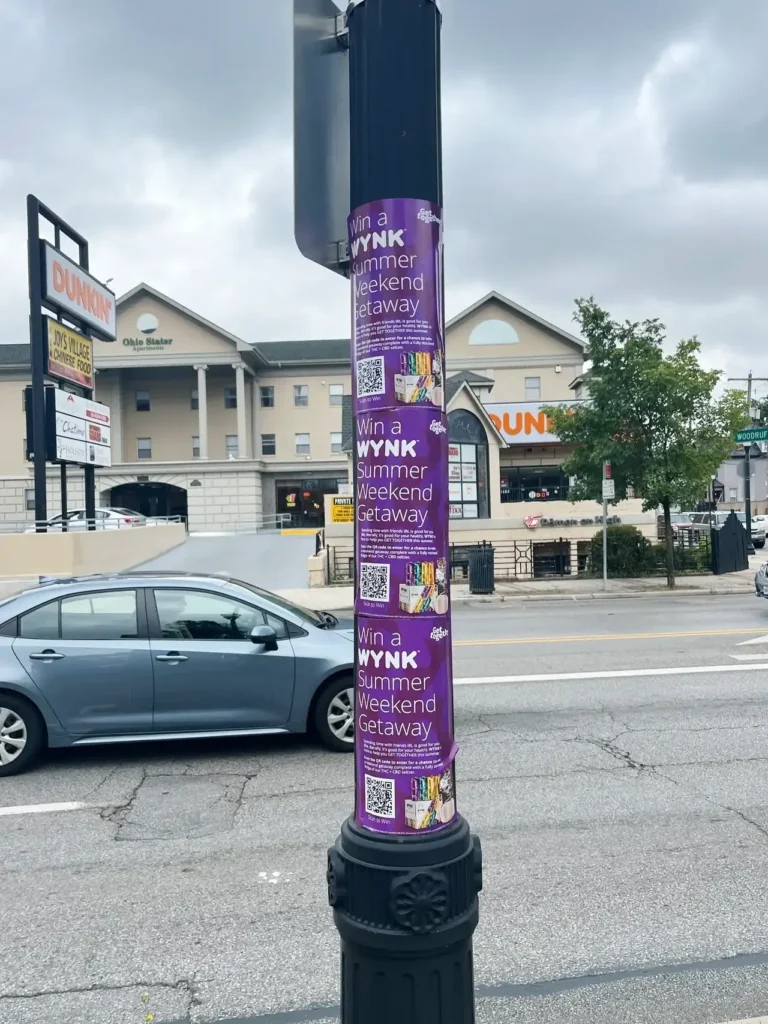
Snipe is the format I say no to most often in Jersey City, and I want to explain why before I explain how we run it.
A snipe campaign is small-format repetition. Modest pieces, placed often, along the routes people already walk, so the same mark lands five or six times on one journey. It works on attention through frequency rather than through scale. Done well, it is the most understated format on the street and the hardest one to execute without creating a mess.
In most markets the default snipe surface is street furniture. Poles, boxes, barriers, boarded frontage, whatever is vertical and unloved. That default does not survive contact with Jersey City.
This city runs a Mayor's Quality of Life Taskforce chaired by the Municipal Prosecutor, and municipal documents describe it as having increased the efficacy of code enforcement and resident engagement on street-condition matters. The municipal code's utility-infrastructure definitions enumerate poles among city infrastructure categories. A complaint about material on a pole downtown has a route and an owner.
So the version of snipe that most buyers picture is not the version we will quote here. What follows is the narrowing: what comes off the table, what is left, and whether what is left is still worth doing.
My honest answer is that it often is, but only in specific pockets and only with the permission work done first.
The surfaces that come off the table before we quote
I would rather have this conversation in the first call than after a print run exists.
Poles are out. Street furniture is out. Utility boxes and signal infrastructure are out. Transit property is out. Anything the municipality or a utility maintains is not a surface we test in a market where enforcement is coordinated and visible.
Boarded storefronts without a named owner are out. In a downtown with this much development churn, a boarded frontage is often mid-transaction, and the person who objects is frequently not the person you assumed owned it.
The Powerhouse Arts District's landmark elevations are a different kind of out. Road closures around the Powerhouse building itself have been reported as long-running due to the structure's disrepair. Working directly against a historically significant and visibly neglected structure is bad judgement regardless of what anyone would say about it.
Residential frontage is out. Jersey City's downtown is intensely residential, including within the converted warehouse stock, and residents in a dense walkable core notice everything on their block within a day.
What is left is narrower than buyers expect and better than they fear: construction hoarding, permissioned private frontage, interior-adjacent surfaces where a business controls the glass or the wall, and the vertical faces of private property where an owner has signed off.
That is the inventory. Everything below is about making it work.
I should add that the narrowing is not a Jersey City problem so much as a Jersey City characteristic. A market that takes its street appearance seriously is also a market where a well-placed, well-maintained piece gets left alone for longer than it would somewhere indifferent. The permission work buys stability, not just cover. In cities with looser enforcement I have watched unpermissioned runs get papered over by somebody else inside a week. That happens less here, because the surfaces that are available are surfaces somebody is actively responsible for.
Hoarding is the real snipe inventory here, and it expires
Jersey City builds constantly. Hoarding wraps those sites, and hoarding is close to an ideal snipe surface. It is flat, it is temporary by design, it stands at exactly the height a walking eye catches, and it runs in long continuous stretches that let a small format repeat down a block without any single piece dominating.
It also has a counterparty you can actually find. The contractor controlling the site is the person who grants permission, and that is a far more direct conversation than tracing an absentee owner through a title.
The catch is expiry. Hoarding permission ends when the project does, and in a market moving this fast, a stretch of board can come down weeks earlier than anyone told you. Large schemes here have been creating new pedestrian plazas and retail frontage, which is a reminder that hoarding is the temporary skin on a process with its own schedule.
So we ask three questions before we commit a run to a hoarding stretch. How long does the contractor expect this board to stand. Is any section scheduled to come out early for deliveries or crane access. Who do we contact when the board changes.
We also do not put the whole campaign on one site. A snipe run that lives on a single hoarding line is one site-manager decision away from zero.
Board quality varies. Unprimed sheet board drinks adhesive unevenly and gives inconsistent cycles across a single stretch, which looks worse than inconsistent placement does. We prime where we are allowed to and we accept shorter cycles where we are not.
One more hoarding reality specific to this city: development churn means the map changes faster than a route sheet ages. We re-survey rather than reusing a list from a previous season, because half the stretches on an old sheet are now buildings.
Small format in nor'easter season
Small pieces fail differently from large ones, and the Jersey City weather pattern punishes them in a particular way.
Coastal storms characterised as nor'easters are most frequent between October and April, and rarely does a winter pass without at least one significant coastal storm bringing strong winds and heavy rain. That is the operating environment for more than half the year.
A large poster has mass and a long perimeter, and when it fails it usually fails at one edge and hangs. A small piece has a short perimeter and very little mass, so when the bond releases it goes completely. One gust and the surface is clean, which is tidier than the alternative but also means your campaign vanished.
Edge treatment is therefore disproportionately important at this size. Full-perimeter adhesion, no corner tacking, and a worked edge on every piece. On a snipe run that is hundreds of small bonds instead of dozens of large ones, which is a real labour factor and the main reason small format is not automatically faster than large.
Waterfront exposure makes it worse. The Hudson frontage is open, and the gaps between tall waterfront buildings channel air with force the ambient forecast will not predict. Downwash off a tower arrives at street level from directions that make no sense until you have stood in it. We keep snipe away from the exposed waterfront frontage and concentrate it on the inland blocks.
Winter brings the other small-format enemy: road salt. Jersey City gets salt on the roads and marine air off the Hudson and the harbour, which means corrosion on any mechanical fixing runs faster than inland norms, and salt spray thrown from the carriageway lands exactly at low snipe height. Pieces placed low on a frontage near a busy road get coated and go opaque long before the adhesive fails. We place higher than instinct suggests on salted corridors, and we use stainless or coated fixings wherever a fixing is used at all.
Humid summers bring the opposite failure. Jersey City sits in the humid subtropical zone that covers almost all of New Jersey, and statewide midday relative humidity runs around 68 percent along the seacoast against 57 percent or less inland. On the Hudson waterfront this city behaves nearer the coastal figure. Moisture stays available at the bond line, and small pieces lift at the corners while still looking fine from across the street. Summer runs get an early condition check, usually within the first full day rather than at the end of the first week.
Freeze and thaw is the third seasonal factor, and it matters more on the older warehouse stock than on hoarding. Soft, porous brick in the Powerhouse district takes up water readily, which is excellent for adhesion when the wall is dry and unreliable when it is saturated. Repeated freezing works on the face of the brick itself. We survey the substrate rather than assuming brick is brick, and we leave shedding elevations alone.
Working Newark Avenue, Grove Street and Journal Square at different hours
Jersey City's snipe-relevant corridors operate on different clocks, and a crew that treats them as one city wastes a night.
Newark Avenue is the downtown spine and carries bar and restaurant trade late. The pedestrian section gives sustained, slow-moving footfall, which is the single best condition for small-format repetition anywhere in this market. People moving slowly past a sequence of pieces is exactly the mechanism snipe depends on. It is also populated until very late, which pushes crew work into the small hours or into the quiet early-evening window before trade builds.
The Grove Street pedestrian plaza is the other high-value pocket, and for a different reason. It is a PATH station, so it combines commuter volume with actual dwell time. People stand there. A format designed for repetition at walking pace gets a bonus from a place where the pace drops to zero. The plaza already carries notable street art, including work by Case Ma'Claim, Fintan McGee and Alice Pasquini, so the visual bar in that pocket is set by people who are good at this.
Morgan Street and the Powerhouse warehouse blocks go quiet much earlier than Newark Avenue. For a crew, that makes them the late-evening working area rather than the four-in-the-morning one, which is a meaningful quality-of-life difference across a multi-night run.
Journal Square is inland, it is a major transit hub, and it serves a different audience from the waterfront downtown. It is a separate plan with a separate permission list, not an add-on loop. UNVERIFIED: we have not confirmed the current retail and nightlife composition around Journal Square and will not characterise it.
The crew logistics are genuinely favourable downtown. The whole core is walkable, so a two or three person crew parks once and works a loop on foot. Parking is the constraint rather than distance, because residential density and permit parking make kerbside space scarce. PATH stations at Grove Street, Exchange Place and Journal Square let a person reach the working area without a vehicle, which is useful for survey, permission meetings and condition checks, though not for carrying materials.
Holland Tunnel approach traffic can slow vehicle movement at peaks, so load-in timing matters more here than the short distances suggest.
The permission paperwork we insist on
Posting is a grey area in most municipalities. It varies by surface ownership and local ordinance, and enforcement is inconsistent between cities and sometimes between blocks. Jersey City is a market where the enforcement side is organised and the permission side is genuinely open, and we work the open side hard.
For every surface in a snipe run we want the same record: the named party granting permission, what goes up, the approximate piece count on that surface, the start and end dates, who removes it, and photographs of the surface condition before we touch it.
The removal commitment does more work than anything else in that list. Small format accumulates. A hundred pieces that nobody agreed to clear is what gives this format its reputation, and a written removal date is often the thing that converts a hesitant contractor into a willing one.
We also document the clear-down. Photographs after removal, same angles. That record is what makes the second campaign on the same hoarding line possible, and in a city with this much repeat development it matters.
We do not quote work on municipal or utility infrastructure, and we tell buyers that at the outset rather than letting it sit as an assumption.
UNVERIFIED: we have not confirmed the specific Jersey City code chapter and section governing attachment of material to poles, street furniture or private frontage, or any associated penalties, and we will not cite section numbers or figures we cannot stand behind. Nothing here is advice about your obligations. Take your own counsel.
What goes wrong, and the briefs I turn down
The brief I decline most often is saturation. A buyer sees that the downtown core is compact and asks us to blanket it. In a walkable core you can cross in a quarter of an hour, saturation reads as clutter within two days, residents complain, contractors get calls, and the campaign ends early with a worse reputation than it started with. Frequency on a route beats volume across a district.
The second is waterfront placement in winter. Exchange Place and the Hudson frontage look spectacular in a plan. Between October and April they are where small format goes to disappear.
The third is pole work, which I have covered, but it comes up in nearly every first call and it is worth repeating.
The fourth is a snipe-only campaign in a city whose visual language is large-scale mural work. Jersey City audiences downtown are used to big, considered wall pieces. Small format arriving alone in that context can read as thin. It performs much better as the repetition layer underneath something with scale.
The fifth is running through the Jazz Festival finale without a crew plan. The Jersey City Jazz Festival distributes performances across intimate venues citywide during Jazz Week before concentrating at a large outdoor event at Exchange Place Plaza, reported for the 2026 cycle as May 27 to 31. That is a great audience and a difficult working environment, because the waterfront fills up and access tightens exactly when you want to refresh pieces. We front-load placement before the finale rather than working through it.
The sixth is ignoring the commuter clock in favour of the events calendar. Weekday PATH peaks at Grove Street, Exchange Place and Journal Square are more dependable than any festival in the year. JCAST, the city's annual art and studio tour, is the one event where the audience is self-selected for visual work, and it deserves its own plan. UNVERIFIED: we have not confirmed 2026 JCAST dates.
Where snipe stops and the next format starts
Snipe buys you frequency along a route. It does not buy you scale, and it does not buy you a conversation.
In Jersey City the natural companion is Street Teams and Experiential, and the reason is structural. Jazz Week spreads an engaged audience across small venues citywide for several days before pulling everyone to the waterfront. Static pieces cannot follow that movement. People can.
A team working the Newark Avenue pedestrian section and the Grove Street plaza during the week, against a snipe layer already running on the hoarding lines those routes pass, gives you the repetition and the direct contact in the same footprint. The static layer makes the team recognisable instead of random, which is the whole point.
The other sensible pairing is Sidewalk Decals and Stencils at the PATH approaches, where the eye is already down and the dwell time is real.
What I would avoid is treating snipe as the inexpensive substitute for wall work. It is not a smaller version of a poster campaign. It is a different mechanism with a different failure mode, and in a city whose downtown is this compact and this well observed, the discipline it demands is higher rather than lower. A client who wants scale should buy scale. A client who wants to be unavoidable along one specific walking route, repeatedly, for a defined window, is buying the right thing.
Frequently asked questions
What does snipe advertising mean in practice?
Small-format pieces placed repeatedly along walking routes, so the same mark registers several times on one journey. It works through frequency rather than size. In Jersey City we run it on permissioned private surfaces and construction hoarding, concentrated along corridors with slow pedestrian movement rather than spread thinly across the city.
Is snipe posting permitted in Jersey City?
It is a grey area. It varies by surface ownership and local ordinance, and enforcement is inconsistent across municipalities. Jersey City runs coordinated code enforcement through a prosecutor-chaired quality-of-life taskforce. We work only from written permission on private surfaces and hoarding, document the surface before and after, and commit to removal dates.
Why will you not place on poles or street furniture here?
Municipal code definitions enumerate poles among city infrastructure categories, and Jersey City’s enforcement machinery is organised and visible. In that combination, infrastructure placement puts a client’s campaign and our relationships with property owners at risk for very little gain. We tell buyers this before quoting rather than after.
How many nights does a Jersey City snipe run take?
It depends on piece count and how many separate permission holders are involved. The downtown core is compact enough that a two or three person crew works a loop on foot from one parked base. Hundreds of small bonds take longer per piece than a few large ones, so small format is not automatically faster.
What time of year works best for small-format work here?
Late spring to early autumn is the most forgiving, with an allowance for humid air slowing adhesive cure. October to April carries recurring nor’easter risk, and winter road salt coats low-placed pieces on busy corridors. Winter runs get higher placement, heavier edge specification and schedule slack for storms.
Can snipe run alongside a poster campaign?
That is usually the better build in this market. Jersey City’s downtown visual language is large-scale wall work, so small format performs best as a repetition layer under something with scale rather than carrying a campaign alone. We plan both against the same corridor map so the pieces reinforce each other on one walking route.
Request a campaign quote
Tell us which Jersey City corridors matter to you, the dates you are working toward, and whether this needs to run through the storm season. We will come back with the surfaces we think are realistically available, the ones we would not pursue, and an honest view of whether small format alone is the right call here.
Request a campaign quote.

Ready to Run Your Campaign?
Call us or email us. We’ll tell you exactly what we can do in your market and what it costs.
Related Service
Explore similar advertising solutions offered by American Guerrilla Marketing.
American Guerrilla Marketing — Los Angeles
Street-level campaigns in Los Angeles and nationwide. Wheatpasting, LED trucks, street teams, and more.
(646) 776-2770
Related Articles
-
Snipe Advertising in Orlando: Corridors and Reality
November 24, 2026
-
Snipe Advertising for Eugene Brands
November 24, 2026
-
Snipe Advertising for Jacksonville Brands
November 23, 2026
-
Snipe Advertising for Pittsburgh Brands
November 23, 2026
-
Snipe Advertising for Cleveland Brands
November 20, 2026