
November 25, 2026
How Sidewalk Decals & Stencils Runs in Kansas City
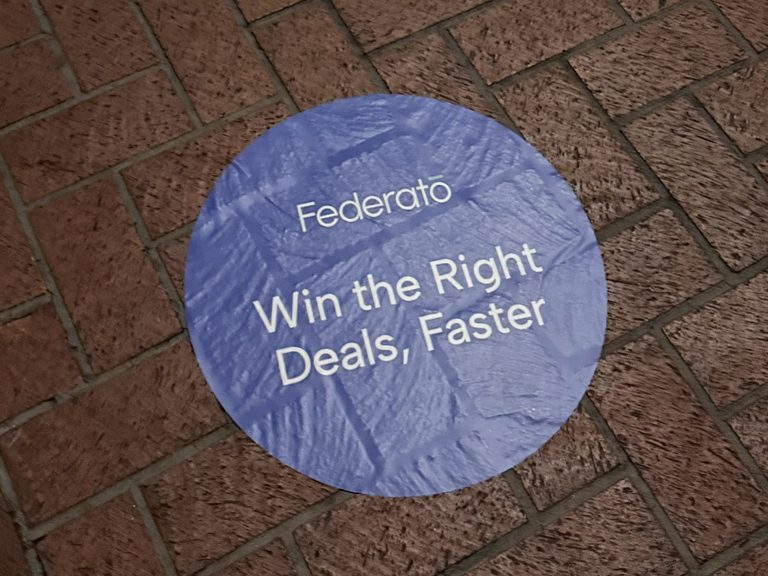
Every other format we run is governed by the wall, the fixture or the sightline. Sidewalk decals are governed by the calendar.
That is the thing to understand before you plan one in Kansas City. A decal is an adhesive bonding to concrete. Concrete in a humid continental climate with four sharply separated seasons spends a large part of the year in a condition where that bond will not form properly, or will form and then be destroyed. Kansas City runs from roughly the mid twenties Fahrenheit in winter to around ninety in summer, and both ends of that range are hostile to a ground-level adhesive.
So the honest version of this service in this market is: there is a good window, there is a workable window, and there is a window where I will tell you to wait.
Clients do not love hearing that. They have a launch date. But a decal that lifts at one corner on day three is not a reduced campaign, it is a hazard and an embarrassment, and we end up removing it early. I would rather have the scheduling conversation in advance.
The second thing to understand is that decals and stencils are two different products with two different permission answers, and buyers routinely use the words interchangeably when asking for a quote. A decal is applied, it sits on the surface, it comes off, and the concrete is as it was. A stencil deposits material. That distinction changes who will say yes to it, and it changes everything about where it can run in Kansas City.
This page works through both, organised the way the job actually runs: by season first, then by place, then by permission.
Sidewalk decals are a concrete problem before they are a print problem
The bond is everything, and the bond depends on three things: surface temperature, surface moisture and surface condition.
Surface temperature is the one people never check. Air temperature and concrete temperature are not the same number. Concrete holds cold. A Kansas City morning in late October can read comfortably on a phone weather app while the slab is still well below the range where pressure-sensitive adhesive will key properly. We take surface readings rather than trusting the forecast, and if the slab is too cold we do not install, because a decal that goes down below its adhesive range looks fine for two days and then peels from the edges.
Surface moisture is the Kansas City problem specifically. This city has persistently muggy summer air, and that moisture does not stay in the air. Concrete that looks dry can be holding enough surface moisture to prevent a full bond, particularly in shaded sections and particularly in the morning after a humid night. We dry and prepare the slab rather than assuming it is ready. On a muggy July install that preparation is a meaningful share of the shift time, and it is the first step a rushed crew skips.
Surface condition decides whether a placement is possible at all. Smooth, sound, cured concrete takes a decal well. Heavily broomed finishes, aggregate exposure, patch repairs and spalling do not, because the adhesive cannot make continuous contact and the gaps become water entry points. Freeze-thaw cycling in a climate like this one is hard on concrete over time, which means a Kansas City sidewalk survey finds more unusable slab than a survey in a mild climate would. We walk the route and mark actual placement points. We do not quote a count off a map.
What that adds up to: the usable placement inventory on a Kansas City route is smaller than the number of visually attractive spots on it. The gap between those two numbers is where disappointed clients come from, and we close it by surveying first.
The Kansas City decal calendar, season by season
Spring, roughly April into early June. This is the best installation window of the year here. Slab temperatures have come up, freeze-thaw has finished, storm frequency has not yet peaked, and humidity is not yet at its summer worst. If your timing is flexible, install in spring.
One spring caveat that is specific to this climate: salt and grit residue from winter plowing sits on concrete well after the snow has gone. It is not always visible. A decal going onto residual salt film bonds to the film rather than the slab, and the film lets go. Early spring installs need proper cleaning, not a quick sweep.
Summer, June through August. Workable but demanding, and the demands are the Kansas City summer pattern. Roughly half of this city's annual rainfall falls from May to August, near nineteen and a half inches across those months, arriving as fast convective thunderstorms off the Great Plains with wind behind them. A decal that has had its full dwell time is fine in a storm. A decal installed three hours before one is not, because the bond has not reached strength and driven water gets under the edge.
Humidity slows everything. Preparation takes longer, dwell takes longer, and a crew places fewer decals per hour in August than in May. We schedule for that rather than discovering it at four in the morning.
Heat is the other summer factor and it cuts both ways. Warm concrete helps the adhesive key, which is good. Very hot concrete in direct afternoon sun is a different matter, because it makes the material too soft to position accurately and it can cause the decal to over-bond at the edges before the centre is laid. We install early morning or at night in high summer, not in the afternoon.
UV is the summer slow burn. July here is the peak UV month, with an average maximum UV index around ten and roughly ten and a half hours of sunshine a day. A horizontal surface takes the full load of that. Sidewalk decals fade faster than vertical placements for exactly this reason, and on an open, unshaded Kansas City sidewalk in July the fade is visible within weeks on anything uncoated. Specify UV-stable print and an overlaminate. The overlaminate also carries the slip resistance, which is not optional on a walking surface.
Autumn, September into early November. The second good window, and in some ways the best of the year for a run that needs to hold. Slab temperatures are still in range, humidity has dropped off, the storm pattern has eased, and freeze-thaw has not started. An autumn install with a proper bond will hold well into the cold.
Winter, roughly late November through March. This is where I tell clients to wait. Cold slabs, snow cover, plowing, grit and salt. Even where a decal could be installed during a mild spell, the campaign has to survive a plow blade and repeated salt applications on a surface that is being mechanically cleared. Freeze-thaw cycling pushes water into any imperfect edge and lifts it.
We do install in winter occasionally, under cover or in protected locations where plowing does not reach, and with surface heating and extended preparation. It is slower, the usable inventory shrinks further, and the honest expectation is a shorter run. If a client's winter requirement is non-negotiable, this is where I point them at Projection Advertising instead, which is genuinely at its best on Kansas City's cold, dry winter nights.
Where decals actually earn their place in Kansas City
A sidewalk decal only works where people look down, and people look down when they stop, queue, cluster or wait to cross.
The downtown to Crossroads streetcar spine is the strongest decal corridor in Kansas City, and the reason is structural. Fixed-rail transit creates waiting. People stand at platform areas, they stand at crossings along that axis, and standing people look at the ground. That is a pattern most of this car-dependent city does not produce. A decal on that spine gets dwell time rather than a glance.
The Crossroads Arts District itself is the other strong environment, especially around First Fridays. The district is former industrial fabric with wide streets, galleries and studios, and on the first Friday of every month people fill it, walking slowly, stopping frequently and browsing. Slow walking is the ideal condition for ground-level work. The Crossroads is also the easiest district in the city to work physically, with wide kerbside access and low overnight residential density.
The Second Sundays market at 19th and Wyandotte in the Crossroads, running mornings into early afternoon across spring months in the current cycle, is a smaller but genuinely useful moment. It also falls inside the best installation window of the year, which is convenient.
Brookside and Waldo are neighbourhood commercial villages south of the core, and they suit decals better than most formats. These are short walkable shopping strips with heavy repeat traffic from nearby residents, lots of stopping at shopfronts, and a scale where ground-level work reads naturally. Because the audience lives there, keep it tidy and keep the count low. Merchant-agreed placements on private forecourt concrete are the right play.
Westport works for decals in a narrow way. The district is nightlife-dense with a pub-crawl character, so there is genuine foot volume, but it is at night, when ground-level visibility is poor, and the surfaces take heavy wear. If you want Westport, the useful placements are inside venue thresholds and entry areas with the operator's agreement, not on the open street.
Country Club Plaza is a managed, high-standard private retail environment with active security. Ground-level work there happens with property management's blessing or not at all.
18th and Vine is a heritage district. Anything we do there goes through the institutions and businesses present, with a reason that stands up.
Stencils are a different product with a different answer
Here is where I have to be straight with buyers, because this is the question that comes in most often and the answer disappoints people.
A stencil deposits material onto a surface. Even where that material is designed to wash away over time, you are leaving something on concrete you do not own. That changes the permission conversation completely, and it changes it in the same direction in every district of Kansas City.
Posting and marking on surfaces you do not own sits in a grey area here. Rules vary by municipality and district, and enforcement is inconsistent and depends on surface ownership, local ordinance and whether anyone objects. I am not going to tell you where the line falls in your situation, and I would be suspicious of anyone in this industry who does.
What I will say operationally is that the grey area is much wider for a removable decal than for a deposited stencil, and that property owners understand that distinction instantly. A building owner or merchant who will happily agree to a decal on their forecourt, because it comes off clean and the concrete is as it was, will often decline a stencil on the same slab. That is a reasonable position and we do not argue with it.
So our working approach in Kansas City is that stencil work runs on private surfaces, with the owner's written agreement naming the surface and the dates, and with removal or weathering terms agreed in advance in writing. Not on the public right of way, and not on a verbal nod from someone on site.
For most Kansas City briefs that arrive asking for stencils, the decal version achieves the same visual result with a far shorter permission conversation and a far cleaner exit. We suggest the swap, and most clients take it once they understand why.
Removal is quoted into every run. For decals that means lifting the material and leaving the slab as found, documented. A format applied to a walking surface in a public place that nobody comes back for is the reason these formats get a bad name, and it closes doors for the next client who wants that same strip.
No ordinance numbers, permit requirements or penalty amounts appear on this page, because none were verified for Kansas City. An invented citation would be worse than silence.
Crew reality: a format that fights Kansas City's night schedule
Most of what we run in Kansas City is night work. Decals are the awkward exception, and it is worth understanding why, because it affects scheduling.
Paste and snipe work wants an empty street, so one to five in the morning suits it. Decals want a dry slab at a workable temperature with enough light to position accurately, and they want pedestrians out of the way. In a Kansas City summer, the slab at four in the morning after a muggy night can be carrying surface moisture, while the slab at ten in the morning is clean and warm but covered in people.
Our usual answer is early morning. Start before the street populates, work with the slab warming rather than cooling, and finish before the foot traffic builds. In the Crossroads that works well because overnight and early morning activity is low and the wide former-industrial streets give the van kerbside space right next to the placement. On the streetcar spine it means working around service hours and platform activity.
Westport is the exception in the other direction. Bar traffic runs very late there, streets are narrow, and kerbside parking is contested. Anything we do in Westport is midweek and after two in the morning, and for decals that mostly means venue-threshold work rather than open street placements.
Crew size is typically two for a defined route. One prepares and places, one manages material, alignment and documentation. Preparation is the bulk of the labour on this format, not the placement, and that ratio surprises clients who have watched a decal go down in ninety seconds and assumed that is the job.
One district per shift. Westport, Country Club Plaza, Brookside, Waldo and 18th and Vine are separate drives from the Crossroads and from each other. Kansas City has one walkable spine and a lot of driving, and a plan that assumes a crew hops districts in a single morning has not accounted for the city's shape.
Weather governs the schedule, not the clock. From May through August we check the convective forecast before committing, because a storm arriving before the bond reaches strength undoes the shift. We ask for a two or three day install window rather than a fixed date.
What we talk Kansas City clients out of
Winter installs on open sidewalk. Plows, salt, grit and freeze-thaw. We will say wait, or we will say projection.
Fixed install dates between May and August. Give us a window. A locked July date bets your print run against the Great Plains storm pattern.
Stencils on the public right of way. Deposited material on surfaces you do not own, in a grey-area environment, with no clean exit. Private surfaces with written owner agreement, or the decal version instead.
Decal counts quoted off a map. The usable inventory is always smaller than the attractive-looking inventory, because of slab condition. We survey first and the survey is not a formality.
Uncoated print on an open summer sidewalk. July UV here is at the top of the scale and a horizontal surface takes all of it. Overlaminate, which also carries the slip resistance you need anyway.
Decals in Westport's open street. Night audience, poor ground visibility, heavy wear. Venue thresholds or nothing.
Scattering placements for coverage. Decals work where people stop. Concentrate them at the crossings, platform areas and shopfront clusters where the gaze goes down. Thirty well-placed decals on the streetcar spine beat a hundred spread across districts where everyone is driving.
The format we most often run alongside decals in Kansas City is Street Teams and experiential, specifically around First Fridays. The logic is that the Crossroads crowd on a first Friday is already in a browsing, stopping, slow-walking state, which is exactly the state decals need, and a small team on the ground converts that attention into something measurable rather than leaving it at awareness. The decals do the persistent work all month and the team does the concentrated work on the night.
Frequently asked questions
When is the best time of year to install sidewalk decals in Kansas City?
Spring from roughly April into early June, and autumn from September into early November. Slab temperatures are in range, freeze-thaw has stopped or not started, humidity is manageable and storm frequency is lower than high summer. Early spring installs need thorough cleaning because winter salt and grit residue prevents the adhesive bonding to the concrete.
Why will you not install decals in a Kansas City winter?
Cold slabs sit below the range where pressure-sensitive adhesive keys properly, and freeze-thaw cycling drives water into any imperfect edge and lifts it. Beyond that, open sidewalks here get plowed, gritted and salted through the season. We will install in protected locations with extra preparation, but the honest expectation is a shorter run.
What is the difference between a decal and a stencil for permission purposes?
A decal is applied, sits on the surface and lifts off leaving the concrete as it was. A stencil deposits material. Property owners grant the first far more readily than the second, and that holds across every Kansas City district. We run stencil work on private surfaces with written owner agreement naming the surface and dates.
Where do decals actually get looked at in Kansas City?
Where people stop. The downtown to Crossroads streetcar spine produces genuine waiting at platform areas and crossings, which is rare in this car-dependent city. The Crossroads during First Fridays puts people on foot walking slowly and browsing. Brookside and Waldo shopping strips produce repeat stopping at shopfronts.
How long does a Kansas City sidewalk decal last?
An autumn install with a proper bond on sound concrete holds well into the cold season. A summer install on an open sunny sidewalk fades faster, because July UV here is at the top of the scale and horizontal surfaces take the full load. Overlaminated print holds colour considerably longer than uncoated.
Is sidewalk decal work permitted in Kansas City?
It is a grey area that varies by surface ownership, district and local ordinance, with inconsistent enforcement. We do not advise on it. We work permission first, with written agreement naming the surface and the dates, we document installs with timestamped photographs, and we quote removal into every run so the slab is left as found.
Request a campaign quote
Tell us when you need to be live in Kansas City and where. If your dates fall in the window where decals hold well, we will survey the route, mark the slabs that will actually take material, identify who controls each one, and come back with a placement plan and a removal commitment.
If your dates fall in the window where they will not hold, we will tell you that and suggest a format that suits the season instead.
Request a campaign quote.

Ready to Run Your Campaign?
Call us or email us. We’ll tell you exactly what we can do in your market and what it costs.
Related Services
Explore similar advertising solutions offered by American Guerrilla Marketing.
American Guerrilla Marketing — Los Angeles
Street-level campaigns in Los Angeles and nationwide. Wheatpasting, LED trucks, street teams, and more.
(646) 776-2770
Related Articles
-
How Sidewalk Decals & Stencils Runs in Cambridge
November 25, 2026
-
How Sidewalk Decals & Stencils Runs in Fort Worth
November 25, 2026
-
How Sidewalk Decals & Stencils Runs in Arlington
November 25, 2026
-
How Sidewalk Decals & Stencils Runs in Indianapolis
November 24, 2026
-
How Sidewalk Decals & Stencils Runs in Santa Monica
November 24, 2026