
November 3, 2026
LED Advertising Truck for Sale: What Owning One Actually
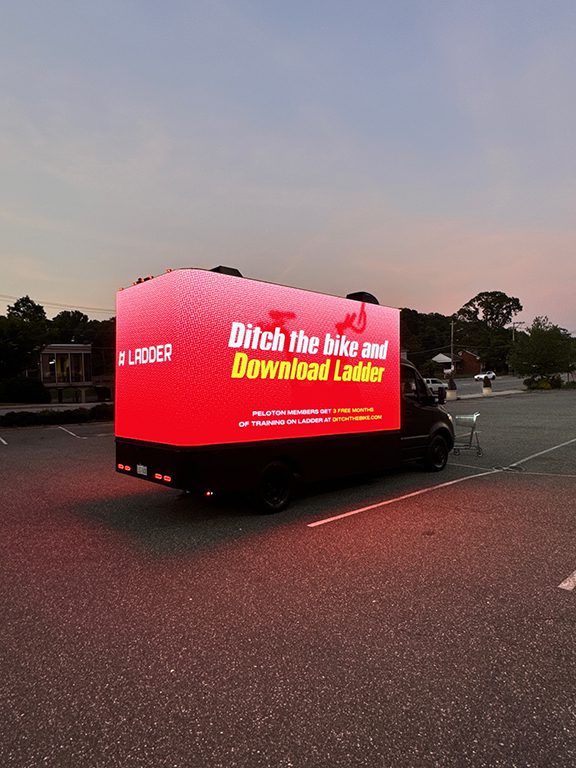
People search for an LED advertising truck for sale for one of two reasons. Either they want to start an outdoor media business, or they are a brand that has run truck campaigns, liked them, and wondered whether owning the asset makes more sense than booking it.
I am going to answer the second question honestly even though we run trucks for a living, and I am going to describe the first one from the operating side rather than the sales side.
We operate LED Trucks across US markets. I have been in the cab, on the route, and on the phone at 9pm when a screen module failed in the middle of a booked shift. The vehicle is the easy part. Everything around the vehicle is the business.
The buyer problem is that listings describe hardware. Screen size, pixel pitch, generator, chassis. None of that tells you what a working week looks like, what breaks, what it takes to keep a truck legally on the road and earning, or how often a single truck sits idle.
So this page covers the operating reality. What the build actually is, how a shift runs, what fails, what the permission picture looks like, and when I would tell someone not to buy.
No figures appear anywhere below. If you want a commercial conversation about running campaigns with our fleet, that is a separate and very short discussion.
What an LED advertising truck actually is
Strip the marketing off a listing and you have four systems bolted together.
The chassis. A box truck or a purpose-built flatbed. This is a commercial vehicle with all the obligations that come with one: registration, commercial insurance, inspections, maintenance, and a driver qualified and licensed for its weight class.
The screens. One, two or three LED panels mounted to the body. Three-sided configurations are the ones that matter for most work, because a rear-only screen reaches drivers queued behind you and nothing else. Side screens are what reach sidewalks, patios, venue queues and event crowds.
The power system. LED panels draw real power continuously. That means a generator, or a battery system, or both, plus fuel and a maintenance regime. Power is the single most common cause of a lost shift that I have seen.
The content system. A media player, a scheduler, a way to update content remotely, and in some builds live-stream capability. This is software, and software fails in ways hardware does not.
Pixel pitch is the spec buyers obsess over. The practical truth is that viewing distance governs everything. A street-level audience standing a few metres from a parked truck sees pitch differences. An audience across four lanes of traffic does not. Buying the tightest pitch available is often money spent on a quality nobody in your actual audience is close enough to perceive.
Brightness matters more than pitch for daytime work, and even a very bright screen loses to printed vinyl under overhead sun. That is not a hardware failing, it is physics. Anyone selling you a screen that beats direct sunlight is overselling.
The working week nobody puts in a listing
Here is what actually fills the time around a truck.
Pre-shift check. Walk the vehicle, confirm fuel and generator, power up the screens, verify every module lights, load and test the content, confirm the route and the parking plan. This takes real time before the first paid hour.
Driving the route. A good route is a loop that repeats high-value segments so the same people see the message more than once. Slow, congested surface streets with pedestrians are the product. Highways are transit between zones, and a truck at speed on a freeway is advertising to people watching the road.
Dayparting. Morning and late afternoon commute on arterials, midday around downtown foot traffic, evening on dining and nightlife corridors. Evening is when an LED screen earns its keep, which means the business is a night business as much as a day one.
Documentation. GPS logs plus photographs of the truck in position at key locations. Clients expect proof of service, and an operator who cannot supply it will not keep accounts.
Post-shift. Fuel, clean, park somewhere secure and permitted, deal with anything that went wrong, prepare tomorrow's content.
Crew is usually one driver per truck for a standard route. Event work frequently needs two, because someone has to manage positioning, talk to venue staff and handle the crowd while the driver stays with the vehicle. Add a street team and the coordination load grows again.
That is the part the hardware listing skips. The truck is an employee who needs a schedule, a supervisor and a maintenance plan.
What breaks
Five things, in roughly the order I have seen them.
Power. Generator problems, fuel issues, a battery system that does not hold through an evening shift. A dark screen on a booked route is the worst outcome in this business, because the client has no deliverable at all.
Modules. LED panels are made of modules, and individual modules fail. A dead block in the middle of a logo is immediately obvious in a client photo. Spare modules and someone who can swap them are not optional for a working fleet.
Media player and connectivity. Content that will not load, a scheduler that reverts to an old playlist, a remote update that does not reach the truck. This happens more than hardware failure and it is usually fixable on the spot by someone who knows the system.
Weather. Screens are built for outdoor use, but heavy rain reduces legibility, strong wind matters for high-sided vehicles, and extreme cold affects both batteries and generators. Heat is the quieter problem. Screens generate heat, summer adds to it, and thermal protection can dim a panel during exactly the hours you booked.
The chassis itself. It is a commercial vehicle doing stop-start city miles with a heavy load and a generator running. Brakes, tyres and cooling wear faster than a listing's mileage figure suggests.
An owner needs a plan for each of those before the first booking, not after the first failure.
Cities, corridors and why location decides the asset
A truck is only worth owning where it can be busy. That is a geography question, not a hardware question.
New York is the strongest market in the country for this format and the most demanding. Midtown around Herald Square and the Thirty-Fourth Street corridor combines crawling traffic with dense pedestrians, which is the ideal condition. Canal Street, lower Broadway and the bridge approaches do similar work. Against that, traffic can destroy a planned loop, parking is hard, and local rules around advertising vehicles are strict enough that routing needs genuine local knowledge.
Las Vegas is close to purpose-built for the format. The Strip moves slowly, the sidewalks are full, the evenings are long, and convention weeks concentrate a specific audience into a handful of streets.
Los Angeles works on corridors rather than citywide. Sunset through Hollywood, Hollywood Boulevard, Melrose, Wilshire through Miracle Mile, the Figueroa approach to the downtown arenas on event nights.
Chicago gives you Michigan Avenue, the Loop grid, Milwaukee Avenue through Wicker Park, and the stadium and arena approaches on game days. Winter is useful rather than hostile here, because a truck runs in conditions that stop every street install we do.
Miami runs Ocean Drive and Collins in South Beach plus Wynwood on weekend evenings. Nashville works Broadway. Atlanta works Peachtree and the stadium district. Austin concentrates downtown and along the campus edge, with festival weeks producing some of the best pedestrian density in the country. Houston works Midtown and the convention centre area. Denver runs the Sixteenth Street district.
The pattern is consistent. Trucks earn where vehicles move slowly and people are outside. A truck based somewhere without those conditions spends its life driving to work.
Permission, ordinance and the grey area
This is the part that most affects whether owning a truck is viable in a given market, and it is genuinely grey.
Rules for vehicles whose primary purpose is carrying advertising vary considerably by municipality. Some cities have specific ordinances addressing them. Some restrict standing or parking such a vehicle. Some treat it as an ordinary commercial vehicle. Some have nothing specific on the books. Enforcement is inconsistent between cities and sometimes between precincts inside a single city, and it changes over time.
How we handle it:
Routes are planned with local knowledge rather than dropped onto a map. Drivers who work a market know which blocks draw attention and which do not.
Standing time is treated carefully, because a moving truck and a parked truck are often different questions. Where a client wants the vehicle stationary, we look for private property with the owner's permission, event lots, or an arranged position with a venue.
The vehicle stays compliant as a vehicle. Registration, insurance, lighting, inspections, condition. A truck pulled over for something mundane costs the client their hours and the operator their reputation.
Everything is documented, so there is a clear record of where the vehicle was and when.
We do not give legal advice. Anyone considering buying a truck should check their own intended markets with their own counsel before committing to an asset, because the answer genuinely varies and an asset that cannot work your home market is an expensive mistake.
I will not tell you this format is free of friction. Good planning makes official conversations rare and uneventful. It does not make them impossible.
When I would tell someone not to buy
I will give this straight, because it is the most useful thing on the page.
Do not buy if you need the truck for one campaign. An asset bought for a single launch sits idle afterwards, and idle assets still cost insurance, storage and maintenance. Booking a route is the correct answer for a campaign need.
Do not buy if nobody on the team can drive it. The licence class, the hours, the night shifts and the city driving are a real job. Owners who assume they will find a driver later usually find one who does not know the market.
Do not buy if your market lacks slow traffic and pedestrians. Covered above. The asset cannot create an audience that is not outside.
Do not buy if you have not checked the ordinance picture in your intended markets. An LED truck that cannot stand still where your clients want it standing still is a limited product.
Do not buy if you cannot service it. Spare modules, a power system you understand, someone who can troubleshoot a media player at 7pm. Without that, every fault becomes a cancelled booking.
Do not buy on pitch alone. Buy on brightness, on screen configuration, on serviceability of the panels and on the reliability of the power system. Those decide whether you deliver shifts.
Do not assume the screen replaces a wrap. For daytime-dominant campaigns, printed vinyl reads better and nothing on it can fail. Plenty of working fleets run both for exactly that reason.
What we talk clients out of, on the campaign side
Even when the question is buying, most people are really trying to solve a campaign problem. Here is what we push back on when they book instead.
Highway-heavy routes. Visible, fast, forgettable.
Flat all-day shifts with no daypart logic. Eight undifferentiated hours usually delivers less to the right people than four well-chosen ones.
LED for a daylight-only campaign. Wrap it instead and save the screen for evening.
One truck covering a sprawling metro. One vehicle covers corridors, not cities. Narrow the geography or add vehicles.
Precise impression counts. GPS logs prove the truck ran the route. They do not measure audience. Impression figures for moving vehicles are models, and we present them as estimates rather than as measured data. If measurement matters, put a campaign-specific URL, a promo code or a scannable mark on the creative and measure response instead.
Dense artwork and phone numbers. A truck is read in a couple of seconds by someone doing something else. One idea, big type, high contrast, one memorable action. For LED, hold frames long enough to actually be read and keep the rotation short, because a passer-by sees one or two frames and no more.
Last-minute event bookings where the ingress pattern has not been scouted. Position is everything at an event, and the crowd walks a predictable path from parking and transit to the doors. Being in the wrong place at a big event is worse than an ordinary street.
What drives the scale of a campaign booking
Since most people reading this will book before they ever buy, these are the levers that actually shape a job. No numbers, just the mechanics.
Number of vehicles, because coverage scales with trucks rather than with hours.
Shift length and which dayparts, since evening and late-night hours carry more crew cost than midday.
Market complexity, because dense cities need experienced local drivers and slower routes.
Wrap versus LED, since wraps carry print and application work while screens carry hardware and content preparation.
Campaign length, because a multi-week flight keeps the same vehicle and driver in market, which is more efficient per day than repeated one-off mobilisations.
Event involvement, with venue coordination, positioning arrangements and tight timing all adding planning work.
Creative production, where one static message is simple and a dayparted rotating LED set is a content project.
Add-ons such as street team coordination, sampling or extended photo and video capture.
Where a truck sits against the rest of the mix
A truck is a movement format. It passes, it does not stay. That is its strength and its ceiling.
If the brief needs a neighbourhood to feel saturated for a fortnight, Wheatpasting & Poster Campaigns do that and the truck amplifies it along corridors the posters cannot reach. Trying to buy persistence from a vehicle is using the wrong tool.
If the brief needs a conversation, Street Teams & Experiential beside a parked truck converts far better than either does alone. The vehicle anchors the team visually and gives them a reason to be standing there.
If the brief needs a single building-scale moment at night, Projection Advertising puts a large image on a surface with nothing attached to it.
And if the brief is an event, a truck working the ingress and egress paths is frequently the strongest single choice available, which is exactly why operators keep buying them.
Frequently asked questions
Is buying an LED advertising truck better than booking one?
It depends on utilisation. An owned truck has to stay busy to justify insurance, storage, maintenance, fuel and a driver. For a brand running one launch, booking a route is the sensible answer. For an operator who can keep a vehicle working most weeks in a market with slow traffic and pedestrians, ownership starts to make operational sense.
What specification actually matters on an LED truck?
Brightness, screen configuration and serviceability, in that order. Three sided screens reach sidewalks, queues and event crowds, while a rear only screen reaches drivers behind you. Pixel pitch matters far less than listings suggest, because viewing distance governs perceived quality. Reliable power and easily swapped modules decide whether you actually deliver booked shifts.
What fails most often on these trucks?
Power first. Generator faults, fuel problems or a battery system that will not hold an evening shift leave you with a dark screen and no deliverable. After that, individual LED modules, the media player and connectivity, weather effects including thermal dimming in summer heat, and ordinary commercial vehicle wear from stop start city driving with a heavy load.
Can an LED truck be parked and left running?
Sometimes, and it is a grey area. Several municipalities treat a stationary advertising vehicle differently from a moving one, ordinances vary, and enforcement is inconsistent. We arrange stationary positions on private property with the owner’s permission, in event lots, or through venue coordination. We do not give legal advice, and intended markets should be checked locally.
How do you prove a truck campaign ran?
GPS route logs show where the vehicle was and when, and drivers photograph the truck in position at key locations across the shift. That is proof of service. It is not audience measurement. For response data, we recommend a campaign specific landing page, a distinct short URL, a scannable mark or a promo code used only on truck creative.
Do LED screens work in daylight?
Less well than printed vinyl. Even a bright panel washes out under direct overhead sun, which is physics rather than a hardware defect. For daylight dominant campaigns we recommend a static wrap, which reads cleanly in full sun and has nothing on it that can fail mid route. Screens earn their place from dusk onward.
Request a campaign quote
If you are weighing an asset purchase against booking routes, tell us the markets you care about, the hours you would want covered and what the campaign is trying to do. We will give you an honest view of whether your market supports a truck, what the route would actually look like, and whether a wrap or a screen fits your hours.
Request a campaign quote. If owning is genuinely the better answer for your situation, we will say that too.

Ready to Run Your Campaign?
Call us or email us. We’ll tell you exactly what we can do in your market and what it costs.
Related Services
Explore similar advertising solutions offered by American Guerrilla Marketing.
American Guerrilla Marketing — Los Angeles
Street-level campaigns in Los Angeles and nationwide. Wheatpasting, LED trucks, street teams, and more.
(646) 776-2770
Related Articles
-
Used LED Billboard Truck for Sale: Buyer Guide
November 3, 2026
-
Billboard Truck Rental: A Field Guide From the Crew
November 3, 2026
-
LED Truck Advertising Day Rate: How Scope Gets Set
November 2, 2026
-
New York Mobile Billboards: LED Truck Advertising NYC 2026
September 12, 2026
-
Truck Side Advertising: Formats, Costs & How It Works (2026)
September 12, 2026