American Guerrilla Marketing
Nationwide Service
Media planning, media buying, billboard advertising, & guerrilla marketing
From Chicago’s lakefront to downstate cities no static board can reach — AGM deploys high-resolution mobile LED screens across the full state. Direct crew, no subcontractors, no middlemen.
Illinois ranks as the sixth most-populous state in the nation, and the Chicago metropolitan area alone accounts for nearly 9.5 million residents — a concentration of buying power that rivals any coastal market. That population doesn’t sit in place. Millions of commuters move through the Illinois Tollway system every weekday, creating predictable high-volume arteries along I-88, I-90, I-290, and I-294 that mobile LED trucks exploit with surgical precision. Unlike a static board locked to a single interchange, an AGM LED truck follows the crowd wherever it concentrates most — a fundamental advantage that fixed outdoor simply cannot match.
The corporate infrastructure of Illinois is formidable. Boeing, McDonald’s, Hyatt, Kraft Heinz, and a deep roster of Fortune 500 headquarters are rooted in Chicago’s Loop and North Michigan Avenue districts. B2B advertisers can put their brand directly in front of C-suite decision-makers during their morning commute or midday lunch hour without purchasing national media weight. State government operations centered in Springfield create a parallel institutional advertising environment — one where lobbying groups, advocacy organizations, and public-facing agencies have historically lacked cost-effective outdoor options. AGM’s mobile format fills that gap precisely.
McCormick Place is the largest convention center in North America, and it generates relentless foot traffic from trade shows, industry conferences, and consumer events year-round. When an exhibitor wants to dominate the pre-show conversation or intercept attendees during badge pickup, a high-resolution LED truck positioned along its primary approach roads delivers brand impressions to a crowd already primed to pay attention. No static banner, digital bus shelter, or geofenced mobile ad achieves that level of event-proximity targeting at comparable cost.
Chicago’s neighborhood diversity is one of the most powerful campaign assets in this state. Pilsen, Chinatown, Little Village, Wicker Park, Hyde Park, and Rogers Park each represent entirely distinct consumer communities within a single city grid. AGM’s on-ground route-scouting process maps demographic concentration at the block level, so a campaign targeting one community never bleeds into irrelevant territory. Dual-language creative — English and Spanish running simultaneously on one truck — can be scheduled through Chicago’s Southwest Side corridors with total geographic control, a capability no other outdoor format replicates.
Beyond the Chicago metro, Illinois’s downstate markets have been chronically overlooked by billboard operators whose capital chases interstate volume. Peoria, Springfield, and the Quad Cities each sustain regional retail and institutional economies that respond aggressively to mobile LED campaigns because the format remains genuinely fresh to those audiences. When an LED truck moves through downtown Peoria, it generates organic street-level attention that no amount of static board saturation can replicate in a market that hasn’t seen this format before. That novelty translates directly into brand recall.
University markets multiply the statewide opportunity. The University of Illinois at Champaign-Urbana enrolls over 55,000 students — one of the largest single-campus enrollments in the Midwest — making it a recurring seasonal target for consumer brands, financial products, streaming platforms, and voter registration efforts. Northwestern in Evanston, DePaul in Lincoln Park, and Loyola on Chicago’s North Side round out the higher-education landscape for campaigns that need to reach the 18-to-24 demographic across multiple campuses within a single activation window.
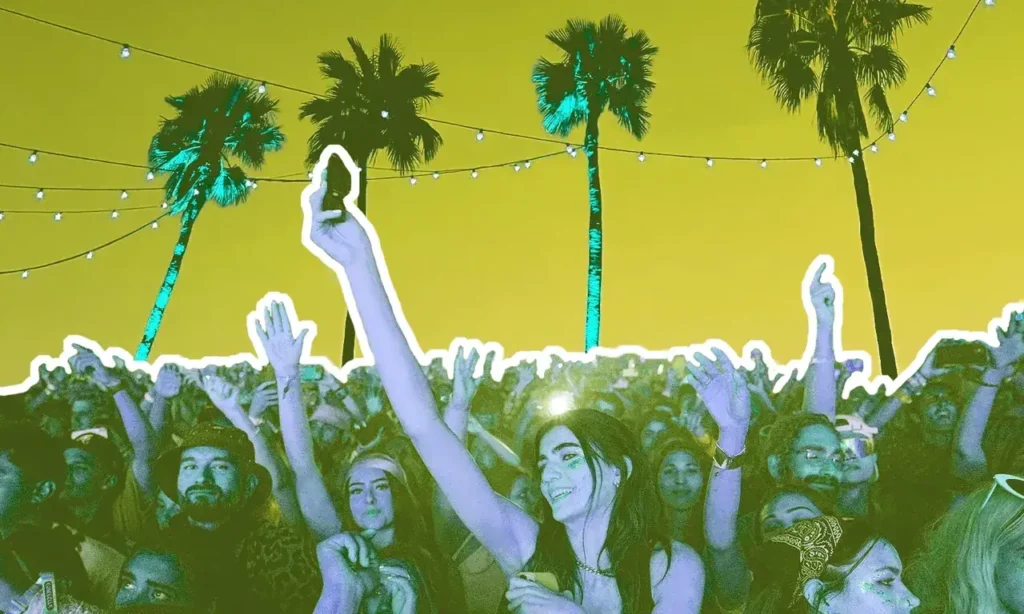
Illinois’s event culture creates additional deployment layers that no other format can match. Lollapalooza draws more than 400,000 people into Grant Park over four days each summer. The Chicago Air & Water Show packs the lakefront with one of the largest single-weekend crowd volumes in the Midwest. The St. Patrick’s Day River Dyeing pulls hundreds of thousands into the Loop corridor during a narrow morning window. Each of these occasions concentrates a captive, engaged audience that an AGM LED truck activates before, during, and after the event footprint expands into surrounding streets.
AGM deploys LED billboard trucks through every major Illinois market — from the Chicago Loop to downstate cities that traditional outdoor never reaches. Direct crew. No subcontractors. Documented results.
The Illinois Tollway network functions as the circulatory system of suburban Chicagoland. I-88, the Reagan Memorial Tollway, runs westward from the city’s edge through Aurora, Naperville, and deep into the Quad Cities — a corridor dense with technology campuses, corporate parks, and major retail anchors. Commuters on I-90, the Jane Addams Memorial Tollway, connect O’Hare International Airport to the northwest suburbs and beyond. I-290 feeds the western suburbs directly into Chicago’s Loop during peak hours. These arteries are not random — their traffic patterns are consistent and predictable, and AGM’s route team maps them in detail before every deployment.
I-55 runs south from Chicago through Joliet, Bloomington-Normal, and Springfield all the way to the Missouri border — the backbone of Illinois’s manufacturing and logistics corridor. Warehousing operations, food processing facilities, and agricultural supply chains run parallel to this route, making it valuable for B2B industrial brands trying to reach plant managers and procurement decision-makers at scale. The freight concentration at the I-80/I-55 interchange is one of the most strategically important logistics zones in the entire country, and it supports a workforce that few consumer campaigns ever address directly.
Michigan Avenue and Lake Shore Drive form Chicago’s most iconic advertising corridor, blending tourist volume with high-earning professional commuter traffic in a combination that few urban environments anywhere can match. The stretch from the Chicago River north to Oak Street — commonly called the Magnificent Mile — concentrates flagship retail flagships, five-star hotels, and high-intent purchasing activity in a walkable two-mile strip. A single AGM truck pass through that zone during peak afternoon traffic reaches an audience density equivalent to a nationally purchased media placement, at a fraction of the production cost.
I-57 opens access to a completely different audience: southern Illinois communities from Kankakee and Champaign through Effingham to the Missouri state line. Regional brands, healthcare networks, utilities, and political campaigns consistently underestimate this corridor, but its relative advertising scarcity means an LED truck produces outsized recall among audiences that aren’t accustomed to seeing this format rolling through their towns. Market novelty carries real commercial value, and downstate Illinois offers it in abundance.
The Loop concentrates the highest per-block pedestrian and vehicle density of any Midwestern central business district, with Wacker Drive, Michigan Avenue, and State Street running in parallel to create layered routing opportunities across a compact geography. Grant Park transforms seasonally into a massive event venue for Lollapalooza, Taste of Chicago, and the Chicago Jazz Festival, each drawing enormous crowds that spill into the surrounding street grid and remain in motion for hours before and after events. Commuter density during morning and evening rush along Washington, Madison, and Monroe Streets adds a weekday dimension that makes this market productive on event and non-event days alike. The Loop’s transit infrastructure — with twelve CTA El lines converging — creates additional foot-traffic funnels at every station entrance.
McCormick Place draws millions of convention attendees annually from every sector of industry and commerce, making the surrounding lakefront corridor one of the most concentrated B2B advertising environments in the country. The primary approach roads — Cermak Road, Martin Luther King Drive, and the Lake Shore Drive connector — become mandatory funnels for everyone entering or exiting the campus on convention days. AGM positions trucks along these corridors during load-in mornings, keynote windows, and evening networking hours when attendees are moving between the venue and nearby hotels in the South Loop and Museum Campus area. Creative can be rotated mid-day to align with specific sessions or product launches happening inside the building.
Springfield is the governmental and institutional hub of Illinois, and its advertising environment is unlike anything available in the Chicago metro. The Illinois State Capitol grounds, the Abraham Lincoln Presidential Library and Museum, and the constellation of state agency buildings surrounding both create a cluster of institutional foot traffic dominated by lobbyists, government employees, journalists, and out-of-state visitors with specialized professional interests. Mobile LED campaigns in Springfield perform especially well for advocacy organizations, healthcare systems seeking legislative attention, and statewide brands that want to align their identity with Illinois governance. The compact nature of Springfield’s downtown core makes a single truck exceptionally efficient — a few repeated passes covers the entire institutional center without excess route miles.
The Peoria metropolitan area functions as the commercial hub for a broad swath of central Illinois, drawing shoppers, workers, and institutional visitors from surrounding counties that have no other regional anchor. Caterpillar’s global headquarters anchors a significant corporate presence alongside major regional healthcare systems and financial institutions, creating B2B targeting opportunities that national campaigns typically overlook. The Quad Cities — Davenport and Bettendorf on the Iowa side, Rock Island and Moline in Illinois — form a binational metro of more than 400,000 residents that Chicago-centric media consistently underweights. An LED truck deployment in the Quad Cities reaches a market that hasn’t been saturated by this format, and that gap in audience exposure translates directly into stronger organic recall and word-of-mouth extension.
Tell us about your campaign goals, target audience, and preferred locations. Our team will help you plan a high-impact LED Billboard Trucks advertising campaign tailored to your needs.
Award Winning Personalized Service
You will get thoughtful, devoted, and individualized attention from our experienced, qualified, and professional personnel. Being one of the most illustrious agencies in Brooklyn, New York, American Guerrilla Marketing has been awarded the Best of Brooklyn title.
Nationwide
Industry City, Brooklyn, New York 11232
American Guerrilla Marketing
Hours
Mon - Fri: 9 AM - 5 PM
Sat & Sun: Closed
Automate your campaign with AGM’s Request for Proposal Builder. Simply answer a few quick questions about your campaign goals, markets, and timeline, and the system will generate a tailored presentation with recommended strategies, quantities, and pricing. Click the RFP Builder to instantly receive your customized proposal.
contact us for pricing — 8hr minimum
contact us for pricing
The standard deployment format for most Illinois city campaigns. High-resolution LED panels visible from two full city blocks in either direction. Well-suited for neighborhood activations, product launches, retail promotions, and university market campaigns across Chicago and downstate markets alike.
contact us for pricing
Extra screen surface for campaigns that need to command attention along major arterials, event perimeters, or multi-lane tollway approaches. The XXL format performs at full impact on Michigan Avenue, McCormick Place approach roads, and any Illinois corridor where vehicles pass at sustained speed.
contact us for pricing
Anamorphic 3D content across seamless LED panels produces the kind of street-stopping visual impact that generates organic sharing and media coverage on its own. Best deployed in high-pedestrian zones — the Magnificent Mile, Navy Pier approaches, dense festival footprints — where audience dwell time maximizes the visual payoff.
~contact us for pricing — starting ~contact us for pricing
The largest format in AGM’s fleet. The hydraulic lift elevates the screen to stadium-visible height, making this the choice for major events at Soldier Field, United Center, Wrigley Field, or any Illinois venue where crowd scale demands maximum visual reach above the surrounding environment.
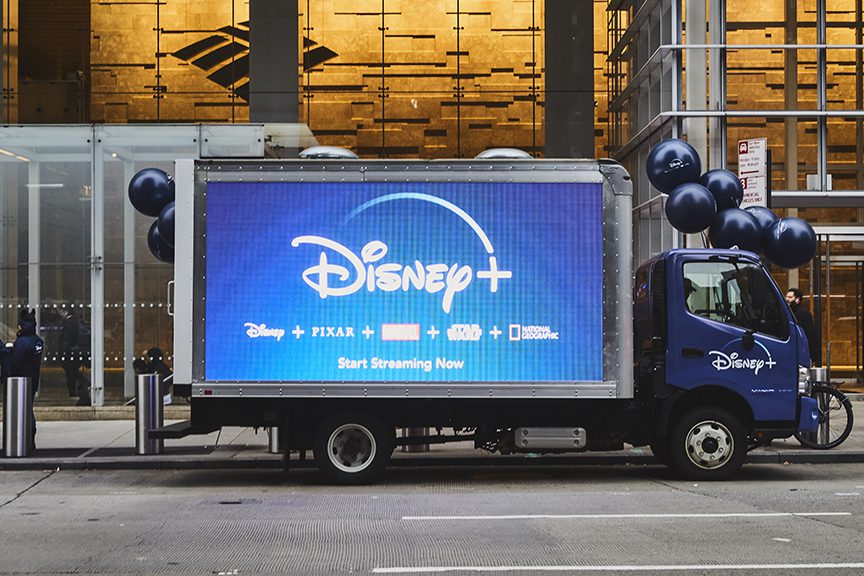
When Disney+ wanted to generate authentic street-level buzz ahead of a major content launch in Manhattan, they deployed AGM mobile LED trucks through the highest-density pedestrian corridors in the city — entertainment district blocks, transit hubs, and commuter convergence points. The campaign produced organic social sharing, local press coverage, and direct-to-consumer awareness that digital pre-roll advertising alone couldn’t manufacture at any budget level. The trucks moved through the environment rather than sitting in it, which meant every impression was a fresh one. That same logic applies directly to Illinois: route through the corridors where your audience already lives, moves, and spends time, and the media earns attention rather than purchasing tolerance.
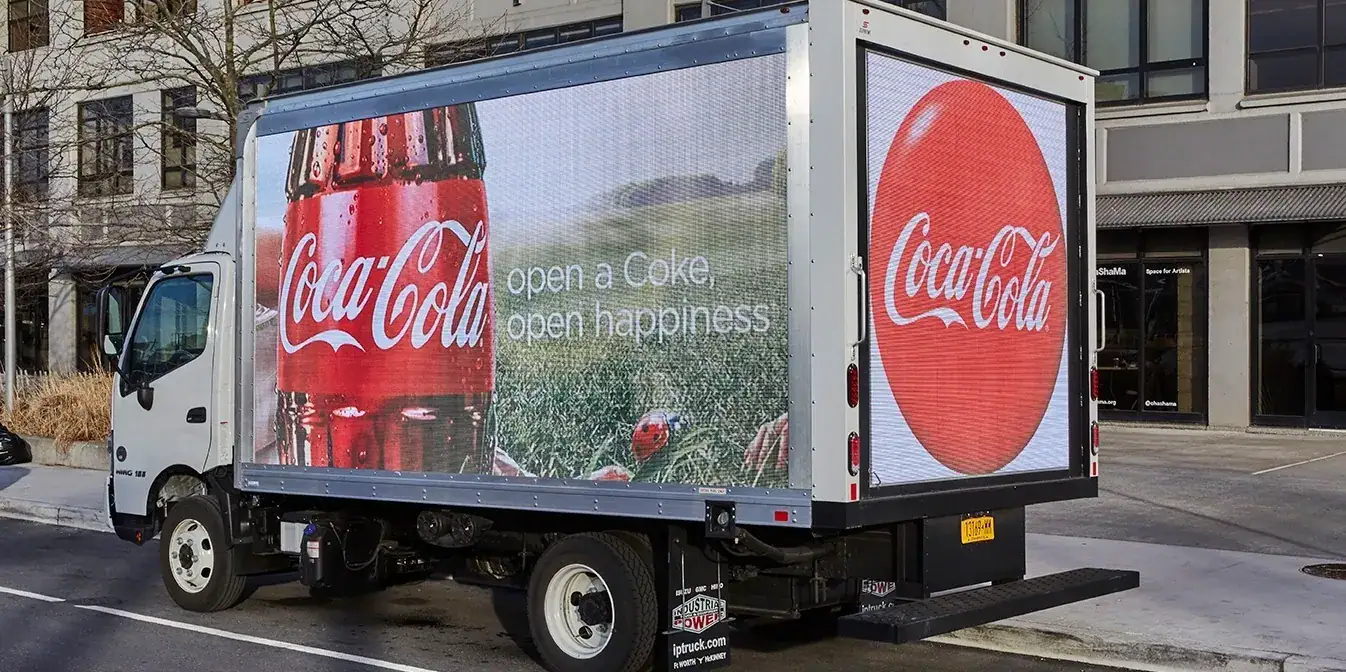
AGM has executed campaigns for Coca-Cola, FanDuel, iHeartRadio, Power 105.1, MINISO×Disney, Federato AI, Live Nation, Yuengling, and the City of New York. Our Best of Brooklyn award reflects a track record built on direct execution — we never subcontract, never delegate route control to a third party, and never route a client’s campaign through a vendor whose standards we can’t verify in real time. Every truck AGM deploys is operated by AGM crew.
Yes, and those markets are often more cost-effective per impression. AGM deploys LED billboard trucks across all major Illinois cities, including Springfield, Peoria, the Quad Cities, Champaign-Urbana, Aurora, Joliet, and Rockford, in addition to every neighborhood in the Chicago metro. Downstate campaigns frequently generate stronger organic audience engagement because the format hasn’t been overused in those markets — the novelty effect remains fully intact.
The Illinois Tollway system concentrates suburban commuter and freight traffic on a set of highly consistent, predictable arterials that our route team maps in advance of every deployment. The morning and evening rush-hour windows on I-88, I-90, I-290, and I-294 create extremely high-volume exposure opportunities that static roadside boards can’t replicate because they’re fixed at single locations. For brands targeting suburban Chicagoland, the tollway pattern allows campaigns to cover enormous geographic reach within a single deployment day.
Absolutely. AGM positions LED trucks on the primary approach and egress routes surrounding McCormick Place — Cermak Road, Martin Luther King Drive, and the Lake Shore Drive feeder streets — to intercept convention traffic during the highest-volume windows of each show day. We synchronize truck positioning with specific show schedules, keynote sessions, or evening networking events to maximize creative relevance for the audience in motion at that moment.
Large-scale events compress enormous audiences into predictable geographic zones over short timeframes — which is exactly the environment where mobile LED performs best. We deploy trucks on perimeter routes, transit corridors, and nearby commercial streets that feed and drain the crowd before and after peak event hours. Pre-event positioning on the morning of a major show routinely delivers the highest impression volume of any deployment type because the audience is alert, in motion, and actively looking at their surroundings.
Yes. The University of Illinois at Champaign-Urbana is fully serviceable as a standalone market, and we route trucks through the campus perimeter and surrounding commercial strips during high-value academic calendar windows — fall orientation, homecoming, finals, and spring recruitment periods. Northwestern’s Evanston campus can be incorporated into broader Chicago metro campaigns. DePaul’s Lincoln Park and Loop campuses sit within standard Chicago deployment routes and can be targeted specifically within a multi-zone campaign day.
The 14ft Standard truck carries an 8-hour daily minimum, translating to a contact us for pricing single-day starting rate. For brand awareness objectives in a competitive market like Chicago, we typically recommend a 3-to-5-day window to build frequency within a target neighborhood. Product launches benefit from 5-to-7 days of concentrated exposure. Multi-week campaigns are common for entertainment, political, and consumer-product clients that want sustained top-of-mind presence throughout a key market period.
Yes. AGM coordinates multi-market Illinois deployments using dedicated trucks per city, with a single operations team managing scheduling, crew briefings, and permitting across all locations. A brand launching regionally across Chicago, Rockford, and Peoria simultaneously can execute all three markets as a unified campaign with shared creative and aligned timing — or staggered by market for sequential rollout coverage.
Chicago’s neighborhood structure is one of the most precisely segmented urban environments in the country for audience-specific routing. Before every deployment, our team maps target corridors based on your consumer profile — income, age range, cultural background, lifestyle indicators, or neighborhood commercial type — and builds a route that concentrates impressions exactly where your audience lives and moves. A campaign targeting young creative professionals routes different streets than one targeting South Side families or North Shore commuters, even within the same campaign day.
Yes. LED billboard trucks display whatever artwork the client provides. For campaigns targeting Chicago’s Little Village, Pilsen, and Southwest Side communities — or Aurora’s substantial Latino population — AGM can deploy bilingual English/Spanish creative or Spanish-only creative through designated corridors. A single truck can shift between language versions as it moves through different neighborhood zones on the same deployment day, without any additional cost beyond standard creative production.
Entertainment and event promoters are the most consistent category, followed by consumer packaged goods brands launching in the Midwest, political campaigns at every level, regional healthcare systems, financial services companies, automotive dealers, and real estate developers. McCormick Place drives sustained B2B and trade-show-adjacent demand throughout the year. University corridors support seasonal peaks from financial products, tech brands, and streaming services targeting college demographics during enrollment and graduation windows.
For campaigns tied to marquee events — Lollapalooza, major McCormick Place trade shows, Soldier Field concerts, or Chicago playoff runs — plan to book four to six weeks ahead at minimum. High-demand windows fill quickly, and route scouting for event-adjacent campaigns requires enough lead time to identify optimal positioning. For standard market campaigns without event timing, two weeks of advance planning is generally sufficient to confirm trucks, finalize routes, and review creative before deployment day.