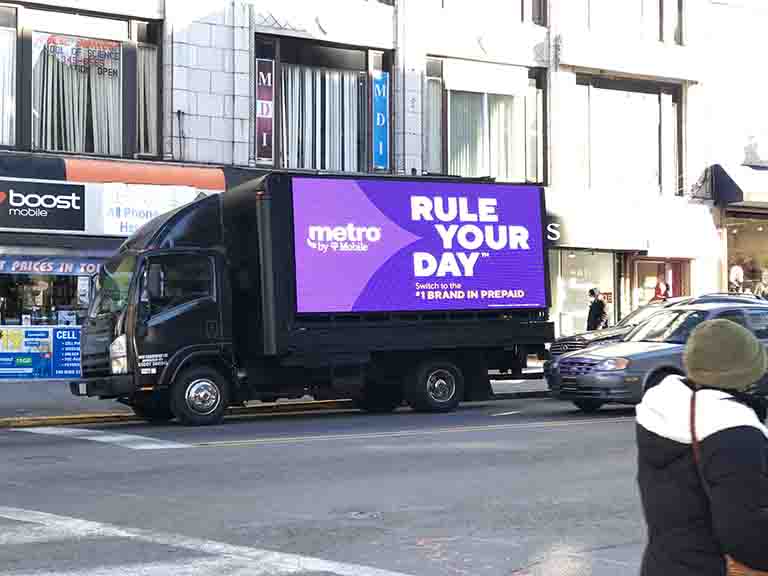
Guerilla Marketing NYC: The Ground-Level Playbook for 2025
New York City is the hardest advertising market in the world to cut through. Eight million people, ten thousand screens, and a population that has been pitched to so many times it’s developed a kind of built-in filter. You have about two seconds on most blocks before someone decides you’re worth stopping for.
Guerilla marketing in NYC is different from guerilla marketing anywhere else. The density is different. The neighborhoods are different. The foot traffic patterns are different. The cultural temperature is different block to block. We’ve been running guerilla marketing campaigns in this city for over a decade, and what works in Williamsburg doesn’t work the same way on the Upper West Side. What lands at the corner of 34th Street and Seventh Avenue won’t land at Wyckoff and Halsey in Bushwick. You have to know the city to work in it.
This is the playbook we actually use. Not a theory piece. A field guide.
Why Guerilla Marketing Works in New York Better Than Anywhere Else
NYC has several properties that make it unusually receptive to guerilla marketing, despite the noise level.
The Density Multiplier
No other city in the United States packs this many people into this small a space. Manhattan below 96th Street has over 70,000 people per square mile in residential count alone. Add the daytime population from commuters, tourists, and business travelers and key corridors like Times Square, Midtown East, and Lower Manhattan hit pedestrian counts that dwarf entire mid-size cities. A single well-placed campaign element in a high-traffic zone reaches more people in four hours than a week-long campaign in most other markets.
The Transit Network
New York’s subway system carries about 3.4 million riders on an average weekday. Every rider is on foot at some point, walking between entrances and exits, standing on platforms, moving through corridors. The subway’s surface connections create predictable pedestrian channels that make positioning campaigns precise rather than speculative. We know when the L train empties at Bedford Avenue on a Friday night. We know the morning flow from the 4, 5, and 6 trains into Grand Central. We build around those patterns.
The Cultural Conversation
New York runs on culture. Street art, fashion, music, food, and visual culture are daily subjects of conversation here in a way that doesn’t hold everywhere. When a brand places something striking in a neighborhood that has strong aesthetic awareness, people talk about it. They photograph it. They share it. The city itself amplifies what the campaign creates. That organic layer of social amplification is a multiplier most media buys can’t buy.
The Audience Quality
Tastemakers, journalists, cultural workers, entertainment industry people, fashion buyers, tech employees, food-world professionals, artists, and influencers are disproportionately concentrated in a handful of New York neighborhoods. A guerilla campaign that lands in SoHo, in the Meatpacking District, in Williamsburg, or in Nolita is reaching an audience that sets cultural tone nationally. Earned attention from that audience travels far beyond the block where the campaign ran.
The Most Effective Guerilla Marketing Formats in NYC
Not every format works equally well in every market. In New York, some approaches outperform others consistently based on what we’ve observed across hundreds of campaigns.
Posted paper in New York has a long, storied history going back decades. The visual environment of NYC has always included posted imagery on construction hoarding, on plywood barriers, on the sides of buildings where permissions exist. When we run poster campaigns, we place on approved surfaces across networks we’ve built and maintained over years. The corner of Houston and Lafayette in SoHo, the scaffolding stretch along Broadway between Prince and Spring, the hoarding at major development sites in Long Island City along Queens Plaza, and the construction walls in DUMBO along Washington Street between the bridges are all part of networks we actively manage.
A well-executed poster campaign in New York generates exposures in the millions when placements are concentrated and maintained. Posters in high-pedestrian corridors get seen by the same people repeatedly over weeks. Repeated exposure builds brand recognition that a single-day event can’t achieve alone.
Street teams put human beings in front of human beings. That’s a fundamentally different kind of contact than any passive medium. Our crews show up in character. They engage, they hand off, they start conversations when the campaign calls for it, and they create interactions that stick in people’s memory in a way that a display ad doesn’t.
We’ve positioned crews at the entrance to the Bedford Avenue L train station during the morning rush, outside the Apple Store on Fifth Avenue at 58th Street during product launches, at the base of the High Line at 14th Street and Tenth Avenue on weekend afternoons, and on the main pedestrian artery through Washington Square Park. Each of these positions requires a different kind of crew and a different approach. The Financial District morning commuter is moving fast and has a short window. The Washington Square Park weekend crowd is in a slower mode and open to a longer interaction.
Chalk and Pavement Installations
Large-scale chalk installations generate immediate attention and strong photography. We’ve created installations at the entrance to Bryant Park from Sixth Avenue, in the main plaza of Rockefeller Center, and in the pedestrian zone in front of the Metropolitan Museum of Art on Fifth Avenue at 82nd Street. The medium is temporary but the social documentation is permanent. What gets photographed and posted lives beyond the time the chalk stays visible.
Ambient and Environmental Placements
Ambient placements are the category where creativity has the highest ceiling. We’ve created branded moments on crosswalk countdowns, on building projections where permissions were secured, on bus shelters along major corridors like 14th Street and 34th Street, and on the interior surfaces of street furniture in high-traffic retail zones. The key with ambient work is that the placement has to feel like it belongs in the environment even while it surprises. It should feel inevitable in retrospect, even if it was unexpected in the moment.
Pop-Up Brand Experiences
When the campaign budget and concept justify it, a pop-up experience delivers something none of the other formats can match: a place. A physical space where people come, engage, experience, and leave with a memory rather than just an impression. We’ve set up brand experiences at the sidewalk level in the Flatiron District on Broadway at 23rd Street, at the entrance plazas around the Oculus in Lower Manhattan, and at the outdoor spaces along the Hudson River Park path between Christopher Street and Pier 45. Done right, a pop-up becomes an event. People tell other people. The line is part of the story.
Neighborhood-by-Neighborhood Strategy Guide
Every New York neighborhood has its own character, its own traffic pattern, and its own audience profile. Campaigns built for the city generically underperform campaigns built for specific blocks.
Lower East Side and Nolita
The LES stretches from the Bowery east to the East River, south from Delancey to the Manhattan Bridge approach. Orchard Street remains a creative retail corridor. Rivington, Ludlow, and Clinton Streets concentrate nightlife and restaurant culture. The audience skews young, fashion-forward, and culturally engaged. This is strong territory for music, fashion, food, and lifestyle brands.
Nolita, the small grid of blocks between SoHo and Chinatown centered on Mott and Mulberry Streets, runs quieter during the week and fills up on weekends with a design-aware crowd that pays attention to what’s on the street. Poster quality matters here. Visual execution matters here. Half-effort doesn’t make the cut.
Bushwick and East Williamsburg
The arts corridor in Bushwick has migrated east from the original gallery cluster at Bogart Street and Wyckoff Avenue toward Flushing Avenue and Jefferson Street. The audience is heavily creative-industry, and the visual culture of the neighborhood sets a high bar for anything placed in it. Our Bushwick campaigns lean into the neighborhood’s aesthetic. We don’t place corporate-looking materials here and expect them to resonate. We design campaigns that could belong in the neighborhood.
Astoria and Long Island City
These two Queens neighborhoods represent different audience segments. Astoria along 30th Avenue and Broadway has running communities, strong local business relationships, and a mix of long-term residents and younger arrivals. Long Island City around Court Square and Queens Plaza has transformed over the past decade into a tech-adjacent residential neighborhood with strong weekday foot traffic from the 7 train and the E and M subway lines. The new development corridors along Queens Boulevard and Jackson Avenue are strong positioning zones.
Harlem and Washington Heights
Harlem from 110th Street north along 125th Street is one of the most culturally significant corridors in the city. The 125th Street Apollo Theater block draws heavy foot traffic every day and especially on weekend evenings. The commercial stretch of 125th between St. Nicholas Avenue and Lexington Avenue is a strong placement zone for campaigns targeting Black consumers and broader urban audiences. Washington Heights from 155th Street north along Broadway and St. Nicholas Avenue reaches a predominantly Dominican community with specific cultural reference points.
NYC Guerilla Marketing: Pricing and Campaign Structure
We give clients clear pricing upfront. Here’s a representative comparison of campaign formats at different investment levels in the New York market.
Campaign Format
Duration
Typical NYC Investment
Expected exposures
Single-zone street team (3 crew)
1 day (8 hrs)
$1,500 – $2,500
5,000 – 15,000 contacts
Multi-zone street teams (10 crew)
1 day (8 hrs)
$4,500 – $7,500
20,000 – 50,000 contacts
Poster campaign (150 placements)
4 weeks
$2,500 – $5,000
500,000 – 2,000,000 exposures
Chalk installation
1 day execution
$1,500 – $4,500
High viral potential, 10K+ social
Product sampling (1,000 units)
1 day
$900 – $1,800
1,000 direct trials
Full brand activation / pop-up
1 – 3 days
$7,500 – $25,000+
Experience-level engagement
What the Investment Actually Buys
Street teams mean trained crew members who know how to engage without being pushy, who report accurately, and who represent the brand correctly under field conditions. Poster campaigns mean placed-and-monitored signage that we visit and document, not a one-time drop. Activations mean a full production team, a brand build-out, and on-site management from start to strike.
The investment buys outcomes, more than hours. We stand behind those outcomes with documentation, photography, and honest post-campaign reporting.
Case Study: What a Typical NYC Guerilla Campaign Looks Like
We ran a campaign for a consumer brand launching a new beverage product. The goal was to reach young professionals and creative-industry workers in lower Manhattan and North Brooklyn. The budget was $12,000 for a two-week push.
Week One: Poster and Sticker Saturation
The first week went into establishing visual presence across three neighborhoods: SoHo, Williamsburg, and the East Village. Posters went up on approved surfaces along Houston Street, along Bedford Avenue from North Third Street to North Tenth, and along First and Second Avenues from Houston to 14th Street. Stickers covered secondary surfaces in the same corridors. By the end of the first week, the brand was visible throughout the target geography.
Week Two: Street Team Activation
The second week layered a five-person street team into the existing visual presence. The crews ran from the Bedford Avenue L station in Williamsburg on weekday mornings, from the Prince Street station exit in SoHo on weekday lunch hours, and from the Union Square farmers market entrance on Saturday and Sunday. The crews handed product samples paired with a QR code for a product finder. Total handout volume over the week was approximately 4,200 units. QR scans from the campaign period tracked 870 conversions to the product landing page.
The Results
Combined poster and street team reach for the campaign was estimated at 650,000 exposures across the two-week period. Direct product trials numbered 4,200. Landing page conversions attributable to the campaign’s QR code totaled 870. The client reported a measurable uptick in sales in the zip codes directly covered by the campaign during the campaign period and the two weeks following. The campaign ran cleanly, on time, and within budget.
Timing Your NYC Campaign Around the City Calendar
New York’s calendar creates concentration moments that multiply the reach of street marketing campaigns. Brands that plan their campaign windows around these moments consistently outperform brands that treat the calendar as irrelevant.
New York Fashion Week in February and September transforms the Meatpacking District, SoHo, and Midtown into high-density zones for fashion, beauty, and lifestyle consumers. Press, buyers, photographers, and influencers from around the world are in the city and moving through specific corridors for a concentrated two-week window. A well-timed activation during NYFW reaches an audience that is both highly influential and already in a discovery mindset.
The summer outdoor markets at places like Smorgasburg in Williamsburg and Prospect Park, the Brooklyn Flea at Industry City in Sunset Park, and the various greenmarkets across the city’s neighborhoods create weekly concentration points that work as reliable activation locations for food, beverage, lifestyle, and wellness brands from May through October.
The Brooklyn Half Marathon in May and the TCS New York City Marathon in November create massive concentrations of health-conscious consumers along their routes. The half marathon’s finish line on the Coney Island boardwalk and the marathon’s route through all five boroughs provide targeting opportunities that few other events can match for sports and wellness brands.
The holiday period from Thanksgiving through New Year’s brings extraordinary tourist density to Midtown, Rockefeller Center, the Meatpacking District, and Fifth Avenue from 34th to 60th Street. Brands with broad consumer appeal can reach a concentrated, high-energy shopping audience during this window at a scale that exceeds nearly any other time of year.
We build campaign calendars for clients that map activation windows to the city’s event rhythm. That alignment is not complicated. It just requires knowing the calendar and planning accordingly. It is one of the most consistent ways to increase campaign ROI without increasing the budget.
Avoiding Common Guerilla Marketing Mistakes in New York
We see the same missteps from brands new to street-level marketing. Most of them are avoidable.
Treating All of NYC as One Market
New York City is not a monolith. It’s fifty distinct neighborhoods with different demographics, cultural identities, and audience profiles. A campaign that uses generic “New York” creative and blankets the same materials across all five boroughs will waste significant budget on mismatched placements. We segment by neighborhood and build the campaign around where the actual target audience lives, works, and moves.
Launching Without Local Knowledge
Agencies that aren’t based in New York and don’t have running crew networks here tend to make positioning mistakes. The corner that looks high-traffic on a map is blocked by scaffolding. The venue that seemed perfect doesn’t allow outside activity within a certain radius. The street that works on Saturday is a construction zone on Monday. Local operational knowledge matters. We have it because we’re here every day.
Going Short on Saturation
In a market this noisy, you need volume to cut through. A light presence, ten posters or one crew member, gets lost in the environment. We recommend clients commit to a level of presence that actually achieves saturation within the target zone. Five hundred exposures in a neighborhood isn’t a campaign. Five thousand exposures in the right corridor over the right time window is a campaign.
Skipping Documentation
We document every campaign extensively because without documentation, a campaign doesn’t exist in any accountable sense. Brands that run campaigns without photo evidence, without crew reporting, and without measurable outputs can’t improve. They can’t verify. They can’t demonstrate value internally. Documentation is not optional. It’s part of what a professional street marketing operation delivers.
Frequently Asked Questions
How long does it take to plan and launch a guerilla marketing campaign in New York?
For a focused street team campaign with existing collateral, we can be operational in as little as five to seven business days. For campaigns involving print production, permit applications, or custom fabrication, two to four weeks is more realistic. Rush campaigns are possible but carry additional logistics costs.
Can you run a guerilla marketing campaign in all five boroughs at once?
Yes. We have our crews and crew networks in Manhattan, Brooklyn, Queens, the Bronx, and Staten Island. Multi-borough campaigns require larger crew deployments and more complex logistics, but we’ve run them successfully. Multi-borough reach is particularly valuable for brands with broad NYC-area distribution.
Do you work with brands that have never done street marketing before?
This is actually where we do some of our best work. Brands new to street-level marketing often bring fresh creative energy and clear goals. We guide clients through format selection, help them understand what to expect, and set realistic benchmarks. The first campaign is often the most revealing for a brand because it puts them directly in contact with their audience in a way that changes how they
What kind of brands do guerilla marketing in NYC?
We’ve worked across a wide range of categories: food and beverage startups, fashion brands, music labels, streaming platforms, fitness studios, app launches, hospitality brands, entertainment companies, and B2B services. Street marketing isn’t limited to consumer brands. Any brand with an identifiable audience that concentrates in specific parts of the city can run a targeted street campaign effec
How do you handle crew management and quality control?
Our captains are experienced field managers who’ve run dozens of campaigns. They brief crews before every shift, monitor performance throughout the day, and file shift reports at the end of each activation window. We review crew footage and photo documentation daily during multi-day campaigns and address any performance issues immediately. Quality control is built into the operational structure, n
What happens to leftover flyers or collateral after a campaign?
We return unused materials to the client or dispose of them based on client preference. We don’t leave collateral in the field after a campaign ends. Any printed materials used in the campaign are accounted for in the final reporting, with handout volume confirmed against the original production run.
Can you help with creative and design for a guerilla marketing campaign?
Yes. We work with design partners who specialize in street-level creative. We can provide art direction, layout, and print-ready file preparation for poster campaigns, flyer designs, sticker artwork, and activation signage. Clients who come with their own creative files can work with us on execution only.