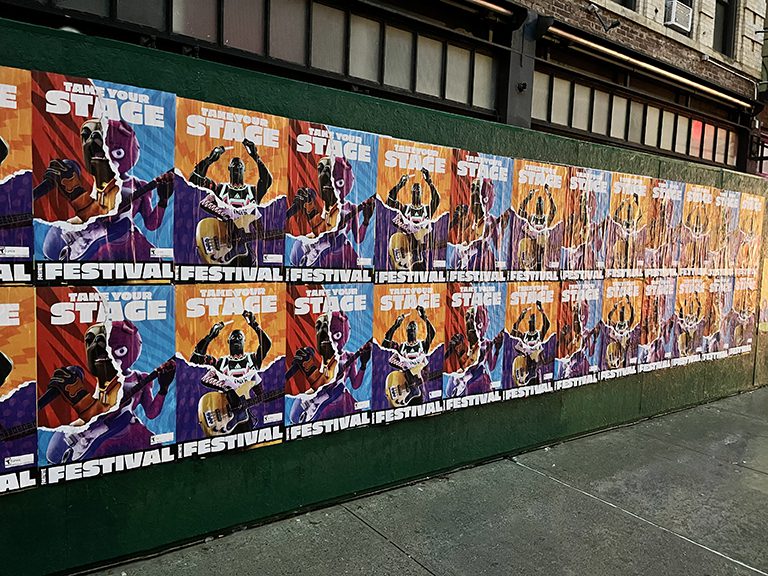
Most advertising posters are 24×36 inches. Most indoor event posters are 18×24. Most movie posters are 27×40. The answer depends on what kind of poster you’re asking about. Here’s the breakdown.
There’s no single answer to “what size are most posters?” because it depends on the type of poster and what it’s used for. Walk around any major city and you’ll see several different sizes on the same block. Some are 18×24 in windows. Some are 24×36 on building surfaces. Some are 11×17 stapled to utility poles. They all serve different purposes and their sizes reflect those purposes.
We run poster campaigns for living. Our crews are in the streets of New York, Los Angeles, Chicago, and Atlanta on a regular basis. We place thousands of posters every month across these cities. We know, from direct experience, what size most posters are in each context. Here’s what that experience tells us.
For street-level advertising in US cities, most posters are 24×36 inches. This is two feet wide by three feet tall. It’s the most widely used format for brand campaigns, entertainment marketing, music promotion, and event advertising at the street level.
The 24×36 is the sweet spot. It’s large enough to see from across the street in a typical urban environment. It’s small enough that one person can carry and post it efficiently. Print cost is manageable in commercial quantities. And virtually every print shop in every city produces it as a standard size.
If you’re specifically asking about window and interior advertising posters, most of those are 18×24 inches. Bars, venues, retail stores, and restaurants overwhelmingly use 18×24 for their window and interior poster displays. It fits standard snap frames. It’s easy to transport and handle in tight spaces. It reads clearly from 10 to 20 feet.
Size Distribution by Poster Category
Poster Category
Most Common Size
Runner-Up Size
Context
Street advertising
24 x 36 in
18 x 24 in
Building surfaces, storefronts, outdoor
Venue / indoor event
18 x 24 in
11 x 17 in
Bar windows, music venues, galleries
Movie / entertainment
27 x 40 in
24 x 36 in
Cinema lobbies, major campaigns
School / science fair
22 x 28 in board
36 x 48 trifold
Classroom, fair display
Political / grassroots
11 x 17 in
18 x 24 in
Mass distribution, yard signs
Decorative / room posters
24 x 36 in
18 x 24 in
Home walls, offices, dorm rooms
Academic research
36 x 48 in
24 x 36 in
Conference presentation
The table shows the pattern clearly. The most common size shifts depending on whether the poster is outdoors, indoors, for entertainment, for academic use, or for decoration. There isn’t one universal answer. But if you’re asking about advertising posters specifically, 24×36 is the answer.
What Size Are Most Music Posters?
Most music and concert posters are 18×24 inches for venue placements. Walk into any bar or small concert venue in the US and the show posters in the window or on the walls are 18×24. This format is the industry standard for club-level music promotion.
For street-level promotion around major venues or in surrounding neighborhoods, 24×36 is common. A major show at a 2,000-person venue will typically have 24×36 posters on building walls in a 5 to 8 block radius. The venue window and interior displays are 18×24.
For big touring acts with major label budgets, the formats can go larger. 27×40 gets used for entertainment-marketing contexts. Custom large formats appear in high-profile locations. But the baseline for most music poster work is 18×24 and 24×36.
What Size Are Most Movie Posters?
Most US movie posters are 27×40 inches. This is the “one-sheet” format standardized by the Hollywood studio system. Theater lobby frames in the US are built around this size. If you see a poster in a cinema lobby, it’s almost certainly 27×40.
The international one-sheet is 27×41 inches, one inch taller. Both formats are used in US cinema contexts, though the 27×40 is more common domestically.
For street-level film promotion outside theater lobbies, 24×36 is commonly used. This is a more manageable size for production and placement on building surfaces in neighborhoods surrounding major cinemas. The 27×40 is specific to theater-lobby infrastructure. Everything outside the lobby tends to run at 24×36.
What Size Are Most Street-Level Posters in Major Cities?
In New York, the dominant size for street-level poster campaigns is 24×36. Walk through SoHo, the Lower East Side, Bushwick, or Crown Heights during a major brand campaign or concert run-up and the posters you see on buildings and storefronts will be 24×36.
In Los Angeles, the same pattern holds. Along Fairfax, Melrose, Sunset, and Crenshaw, advertising poster campaigns run primarily in 24×36. Smaller 18×24 pieces appear in venue windows and storefronts.
In Chicago, the pattern repeats on Milwaukee Avenue in Logan Square, along Milwaukee in Wicker Park, in Pilsen, and in the South Loop. Street-level work is 24×36. Window and venue work is 18×24.
This convergence isn’t coincidental. The 24×36 became the dominant street size because it works in the physical environment of most US cities. The blocks, the pedestrian sight lines, the typical viewing distances in dense urban areas all fit the 24×36 format. It evolved as the street standard because it’s the right size for the context.
Field observation: In New York, during a major campaign rollout, you might see hundreds of 24×36 posters appear overnight across an entire neighborhood. That’s the scale at which street poster advertising works. If you see a lot of posters all at once in the same size, it’s almost certainly 24×36.
What Size Are Most Posters for Decoration?
For decorative use at home or in offices, the most common poster sizes are 24×36 and 18×24. These are the sizes most widely available from online poster shops and art print vendors. They fit standard poster frames sold at IKEA, Target, and home goods stores.
Smaller decorative sizes include 12×16, 16×20, and 18×24. Larger decorative sizes go up to 24×36 and occasionally 27×40. The 24×36 is by far the most popular single decorative poster size because it makes a visual statement on a wall without overwhelming most room sizes.
What Factors Determine What Size Most Posters Are?
The sizes that “most” posters land on come from three factors working together:
Factor 1: Infrastructure
Frames, display hardware, and physical mounting systems are built around specific sizes. Theater lobby frames are 27×40. Retail snap frames are 18×24. When infrastructure is built around a size, that size becomes dominant because using it doesn’t require special hardware.
Factor 2: Print Economics
Print costs are lowest when sizes match the natural output dimensions of printing equipment. The 24×36 comes from a 24-inch roll cutter without waste. The 18×24 comes from the same roll with one cut. These efficient sizes are cheaper to produce and therefore more widely used.
Factor 3: Campaign Convention
Once a size becomes dominant in an industry, it stays dominant because everyone in that industry knows it, specifies it, and uses it. Designers design to it. Printers produce it. Display hardware is built for it. The convention reinforces itself over time.
Bottom line: Most advertising posters are 24×36. Most indoor and venue posters are 18×24. Most movie posters are 27×40. If you’re buying or ordering posters and want the most common size, go 24×36 for outdoor and 18×24 for indoor.
What Size Should Your Posters Be?
If you want to match what most posters are:
For outdoor street campaigns: 24×36 inches
For indoor venue and window campaigns: 18×24 inches
For entertainment marketing: 27×40 inches
For grassroots or budget-conscious campaigns: 11×17 inches
For decorative home or office use: 24×36 or 18×24 inches
Going with the most common size for your context isn’t always wrong. Standard sizes exist because they work. They’re efficient to produce. Display hardware supports them. Viewers are familiar with them. Unless you have a specific reason to use a non-standard size, starting with the most common size for your context is usually the right call.
What Size Are Most Posters by Quantity: US Print Industry Data
The most-ordered poster sizes in the US print industry by volume tell us where the market concentrates. While exact industry volume data isn’t publicly available at the granular level, the distribution of print shop offerings, pricing tiers, and material stock availability tells a consistent story.
11×17 is produced in the highest quantity across all print vendors. Every copy center, digital print shop, and online printing service optimizes for this size. It’s the default for event flyers, promotional inserts, interior campaign pieces, and any print job that needs mass distribution at low cost. The total number of 11×17 sheets produced annually in the US across all applications dwarfs any other poster-format size.
18×24 has the most consistent demand at campaign volume. This is the size that professional marketing campaigns return to for interior venue and retail window placement. The order profile is consistent: 100 to 500 pieces per campaign, multiple times per year for repeat clients. Professional marketing agencies and brand marketers drive this volume.
24×36 has the highest per-unit revenue and is the dominant size for outdoor advertising work. Fewer pieces are produced than 11×17, but the per-unit cost is higher, and the customers ordering it are professional marketing buyers running substantial campaigns. The outdoor advertising and brand activation industry drives 24×36 volume.
What Size Are Most Art Posters?
Art and decorative posters have a different size distribution than advertising posters. The most common sizes sold through art print services and in retail art stores:
8×10 and 8.5×11: Affordable entry-level print sizes. Widely available from photo print services at low cost. Common for independent artist merchandise and affordable art prints.
11×14: A classic art print size with wide frame availability. Fits between the 8×10 and the 18×24 in terms of presence and cost.
18×24: One of the most popular sizes for gallery-quality art prints. Fits standard frames and looks impressive on a wall. Common in both physical art markets and online print-on-demand platforms like Society6 and Redbubble.
24×36: The largest commonly available art print size with widely available retail frames. The go-to for statement pieces in home decor and for serious poster collectors.
27×40: The movie poster format. Collector prints, limited editions, and officially licensed entertainment posters in this size serve a focused collector market.
What Size Are Most Posters at Retail?
Walk into a Target, Urban Outfitters, or IKEA looking for poster art. The sizes stocked tell you what most posters are at retail.
IKEA stocks poster-format art prints at 18×24 and 24×36 most prominently. Their frame offerings at these sizes drive sales volume for both. Target stocks 18×24 and 24×36 as primary art print sizes with 11×17 appearing in smaller quantities. Urban Outfitters and similar lifestyle retailers stock a mix including 18×24, 24×36, and sometimes 27×40 for entertainment-themed content.
The retail art market has converged on 18×24 and 24×36 as the default sizes. Both have wide frame availability. Both ship efficiently in flat packs or rolled tubes. Both display well in the typical residential or commercial interior. The most commonly sold decorative posters are in these two sizes, which reinforces what the advertising market independently running as the standard sizes.
Why the Most Common Poster Sizes Haven’t Changed Much
The standard poster sizes we use today have been largely stable for decades. That’s not inertia. It’s the natural result of market selection pressure.
The 18×24 survived because it fits retail display hardware that was manufactured to that spec. Print shops bought roll stock to produce it. Distributors built transport systems around it. Every link in the supply chain optimized for the same size. Deviating from it adds friction and cost at every step.
The 24×36 survived for outdoor because it’s the largest poster size that one person can comfortably transport, position, and paste in the field without mechanical assistance. Campaigns need to be installed efficiently by crews who are working quickly across many locations. The 24×36 threads the needle between visual impact and installation practicality.
Future changes to these standards will come from technology shifts, not preferences. If large-format digital printing costs drop significantly at 36×48, or if new lightweight substrates make very large posters easier to handle and transport, the dominant sizes may shift upward. For now, 18×24 and 24×36 remain the dominant sizes because they’ve proven themselves across millions of campaigns over several decades.
Frequently Asked Questions
What size are most posters in the US?
For advertising and street campaigns, most posters in the US are 24×36 inches. For indoor and venue use, most are 18×24. For home decoration, the most popular size is also 24×36, followed by 18×24. The answer depends on the context and application.
What size are most concert and music posters?
Most concert and music posters are 18×24 inches for venue and window placements. For street-level promotion in surrounding blocks, 24×36 is more common. Both sizes are standard in music marketing campaigns.
What size are most movie posters?
Most US movie posters (the one-sheet) are 27×40 inches. This is the standard for theater lobby frames. Street-level film promotion often uses 24×36 outside of theater settings.
Are most posters portrait or environment?
Most advertising posters are portrait (taller than wide). The 24×36 and 18×24 are both standard portrait sizes. environment posters exist but are less common for street and venue advertising. Transit advertising and retail display panels sometimes use environment orientation.
What size are most band posters?
Most band posters used for promotion are 18×24 inches. This is the dominant format for venue, bar, and club promotion. For street-level placements near major shows, bands and agencies step up to 24×36. Classic collector band posters are often 24×36 or larger.
What size are most vintage posters?
Vintage poster sizes varied by era and country. US vintage posters from the 1960s and 1970s rock era are often approximately 14×20, 20×28, or 23×35 inches. These don’t align exactly with modern standard sizes. Vintage film posters were typically one-sheet (27×41) or half-sheet (22×28).
What size are most commercial posters sold in stores?
In retail stores, the most commonly available commercial poster sizes are 24×36 and 18×24. These are the sizes offered by major online poster shops and art print vendors. Frame sizes at retailers like IKEA and Target are built around 24×36 and 18×24.