Standard Poster Sizes in Inches | American Guerrilla Marketing
Poster size matters. Pick the wrong dimensions and your art gets cropped, your print order gets rejected, or your message disappears on a busy wall. Pick the right size and everything clicks: the visual fills the space, the type is readable from across the street, and the printer does not charge you for a custom run.
We print and post a lot of paper. We know which sizes hold up in the real world and which ones cause headaches. This guide covers every standard poster size in inches, explains when to use each one, and gives you the table you need to make the right call the first time.
Paper mills, print shops, and press equipment are all built around specific sheet sizes. Standard dimensions reduce waste, speed up production, and keep costs down. When you order a non-standard size, someone has to trim stock manually. That adds time and money.
Standard sizes also match standard frames. If you want your poster to end up in a store window display or a gallery show, a standard size means you buy a frame off the shelf. Custom sizes mean custom frames. Nobody wants that bill.
There are two main systems in play: the US system (based on inches) and the ISO system (used almost everywhere else, based on millimeters). We will cover both, but the focus here is inches because that is what most US print shops work with by default.
The Core US Standard Poster Sizes
These are the sizes you will see on print shop menus across the country. They are widely stocked, fast to print, and easy to source locally or online.
The Most Common Size: 24×36
The 24×36 poster is the workhorse of street-level print campaigns. It is big enough to command attention, small enough to be cost-effective in volume, and every print shop has it in stock. When in doubt, this is your default.
Small Poster Sizes: 11×17 and 18×24
The 11×17 inch poster is technically called a tabloid sheet. It is the same size as two letter-sized pages stacked together. Most office printers can handle 11×17. Full-service print shops definitely can.
This size works well for:
Bar and club promotions posted near the door
Coffee shop bulletin boards
Handbill-style distribution at events
Inside elevator doors or hallway noticeboards
The 18×24 inch size steps up noticeably. It reads well from about 10 to 15 feet away. You see this size in retail windows, behind bar counters, and in lobby display cases. The proportions are close to a standard sheet of foam board, which makes it easy to mount without trimming.
Both sizes print on standard digital press equipment. No special setup fees. Order quantities as low as 1 or 2 and the price per sheet is still reasonable.
The 24×36 Standard: Why Everyone Uses It
Ask any print shop what their most popular poster size is and they will say 24×36. This is the standard poster size in the US for a reason.
At 24 inches wide by 36 inches tall, this format:
Fills a wall display without dominating a small space
Reads clearly from 15 to 25 feet away
Fits inside a standard 24×36 snap frame or poster sleeve
Ships rolled in a standard tube, which is cheap to mail
Prints on most large-format inkjet machines with no custom setup
Concert posters, movie promotions, retail sales announcements, event posters, neighborhood advertising campaigns all default to 24×36. If you are producing posters in volume for any kind of marketing push, this is the size to anchor your program around.
The aspect ratio is 2:3. That matches a lot of standard photography and design templates, so artwork rarely needs to be re-cropped or stretched when prepping files.
Movie Poster Sizes: 27×40 and 27×41
Hollywood standardized the one-sheet movie poster at 27 inches by 40 inches decades ago. This size fits theater display cases and lobby light boxes. It is taller than a 24×36, which gives it an imposing presence on a wall.
The 27×41 advance movie poster is one inch taller. That extra inch is a holdover from how older light boxes were built. Both sizes are still in production today. If you want a poster that looks like it belongs in a Cineplex lobby, these are your dimensions.
These sizes cost a bit more than 24×36 because they require larger paper stock and more ink coverage. But for entertainment marketing, the look is worth the premium.
Large Format Poster Sizes: 40×60 and Beyond
When you move above 24×36, you enter large format territory. These prints require wide-format printers, which most basic print shops do not have. You need a shop with roll-fed inkjet equipment.
The 40×60 size is popular for retail environments. Department stores, brand pop-up shops, and trade show booths all use this scale. At this size, images need high resolution files. Minimum 150 DPI at final output size. If you submit a 72 DPI web image, it will look terrible.
Sizes beyond 40×60 move into banner and billboard territory. The 48×96 size (4 feet by 8 feet) is a common substrate for outdoor display. Above that, most prints are produced in sections and seamed together on installation.
Resolution Rule for Large Format
Working at final output size, aim for 150 DPI minimum for large format prints viewed from 10+ feet. For anything viewed up close, go 300 DPI. Send your files as PDF or high-resolution TIFF. Never send JPEGs compressed for web.
ISO Poster Sizes in Inches (A-Series)
The international A-series paper sizes are used everywhere outside the United States. You will encounter these sizes if you are working with European print vendors, designing for international markets, or ordering from online print services that default to metric.
Here are the main A-series poster sizes converted to inches:
ISO Size
Inches (approx.)
Millimeters (exact)
US Equivalent
A0
33.1 x 46.8
841 x 1189
Closest to 33×47
A1
23.4 x 33.1
594 x 841
Closest to 24×33
A2
16.5 x 23.4
420 x 594
Closest to 16×23
A3
11.7 x 16.5
297 x 420
Closest to 12×16
A4
8.3 x 11.7
210 x 297
Similar to letter (8.5×11)
A1 is the size used most often for large indoor posters internationally. It falls between a US 18×24 and a US 24×36 in total area. If a vendor quotes you on A1 and you are used to thinking in US sizes, think of it as a slightly smaller 24×36.
Choosing the Right Size for Your Campaign
The right size depends on where the poster will live, how far the viewer stands from it, and what your budget allows.
Here is a practical framework:
Indoor, close range (under 6 feet): 11×17 or 18×24
Indoor, mid-range (6 to 20 feet): 24×36
Outdoor, viewed from a sidewalk: 24×36 minimum, 27×40 preferred
Retail window or lobby anchor: 40×60 or 27×40
Outdoor building wrap or billboard: Custom, typically 48×96 and up
For high-volume street campaigns, we always recommend standardizing on one size. Mixing 24×36 and 27×40 in the same campaign creates headaches with frames, display hardware, and vendor pricing. Pick one. Run it everywhere.
Paper Stock and Finish Considerations
Size is only half the equation. The paper stock and finish affect how a poster performs in the real world.
Coated Gloss: Bright colors, vivid images. Best for indoor use. Fingerprints show easily. Not ideal for outdoor environments that see moisture.
Coated Matte: Refined look, no glare. Works well under fluorescent lighting. Colors slightly less saturated than gloss.
Uncoated: Raw, natural feel. Popular with music and arts campaigns. Takes pen and marker ink well. Less water-resistant.
UV Laminate: A thin coating applied after printing. Adds moisture resistance and scratch protection. Worth the extra cost for outdoor applications.
Satin: A middle ground between gloss and matte. Good all-purpose finish for both indoor and outdoor.
File Setup for Standard Poster Sizes
Getting your file right before you send it to the printer saves money and avoids reprints. Here is the standard setup for common poster sizes:
Document size: Set to final trim size (e.g., 24×36 inches)
Bleed: Add 0.125 inches (1/8 inch) on all sides
Resolution: 300 DPI for small format, 150 DPI minimum for large format
Color mode: CMYK for print. Do not submit RGB files to a commercial printer
Safe zone: Keep text and important design elements 0.25 inches from the trim edge
File format: PDF/X-1a or PDF/X-4 preferred. High-res TIFF also accepted at most shops
If you are designing in Canva, note that Canva exports in RGB by default. You may need to adjust colors after conversion, or use a design tool like Adobe Illustrator or InDesign that lets you work natively in CMYK.
How Standard Poster Sizes in Inches Work in Real Campaigns
Standard sizes matter because they match the real-world infrastructure of print production and display. Here is what those standards mean in actual campaign environments.
Printing at Standard Sizes Costs Less
Print vendors run their equipment most efficiently at standard sizes. When you order at 24×36, the print shop can produce your job on a roll of paper that is set up for 24-inch-wide printing. Custom sizes require re-setup, paper trimming, and often a price premium of 20 to 40 percent over the nearest standard size. For campaigns of 100 pieces or more, that premium adds up quickly. Sticking to standard sizes in inches keeps production budgets predictable and helps you avoid surprises at billing.
Standard Sizes Fit Existing Display Hardware
The reason standard sizes became standard is that the physical infrastructure of display at concerts, in retail, and in transit advertising was built around specific dimensions. A 27×40 poster was standard in movie theaters because the display cases in theater lobbies were built to 27×40. A 18×24 is standard in retail because the snap frames and display stands are built to 18×24. The standard sizes and the display hardware have co-evolved over decades. Ordering at non-standard sizes means your poster may not fit the hardware where you intend to display it.
Street Campaign Standard Sizes in Inches
In street marketing, the standard sizes in inches are 24×36 for primary outdoor placements and 11×17 for high-volume secondary placements. This combination is used consistently across New York, Los Angeles, Chicago, and every other major US street marketing market because it provides the right scale for street-level visibility at both viewing distances and budget constraints. Our crews have installed hundreds of thousands of posters at these two sizes across dozens of cities. The standard works because it was selected through competitive pressure over many campaigns and many years.
When to Break from Standard Sizes
Non-standard sizes are worth the extra cost and complexity in two specific situations. First, when the installation surface has unusual dimensions that make a standard size look wrong: too small for the space, or the wrong aspect ratio for the wall. Second, when the brand’s creative concept requires a specific format to work properly, and no standard size is close enough to adapt to. Outside these situations, standard sizes in inches are the right choice for cost, speed, and compatibility.
How Standard Sizes Work on Different Street Surfaces
Not every wall is the same. A smooth painted cinder block surface holds paste differently than a textured brick wall. A plywood construction hoarding takes paste cleanly at large format. An older brick wall with irregular mortar joints works better with flexible paper stock. Understanding how your chosen size interacts with the target surface prevents waste and keeps your placements looking sharp.
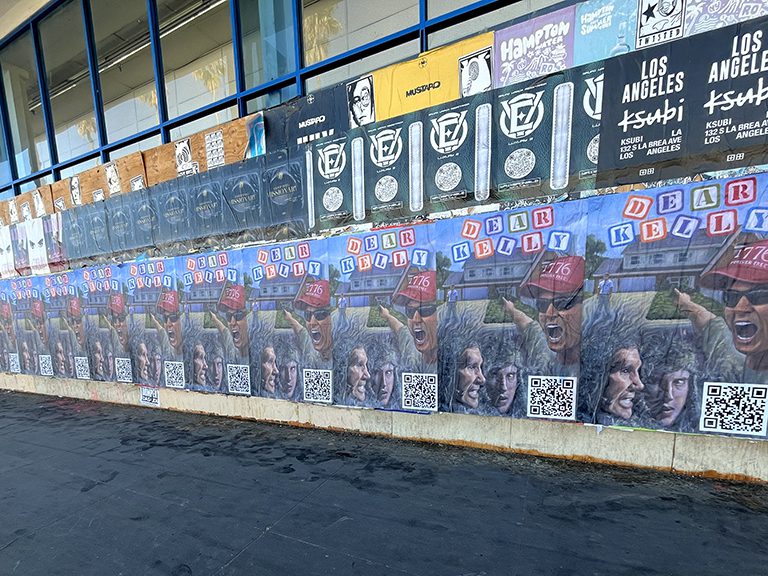
In New York City, the most productive paste-up surfaces include construction hoarding in active development corridors like the Lower East Side, long blank walls in Bushwick and Greenpoint, and scaffolding wrapped panels in midtown and downtown Manhattan. The 24×36 poster works cleanly on all of these surfaces. A single application of paste, smoothed outward from center to edges, eliminates bubbles and creates a clean finish that lasts through a week of normal weather without curling or peeling at the corners.
In Los Angeles, the texture of outdoor walls varies more. Stucco surfaces common in Silver Lake and Echo Park require a heavier paste application and occasionally a second adhesive coat over the poster face to hold the edges. The 24×36 format at 100 lb text stock performs well on these surfaces because the heavier stock resists the tendency of lighter paper to curl away from irregular plaster textures. Knowing your surface before you go to print is part of running a campaign that holds up on the street.
Poster Size FAQs
Does poster orientation affect which size I should choose?
Somewhat. Most standard sizes are portrait (taller than wide) by default. environment orientation is available in the same dimensions but may require a custom print run at some shops. The 24×36 in environment becomes 36×24, which works well for bus shelter interiors and horizontal wall runs.
Frequently Asked Questions
What is the most common standard poster size in inches?
24×36 inches is the most common poster size in the US. It is the default for concerts, movies, retail, and street marketing campaigns. Most print shops stock this size as a ready-to-print format with fast turnaround.
What is the difference between 24×36 and 27×40 poster sizes?
The 24×36 is the general-purpose standard poster. The 27×40 is the official movie one-sheet size used by theater chains. Both are portrait orientation. The 27×40 is wider and taller, giving it more visual presence on a wall.
Is 11×17 considered a real poster size?
Yes. The 11×17 tabloid size is widely used for smaller indoor posters, event flyers, and handbills. It is not large enough for most street campaigns, but it works well in tight indoor spaces where viewers are close.
What resolution do I need for a 24×36 poster?
300 DPI at 24×36 inches is the gold standard. If your image source does not support 300 DPI at that size, aim for at least 150 DPI. Anything below 100 DPI at final output size will show visible pixelation.
What is the A1 poster size in inches?
An A1 poster measures approximately 23.4 x 33.1 inches (594 x 841 mm). It is the most common large indoor poster size in international markets. It is slightly smaller than a US 24×36.
How do US and European poster sizes compare?
US sizes are based on inch measurements and do not follow a fixed ratio. European ISO sizes (A0, A1, A2, etc.) all share the same aspect ratio (1:1.414) so they scale perfectly into each other. Neither system is directly compatible with the other without some cropping or adjustment.
What is a large format poster size?
Large format typically refers to anything 40×60 inches and above. These prints require wide-format roll-fed printers. Sizes like 48×96, 60×96, and larger are used for outdoor displays, building wraps, and billboard applications.