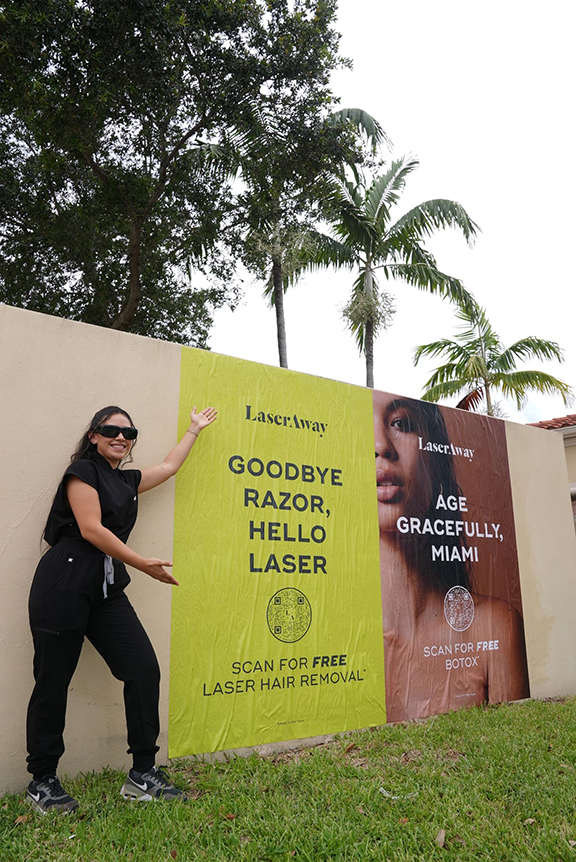
Large Poster Size Dimensions: Every Oversized Format Explained
Large poster size dimensions start where standard posters leave off. Once you go beyond 24 x 36 inches, you are working in large format territory. The rules change. Installation is more complex. Print costs rise. But the visual impact at the right location justifies every additional dollar.
At American Guerrilla Marketing, large format is part of our core business. We have installed oversized posters across New York, Chicago, Miami, Atlanta, Houston, and dozens of other markets. We know the dimensions that work in the real world, the installation considerations that determine success, and the campaign types where large format delivers results that standard sizes simply cannot match.
This guide covers every large poster format, from the first step above standard at 27 x 40 inches all the way to the massive installations that can span entire building facades.
The transition from standard to large format is not a hard line. Different parts of the industry draw it differently. In print, large format typically refers to any output over 24 inches in width that requires a focused large-format printer rather than a standard sheet-fed press. In the street marketing world, we consider anything over 24 x 36 inches as entering large format territory.
The practical threshold is defined by installation. A standard 24 x 36 poster can be handled by a single person. It is light, manageable, and fits on most surfaces without special preparation. Once you move to 36 x 48 or larger, you need at least two people for installation. The logistics scale with the dimensions.
Budget awareness matters here too. Large format printing costs roughly two to four times more per square inch than standard format printing. The infrastructure is more expensive to operate. The material costs more. The installation takes longer. Every decision to go large format needs to be justified by the campaign goal and location quality.
Common Large Poster Size Dimensions
27 x 40 Inches (The One-Sheet)
This is the theatrical cinema standard. The movie industry has used this format for decades. It is the first stop above 24 x 36 for campaigns that want a premium look. The 27 x 40 has a distinctive tall and narrow proportion that gives it a refined, editorial quality. For entertainment campaigns, it signals industry credibility. For non-entertainment campaigns, it provides a distinctive alternative to the ubiquitous 24 x 36.
30 x 40 Inches
Less common than the one-sheet but used in some retail and gallery contexts. The 30 x 40 format gives more horizontal space than the 27 x 40 while maintaining a large scale. Some photo printing vendors specialize in this format for photographic display and art prints. It appears occasionally in high-end retail marketing.
36 x 48 Inches
This is the first format our teams call “truly large.” At three feet by four feet, the 36 x 48 creates a visual presence that a standard poster cannot match. It covers four square feet of surface. From a distance of 50 feet, the headline is clearly readable if designed appropriately. This format works well on construction fencing, large blank walls, and scaffolding systems.
40 x 60 Inches
Used in retail environments with large display systems. Some high-end boutiques and department stores run 40 x 60 display panels as their standard large format. The proportions are similar to 24 x 36 (a clean 2:3 ratio) which makes design adaptation straightforward. This format is less common in outdoor street campaigns but shows up in branded retail environments.
48 x 72 Inches
Four feet by six feet. This is our preferred format for high-impact single-location outdoor installations. At 48 x 72, a well-designed poster becomes a statement rather than just a piece of marketing. A bold image and a single line of large type at this scale creates the kind of visual interruption that people remember and photograph. We use this format for album drops, brand launches, and event campaigns where a premium location justifies the premium format.
60 x 90 Inches and Beyond
Beyond 48 x 72, most campaigns transition to tiled installations rather than single sheets. Individual sheets at 60 x 90 or larger are difficult to transport and install without structural support. Tiled campaigns use standard large-format sheets arranged in a grid to create mural-scale images. The individual tiles stay at manageable dimensions while the combined visual effect is enormous.
Our Most-Used Large Format: The 48 x 72 inch poster is our go-to for premium single-location outdoor installations. It delivers maximum visual impact without crossing into the logistical complexity of tiled mural campaigns.
How Large Poster Dimensions Affect Design Requirements
Designing for large format requires different thinking than designing for standard posters. The scale changes what works visually and what fails completely.
Typography is the first consideration. At 48 x 72 inches, body text is essentially invisible from any meaningful viewing distance. The hierarchy must be extremely simple. One headline. One supporting visual element. One call to action, maximum. Everything else is noise at large format scale.
Image resolution also changes dramatically. A 24 x 36 poster at 300 DPI requires a 7,200 x 10,800 pixel file. A 48 x 72 poster at the same resolution requires a 14,400 x 21,600 pixel file. These are enormous files. In practice, large format prints at lower resolution because viewing distance compensates for reduced pixel density. A 48 x 72 print at 100 DPI looks excellent from 15 feet away. The same resolution looks poor at arm’s length, but nobody views a 48 x 72 poster from arm’s length in a real installation context.
Color also behaves differently at large format. Colors that look vibrant on screen can wash out at large scale, especially on backlit or textured surfaces. Testing a section of the design at actual print size before running a full job is worth the extra cost for any large format campaign.
Large Format Dimensions for Specific Surface Types
Surface type should drive your dimension decision for large format work. Here is how we match dimensions to surface types in the field:
Construction plywood barriers: Standard plywood panels are 4 x 8 feet (48 x 96 inches). A 48 x 72 poster covers one full panel with room to spare on the top edge. Multiple panels in a row can be covered with repeating posters for a gallery effect or with tiled artwork for a mural approach.
Building walls: Large blank walls vary widely in dimension. For walls up to 10 feet wide, 48 x 72 works as a single prominent piece. For wider walls, tiling is more effective. We often spec three or four 24 x 36 or 36 x 48 tiles across a wide wall to create an oversized composition.
Scaffolding: Scaffolding is a premium outdoor large format surface. The structure itself provides mounting points. Scaffolding installations often use vinyl banners rather than paper posters at large format dimensions because vinyl handles wind and weather better. Typical dimensions for scaffolding installations range from 10 x 20 feet up to full building facade coverage.
Construction fencing: Chain link or wooden construction fencing is ideal for 24 x 36 or 36 x 48 formats. Single posters in repeating patterns create visual rhythm along fence lines. Very long fence runs can use a large image tiled across multiple poster sheets for maximum visual impact.
Installation Reality: Any poster dimension over 36 x 48 inches requires at least two people and additional installation time. Budget labor accordingly. A 48 x 72 poster takes approximately three to four times as long to install cleanly as a 24 x 36.
Print Cost Reality for Large Poster Dimensions
Cost scales with area but not linearly. Here is how print costs typically compare for large format dimensions relative to the 24 x 36 baseline:
A 36 x 48 poster has exactly twice the area of a 24 x 36. Print cost is roughly 1.8 to 2.2 times higher per unit. The slight premium over the pure area difference reflects setup time and paper waste.
A 48 x 72 poster has four times the area of a 24 x 36. Print cost is roughly three to four times higher. Again, the cost premium tracks closely with the area multiplier.
For campaigns with limited budgets, one well-placed 48 x 72 poster on a premium corner often delivers better results than four 24 x 36 posters on mediocre walls. Location quality and format size work together. The large format multiplier makes sense when the location multiplier is equally large.
Choosing the Right Large Poster Dimension for Your Campaign
The decision tree our teams use for large format dimension selection:
Step 1: Identify the surface. Measure the available wall, fence, or scaffolding area. The maximum poster dimension is constrained by the surface. A 48 x 72 poster on a 36-inch wide surface does not work physically.
Step 2: Determine the viewing distance. How far away will most viewers be when they first see this installation? Street-level viewers at a crosswalk: 20 to 40 feet. Vehicle traffic from the road: 40 to 100 feet. Adjust your dimension to ensure the message reads clearly at the realistic viewing distance.
Step 3: Set the budget. Large format costs more to print and more to install. Confirm the total campaign budget before specifying dimensions. A single 48 x 72 poster with installation can cost as much as 50 to 100 standard 24 x 36 posters with installation. Make sure the location justifies the investment.
Step 4: Simplify the message. For every size increase, reduce the message complexity. At 36 x 48, you can still carry a headline and two to three lines of supporting text. At 48 x 72, you should be working with a headline and a visual. Bigger format, simpler message.
Large Poster Dimensions in Real Campaign Contexts
Large format poster dimensions create different campaign possibilities than standard sizes. Here’s how specific large dimensions play out in real campaigns.
36×48 on Construction Barriers
The 36×48 format is particularly effective on construction barriers in dense urban areas. A typical plywood hoarding panel on a NYC sidewalk measures approximately 4 feet wide by 8 feet tall. A 36×48 inch poster fills that panel cleanly with visible margin, creating a contained visual unit. When three or four panels display the same 36×48 format side by side, the result is a continuous visual presence that reads like a large-scale installation from the sidewalk. We use this format extensively on construction barriers in Lower Manhattan, Midtown, and along Brooklyn’s Atlantic Avenue, where significant development has created long runs of hoarding with consistent panel dimensions.
48×72 for Building-Side Placement
The 48×72 format works best on building-side placements with clean, flat surfaces and significant foot traffic approaching from a distance. On Broome Street in SoHo, the wide sidewalks and relatively low-rise buildings create viewing conditions where 48×72 reads comfortably from 30 to 50 feet. That’s the minimum you need to justify the format’s production and installation cost. We assess each large-format placement location for approach distance and unobstructed sight lines before recommending 48×72 or larger. A 48×72 poster invisible from a distance is an expensive mistake.
Custom Dimensions for Specific Wall Faces
Some of our most effective large-format campaigns use dimensions that don’t match any standard format because they were designed specifically for a particular wall face. A building side that’s 11 feet wide and 14 feet tall calls for a custom poster sized to those dimensions. Standard 48×72 would either fall short or be cut awkwardly. We measure first and print to fit when the location warrants it. The added production cost of a custom dimension is typically more than offset by the visual coherence of a poster that fills its surface completely and cleanly.
Most street campaigns use large format posters as anchor pieces within a broader poster mix, not as the entire campaign. Understanding how large format dimensions relate to the rest of the campaign’s poster sizes helps you build a coherent visual presence rather than an inconsistent one.
A typical approach: use 48 x 72 or 36 x 48 formats for two or three premium anchor locations in the target zone. Use 24 x 36 formats for the surrounding coverage locations where the surface dimensions don’t justify a larger format. Use 18 x 24 for high-frequency placement in dense corridors where quantity of exposures matters more than individual visual scale. This tiered approach creates a visual hierarchy in the campaign territory. The consumer encounters the campaign multiple times at different scales, which deepens the brand impression without requiring every location to be large format.
Consistent color, typography, and visual style across all three formats makes the tiered approach work. A consumer who sees an 18 x 24 piece on the walk to the subway and then encounters the 48 x 72 anchor piece on the main corner should immediately recognize the connection between them. Visual consistency across sizes is what makes a multi-format poster campaign feel like one campaign rather than a collection of disconnected placements.
We spec campaigns with this tiered approach regularly. It gives clients the visual impact of large format at the key locations without requiring large format costs at every placement. The result is a more efficient use of budget while maintaining the campaign’s visual coherence across the full coverage area.
Frequently Asked Questions
What is the most common large poster size dimension?
The most common large poster size dimension in street marketing campaigns is 48 x 72 inches. For transitional large format, 36 x 48 inches is also very common. The 27 x 40 one-sheet is the standard large format in entertainment industry applications.
What is the largest single-sheet poster size available?
Most large format printers can output single sheets up to 60 inches wide. Length can extend much further on roll-fed printers. Practical single-sheet poster installations typically top out at 60 x 90 inches. Beyond that, tiled or panel installations become more practical.
How do large poster dimensions compare to billboard dimensions?
Standard billboards are 14 x 48 feet (168 x 576 inches). Even the largest single-sheet posters are tiny by comparison. Large poster campaigns and billboard campaigns are different products targeting different budgets and viewing contexts. Large format posters at 48 x 72 or 60 x 90 are street-level products designed for pedestrian and close-range vehicle viewing, not highway reading distances.
What resolution should I use for large poster dimensions?
For large posters viewed from 10 to 20 feet away, 150 DPI is generally sufficient. For very large formats viewed from 30 feet or more, 72 to 100 DPI is acceptable. Always consult your print vendor’s specific requirements before finalizing large format files. The viewing distance determines acceptable resolution, not the print size alone.
Can I scale a standard 24×36 design to large poster dimensions?
You can scale the layout, but the file resolution may not hold up. If your 24 x 36 master file was built at 300 DPI, scaling to 48 x 72 drops resolution to 150 DPI, which is acceptable for large format. Scaling to 60 x 90 drops to 120 DPI, which is borderline. Always check that your scaled file meets the minimum resolution for the output size before sending to print.
What paper stock should I use for large format poster dimensions?
For large outdoor posters, 80 lb cover or heavier is recommended for durability. For temporary installations lasting a few days to a week, 60 to 70 lb cover is acceptable at lower cost. For installations expected to last two weeks or more in variable weather, consider 100 lb cover or coated stocks that resist moisture absorption.
How many crew members does it take to install a 48×72 poster?
A 48 x 72 inch poster requires at minimum two experienced crew members for clean installation. One person applies paste to the surface or the poster while the other manages placement and smoothing. On surfaces over six feet high, a third person may be needed to handle elevated sections safely.
Are large poster size dimensions different for indoor vs. outdoor applications?
The dimensions are the same, but material choice differs. Indoor large format posters often use foam board, adhesive vinyl, or fabric substrate. Outdoor large format posters need weather-resistant materials. Paper posters at large dimensions are typically only suitable for short-term outdoor installations in dry weather conditions. Written by Livy Phillips | American Guerrilla Marketing | New York