How Big Is a Poster Size? Complete Dimensions Guide
Poster sizes range from 11×17 to 36×48 inches and beyond. “Poster size” in advertising typically means 24×36. Here’s exactly how big every standard size is and what you can do with each one.
When someone says “poster size,” they’re usually referring to a specific set of standard dimensions that the printing and advertising industry has settled on. The most common reference point is 24×36 inches. But “poster size” can mean different things in different contexts, and understanding the full range is important for anyone ordering or designing a print campaign.
We run poster campaigns from New York to Los Angeles. The question of “how big” comes up constantly. Here’s the definitive guide to poster size dimensions, with context for every format.
The table covers the full range of what advertising and print shops call “poster sizes.” From 1.3 square feet to nearly 17 square feet of print area. The physical scale difference between an 11×17 and a 40×60 is enormous. But all of them are called “posters” in common use.
How Big Is an 11×17 Poster?
The 11×17 poster is 11 inches wide and 17 inches tall. In centimeters, that’s approximately 27.9 x 43.2 cm. In square inches, the print area is 187 square inches, or just over 1.3 square feet.
Physical reference: an 11×17 is about the size of a magazine page with the long side extended. It’s the size of a standard tabloid newspaper. It’s big enough to hold at arm’s length and read comfortably. On a bulletin board, it takes up a significant portion of a typical board section.
At street level, an 11×17 is too small to create the kind of visual presence that makes a campaign impactful. It works at close range, inside venues, on bulletin boards, and in high-density postering areas where multiple pieces create a collective effect. One 11×17 on a building wall barely registers.
How Big Is an 18×24 Poster?
The 18×24 poster is 1.5 feet wide and 2 feet tall. In centimeters, that’s approximately 45.7 x 61 cm. The print area is 432 square inches, or exactly 3 square feet.
Physical reference: an 18×24 is about the size of a large bath towel stood on its end. It’s the size of most standard kitchen cabinet doors. It fits in most car trunks flat without rolling. On a window, it takes up a significant portion of a standard storefront window.
At 18×24, the poster is readable from 15 to 20 feet with clean design and large headline text. This is why 18×24 is the dominant indoor and window poster format. The viewing distance inside most retail environments and venue spaces falls in the 10 to 20 foot range, and 18×24 works perfectly within that range.
18×24 physical sense: Lay an 18×24 poster flat on a standard kitchen counter. It extends from one edge most of the way across. Stand it upright on its long side and it reaches from the counter to just above eye level for an average-height adult. That’s how big 18×24 is in everyday physical terms.
How Big Is a 24×36 Poster?
The 24×36 poster is exactly 2 feet wide and 3 feet tall. In centimeters, that’s approximately 61 x 91.4 cm. The print area is 864 square inches, or exactly 6 square feet.
Physical reference: a 24×36 poster is about the same size as the front of a standard American refrigerator, minus the handles. It’s about the width of a standard interior door and half the height. If you lay it flat on a kitchen table, it takes up most of the table surface.
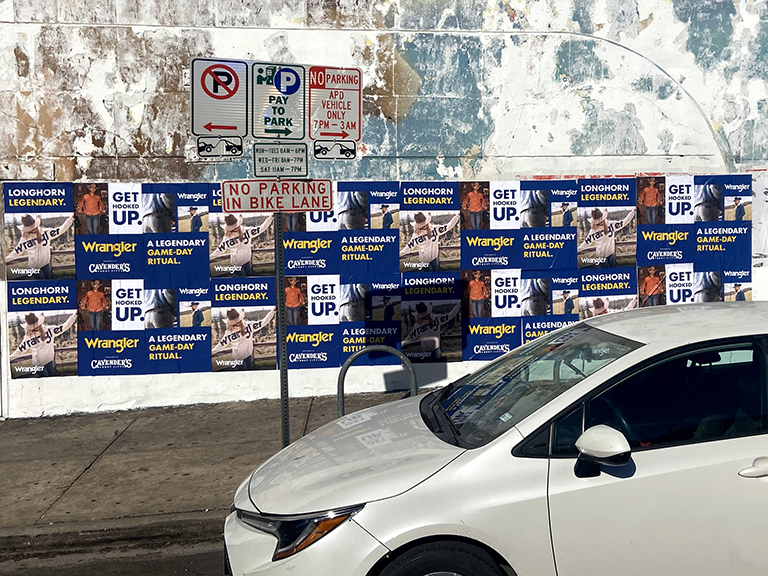
At street level, a 24×36 is visible from 30 to 40 feet in typical city conditions. On a building wall in SoHo or Silver Lake or Lincoln Park, it commands a viewer’s attention from across the street. That visibility is why 24×36 is the standard for street-level advertising campaigns.
In terms of pixel dimensions, a 24×36 at 150 DPI is 3,600 x 5,400 pixels. At 300 DPI (for close-range viewing), it’s 7,200 x 10,800 pixels. At 72 DPI (sufficient for very large outdoor viewing at 50+ feet), it’s 1,728 x 2,592 pixels.
How Big Is a 27×40 Poster (Movie One-Sheet)?
The 27×40 movie one-sheet is 27 inches wide and 40 inches tall. That’s 2.25 feet wide and 3.33 feet tall. In centimeters, approximately 68.6 x 101.6 cm. The print area is 1,080 square inches, or 7.5 square feet.
Physical reference: a 27×40 poster is slightly wider than a 24×36 (3 inches wider) and taller (4 inches taller). The extra dimensions are noticeable in person. A 27×40 in a theater lobby feels significantly larger than a 24×36 in a street context, partly because of the framing and the environment.
The theater lobby display case is designed for 27×40. If you put a 24×36 in a 27×40 theater frame, you’ll have visible gaps around the edges. For entertainment contexts where theater-quality presentation matters, the size difference between 24×36 and 27×40 is significant.
How Big Is a 36×48 Large Format Poster?
The 36×48 is 3 feet wide and 4 feet tall. In centimeters, approximately 91.4 x 121.9 cm. The print area is 1,728 square inches, or 12 square feet.
Physical reference: a 36×48 poster is roughly the size of a folding table top in one dimension. It’s about as tall as a six-year-old child when placed portrait. On a wall or building surface, it’s a substantial visual presence that’s visible from 50 feet or more with good contrast design.
At this size, design must be extremely simple. One image, one message. The complexity that works at 24×36 falls apart at 36×48 because the scale changes the way the viewer experiences the content. Bold works. Subtle fails. This is a format for impact, not information.
36×48 physical sense: Imagine four 18×24 posters arranged in a 2×2 grid. That’s a 36×48. At a transit shelter or large retail window, this size fills the display panel completely and is the dominant visual element in the viewer’s field of attention.
How Big Is a 40×60 Poster (Bus Shelter)?
The 40×60 bus shelter format is 40 inches wide and 60 inches tall, or roughly 3.33 feet by 5 feet. In centimeters, approximately 101.6 x 152.4 cm. The print area is 2,400 square inches, or 16.7 square feet.
Physical reference: a 40×60 is roughly the size of a large sofa back section or a dining room table turned on its end. It’s a significant physical object. In a bus shelter, it fills the entire advertising panel. It’s typically backlit, which dramatically increases its effective visibility range.
This is the largest size typically classified as a “poster” rather than a billboard or banner. Above 40×60, advertising formats typically use multiple panels, structural mounting systems, and are classified as different media types.
Poster Size by Viewing Distance: A Practical Guide
Poster Size
Min. Headline Text Height
Effective Viewing Distance
Visibility from Street
11 x 17 in
1 to 1.5 in
Up to 12 feet
Poor (too small)
18 x 24 in
1.5 to 2 in
10 to 20 feet
Fair from 15 feet
24 x 36 in
2.5 to 3 in
20 to 40 feet
Good from across street
27 x 40 in
3 to 4 in
20 to 40 feet
Good, enhanced by size
36 x 48 in
4 to 6 in
30 to 60 feet
Very good from distance
FAQ: How Big Is a Poster Size?
How Big Does a Poster Need to Be for Outdoor Advertising?
Street-level outdoor advertising has a hard floor for poster size. Below that floor, the poster becomes invisible in the visual competition of a busy urban environment. Here is a realistic assessment of what works at each scale in major US markets.
In New York City
New York’s pedestrian density and visual noise level are among the highest in the world. On a busy block in SoHo or the Lower East Side, an 11×17 poster is effectively invisible to anyone not already standing directly in front of it. The 18×24 starts to cut through in lower-density indoor environments. For meaningful outdoor visibility at street level in NYC, 24×36 is the minimum effective size. On major construction barriers along avenues like Broadway or Sixth Avenue in Midtown, the 24×36 can be tiled in grids of four to eight pieces to create a much larger effective display area.
In Los Angeles
LA’s car culture shifts the calculus. Pedestrians move at walking speed in some neighborhoods (Silver Lake, Echo Park, Venice, Melrose) and at vehicle speed in others. For vehicle-speed viewing along Sunset Boulevard or Fairfax Avenue, even 24×36 can be too small. The effective minimum for car-accessible outdoor placements in LA is 36×48. For pedestrian-speed streets and commercial strips, 24×36 works well.
In Chicago
Chicago’s wide sidewalks and regular building grid create good conditions for 24×36 outdoor posters. The average viewing distance from the street to a storefront in Chicago’s commercial neighborhoods is 15 to 25 feet, which is exactly the effective range of a well-designed 24×36. Transit stop placements near elevated CTA stations benefit from 24×36 to 36×48 for commuters approaching from a distance.
Poster Size and Campaign Budget: A Practical Framework
Every dollar of print budget produces different output at different poster sizes. Here is a concrete example using a $2,000 print budget across three size scenarios.
Poster Size
Cost per Unit (100 pcs)
Quantity at $2,000
Estimated Placements
Coverage Profile
11 x 17 in
$0.75 – $1.50
1,300 – 2,600
100 – 200 locations
High volume, broad reach
18 x 24 in
$2.00 – $4.00
500 – 1,000
50 – 100 locations
Balanced reach and impact
24 x 36 in
$4.00 – $8.00
250 – 500
25 – 50 locations
High impact, focused
These numbers illustrate the core trade-off clearly. The same $2,000 buys you either very broad geographic coverage at small poster size or concentrated high-impact presence at a few key locations with large poster size. There is no universally right answer. The campaign objective determines which trade-off is correct for your specific situation.
For a local event trying to reach everyone in a neighborhood, the high-volume 11×17 campaign covers more ground and generates more individual exposures across more locations. For a brand launch trying to make a statement at the most important locations in a market, the concentrated 24×36 campaign delivers more impact per placement and a stronger visual signal about the brand’s seriousness.
How to Measure Your Posting Site Before You Print
One of the most practical steps in campaign planning is the site survey. Too many brands print 200 posters and discover on installation day that half their target locations won’t accommodate the chosen size. A quick site survey prevents this.
When you survey a posting location, measure the available surface width and height. Note any obstructions like fire hydrants, utility boxes, or sidewalk signage that reduce the effective posting area. Confirm the surface type: is it smooth enough for adhesive, or does it need a different application method?
For a wall that’s 6 feet wide and 8 feet tall, here’s how different poster sizes fit:
11×17: Up to 7 posters across (7 x 11 = 77 inches, just over 6 feet) and 5 rows high (5 x 17 = 85 inches, about 7 feet). That’s 35 posters on one wall.
18×24: Up to 4 posters across (4 x 18 = 72 inches) and 4 rows high (4 x 24 = 96 inches, 8 feet). That’s 16 posters on one wall.
24×36: 3 posters across (3 x 24 = 72 inches) and 2 rows high (2 x 36 = 72 inches). That’s 6 posters on one wall.
This is why 11×17 creates saturation and 24×36 creates impact. On that same 6×8 foot wall, 35 small posters versus 6 large ones. Different visual effect entirely. Neither is wrong. Know what effect you’re going for.
Document your site surveys with photos and measurements. Build a location inventory before you commit to a print run. Then choose your size based on what the actual locations will support, not what looks good on a PDF.
Frequently Asked Questions
How big is a standard poster in inches?
The standard poster size in US advertising is 24×36 inches for outdoor use and 18×24 inches for indoor use. The 24×36 is 2 feet wide and 3 feet tall. The 18×24 is 1.5 feet wide and 2 feet tall.
How big is a 24×36 poster compared to a person?
A 24×36 poster is 2 feet wide and 3 feet tall. For an average adult of 5’6″ to 5’10”, the poster reaches from roughly knee height to shoulder height when placed vertically. It’s about half the height of most adults.
How big is an 18×24 poster compared to regular paper?
A standard letter sheet is 8.5×11 inches. An 18×24 is about 4 times larger in area (432 sq in vs 93.5 sq in). Side by side, two 18×24 posters are as wide as three standard letter sheets and taller than any of them.
How many inches is a movie poster?
The US standard movie poster (one-sheet) is 27 inches wide by 40 inches tall. That’s 27×40 inches. The international version is 27×41 inches. Both are slightly wider and taller than the common 24×36 advertising poster.
How big is a poster in pixels?
It depends on the resolution. A 24×36 poster at 150 DPI is 3,600 x 5,400 pixels. At 300 DPI, it’s 7,200 x 10,800 pixels. An 18×24 at 150 DPI is 2,700 x 3,600 pixels. Set your document dimensions and resolution before placing any artwork.
How big is a 27×40 poster compared to 24×36?
The 27×40 is 3 inches wider and 4 inches taller than a 24×36. In area, 27×40 has 1,080 square inches versus 864 for the 24×36. The 27×40 is about 25% larger in total area. In person, this size difference is noticeable and the 27×40 feels significantly more substantial.
How big is too big for a poster?
There’s no absolute limit, but once a printed piece exceeds about 40×60 inches, it’s typically classified as a banner, sign, or mural rather than a poster. “Poster” as a format implies a certain portability and the ability to be handled, transported, and mounted by one or two people. Larger formats require structural installation.