Common Poster Sizes: Field-Tested Guide from Street Campaign Pros
When clients call us to plan a poster campaign, one of the first questions is always some version of “what size should we print?” It is a deceptively simple question with a lot of variables behind it. The answer depends on what surfaces you are targeting, how far away your audience will be when they encounter the poster, how many units your budget can support, and what the campaign is trying to accomplish in the first place. Over the years our crews have installed posters in nearly every format imaginable across New York City, Los Angeles, Chicago, and markets across the country. This guide is our definitive breakdown of every common poster size, what it is, what it measures, and where it performs.
We cover everything from the small 8.5 x 11 inch snipe to the 40 x 60 inch transit two-sheet, with exact measurements in both inches and centimeters, aspect ratios, print specifications, and honest field notes on where each format works best. No guesswork, just practical, tested knowledge from a team that actually handles this material every day.
Before we get into the detail on each format, here is a complete reference table of the most common poster sizes you will encounter in the United States and internationally.
Small Common Poster Sizes: 8.5 x 11 and 11 x 17 Inches
8.5 x 11 Inches, The Snipe (21.6 x 27.9 cm)
The 8.5 x 11 is the smallest of the commonly used street poster sizes, but do not underestimate it. In high-volume snipe campaigns, this format blankets a neighborhood faster than any other size. Our crews can carry hundreds of 8.5 x 11 posters in a single backpack and cover 10 blocks in a few hours. The format is 21.6 centimeters wide by 27.9 centimeters tall, matching the US Letter paper size, which means any office laser printer can run a test print before you go to a commercial printer for the campaign run.
At this size, the poster communicates at close range. The ideal viewing distance is 3 to 8 feet, the distance of a pedestrian walking past a pole or looking at a wall at eye level. Headlines need to be large relative to the page, typically 50 points or more, with minimal body copy. We use 8.5 x 11 for campaigns where we want extreme frequency in a tight geographic radius, a record release, a restaurant opening, an event. The cost per unit is the lowest of any common poster format, which means a modest budget can produce thousands of units and achieve genuine visual saturation.
11 x 17 Inches, The Concert Poster Standard (27.9 x 43.2 cm)
Of all common poster sizes, the 11 x 17 carries the most cultural history. Every concert flyer, every touring band, every underground club night has used this format. It is 27.9 centimeters wide by 43.2 centimeters tall, with an aspect ratio of 11:17, slightly narrower than 2:3, which gives it that classic tall, slim concert poster silhouette. At this size you have enough canvas for a strong visual hierarchy: a hero image or illustration, a headline, supporting details, and a logo, all without feeling cramped.
On the street, 11 x 17 reads cleanly from 10 to 15 feet. It is one of the most efficient common poster sizes from a cost-per-square-inch perspective, and it is the dominant format for music, arts, and entertainment clients with moderate budgets. Our crews often run 11 x 17 as the secondary format in a campaign where 24 x 36 is the primary, using the smaller format to extend coverage into adjacent blocks and corridors that a higher-cost format would not justify.
Medium Common Poster Sizes: 12 x 18 and 18 x 24 Inches
12 x 18 Inches (30.5 x 45.7 cm), The Clean 2:3
Twelve by eighteen inches is a common poster size that often gets overlooked in favor of its more famous siblings, but our crews use it regularly. At 30.5 by 45.7 centimeters, it is a true 2:3 aspect ratio, cleaner than 11 x 17’s slightly non-standard proportions. This makes it easier to adapt artwork from other 2:3 formats (like 24 x 36) without reformatting the layout. Just scale down.
The 12 x 18 works well when you want slightly more presence than an 11 x 17 but are not yet ready to commit to the higher print cost of an 18 x 24. It is also a common size for photo prints and art prints, which means the print infrastructure for it is widely available at good prices. For campaigns on café bulletin boards, community boards, and smaller venue walls, 12 x 18 is often the optimal common poster size.
18 x 24 Inches (45.7 x 61.0 cm), The Street Staple
If any single format can be called the most common poster size for professional street campaigns, it is 18 x 24 inches. At 45.7 by 61.0 centimeters and a clean 3:4 aspect ratio, this format is big enough to demand attention from 20 to 25 feet while remaining light enough to handle in volume. Our crews can carry a tube of 50 rolled 18 x 24 posters without a logistics problem, and installation is fast, one person can paste an 18 x 24 in under two minutes.
From a print cost perspective, 18 x 24 is one of the best values in the common poster size range. Stock paper sheets are available in large quantities, offset presses handle the format efficiently, and the per-unit cost at a run of 500 or more is very competitive. For clients running multi-city campaigns where consistent presence across dozens of neighborhoods is the goal, 18 x 24 is frequently the right answer. It is versatile enough to work in music, retail, entertainment, brand, and consumer product categories.
Large Common Poster Sizes: 24 x 36 Inches
24 x 36 Inches (61.0 x 91.4 cm), The Campaign Workhorse
The 24 x 36 poster is the format our team reaches for when a campaign needs to make a statement. At 61.0 centimeters wide by 91.4 centimeters tall, with a 2:3 aspect ratio, it is big enough to be seen from across a street in typical urban conditions. A bold headline at 24 x 36 can be set at 4 to 6 inches tall, readable from 50 feet or more in good light.
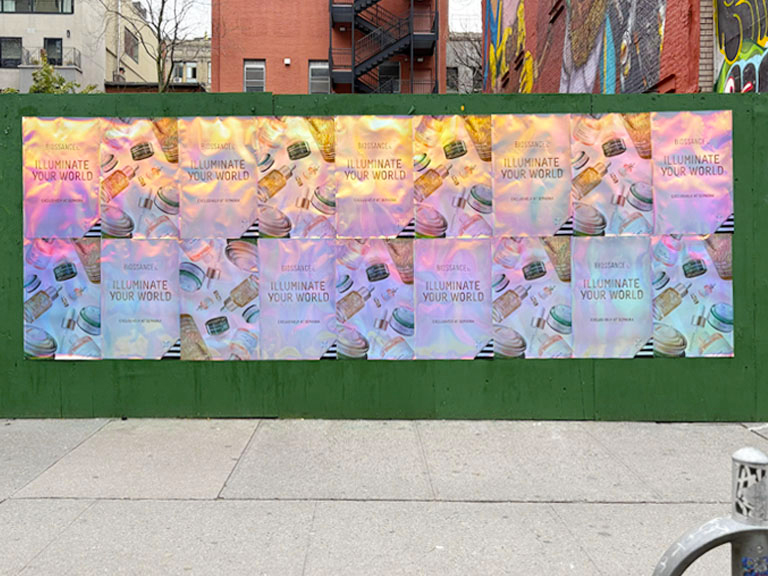
For wheatpaste installations, construction hoarding coverage, and any application where visual dominance of a space is the goal, 24 x 36 is our go-to. The format tiles cleanly in grid patterns, two across a standard 4-foot panel, three across a standard 6-foot panel, which makes it ideal for larger wall coverage using multiple sheets. Printing at 200 DPI at actual size (7,200 x 10,800 pixels at 300 DPI, or 4,800 x 7,200 pixels at 200 DPI) gives excellent quality for street viewing distances.
On cost: 24 x 36 typically runs four to six times the per-unit cost of an 11 x 17 at equivalent quantities. This means the strategic choice is usually one of these two formats, with 18 x 24 as the middle ground. For campaigns where a few hundred hero placements in premium locations is the goal, 24 x 36 wins every time. For campaigns where thousands of exposures in a dense grid is the goal, 11 x 17 or 18 x 24 may be more efficient.
20 x 30 Inches, The In-Between Format (50.8 x 76.2 cm)
The 20 x 30 inch poster sits between the 18 x 24 and the 24 x 36 and is a common poster size in retail and display contexts more than street campaigns. At 50.8 centimeters by 76.2 centimeters, it maintains the 2:3 aspect ratio and is widely used for window displays, lobby boards, and point-of-sale installations. Our crews encounter this format occasionally in campaigns that include a retail component, a window display in the client’s stores paired with a street-facing 24 x 36 program outside. For pure street campaigns, we tend to go directly to 24 x 36 rather than 20 x 30 because the cost difference is modest and the additional size is meaningful.
The 27 x 40 One-Sheet, America’s Most Famous Common Poster Size
The 27 x 40 inch one-sheet is the standard movie poster format in America. At 68.6 centimeters wide by 101.6 centimeters tall, this is a format that carries instant cultural recognition, the proportions alone signal “entertainment” to most American viewers before they even read the poster. The aspect ratio of 27:40 is unique, it does not reduce to a clean fraction, which gives the format its distinctive tall, slightly more narrow appearance compared to a 2:3 format.
For entertainment campaigns on the street, our team often produces 27 x 40 as the anchor format for lobby and frame installations, supplemented by 24 x 36 for exterior street work. The two sizes are close enough in proportion that artwork can often be adapted from one to the other with minor adjustments. When a client needs to purchase pre-existing poster frames (retail, entertainment, hospitality), the 27 x 40 dimension is the most widely available frame size in the US market.
Oversized Common Poster Sizes: 36 x 48, 40 x 60, and Beyond
36 x 48 Inches, Jumbo Format (91.4 x 121.9 cm)
The 36 x 48 jumbo poster is one of the less commonly used sizes in our campaigns from a volume perspective, but it is a high-impact format when used strategically. At 91.4 by 121.9 centimeters and a 3:4 aspect ratio, a single 36 x 48 commands a large area of visual real estate. We use this format for premium hero placements, a corner wall, a wide window, a key transit corridor, where we want the poster to feel like a billboard. Print costs are substantially higher per unit than 24 x 36, so 36 x 48 is always a targeted format rather than a volume format in our campaigns.
40 x 60 Inches, Transit Two-Sheet (101.6 x 152.4 cm)
The 40 x 60 two-sheet is the standard common poster size for bus shelter advertising. At 101.6 centimeters wide by 152.4 centimeters tall, with a 2:3 aspect ratio, this format fills a backlighted transit shelter frame. At this size the poster is essentially a small billboard, visible from across an intersection and readable from a moving vehicle. Our team pairs bus shelter 40 x 60 programs with street-level poster campaigns to create a layered presence in a market, hitting pedestrians up close with 24 x 36 posters and drivers at a distance with the 40 x 60 format.
41 x 81 Inches, Three-Sheet (104.1 x 205.7 cm)
The three-sheet is a tall vertical format that fills column wraps, doorway columns, and stairwell walls in transit environments and entertainment venues. At roughly 1:2 aspect ratio, it is a specialist format not commonly used in general street campaigns but important in entertainment and transit advertising. Our crews handle three-sheets primarily for album release campaigns and film premieres where the entertainment client wants presence in transit environments.
Common Poster Sizes in International (ISO) Standards
For campaigns that include European or international markets, the ISO A-series is the dominant standard. These sizes are based on a fixed 1:√2 (1:1.414) aspect ratio, meaning each sheet folds exactly in half to produce the next smaller size. Here is how the A-series maps to common American poster sizes:
ISO Size
Inches (W x H)
Centimeters (W x H)
Closest US Size
A0
33.1 x 46.8 in
84.1 x 118.9 cm
No direct US equivalent (between 33×47)
A1
23.4 x 33.1 in
59.4 x 84.1 cm
24 x 36 (close)
A2
16.5 x 23.4 in
42.0 x 59.4 cm
Between 18×24 (slightly smaller)
A3
11.7 x 16.5 in
29.7 x 42.0 cm
Close to 12 x 16
A4
8.3 x 11.7 in
21.0 x 29.7 cm
US Letter (8.5 x 11)
When running international campaigns, our recommendation is to produce artwork in US sizes first, then confirm with international printers that they can accommodate those dimensions. Most professional print shops globally can print to US standard sizes. When the client has a preference for ISO sizes, A1 (59.4 x 84.1 cm) is the international functional equivalent of our 24 x 36, and A2 (42.0 x 59.4 cm) is closest to our 18 x 24.
How Common Poster Sizes Are Used in Multi-Format Campaigns
Professional street campaigns rarely use a single poster size. The most effective campaigns our team runs involve two or three sizes working together to create coverage at multiple viewing distances and in multiple surface types at the same time. Here is a typical multi-format campaign structure:
The Standard Three-Tier Structure
The most common multi-format structure we recommend for urban campaigns:
Tier 1, Hero format: 24 x 36 inches (or 27 x 40 for entertainment). 100-200 units. Premium corner locations, high-visibility walls, construction hoarding. These are your statement placements, seen from distance, remembered by commuters.
Tier 2, Mid format: 18 x 24 inches. 300-500 units. Secondary streets, side streets, venue neighborhoods, corridors between Tier 1 locations. These extend coverage and create frequency.
Tier 3, Saturation format: 11 x 17 inches. 500-1,000+ units. High-volume snipe coverage across the broader target neighborhood. Creates the feeling that the campaign is everywhere.
When a client asks us to make a campaign feel “unavoidable” in a market, this three-tier structure delivers that result better than any single-size approach. The 24 x 36 catches the eye from distance. The 18 x 24 fills in coverage on secondary streets. The 11 x 17 creates the background frequency that makes the brand feel omnipresent. Each common poster size plays a specific role in the network.
Common Poster Sizes for Specific Campaign Types
Music and Entertainment Campaigns
For music releases and entertainment campaigns, the standard stack is 27 x 40 for lobby and frame installations, 24 x 36 for primary street work, and 11 x 17 for saturation in the immediate neighborhoods around key venues and hubs. Concert campaigns that need to reach fans in specific neighborhoods often emphasize 11 x 17 for volume in those areas, supplemented by 24 x 36 at premium anchor locations.
Consumer Brand and Product Launch Campaigns
Brand campaigns tend to favor 24 x 36 and 18 x 24 as their two core sizes because these formats are large enough to display the brand image and messaging properly. An 11 x 17 snipe campaign for a consumer brand can feel downmarket unless the creative is exceptionally strong. The 24 x 36 gives the brand enough canvas to make a visual statement. For high-end brands, we sometimes produce 36 x 48 as a hero format at a handful of premium placements to establish a visual anchor for the campaign in each market.
Event and Experience Marketing
Event campaigns work well in 18 x 24 and 24 x 36 because the posters need to communicate date, time, venue, and ticket information, information density that requires more space than a snipe can provide. An 11 x 17 can carry event details but the type gets small quickly. Our crews typically run 18 x 24 at high volume for event campaigns, focusing on neighborhoods within a reasonable distance of the venue, and use 24 x 36 for key corner placements on main thoroughfares.
Choosing the Right Common Poster Size: A Decision Framework
When a client asks us which common poster size is right for their campaign, we walk through four factors:
1. Surface inventory. What surfaces are available in the target area? Utility poles? Construction hoarding? Blank walls? The surface dictates the maximum workable size. A standard pole face is 12 inches wide, which means 11 x 17 or 12 x 18 with overhang is the practical limit. A 10-foot-wide blank wall can accommodate 24 x 36 tiled across it or a single 36 x 48 hero placement.
2. Viewing distance. How far away is the typical viewer when they first encounter the poster? If your target audience is pedestrians at 5 to 10 feet, 11 x 17 or 18 x 24 is appropriate. If the audience is across a street at 40 to 50 feet, you need 24 x 36 or larger.
3. Campaign volume. How many exposures is the campaign aiming to generate? A 500-unit campaign of 11 x 17 covers more surfaces and generates more exposures than 100 units of 24 x 36 at the same budget. If volume of individual touchpoints matters more than size of individual touchpoints, go smaller.
4. Budget and timeline. Larger common poster sizes cost more to print and more to install. At 500 units, a 24 x 36 might cost four to five times more than an 11 x 17. Timeline matters too, large format printing has longer lead times than standard press runs for smaller sizes.
Print Specifications for Common Poster Sizes
Size
Min DPI
Rec. DPI
Bleed
Stock (Street)
Stock (Indoor)
8.5 x 11 in
150
300
0.125 in
60 lb uncoated text
80 lb coated
11 x 17 in
150
300
0.125 in
60-70 lb uncoated text
80 lb coated
12 x 18 in
150
300
0.125 in
70 lb uncoated text
80 lb coated
18 x 24 in
100
200-300
0.125 in
70-80 lb uncoated text
80-100 lb coated
24 x 36 in
100
150-200
0.125-0.25 in
80 lb uncoated text
100 lb coated
27 x 40 in
100
150-200
0.25 in
80 lb uncoated text
100 lb coated
36 x 48 in
72
100-150
0.25 in
80-100 lb uncoated
100 lb coated
40 x 60 in
72
100-150
0.25 in
N/A (digital WF)
Digital wide-format
Frequently Asked Questions
What is the most common poster size for street campaigns?
The most common poster size for professional street campaigns is 18 x 24 inches (45.7 x 61.0 cm). It provides a strong visual presence from 20 to 25 feet, is easy for crews to handle and install in volume, and offers competitive per-unit print pricing. The 24 x 36 inch format is the most common choice when maximum visual impact at a smaller number of placements is the goal.
What are the most common poster sizes for music and concerts?
The 11 x 17 inch (27.9 x 43.2 cm) is the traditional concert poster format and remains one of the most common poster sizes for music campaigns. For larger-scale tours and label-backed releases, 24 x 36 (61.0 x 91.4 cm) is common for street work, supplemented by 27 x 40 (68.6 x 101.6 cm) for venue lobbies and retail installations.
What is the difference between 18 x 24 and 24 x 36 poster sizes?
The 18 x 24 inch (45.7 x 61.0 cm) has a 3:4 aspect ratio and is the most common mid-range street poster. The 24 x 36 inch (61.0 x 91.4 cm) has a 2:3 aspect ratio and provides significantly more visual area, 864 square inches versus 432 square inches, exactly double. The 24 x 36 reads from farther away and makes a stronger visual statement, but costs more per unit and is heavier to handle in volume
What common poster size is closest to the ISO A1 standard?
The ISO A1 size is 23.4 x 33.1 inches (59.4 x 84.1 cm), which is closest to the US 24 x 36 inch (61.0 x 91.4 cm) format. A1 is slightly smaller than 24 x 36. If you are adapting artwork between US and ISO sizes, the scaling factor from A1 to 24 x 36 is approximately 1.027x (about 2.7% larger in each dimension).
What common poster size works for bus shelter advertising?
The standard bus shelter poster size is 40 x 60 inches (101.6 x 152.4 cm), known as the transit two-sheet. Some markets use 47.5 x 69 inches for certain frame configurations. Always verify the exact dimensions with the transit vendor before producing artwork. Interior bus transit cards are a different format entirely, typically 11 x 28 inches or similar elongated dimensions.
Are there standard poster sizes for retail store windows?
Retail window poster sizes vary by storefront, but common formats include 18 x 24 (for smaller windows and door panels), 24 x 36 (most common for standard retail windows), 27 x 40 (entertainment and media retail), 36 x 48 (large format window takeovers), and custom cut-to-size formats for unusually proportioned windows. For chain retail clients, we often print custom sizes to precisely fit each lo
What is the cheapest common poster size to print in large quantities?
The 11 x 17 inch format is typically the most cost-effective common poster size for high-volume printing. It fits on standard US tabloid press sheets, uses less material per unit than larger formats, and most commercial print shops have it in their standard catalog. For runs of 500 or more, the per-unit cost of 11 x 17 is often one-fourth to one-fifth the cost of 24 x 36 at the same quantity.