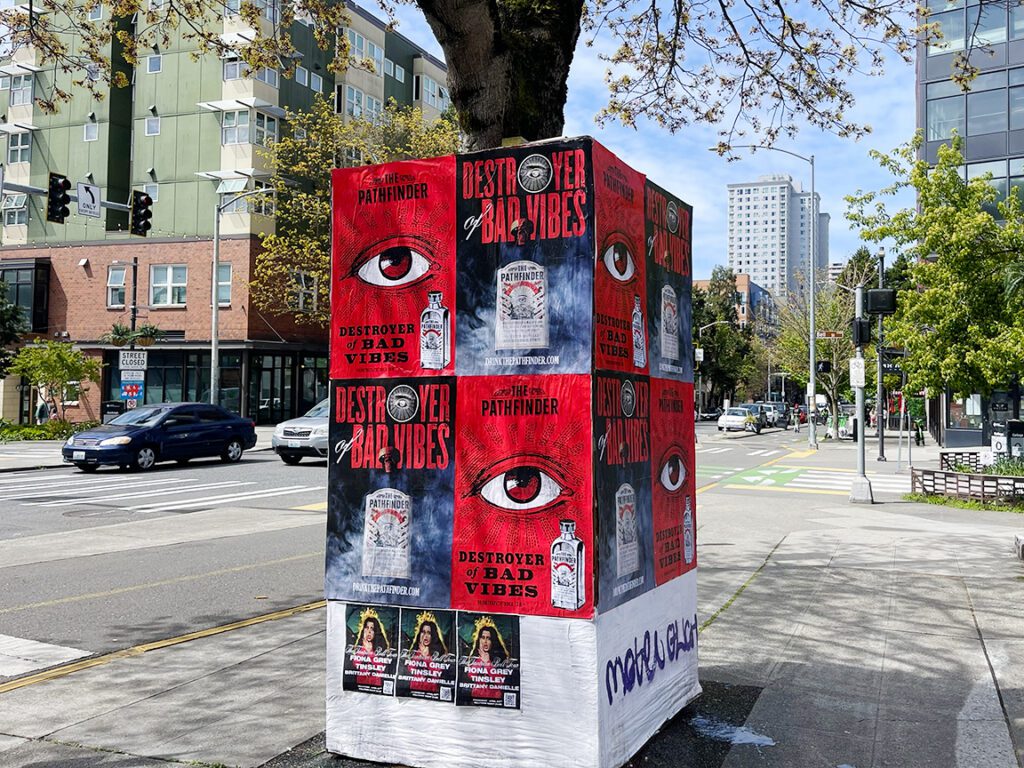
Poster dimensions are not a mystery, but they do require context. The “right” size depends on what you’re printing, where you’re placing it, and what your budget looks like. We’ve run poster campaigns from the streets of Manhattan to neighborhoods in Brooklyn, the Bronx, and beyond. We know which dimensions actually work in the real world.
This guide covers common poster dimensions for every major use case. We’ll give you exact measurements, explain the logic behind each standard, and help you make an informed decision before you print a single sheet.
A handful of dimensions account for the vast majority of poster production in the United States. These sizes have become standard because they’re practical, they fit available print equipment, and they work across a wide range of applications.
Size Name
Dimensions (inches)
Best Use Case
Letter/Flyer
8.5 x 11
High-volume indoor distribution, bulletin boards
Tabloid
11 x 17
Street posting, venue promotion, bars and restaurants
Concert posters, film campaigns, large-format outdoor
Movie One-Sheet
27 x 40
Theater displays, entertainment industry
Jumbo Poster
36 x 48
High-visibility outdoor, building placements
Understanding the 11×17 Dimension
The 11×17 poster is the backbone of most street-level campaigns. It hits a sweet spot between visibility and cost. You can read it from across a sidewalk. You can print hundreds of copies without spending a fortune. And it fits most standard posting surfaces without modification.
We use 11×17 constantly. It’s the format for music shows in the Lower East Side. It’s the go-to for gallery openings in Bushwick. It’s the first choice for any campaign that needs high volume and broad geographic coverage.
Design for this size must be tight. The message needs to land in two seconds. Big type, clear image, one piece of information. If you’re cramming paragraph text into an 11×17, you’re doing it wrong.
Understanding the 18×24 Dimension
18×24 is the classic street poster dimension. When you picture a poster plastered on a construction wall in SoHo or stapled to a telephone pole in Greenpoint, you’re probably imagining something close to this size.
This format gives designers real estate to work with. You can include more visual information. A full artwork image. A logo plus subtext. Event details with time, date, and venue. The size supports more content without feeling crowded.
Cost per unit is higher than 11×17, so campaigns typically run in smaller quantities. A run of 100 to 200 pieces is common. Placement becomes more deliberate. You’re selecting quality locations rather than carpet-bombing a neighborhood.
Understanding the 24×36 Dimension
24×36 is the large-format standard for high-impact campaigns. Concert promoters use it. Film companies use it. Brands running major market campaigns use it. It’s the format that makes a statement.
This size works best in environments with good sightlines and focused posting space. Places where people slow down and look. Museum districts. Major transit corridors. Busy commercial intersections. A 24×36 poster hidden in a cluttered environment is a waste of material and money.
Print costs for 24×36 are significantly higher than for smaller formats. Plan your placement strategy carefully before committing to a large run at this size.
Volume vs. Impact: 11×17 gives you more posters for your money, which means more coverage. 24×36 gives you more visual impact per placement. Neither is universally better. The right choice depends on your specific campaign goals and posting locations.
Common Dimensions by Campaign Type
Music and Concert Promotion
Concerts typically use 11×17 for venue walls and local posting, and 18×24 or 24×36 for premium placements near the venue. The smaller size gets the word out across neighborhoods. The larger size marks key locations close to the show.
Film and Entertainment
The film industry uses the 27×40 one-sheet as its standard. This is the classic lobby poster format. For outdoor street promotion outside of official theater placements, 24×36 is the common alternative.
Brand and Product Campaigns
Brand campaigns often split between large-format pieces for awareness and smaller pieces for coverage. A luxury brand campaign might run 24×36 in targeted premium locations. A consumer product launch might use 11×17 across a wide area to build frequency.
Events and Parties
Events and parties typically use 11×17 in high volume. The goal is to hit bars, coffee shops, record stores, and venues in the target neighborhood. Volume and placement density matters more than format size for event promotion.
Retail and Store Openings
Retail uses 18×24 and 24×36 in window displays and near-store environments. The viewing distance from the sidewalk into a window requires a larger format to be legible. Small posters in retail windows often get lost.
Common Poster Dimensions in Centimeters
If you’re working with international suppliers or clients, you need to know how US sizes translate to metric measurements.
US Dimensions (inches)
Metric Equivalent (cm)
8.5 x 11
21.6 x 27.9
11 x 17
27.9 x 43.2
18 x 24
45.7 x 61.0
24 x 36
61.0 x 91.4
27 x 40
68.6 x 101.6
36 x 48
91.4 x 121.9
International ISO Poster Dimensions
The ISO paper size system is used in most countries outside the US. The A-series is the most relevant for poster work.
A4 is 8.27 x 11.69 inches (equivalent to US letter in general use). A3 is 11.69 x 16.54 inches (close to 11×17). A2 is 16.54 x 23.39 inches (close to 18×24). A1 is 23.39 x 33.11 inches (close to 24×36).
The proportions are slightly different between ISO and US systems. If you’re working across borders, confirm which system your printer uses before submitting your file. A design built for 18×24 will need minor adjustments to fit A2 properly.
File Setup for Common Poster Dimensions
Getting the file right is as important as choosing the right size. We see files submitted incorrectly all the time. These are the most common mistakes and how to avoid them.
Resolution
Set your document to 300 DPI at the final print size. If you’re designing at a reduced size and planning to scale up, your resolution will drop. Design at actual size, at 300 DPI.
Color Mode
Work in CMYK. RGB looks great on screen. It does not translate directly to print. Colors shift when converted from RGB to CMYK. Blues can go purple. Vibrant oranges can muddy. Set CMYK from the start and avoid the surprise.
Bleed
Add 0.125 inches of bleed on all four sides. This is a safety margin for trimming. Without bleed, a slight trim variation leaves white edges on your poster. With bleed, the design extends past the trim line and the finished piece looks clean.
Safe Zone
Keep important content at least 0.25 inches from the trim edge. Bleed extends out. Safe zone lives inside. Your headline, logo, and phone number should never be right at the edge of the document. Give them room.
Submit a Print-Ready PDF: When you send your file to a printer, export as PDF/X-1a (for offset printing) or PDF/X-4 (for digital printing). Embed all fonts. Link all images. This is the format printers expect. It prevents compatibility issues that delay production.
Choosing the Right Quantity for Common Poster Dimensions
Dimensions and quantity go together. The wrong quantity at the right size still results in a weak campaign.
For 11×17 campaigns, we typically recommend at least 200 pieces for a small neighborhood focus and 500 to 1,000 pieces for broader coverage. At this size, the cost per piece is low enough that volume is achievable without a huge budget.
For 18×24 campaigns, 100 to 200 pieces is a solid starting point. Enough to hit key locations but not so many that placement becomes a logistics challenge.
For 24×36 campaigns, 50 to 100 pieces is often sufficient when placements are high-quality and targeted. If you’re going for saturation, you’ll need more, but these campaigns are usually more selective.
Paper Stock Options for Printed Posters
The paper stock you choose affects how the poster looks and how long it holds up.
For outdoor posting, 80 lb gloss or matte coated stock is common. It’s durable enough for outdoor conditions while still being affordable for large runs.
For indoor displays and venues, 100 lb or heavier coated stock gives a more premium feel. It’s stiffer, holds color better, and looks more finished.
For window clings and vinyl applications, the substrate changes entirely. These aren’t paper, they’re vinyl or polyester films that adhere to glass surfaces. The sizing conventions are the same, but the production process differs.
Common Poster Dimensions by Campaign Type: Field Examples
The most common poster dimensions perform differently depending on campaign type. Here is what our field experience shows about which dimensions to use for specific campaign objectives.
New product awareness campaigns
For consumer product launches entering a market for the first time, we recommend 24×36 as the primary format at all primary locations. New products need to assert visual presence in order to compete against running brands that already occupy mental shelf space in the consumer’s mind. The 24×36 delivers enough visual real estate to show the product, communicate a benefit, and provide brand identification in a single glance. Secondary locations can use 18×24 to extend geographic coverage within the budget.
We have launched food, beverage, beauty, and tech products using this approach in New York, Los Angeles, and Chicago. In each case, the 24×36 at primary wall surfaces in target neighborhoods performed as the awareness anchor while the 18×24 extended reach into adjacent areas without cannibalizing the primary placements’ visual authority.
Event and concert promotion
Event promotion typically runs multiple common dimensions at the same time. The 11×17 goes up on telephone poles in the neighborhood surrounding the venue, starting two to three weeks before the event. The 18×24 goes into venue and bar windows two weeks out. The 24×36 goes onto walls and construction surfaces near the venue one to two weeks out. The layered approach creates a sense of the event’s growing presence in the neighborhood as the date approaches. The campaign feels like it is building momentum, which it is.
Retail sales campaigns
Retail-focused campaigns use 18×24 most heavily because that is the size that fits retail display hardware, window frames, and POP display systems. The 24×36 gets used in adjacent outdoor spaces. The 11×17 goes inside the store for aisle-level and counter placement. For campaigns tied to specific retail partners, the format selection is often dictated by the retailer’s display standards. We work within whatever system the retail partner uses and maximize impact within those constraints.
Why Common Poster Dimensions Are Common: The Economics
Common poster dimensions are common for a specific reason: they are the most economical to produce at scale. Understanding this helps brands make smarter decisions about format selection.
Wide-format printers use roll stock in standard widths: 24 inches, 36 inches, 42 inches, 60 inches. Cutting a 24×36 from a 36-inch roll produces zero waste. Cutting a 25×37 from a 36-inch roll wastes 11 inches of width per poster. That waste adds up across a large print run. Standard dimensions exist because they fit roll stock without waste.
Frame and display hardware manufacturers build to standard dimensions because those are the sizes with the most market demand. If you use a common dimension, you have access to a wide range of hardware at commodity pricing. If you use a custom dimension, you need custom hardware that costs more and has longer lead times.
Print vendors price standard dimensions as catalog items. Non-standard dimensions require custom setup, which typically adds $25 to $75 in setup fees on top of the standard per-unit price. For small runs, this setup fee significantly increases the effective cost per piece. For large runs, the per-unit premium for non-standard dimensions is smaller but still present.
The bottom line: common poster dimensions are common because they are the economically rational choice for the vast majority of campaign applications. Custom dimensions are appropriate when a specific creative or placement requirement cannot be met with a standard size. That is a legitimate reason to go custom. Cost savings alone is not a good reason to go standard. But it is a strong reason to start from standard and only deviate when you have a specific reason to do so.
How do common poster dimensions affect shipping and handling?
Posters shipped flat use cardboard backing and corrugated boxes sized to the flat sheet dimensions. Posters shipped rolled use triangular or round poster tubes. An 11×17 flat box is compact and easy to stack. A 24×36 flat box is large and requires careful handling to avoid bending. A 24×36 rolled in a standard 3-inch diameter tube is easier to transport but needs care when unrolling to avoid creasing. For field teams handling campaign materials, always specify flat versus rolled in the print order and make sure the team has proper storage in their vehicles.
Frequently Asked Questions
What are the most common poster dimensions?
The most common poster dimensions in the US are 11 x 17, 18 x 24, and 24 x 36 inches. These three formats cover the majority of street-level, event, and campaign applications.
What size is a standard street poster?
11×17 and 18×24 are the most commonly used sizes for street campaigns. 11×17 gives more coverage per dollar. 18×24 delivers more visual impact per placement. Both are widely used in the field.
What DPI do I need for poster printing?
300 DPI at the final print size. This is the standard for commercial printing. Files set up at lower resolution will appear pixelated when printed at full size.
What is bleed and why does it matter?
Bleed is the area beyond the trim edge of your design. It’s needed because cutting machines can shift slightly. Without bleed, that shift produces a white edge. Standard bleed is 0.125 inches on each side.
How do US poster sizes compare to ISO sizes?
US and ISO sizes are similar but not identical. US 11×17 is close to ISO A3. US 18×24 is close to ISO A2. US 24×36 is close to ISO A1. If your printer uses ISO sizes, adjust your file dimensions before submitting.
What paper stock should I use for outdoor posters?
80 lb coated gloss or matte is the standard for outdoor posting. It’s affordable, durable enough for outdoor conditions, and takes color well in both digital and offset printing.
It depends on coverage goals. For a focused neighborhood campaign at 11×17, 200 to 500 pieces is a solid range. For 18×24 campaigns, 100 to 200 pieces is common. For 24×36 targeted placements, 50 to 100 is often enough.