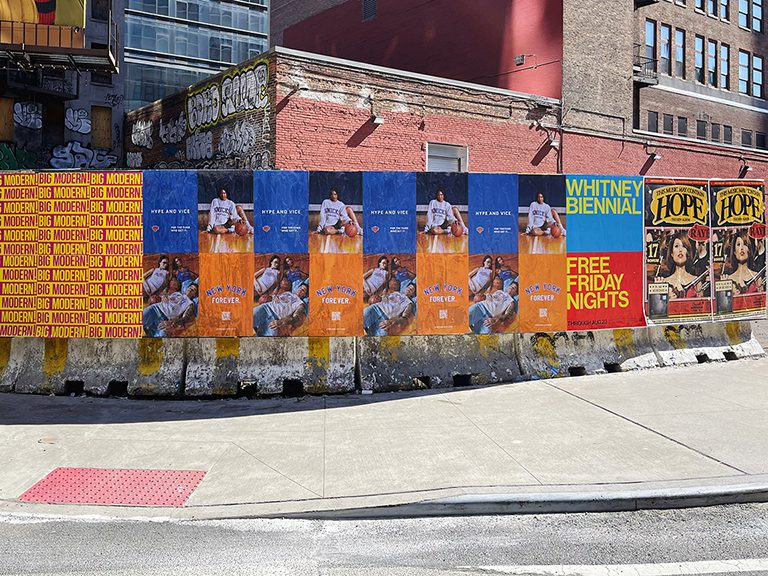
The average size of posters in the United States is 18 inches by 24 inches. That is the measurement you will find most consistently across event posters, concert promotions, retail signage, and general indoor campaigns. It is the format that print shops default to, the size that most framing options accommodate, and the dimension that most designers use when building a poster template.
But “average” is a starting point, not a prescription. We manage poster campaigns for brands, artists, and organizations across the country. We know when the average size is exactly right and when it leaves impact on the table. This guide covers the full spectrum of poster dimensions, explains why the average became what it is, and helps you decide whether the average is the right choice for your specific project.
The average shifts depending on what kind of poster you are talking about. Here is a breakdown by category:
Category
Average Size
Typical Range
Concert and Event
18 x 24 inches
11×17 to 24×36
Movie and Film
27 x 40 inches
24×36 to 30×40
Retail In-Store
22 x 28 inches
14×22 to 24×36
Outdoor Street Campaign
24 x 36 inches
18×24 to 36×48
Academic / School
22 x 28 or 11 x 17 inches
8.5×11 to 36×48 (tri-fold)
Trade Show Panel
24 x 36 inches
20×30 to 36×48
When you blend all categories together, 18×24 inches emerges as the closest thing to a single average. It sits in the middle of the range across all applications and industries. The 24×36 is the average for outdoor-focused campaigns specifically.
Why 18×24 Is the Universal Average
Three forces converged to make 18×24 the average poster size in the United States.
Commercial Printing Efficiency
Large-format roll printers typically use 24-inch or 36-inch wide rolls. An 18×24 poster can be produced two-up across a 36-inch roll, making it extremely efficient from a material yield perspective. Two 18-inch widths fit perfectly across one 36-inch roll. This efficiency made the 18×24 format the lowest-cost option at most print shops, which drove adoption, which made it average.
Frame and Hardware Availability
Consumer and commercial frame manufacturers produce 18×24 frames in quantity because that is what the market demands. The market demands it because the format is affordable to print. This circular relationship between print economics and frame availability created a stable, self-reinforcing standard over decades.
Display Space Dimensions
Many standard commercial display surfaces are sized around the 18×24 format. Bulletin board panels, venue window widths, and standard display cases in many institutional and commercial environments comfortably accommodate an 18-inch wide sheet. The physical environment was gradually adapted to the format as the format proliferated.
Average Poster Size Does Not Mean Best Poster Size
The average size (18×24) is the right choice for a lot of campaigns. It is also an unthinking default for a lot more campaigns where a different size would perform better. Before committing to the average, ask whether your placement context actually calls for it. We have seen campaigns dramatically improve just by stepping up from 18×24 to 24×36 for outdoor placements where the smaller size was simply not visible enough.
Average Poster Size by Market Tier
The size of posters used in a campaign often correlates with the scale and budget of the organization running it. Here is how that typically breaks down:
Grassroots / DIY Campaigns
Average size: 11×17 to 18×24. Budget constraints push toward smaller formats. High-volume distribution of smaller posters compensates for the reduced individual impact. For local bands, community events, and small businesses with limited print budgets, this is the practical reality.
Mid-Tier Campaigns
Average size: 18×24 to 24×36. Mid-tier campaigns typically mix formats. They use 18×24 for broad indoor distribution and 24×36 for key outdoor placements. This is the strategy we use most often for clients who have a real marketing budget but are not spending at the major brand level.
Major Brand Campaigns
Average size: 24×36 and above. Large brands use larger formats because they can afford the print cost and because their campaigns require the visual scale that larger formats deliver. Major campaigns in New York or Los Angeles regularly use 24×36, 36×48, and even larger formats for high-profile placements.
Surface Area Comparison: How Average Sizes Stack Up
It helps to understand how much visual real estate each size provides compared to the others:
Poster Size
Area (sq inches)
Relative to 18×24
8.5 x 11 (flyer)
93.5
22% of 18×24
11 x 17
187
43% of 18×24
18 x 24 (average)
432
100% (baseline)
22 x 28
616
143% of 18×24
24 x 36
864
200% of 18×24
27 x 40
1080
250% of 18×24
36 x 48
1728
400% of 18×24
A 24×36 poster is exactly twice the surface area of an 18×24. This is a useful mental model. When you step up from average to large, you are doubling your visual footprint. That doubling effect on visual presence in a placement is often worth the increase in per-unit print cost.
How the Average Poster Size Performs in Key Cities
We run campaigns in urban markets across the United States. The average poster size performs differently depending on the city and neighborhood context.
New York City
New York is visually dense. The average 18×24 poster can get lost among competing visual elements in busy commercial corridors like the Lower East Side, Bedford Avenue in Williamsburg, or the blocks surrounding Union Square. In New York, we often push campaigns toward 24×36 for outdoor placements and reserve 18×24 for inside venues and windows where viewing distance is shorter.
Los Angeles
Los Angeles is more spread out. Visual competition varies dramatically by neighborhood. In dense commercial districts like Melrose, Silver Lake, or Downtown, 18×24 can hold its own in a window. In more car-oriented corridors, 24×36 or larger is necessary because viewers are reading from a moving vehicle at 25 to 35 miles per hour. LA campaigns often mix both sizes more aggressively than campaigns in walking-oriented cities.
Chicago
Chicago’s neighborhoods vary from dense pedestrian environments in Wicker Park and Logan Square to wider commercial streets in outlying areas. The 18×24 average works well in the denser neighborhoods where foot traffic is high and viewing distances are short. Outdoor placements in larger commercial corridors benefit from the 24×36 step-up.
Designing for the Average Poster Size
When you design for an 18×24 poster, these principles apply:
Think in thirds: Divide the vertical space into thirds. One third for the headline and primary visual. One third for supporting information. One third for secondary details and contact information. This gives your design a natural hierarchy.
Use vector graphics whenever possible: At 18×24, vector art stays crisp at any scale. Raster images must be at least 150 DPI at the final size to print cleanly.
Set up your file correctly from the start: Create your document at exactly 18×24 inches with 0.125-inch bleed and 0.25-inch safe margins. Do not design on an 8.5×11 and scale up later.
Design for daylight conditions: If the poster will hang in a window or outdoor location, it will be viewed in varying light conditions. High contrast designs perform better than subtle, low-contrast layouts in variable lighting.
The Bleed and Safe Area Rule
Every poster sent to professional print production needs a 0.125-inch bleed on all four sides. This is the extra print area that gets trimmed off during finishing. Keep all critical content at least 0.25 inches inside the finished edge. Design software like Adobe Illustrator, InDesign, and Canva all support bleed setup. Never skip this step.
What is the average size of a poster?
The average size of a poster in the United States is 18 inches by 24 inches. This is the most widely used format across events, concerts, retail campaigns, and general indoor promotions. For outdoor campaigns, the average steps up to 24×36 inches.
Is the average poster size 18×24 or 24×36?
The 18×24 is the overall average across all poster applications. The 24×36 is the average specifically for outdoor and large-format campaigns. Both are widely considered standard, and many campaigns use both sizes at the same time for different placement types.
How does the average poster size compare to a movie poster?
The average general-use poster (18×24) is smaller than a standard movie poster (27×40). A movie one-sheet is about 250 percent the area of an 18×24 poster. The movie poster format is larger because theater display hardware and transit advertising cases are designed for that specific size.
What is the average size of a retail store poster?
The average retail store poster is 22×28 inches. This format is the standard for floor stand display inserts in grocery stores, pharmacies, and big-box retailers. Point-of-purchase display hardware across the retail industry is built around this specific size.
Does the average poster size work for outdoor campaigns?
In some contexts, yes. An 18×24 outdoor poster works in tight spaces, on venue doors, and in windows where viewing distance is under 15 feet. For open outdoor environments where viewers are passing at greater distances, the 24×36 format is more appropriate and delivers better readability.
What file resolution do I need for the average poster size?
For an 18×24 poster at 150 DPI, you need a design file of 2,700 by 3,600 pixels. At 300 DPI, that doubles to 5,400 by 7,200 pixels. The 150 DPI option is adequate for most poster campaigns where viewing distance is 10 feet or more.
How much does it cost to print the average poster size?
An 18×24 poster costs approximately $1.50 to $3.50 per piece in quantities of 100. Larger quantities (500+) can bring per-unit costs below $1 at online print shops. Local print shops charge more but offer faster turnaround. Factor in paper stock and finish options, which can add $0.50 to $2 per piece.
What is above average for poster size?
The 24×36 is the next step above the 18×24 average. Beyond that, 27×40, 36×48, and larger custom formats represent the upper end of standard poster production. These larger formats are used for high-visibility placements, major brand campaigns, and wide-format exhibition applications.
Frequently Asked Questions
What is the average size of a poster?
The average size of a poster in the United States is 18 inches by 24 inches. This is the most widely used format across events, concerts, retail campaigns, and general indoor promotions. For outdoor campaigns, the average steps up to 24×36 inches.
Is the average poster size 18×24 or 24×36?
The 18×24 is the overall average across all poster applications. The 24×36 is the average specifically for outdoor and large-format campaigns. Both are widely considered standard, and many campaigns use both sizes at the same time for different placement types.
How does the average poster size compare to a movie poster?
The average general-use poster (18×24) is smaller than a standard movie poster (27×40). A movie one-sheet is about 250 percent the area of an 18×24 poster. The movie poster format is larger because theater display hardware and transit advertising cases are designed for that specific size.
What is the average size of a retail store poster?
The average retail store poster is 22×28 inches. This format is the standard for floor stand display inserts in grocery stores, pharmacies, and big-box retailers. Point-of-purchase display hardware across the retail industry is built around this specific size.
Does the average poster size work for outdoor campaigns?
In some contexts, yes. An 18×24 outdoor poster works in tight spaces, on venue doors, and in windows where viewing distance is under 15 feet. For open outdoor environments where viewers are passing at greater distances, the 24×36 format is more appropriate and delivers better readability.
What file resolution do I need for the average poster size?
For an 18×24 poster at 150 DPI, you need a design file of 2,700 by 3,600 pixels. At 300 DPI, that doubles to 5,400 by 7,200 pixels. The 150 DPI option is adequate for most poster campaigns where viewing distance is 10 feet or more.
How much does it cost to print the average poster size?
An 18×24 poster costs approximately $1.50 to $3.50 per piece in quantities of 100. Larger quantities (500+) can bring per-unit costs below $1 at online print shops. Local print shops charge more but offer faster turnaround. Factor in paper stock and finish options, which can add $0.50 to $2 per piece.