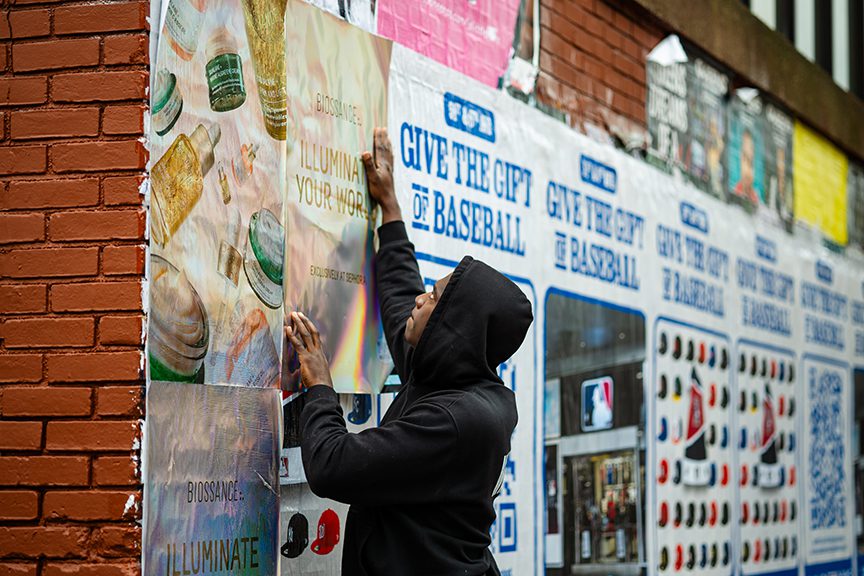
Common Poster Board Sizes: The Complete Field Guide
We buy, print, and hang posters for campaigns across the country. These are the sizes that actually show up in the field, and what each one gets used for.
We buy, print, and hang posters for campaigns across the country. These are the sizes that actually show up in the field, and what each one gets used for.
There is no universal standard poster board size. What counts as “common” depends heavily on the context. A concert venue poster is not the same size as a retail window display. A street-level paste campaign uses different dimensions than a trade show backdrop. The word “poster” covers a massive range of formats, and the right board size depends on where it is going and what it needs to accomplish.
We have been running poster campaigns in New York, Chicago, Los Angeles, Miami, and other cities for over a decade. We order paper in bulk, work with print shops constantly, and hang posters in every environment imaginable. Here is what the common poster board sizes actually look like in practice, and how to choose the right one for your project.
When people say “poster board,” they mean two different things. The first is the foam core or cardstock boards you find at office supply stores. These are rigid or semi-rigid backing boards used for science fair displays, presentations, and retail signage. The second meaning is the physical paper poster itself, printed flat and meant to be displayed on a wall, board, or surface.
In advertising and campaign work, poster board almost always refers to the printed poster. The board is the substrate. The print is the message. In craft and educational contexts, poster board is the blank backing material. We will cover both here, because searches for “common poster board sizes” land on both meanings.
The Most Common Poster Board Sizes in the US
These are the sizes we see most often across campaigns, retail, and educational use. They are not arbitrary numbers. Each size grew from a combination of standard paper sizes, printing press dimensions, and practical display needs.
11 x 14 inches
This is the small end of the poster range. It sits between standard letter size (8.5×11) and the next step up. Restaurants use it for daily specials. Retail stores use it for sale announcements near the register. For advertising campaigns, it works well in tight spaces: doorways, stairwells, close-up bulletin board placements. Our crews use 11×14 for supporting placements in dense neighborhoods like the East Village in Manhattan or Wicker Park in Chicago.
11 x 17 inches (Tabloid)
This is the most common small-format poster board size in North America. It matches the tabloid paper standard that most commercial printers use. Laser printers handle 11×17 without an upgrade. Offset presses run it standard. Almost every local print shop can produce 11×17 in quantity quickly. For campaign work, 11×17 works on poles, doors, community boards, and anywhere you need volume without large-scale cost. This is our high-volume workhorse size for neighborhood saturation campaigns.
18 x 24 inches
Step up from tabloid and you land on 18×24. This is a genuine poster size. It is large enough to command attention at street level but small enough to fit on most available surfaces without modification. Many outdoor advertising formats, from bus shelters to kiosk boards, are built around 18×24 or its close relatives. We run a lot of 18×24 campaigns in New York neighborhoods like Bushwick, the Lower East Side, and Astoria. Print costs are reasonable, transport is manageable, and the format fits practically every paste surface we encounter.
22 x 28 inches
This size dominates retail environments. Most point-of-purchase displays in grocery stores, pharmacies, and big-box retail are built around 22×28. The format is sometimes called a “two-sheet” because it represents two standard pages combined. Retail display frames, header cards, and shelf signage systems are engineered to this size. For brand campaigns that include retail components, specifying 22×28 ensures compatibility with standard retail display hardware.
24 x 36 inches
This is the standard “large poster” that most people picture when they think about street advertising. The 24×36 format is what you see on construction hoarding in Manhattan, on walls in Melrose in LA, and on every third surface in the Wicker Park neighborhood in Chicago. It is big enough to stop foot traffic. It fits a standard tube for transport. And most print shops run this size routinely on wide-format inkjet systems. For our outdoor campaigns, 24×36 is the starting point for any placement that needs to be read from more than 10 feet away.
27 x 40 inches (Movie One-Sheet)
Movie theaters and entertainment industry use 27×40 as their standard single poster format. The “one-sheet” has been the film industry standard for decades. If you have ever bought a movie poster at a poster shop, it was almost certainly 27×40. For advertising campaigns that want that cinematic feeling, this size works well on flat walls and in frame displays. It is slightly more expensive to print than 24×36 but delivers a noticeably larger presence.
40 x 60 inches
This is large-format territory. A 40×60 poster requires wide-format printing and careful handling. Most print shops that handle outdoor work can produce this size on roll stock. Our crews use 40×60 for statement placements, large wall sections, and areas where the campaign needs to dominate the visual field. In New York, we have used 40×60 on Bowery walls, construction fencing in the Meatpacking District, and loading dock doors in Red Hook.
Most-Used Sizes in Our Campaigns
Across hundreds of campaigns, our most ordered sizes in descending order are: 24×36, 18×24, 11×17, 27×40, and 40×60. The 24×36 dominates because it balances visibility, cost, and surface compatibility better than any other format.
Standard Poster Board Sizes for Presentations and Education
If you are looking for the rigid foam core or cardstock boards sold at office supply stores, the common sizes are different from advertising posters.
The most common rigid poster board sizes:
22 x 28 inches: The single-panel standard. One board, portrait or environment orientation. Common for science fairs, short presentations, retail signs.
28 x 44 inches: Tri-fold boards unfold to this size. The tri-fold format is the science fair board everyone recognizes. Three panels that stand up on their own.
36 x 48 inches: Large single-panel board used for trade show displays, real estate marketing, and large presentation formats.
24 x 36 inches: Also available in rigid stock. Works as a floor display or mounted presentation board.
For craft paper poster boards (the flat, colored cardstock sheets), sizes run from 22×28 down to 11×14. These are sold at Staples, Target, and Dollar Tree for school projects and hand-lettered signs.
Size (inches)
Common Name
Primary Use
Print Method
11 x 14
Small Poster
POS, event flyer, close-range placement
Laser, inkjet, offset
11 x 17
Tabloid / Half-Sheet
Street campaign, bulletin boards, poles
Laser, offset, digital
18 x 24
Small Large-Format
Street, retail, outdoor display
Wide-format inkjet, offset
22 x 28
Two-Sheet / Retail
Retail POP, pharmacy, grocery
Wide-format inkjet, offset
24 x 36
Standard Large Poster
Outdoor, event, street campaign
Wide-format inkjet
27 x 40
Movie One-Sheet
Entertainment, cinema, retail
Wide-format inkjet, offset
40 x 60
Large Format
Wall takeovers, street domination
Wide-format inkjet (roll)
How Surface Type Determines Which Size to Use
Choosing a poster board size is not purely a design decision. The surface you are posting on determines what will work. We factor surface dimensions into every campaign before we finalize print specs.
Utility poles and lamp posts work best with 11×17. The narrow vertical profile fits without overhang. 18×24 in portrait orientation also works on wider poles.
Construction hoarding, which we see constantly on New York job sites in Midtown and Downtown Brooklyn, accommodates almost any size. We typically plan for 24×36 in grid patterns. The plywood panels are usually 4×8 feet, which means six 24×36 posters tile neatly without major gaps.
Retail windows are usually measured by the retailer. Standard display frames for window use tend to fit 22×28 or 24×36. When we execute retail campaigns, we confirm frame sizes before printing.
Blank wall sections in urban environments are where size really opens up. We have covered entire building sides with multi-panel 40×60 campaigns. We have also used single 24×36 placements on narrow walls between storefronts. The wall dictates the format.
Always Measure Before You Print
Our crews carry tape measures. Before any campaign, we scout locations and measure available surfaces. A 24×36 poster on a wall that is only 20 inches wide does not work. Matching poster size to surface size is fundamental. We never guess.
Portrait vs. environment Orientation in Common Sizes
Every standard poster size can be printed in portrait (taller than wide) or environment (wider than tall) orientation. The orientation changes the visual impact and practical fit.
Portrait orientation is more natural for standing figures, vertical headline reads, and surfaces that are taller than wide. Most street-facing walls favor portrait orientation for individual posters.
environment orientation works for horizontal surfaces, wide walls, and designs that span a wide field. Concert backdrops, trade show displays, and wide retail windows often use environment format posters.
The common sizes do not change with orientation. A 24×36 portrait is 24 inches wide by 36 inches tall. A 24×36 environment would be 36 inches wide by 24 inches tall. Same dimensions, different orientation. Confirm orientation with your design and surface before printing. Reprinting environment when you needed portrait costs time and money.
Choosing the Right Size for Your Campaign
The decision is simpler than most people make it. Run through these questions in order.
First: How far will viewers be from the poster? Less than six feet, 11×17 works. Six to fifteen feet, 18×24 is better. More than fifteen feet, go 24×36 or larger. Distance determines legibility, and legibility determines whether the campaign works.
Second: How much wall space is available? Measure it. Do not estimate. A poster that hangs past the edge of a surface looks sloppy and often does not bond well at the edges.
Third: What is your print budget? Wide-format inkjet printing is priced per square foot. A 40×60 costs roughly seven times more to print than an 11×17. Campaigns with tight budgets use smaller sizes and higher volume. Campaigns with room for large formats use bigger sizes and fewer placements.
Fourth: What does the design require? Some designs only work at a specific size. A detailed image loses impact at 11×17. A bold text-only design reads fine at any size. Let the creative drive the format floor, not the ceiling.
Frequently Asked Questions
What is the most common poster board size?
For outdoor advertising and street campaigns, 24×36 inches is the most common single-poster size. For retail use, 22×28 is standard. For educational and presentation use, 22×28 and the 28×44 tri-fold are most common.
What size is a standard poster board at the store?
Craft and office supply stores typically sell poster boards in 22×28 inches as the main size. Smaller options like 11×14 and 14×22 are also common. These are the foam core and cardstock boards for school projects and presentations.
Is 24×36 a standard poster board size?
Yes. 24×36 is one of the most widely used sizes for professionally printed outdoor posters. It is a standard output size for wide-format inkjet printers and is recognized across the print industry as a common large-format poster size.
What is the difference between 18×24 and 24×36 posters?
18×24 is smaller and better suited for close-range placement or surfaces with limited space. 24×36 is a full large-format poster that commands attention from greater distances. The print cost difference is significant. 24×36 prints typically cost two to three times more than 18×24 on wide-format inkjet.
What size poster board do I need for a science fair?
Science fair tri-fold boards are typically 28×44 inches when fully opened. Single-panel science fair boards are most commonly 22×28 inches. These dimensions are standardized by most schools and science fair organizers.
Can I print any size poster at a local print shop?
Most local print shops can print standard sizes like 11×17, 18×24, and 24×36. For sizes beyond 36 inches in either dimension, you need a shop with wide-format roll printing capabilities. Not every local shop has that equipment. Call ahead to confirm.
18×24 and 24×36 are the most practical for street-level campaigns. They are large enough to attract attention at walking pace, affordable to print in quantity, and small enough to handle and transport without special equipment.