Dimension Poster Guide: Every Format, Every Measurement, Every Use Case
Poster dimensions determine what a campaign can and cannot do. The dimension is not decoration. It is a functional specification that affects visibility, installation, print cost, and campaign effectiveness. Get the dimensions right and everything downstream works. Get them wrong and you are reprinting, reinstalling, and losing time.
This guide covers poster dimensions comprehensively. We go through every standard format used in street-level marketing, print production, retail display, and event signage. Every dimension gets a practical explanation, more than a measurement. Our crews at American Guerrilla Marketing work with these formats every day in real campaign environments across the US.
Understanding Poster Dimensions: Width, Height, and Orientation
A poster dimension is described as width x height in the United States. A 24 x 36 poster is 24 inches wide and 36 inches tall. This is portrait orientation (taller than wide). The same sheet turned sideways becomes 36 x 24, which is environment orientation.
Most posters use portrait orientation. The human visual field at resting attention is slightly taller than wide, and most vertical surfaces (walls, fences, poles) accommodate portrait formats more naturally. environment orientation works for wide horizontal surfaces and for messages that need to span width, like directional signage.
When specifying poster dimensions, always be explicit about orientation. A vendor told “24 x 36” will typically assume portrait. If you want environment, say “36 wide by 24 tall” or specify environment explicitly in your order.
The Core Poster Dimension Lineup
The poster dimension environment in the US is built around a core set of sizes that handle the vast majority of professional campaign needs. Here they are with full context:
Dimension: 8.5 x 11 Inches
This is the smallest format that qualifies as a poster rather than a flyer. At 8.5 x 11 inches, the sheet matches the standard US letter paper size. Every office printer handles this. Every printer vendor stocks it. Cost per unit is the lowest of any format. The trade-off is limited visibility range. This dimension works at arm’s length and distances up to about five feet. Use it for counter cards, bulletin board supplements, and handout campaigns.
Dimension: 11 x 17 Inches
The 11 x 17 is the workhorse of high-volume street campaigns. At tabloid size, this dimension fits the most common street-level surfaces including utility poles, small fences, door windows, and community bulletin boards. The 11 x 17 dimension prints on virtually any commercial printer. Cost per unit is very low for large runs. Visibility range extends to about 10 to 12 feet in good conditions.
Dimension: 18 x 24 Inches
The 18 x 24 is the entry point for posters that create genuine street-level presence. At one and a half feet wide by two feet tall, this dimension commands wall space without requiring a large surface. It is the standard dimension for yard signs, small outdoor kiosks, and transit-adjacent placements. Visibility range at this dimension extends to about 20 feet with bold typography.
Dimension: 24 x 36 Inches
The primary standard dimension for street marketing posters in the United States. Two feet wide by three feet tall. This dimension is the default at most print vendors, the most common format requested by clients, and the size that most standard display hardware is built to accommodate. Visibility range with appropriate type sizing reaches 30 to 35 feet. This is the dimension our crews use as the baseline for most campaigns.
Dimension: 27 x 40 Inches
The theatrical movie one-sheet dimension. Two feet three inches wide by three feet four inches tall. This dimension has been the cinema standard for decades and carries strong entertainment industry associations. It is slightly taller and narrower than the 24 x 36, giving it a distinctive tall format that works well for portrait-oriented compositions with large vertical images.
Dimension: 36 x 48 Inches
The large format standard dimension. Three feet wide by four feet tall. This dimension enters large format territory and requires specialty printing equipment. Installation takes two people. Visual presence is significantly stronger than the 24 x 36, covering twice the surface area. Best used for high-traffic single-location placements where maximum impact is the goal.
Dimension: 48 x 72 Inches
Four feet wide by six feet tall. The largest commonly used single-sheet poster dimension for outdoor campaigns. A 48 x 72 poster on a prominent wall corner creates a visual statement that is visible from 75 feet away with appropriate design. This dimension justifies a significant print and installation investment in the right high-traffic location.
Dimension Default: When no other specification is given, default to 24 x 36 inches. It is the universal standard that covers the widest range of applications without special handling or premium pricing.
Aspect ratios are the relationship between width and height. Understanding ratios makes scaling posters between formats much simpler. Formats with the same ratio scale cleanly. Formats with different ratios require artwork adjustment.
The most common poster ratio in the US standard system is 2:3. This is the ratio of 24 x 36 inches and also of 48 x 72 inches. Artwork designed for 24 x 36 scales directly to 48 x 72 by doubling both dimensions. No redesign needed. The ratio holds.
The 18 x 24 and 36 x 48 formats share the 3:4 ratio. These also scale cleanly to each other. A design built for 18 x 24 adapts directly to 36 x 48 by doubling both dimensions.
The 11 x 17 format has an approximate 1:1.55 ratio. This does not match any other common format cleanly. Scaling an 11 x 17 design to 24 x 36 requires some proportion adjustment. The design does not stretch without some cropping or repositioning.
The 27 x 40 one-sheet has a distinctive 1:1.48 ratio. It does not scale directly to any other standard format. Always create a focused design file for 27 x 40 rather than trying to adapt a design from another format.
Poster Dimensions and Typography: A Practical Guide
The dimension of a poster determines how large text elements need to be to read at the intended viewing distance. This relationship is critical and often underestimated by designers who approach poster work from a screen-first perspective.
For a 24 x 36 poster viewed from 30 feet away, the headline text needs to be at least 2 inches tall. In point size, this translates to approximately 140 to 160 points depending on the typeface. This is much larger than most people’s instinct when designing on screen. At 100 percent zoom on a standard monitor, 160-point text looks enormous. On a 24 x 36 poster viewed at 30 feet, it reads as appropriately sized.
Body text and detail copy on outdoor posters is decorative at distances beyond 15 feet. Nobody reads small body text on a street-level poster while walking. Design for your actual viewer in their actual situation. Keep large-format poster content to one compelling headline and one clear visual.
Dimension Decisions in Real Campaign Scenarios
Theory is one thing. Here is how dimension decisions play out in actual campaign scenarios our teams have worked on:
Music festival promotion in Brooklyn: We ran 18 x 24 on storefront windows in Williamsburg and 24 x 36 on flat wall surfaces along Bedford and Grand. The two dimensions served different surfaces. Total campaign covered the neighborhood thoroughly without wasting budget on oversized formats for surfaces that could not accommodate them.
Fitness brand launch in Chicago: The client wanted maximum impact at two specific high-traffic corner locations in Wicker Park and Logan Square. We specified 48 x 72 for the corner walls. The oversized dimension matched the premium location quality. The result was a visual landmark that generated social media sharing without any digital investment.
Restaurant opening in LA: Tight budget, need for neighborhood saturation. We specified 11 x 17 for a volume run of 400 pieces covering a 12-block radius in Silver Lake. High volume at small dimension covered the neighborhood cost-effectively and created the repeated impression effect that makes a new opening feel like an running presence.
Dimension Strategy: Match the dimension to the surface and the viewing distance first. Then match the content to the dimension. Not the other way around. The street tells you what size to use. Not the other way around.
Poster Dimension File Specifications for Print
Every poster dimension requires specific file setup. Here are the standard technical specifications for the most common dimensions:
11 x 17 print file: 11.25 x 17.25 inches (with 0.125 bleed per side), 300 DPI, CMYK
18 x 24 print file: 18.25 x 24.25 inches (with 0.125 bleed), 300 DPI, CMYK
24 x 36 print file: 24.25 x 36.25 inches (with 0.125 bleed), 300 DPI, CMYK
27 x 40 print file: 27.25 x 40.25 inches (with 0.125 bleed), 300 DPI, CMYK
36 x 48 print file: 36.25 x 48.25 inches (with 0.125 bleed), 150 DPI, CMYK
48 x 72 print file: 48.25 x 72.25 inches (with 0.125 bleed), 100-150 DPI, CMYK
Always confirm bleed and resolution requirements with your specific print vendor. These are general guidelines. Different vendors have different equipment configurations and preferences.
Poster Dimensions Across Campaign Types
Poster dimensions are not abstract numbers. They are design constraints that shape what your campaign can communicate, where it can be placed, and how much it costs. Here is how dimension choices play out across the most common campaign types.
Street-Level Guerrilla Campaigns
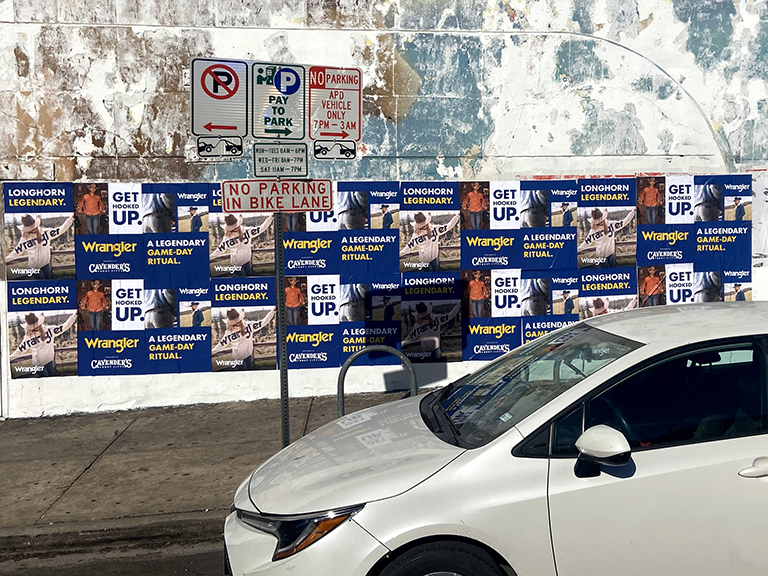
The 24×36 inch dimension is the field standard for street guerrilla campaigns in any major US city. The 2:3 aspect ratio is well-suited to portrait-format wall surfaces. The 24-inch width fits between typical obstructions on urban building surfaces. The 36-inch height fills enough visual space to command attention from across a sidewalk. Our crews in New York install thousands of 24×36 pieces monthly, and this dimension has proven consistent across every neighborhood from the East Village to Crown Heights.
Window Advertising
For window advertising, the 18×24 dimension is the standard. The 18-inch width fits most retail window panes without requiring the poster to be divided or custom-cut. The 24-inch height fills the visible window area proportionally. In large-format display windows, the 24×36 works well, but the 18×24 is the default because it accommodates the widest range of actual window sizes in commercial and retail environments.
Event Promotion
Event promotion typically uses a layered dimension strategy. The 24×36 dimension for outdoor building and fence placements handles visibility from a distance. The 18×24 dimension for venue and retail window placements handles indoor visibility. The 11×17 dimension for community bulletin boards and bars handles saturation in the immediate neighborhood. Each dimension serves a different placement environment in the same campaign.
Large-Scale Outdoor Installations
For major brand presence campaigns on high-traffic corners, scaffolding, and construction hoarding, poster dimensions step up to 36×48 or 48×72. These dimensions fill large blank surfaces proportionally and create visual presence at the scale of the built environment. A 48×72 poster on a scaffolding wall that covers an entire building face creates a brand moment that smaller dimensions cannot match, regardless of print quality or creative excellence.
Frequently Asked Questions
What is the standard poster dimension in inches?
The primary standard is 24 x 36 inches (width x height, portrait orientation). Secondary standards include 11 x 17, 18 x 24, 27 x 40, and 36 x 48 depending on the application and industry context.
What poster dimension is used for outdoor street marketing?
For outdoor street-level marketing, 24 x 36 inches is the most common dimension. For high-volume coverage campaigns on poles and small surfaces, 11 x 17 is the standard dimension. For premium single-location outdoor installations, 36 x 48 or 48 x 72 is used.
How do I calculate the pixel dimension for a poster?
Multiply the physical dimension in inches by the target DPI. For a 24 x 36 poster at 300 DPI: 24 x 300 = 7,200 pixels wide, 36 x 300 = 10,800 pixels tall. Total file dimension: 7,200 x 10,800 pixels.
Can I design a poster at one dimension and print it at another?
You can scale up or down, but quality is affected by scaling up. Designing at 11 x 17 and printing at 24 x 36 means your resolution drops significantly. Designing at 24 x 36 and printing at 11 x 17 works fine because you are scaling down, which always maintains or improves apparent resolution.
What dimension poster fits in a standard retail display frame?
Most standard retail display frames are built for 22 x 28 or 24 x 36 inch inserts. Confirm the frame dimensions before printing. Having a 24 x 36 poster for an 18 x 24 frame is a wasted print run.
Is there a dimension poster size that works for both print and digital social media?
A 24 x 36 poster at 300 DPI creates a very large digital file. For digital social media use, the poster would be scaled down significantly. Designing the poster first at print dimensions and then creating a separate social media crop is the most efficient approach. Do not try to serve both purposes with a single file size.
What is the minimum dimension for an effective outdoor poster?
For outdoor visibility at normal pedestrian street distances of 15 to 20 feet, the minimum effective dimension is 18 x 24 inches. The 11 x 17 dimension is the minimum for very close-range outdoor viewing (bulletin boards, pole posting at close pedestrian distance). Below 11 x 17, outdoor poster effectiveness drops significantly.