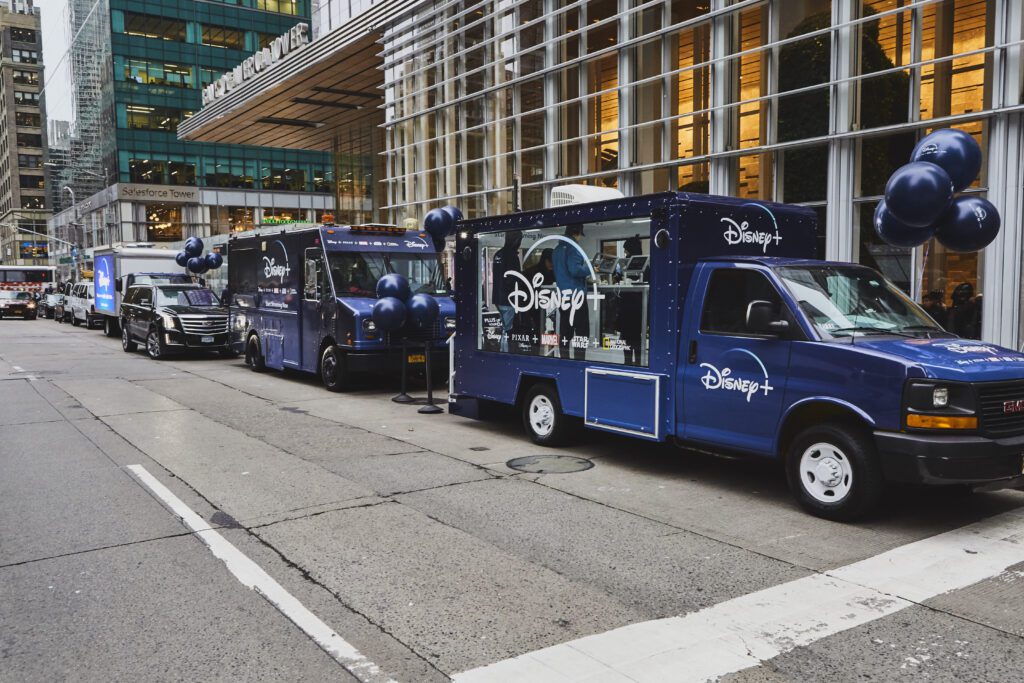
The brands that people actually talk about are the ones they encountered physically — and pop-up brand experiences are one of the most direct ways to create those encounters at scale.
A pop-up brand experience is different from a sampling table. It is different from a booth at a trade show. It is different from a product launch party where the same hundred people drink free wine and leave with a tote bag. A pop-up brand experience is a deliberate, designed, temporarily deployed physical environment that communicates what the brand actually is — not just what it makes or what it costs, but what it stands for, what kind of world it is trying to create, and what it feels like to be associated with it.
The difference shows up immediately in the way consumers engage. A sampling table generates transactions: someone takes a sample, maybe talks to a brand ambassador for sixty seconds, and moves on. A well-designed pop-up brand experience generates encounters: people stop, look around, take photos, ask questions, sit down, spend time. They remember it. They tell other people about it. They search for the brand online when they get home. That behavioral difference is the value proposition of the pop-up brand experience as a format.
We have built pop-up brand experiences across categories including beverage, beauty, apparel, food, consumer tech, and media. The production values and budgets have ranged from modest to significant. What determines success is not the budget — it is the clarity of the creative concept, the quality of the execution, and the strategic logic connecting the brand experience to a specific business objective.
Every pop-up brand experience, regardless of category, budget, or format, has the same core components. Understanding what each component contributes to the overall experience — and what happens when one is weak — is the foundation of effective design.
Environment
The environment is the physical space: its design, materials, lighting, sensory qualities, and overall aesthetic. The environment communicates brand identity before a consumer reads a single word of copy or talks to a single staff member. It sets emotional tone. A brand with a warm, artisan identity needs an environment that feels handcrafted and personal. A brand with a precision performance identity needs an environment that feels clean, exact, and technically sophisticated. The environment needs to be coherent with the brand it represents, not generic or decoratively inconsistent.
Visual design quality determines whether the experience gets photographed and shared. Consumers photograph things that are beautiful, unusual, or culturally resonant. A generic branded backdrop does not get photographed. A genuinely distinctive, visually striking environment gets photographed hundreds or thousands of times by the people who walk through it. Every design decision about the pop-up environment should be made with one question on the table: does this make the space more or less worth photographing?
Interaction Design
Interaction design is the structure of what happens when a consumer enters the space. What do they encounter first? What are they invited to do? What choices do they have? How does the experience flow from one moment to the next? What is the peak moment — the thing they will remember and share? What is the takeaway that goes home with them?
Interaction design is underinvested in most pop-up brand experiences. Significant resources go into environmental design and production, and then the actual consumer interaction is left to “the staff will figure it out.” This is a mistake. The quality of the consumer experience is determined by how the interaction is designed, not just by how good the environment looks. A scripted flow that guides the consumer through a sequence of meaningful brand touchpoints — each building on the previous one — creates a deeper, more memorable experience than an open-ended environment where consumers wander and staff improvise.
Staff and Human Connection
Staff are the most humanizing element of any brand experience and typically the one with the biggest impact on how consumers feel about the brand afterward. Staff who know the product deeply, engage authentically, and genuinely care about the consumer’s experience create brand affinity in a way that no environmental design or interactive element can replicate.
The ideal brand ambassador at a pop-up experience is someone who actually uses and loves the product, can tell a genuine story about it, and has the social intelligence to read different consumers and adapt their engagement approach accordingly. Not every person who applies for a brand ambassador position has these qualities. Finding the ones who do, training them thoroughly on product and brand, and then giving them a strong framework to work within is the staffing challenge at the heart of every pop-up experience.
Content Infrastructure
Content infrastructure means the physical and organizational elements designed to generate documentation and social sharing from the experience. This includes: designated photography zones with consistent, flattering lighting; branded elements that appear clearly in photos taken throughout the space; staff whose responsibilities include capturing content during the event; a hashtag strategy with visible display throughout the space; and a process for quickly reviewing, approving, and reposting user-generated content during the activation itself.
If a pop-up brand experience happens and the brand does not have fifty high-quality photos and videos from it within 24 hours, the content opportunity was not taken seriously. That content is the experience’s second life — it reaches audiences far beyond the people who were physically there.
Choosing the Right Location
Location choice for a pop-up brand experience is a strategic decision with operational, audience, and cultural dimensions that all need to align.
Audience alignment is the first filter. The location needs to be somewhere the target consumer actually spends time. A premium beverage brand targeting young professionals in New York City has completely different location logic than a functional food brand targeting suburban parents or an apparel brand targeting teenagers. The demographic profile of the neighborhood and the nature of the foot traffic at the specific site both need to match the audience the brand is trying to reach.
Cultural context is the second filter. Every neighborhood has a cultural character that affects how brand experiences land within it. SoHo in Manhattan has a strong fashion and contemporary culture context that works for premium lifestyle brands. Williamsburg has a creative, independent, and food-forward culture that works well for food and beverage brands with authentic stories. The Meatpacking District is nightlife and premium consumer goods. The Lower East Side is countercultural and trend-forward. These distinctions matter. A brand that does not fit the cultural context of its chosen neighborhood creates a jarring rather than resonant encounter with the locals who dominate that foot traffic.
Operational feasibility is the third filter. Permitting, power access, space dimensions, loading access, pedestrian traffic patterns, sight lines from the street — all of these determine whether a given location is practically viable for the activation being planned. A visually perfect location that lacks power access or requires a permit that takes twelve weeks to obtain is not the right location for a campaign with a six-week planning window.
Examples of Pop-Up Brand Experience Formats
Format
Typical Scale
Ideal For
Key Design Priority
Branded Container / Cube Build
Medium
Street-level brand presence; retail push
Exterior graphics; clear interior flow
Temporary Retail Space
Medium – Large
DTC brands; limited-edition launches
Retail merchandising; checkout experience
Experiential Installation
Large
Awareness campaigns; cultural moments
Visual distinctiveness; shareability
Service-Based Pop-Up
Medium
Beauty; wellness; personal care
Service quality; physical comfort
Event-Embedded Brand Space
Small – Medium
Festival and event sponsorships
Stand-out from event environment
Designing for Social Content
Social content is not a side benefit of a pop-up brand experience — it is often the primary mechanism through which the experience reaches most of its eventual audience. The people who physically attend the experience are the seed audience. Their social sharing is what extends the experience’s reach to networks that were not physically present.
Designing specifically for social content means making deliberate choices about every visual element of the space. It means thinking about which moments will be photographed — and making those moments genuinely photogenic. It means creating a designated photography zone with the right brand elements in the frame and the right lighting for quality phone photography. It means briefing staff to actively assist with photography rather than just tolerating it. And it means having a system in place to respond quickly to user-generated content — reposting the best of it, engaging with the people who shared it, and creating a visible feedback loop that motivates more sharing.
One effective tactic is creating a specific, bespoke element within the pop-up environment that exists for no other reason than to be photographed. A distinctive prop, a branded installation, a mirror moment, an unexpected visual — something that people want to photograph and share because it is genuinely interesting or beautiful, and that clearly communicates the brand identity to anyone who sees the photo without having been at the experience. This type of element, when it works, generates a disproportionate amount of the social content and earned reach from the activation.
Connecting Pop-Up Experiences to Business Outcomes
Pop-up brand experiences are a brand marketing investment. They generate awareness, affinity, trial, and content. Connecting those outputs to specific business outcomes requires deliberate measurement architecture built before the activation launches.
For brands in retail distribution, the most direct business outcome connection is retail sales lift in markets where the pop-up experience ran. Tracking retail scan data in the activation market against a comparable control market during and after the activation period gives a direct measurement of whether the experiential investment moved product. This requires the measurement framework to be established before the activation, which is why post-hoc ROI calculation for experiential campaigns is usually less reliable than pre-planned measurement designs.
For direct-to-consumer brands, the connection is through the CRM. Every opt-in captured at the pop-up experience is a new member of the CRM who can be tracked through the purchase funnel. The conversion rate from opt-in to first purchase, and the customer lifetime value of pop-up-acquired customers versus other acquisition channels, are the business outcome measures that matter.
For brand awareness campaigns, the measure is brand tracking data: awareness, consideration, and preference scores in the markets where the experience ran compared against markets where it did not. Running regular brand tracking surveys is a prerequisite for this type of measurement. Brands that do not have baseline brand tracking data cannot credibly measure the awareness impact of their experiential investments.
Building Pop-Up Brand Experiences That Generate Long-Term Value
The most valuable pop-up brand experiences create value that extends well beyond the physical duration of the event. They generate consumer relationships that continue through CRM, social content that reaches audiences for weeks or months, and brand equity that persists in the memory of every consumer who participated. Building for this extended value requires deliberate design choices that go beyond creating a good event and toward creating a good beginning to an ongoing relationship.
Consumer data capture is the mechanism that converts a one-time event into an ongoing relationship. Every consumer who has a positive experience at a pop-up brand experience is a potential lifelong customer. Without a data capture mechanism, that consumer’s relationship with the brand exists only in their memory — which is valuable but not actionable. With a data capture — an email address, a phone number, a social follow — the brand has the infrastructure to continue the relationship, deliver follow-up value, and track the consumer’s process from the activation encounter through trial, first purchase, and repeat purchase.
The data capture design at pop-up brand experiences should be frictionless and value-driven. A consumer who has just had a genuinely positive experience with the brand is the most receptive moment for a data capture request. The incentive for providing contact information should be genuine — a significant discount, an exclusive offer, access to content or products not available elsewhere. A QR code that links to a simple form and delivers a meaningful reward creates capture rates that clipboard-based sign-up sheets cannot approach.
Content Strategy for Pop-Up Brand Experiences
The content strategy for a pop-up brand experience should be as deliberately designed as the activation itself. The goal is to create content that performs well on social platforms — that is interesting enough to stop a scrolling thumb, distinctive enough to be immediately recognizable as the brand, and authentic enough to feel like it represents a real experience rather than a produced advertisement.
The most valuable content from pop-up brand experiences is consumer-generated rather than brand-produced. A consumer who photographs themselves in the activation space, trying the product, or participating in a brand activity creates content with the authenticity premium that branded photography cannot replicate. Designing the activation with clear, high-quality photography opportunities throughout the space — distinctive backdrops, flattering lighting, interesting visual elements — enables and encourages this organic content generation without requiring explicit incentives for every post.
Staffing Pop-Up Brand Experiences for Maximum Impact
The staff who operate a pop-up brand experience are not just execution personnel — they are the brand’s ambassadors in the most literal sense. Every consumer who enters the activation space will interact with the staff, and those interactions are the primary mechanism through which the brand story is told, the brand relationship is built, and the consumer’s decision to engage or disengage is made.
Staffing for pop-up brand experiences requires more than filling positions with available people who meet basic appearance standards. It requires selecting people who genuinely embody the brand’s values and aesthetic, who have the social intelligence to create warm, memorable interactions with a wide range of consumer types, and who have the physical and emotional stamina to maintain high quality engagement across long days with many consumer interactions.
Training for pop-up brand experience staff should be comprehensive enough that every staff member can tell the brand’s story, answer product questions with confidence and accuracy, describe the experience they are part of with genuine enthusiasm, and guide consumers through the activation in a way that ensures they leave with the experience the design intended. This level of training takes more time than standard brand ambassador briefings, but the investment is justified by the quality difference it produces in the consumer encounter.
Staff management during the activation is as important as pre-activation training. A field manager who monitors staff performance throughout the event, provides real-time coaching, rotates staff to maintain energy levels, addresses any quality issues immediately, and documents the event for improvement purposes creates a consistently high-quality experience from the first consumer to the last. Events that start strong and fade as the day progresses suffer from inadequate in-event management as much as from any design failure.
Building Long-Term Program Value
The full value of a well-executed activation program is not captured in the metrics from a single campaign. The most valuable activation programs are the ones that improve and compound over time — where each iteration generates learning that makes the next iteration more effective, where retailer and venue relationships deepen over multiple program cycles, where staff quality improves as the best ambassadors gain experience with the brand, and where consumer community presence builds as repeated encounters create familiarity and recognition.
Building this long-term program value requires treating activation investment as an ongoing commitment rather than a series of independent campaigns. Each campaign generates information: which locations performed best, which interaction approaches converted most reliably, what staff qualities made the biggest difference, how the consumer responded to the brand story and product. That information is only valuable if it is captured, analyzed, and applied to improve the subsequent program. Programs that do not close this learning loop repeat the same mistakes and miss the same opportunities cycle after cycle.
The organizational infrastructure for long-term activation programs includes: a consistent measurement framework that captures comparable data across all program cycles, a performance analysis process that extracts actionable insights from each cycle’s data, a program management structure with continuity across cycles rather than re-starting with a new team for each campaign, and a budget commitment that reflects the compounding value of sustained investment over episodic campaign spending.
Staff Development and Retention
The brand ambassadors who represent a brand in the field over multiple program cycles develop a depth of product knowledge, brand understanding, and consumer engagement skill that new hires cannot match. A brand ambassador who has been running a brand’s sampling program for two years knows how different consumer types respond to different engagement approaches, has answers to every question they are likely to encounter, and can adapt their interaction style based on years of field experience with the brand. That accumulated competence is genuinely valuable and difficult to replace when it leaves.
Investing in staff retention for high-performing brand ambassadors is one of the most cost-effective investments in activation program quality available. The combination of competitive compensation, genuine recognition of contribution, opportunities to advance within the program (from ambassador to field supervisor, for example), and a working environment that is genuinely positive and well-managed retains the people whose performance makes the program excellent. The cost of this investment is consistently less than the cost of recruiting, training, and developing the next generation of ambassadors to replace those who leave.
Consumer process Integration
Activation programs reach their full potential only when they are designed as components of an integrated consumer process rather than as standalone marketing events. The consumer who encounters a brand at an activation and has a positive experience needs a clear, frictionless path from that encounter to first purchase, and from first purchase to repeat purchase, for the activation investment to fully realize its commercial value.
The first transition — from activation encounter to first purchase — is supported by: a first-purchase incentive delivered at the activation event (a digital coupon, a loyalty program sign-up with a welcome discount, a QR code that provides a direct path to online or retail purchase), a follow-up CRM communication within 48 to 72 hours that reinforces the positive encounter and re-delivers the purchase incentive, and a retail distribution point that is accessible from the activation location so consumers can act on their purchase intent while it is fresh.
The second transition — from first purchase to repeat purchase — is supported by: a post-purchase CRM sequence that provides additional value (usage tips, recipe ideas, additional product information) rather than just promotional offers, a loyalty program that rewards repeat purchase with increasing value, and ongoing activation presence in the markets where the brand is building its consumer base. Brands that manage all of these transitions deliberately consistently achieve higher lifetime value from activation-acquired customers than those that focus exclusively on the activation event itself.
The measurement of this full consumer process — from first activation encounter through CRM capture, first purchase, repeat purchase, and eventually brand advocacy — requires data infrastructure that most brands have not fully built. The investment in this measurement infrastructure is justified by the strategic clarity it provides: knowing which activation formats, which market contexts, and which interaction designs create the highest-value long-term consumer relationships is the most important knowledge input for making activation investment decisions well.
Working with AGM on Your Activation Program
American Guerrilla Marketing designs, produces, and manages brand activation programs across all major U.S. markets. Our work spans pop-up events, mobile truck programs, retail activation campaigns, roadshow tours, sponsorship activations, and custom experiential installations. We have operated in New York City since the company’s founding and have built the field infrastructure, retailer relationships, and staff networks that make activation programs work reliably across the markets our clients need to reach.
Our process starts with understanding the specific business objective the activation program needs to achieve. We do not accept generic objectives. We ask: what specifically needs to happen in the consumer’s mind or behavior as a result of this program? Who is the specific consumer? Where are they? When are they most receptive? What encounter design will create the behavior change the brand needs? Those answers determine the program design, not the other way around.
Our production approach prioritizes execution quality over visual elaborateness. We have consistently found that a well-positioned activation with excellent staff and a quality consumer interaction delivers more commercial value than an elaborate production with mediocre execution. We invest the budget where it generates the most value in the consumer encounter, not where it photographs best in a portfolio.
Our reporting tells clients what actually happened in the field: interaction counts, product distributed, data captured, content generated, and an honest assessment of what worked and what would be done differently. We do not produce reports designed to justify the agency’s continued engagement. We produce reports designed to help clients make better decisions about how to invest in subsequent programs.
Every activation program we manage is covered by comprehensive field documentation: daily field reports during the program, photo documentation from every activation stop, and a post-program analysis that covers performance by location and market, staff observations, and specific recommendations for subsequent program cycles. Clients who engage with this reporting seriously run consistently better programs over time because the learning compounds.
We work with brands across food, beverage, beauty, personal care, technology, and lifestyle categories. We work with emerging brands that are building their consumer base from scratch and with established brands that are defending market position or expanding into new geographies. The strategic challenges are different at each stage, but the core operational principles — field execution quality, location intelligence, staff investment, measurement rigor — apply at every scale.
If you have a specific activation objective and you are trying to determine whether there is a program format and approach that can help you achieve it effectively and efficiently, we are worth a conversation. We will tell you honestly what we think will work and what we think will not, and we will give you a specific program recommendation that reflects our genuine assessment of what will produce the results you need.
Frequently Asked Questions
What is a pop-up brand experience?
A pop-up brand experience is a temporary, physical environment or event designed specifically to represent and communicate a brand’s identity, products, and values through direct consumer interaction. It goes beyond sampling or simple product distribution to create a multi-sensory, emotionally engaging encounter.
How much does a pop-up brand experience cost?
Costs vary widely based on format, duration, location, and production quality. A simple pop-up event with branded elements and staffing might run $15,000 to $40,000. A full experiential installation with custom fabrication, technology, and multi-day staffing in a major market typically runs $75,000 to $300,000 or more.
What cities are best for pop-up brand experiences?
New York City, Los Angeles, Chicago, Miami, and Austin consistently deliver strong results for pop-up brand experiences due to population density, cultural openness to experiential marketing, and media market coverage. The right city depends on where the target audience is concentrated and which markets matter most to the brand’s distribution strategy.
How do you get media coverage for a pop-up brand experience?
Earned media coverage from pop-up experiences comes from visual newsworthiness (something that looks distinctive and is worth photographing), a clear story angle (why is this brand doing this now), and proactive media outreach to local press and lifestyle reporters before the activation opens. Social amplification from attendees is often the most reliable media driver.