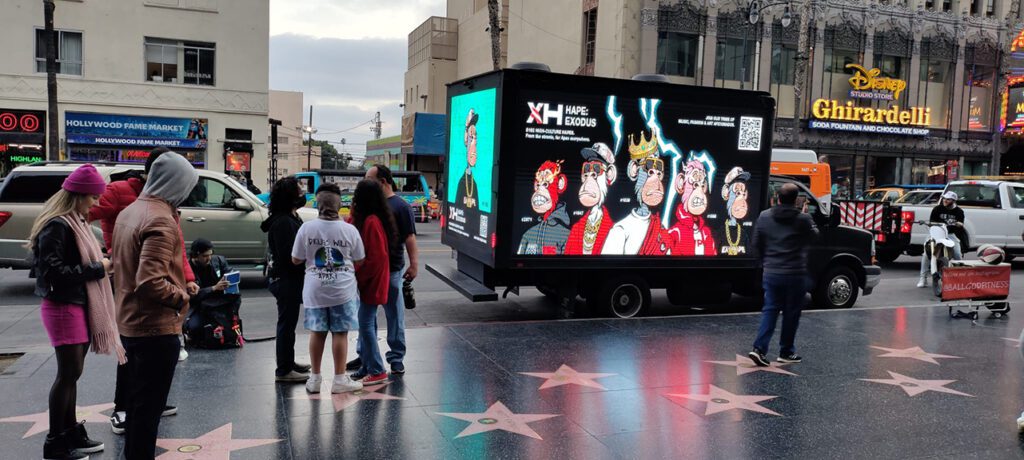
A brand activation trailer is a complete branded environment that you can drive to any market. When the build is right, it delivers a flagship-quality consumer experience at every stop on the tour — from Coachella Valley to Times Square to a farmer’s market in Denver.
An experiential marketing trailer is one of the most versatile and high-impact assets a brand can deploy for consumer engagement programs. Unlike fixed installations or venue-based activations, a custom trailer creates a controlled brand environment that can be positioned in any market, at any event, in any city — delivering a consistent, high-quality consumer experience regardless of location.
We are American Guerrilla Marketing. We have worked with trailer-based activation programs across multiple categories and markets. This guide covers how experiential marketing trailers work, how they are built, what formats are available, and what the operational realities look like for a brand managing a trailer-based activation program.
An experiential marketing trailer is a custom-designed trailer unit that has been built to function as a branded consumer environment. It is towed by a truck to activation locations and deployed as a self-contained brand experience. The trailer is both a physical brand asset — wrapped in the brand’s visual identity and visible from a distance — and a functional interior space where consumers interact with the brand, its products, and its representatives.
Trailers come in multiple forms:
Fixed-footprint trailers: A standard trailer configuration with a defined interior and exterior space. Simpler build, lower cost, less dramatic visual impact when deployed.
Slide-out trailers: Trailers with mechanical sections that expand outward when parked, dramatically increasing the usable floor space. A 20-foot trailer with slide-outs can expand to 600+ square feet of usable space, creating a genuinely immersive environment from what travels as a compact footprint.
Double-expandable trailers: Trailers with slide-outs on both sides, creating the maximum possible floor space from a towable vehicle. These are the flagship format for brands that want maximum impact at major events and can manage the larger deployment requirements.
Stage trailers: Trailers built with stage platforms and backdrop structures that create a performance or presentation environment. Used for demonstrations, speaker events, product launches, and branded entertainment programming.
What Goes Inside an Experiential Marketing Trailer
The interior of a brand activation trailer is a blank canvas at the design stage. What gets built into it depends on the brand’s specific activation format and consumer experience objectives.
Product Display and Sampling Areas
Food and beverage brands typically configure their trailers around product display and sampling stations. A well-designed sampling station allows a trained product specialist to interact with multiple consumers simultaneously, preparing samples and explaining the product while others wait in a queue. The flow design of the trailer interior — how consumers enter, move through, sample, and exit — is a significant factor in how many consumers the activation can serve per hour.
Technology brands, personal care brands, and automotive brands use trailer interiors as controlled demonstration environments. The trailer creates a private or semi-private context for a demonstration that would not be possible in an open street environment. A consumer trying a skincare protocol in a properly lit trailer environment has a better experience than the same consumer trying samples at an outdoor table in variable lighting and weather conditions.
Immersive Brand Environments
Premium brands and product launches use trailers as fully immersive brand worlds. The interior is designed to express the brand’s complete visual identity and lifestyle context, not just display a product. Consumers who enter feel transported into the brand’s world rather than simply receiving a sample. This format is highly photo-worthy and generates strong organic social documentation.
Trailer Type
Typical Footprint When Deployed
Best Brand Category
Build Complexity
Fixed 20-foot trailer
200 sq ft interior
CPG, sampling programs
Moderate
Single slide-out trailer
350-500 sq ft
Technology, beauty, food
High
Double slide-out trailer
500-800 sq ft
Automotive, premium lifestyle, launch events
Very high
Stage/presentation trailer
Stage platform + backdrop
Entertainment, product launches, demonstrations
High
The Build Process for Experiential Marketing Trailers
Custom trailer builds require coordination between the brand’s creative team, the fabricator, and the operational team that will manage the trailer in the field. Here is how the process typically works:
Program brief and consumer experience design: Define the specific consumer experience the trailer needs to deliver. How many consumers per hour? What is the interaction format? What product or technology needs to be housed?
Concept design: Interior and exterior design concepts that express the brand identity and accommodate the operational requirements.
Production drawings: Detailed drawings that the fabricator can build from. These specify all dimensions, materials, mechanical systems, and technology integrations.
Fabrication: Eight to fourteen weeks for most custom trailer builds, depending on complexity.
Systems installation: Electrical, HVAC, plumbing (if applicable), and technology integrations.
Graphics and wrap installation: Exterior brand graphics applied after the structural build is complete.
Testing and rehearsal: The trailer is tested in a controlled environment before the first activation. Setup, operation, and breakdown procedures are rehearsed with the team that will operate it.
The trailer is the most visible element of a trailer-based tour program. It is visible from two blocks away, and the quality of the exterior design and graphics is the first brand impression every consumer gets before they ever interact with a team member. The investment in the trailer build quality is not overhead — it is the primary creative canvas for the entire campaign.
Operating an Experiential Marketing Trailer: The Practical Reality
Trailer-based activations have specific operational requirements that differ from simpler street-based programs.
Tow vehicle and driver: The trailer requires a properly rated tow vehicle and a licensed driver. For tours that cross state lines, there may be specific commercial vehicle regulations that apply depending on trailer weight and length. We address these requirements in the planning phase.
Setup and breakdown time: A slide-out trailer requires 30-90 minutes to set up properly including leveling, expanding, powering on, and interior preparation. Breakdown requires similar time. Venue access windows need to account for these requirements.
Power access: Most trailer activations require external power for lighting, HVAC, and any technology components. This means either connection to a venue’s power source or a generator. Generator placement and sound need to be managed so they do not affect the consumer experience.
Space requirements: A deployed slide-out trailer requires more space than the driving footprint suggests. A 24-foot trailer with fully deployed slide-outs may require a 40-foot width of clear space for the full deployment. Venue selection and setup positioning need to account for the deployed footprint, not just the towing footprint.
Why Brands Choose Trailers Over Other Activation Formats
The decision to invest in a trailer-based activation program over other formats is driven by specific program requirements that trailers address particularly well.
Brands choose trailers when the consumer experience requires more physical space than a truck or pop-up tent can provide. When the activation needs to convey premium quality through environmental design. When the program operates primarily at planned events where there is adequate venue access for a larger vehicle. When the brand’s product story benefits from a private, unhurried consumer interaction rather than a quick street-level exchange. And when the program will repeat enough times across its useful life to justify the higher initial investment relative to simpler formats.
Brands that choose trailers and succeed with them share a common approach: they treat the trailer as a flagship physical brand expression, not as a delivery vehicle for samples. They invest in the design quality that makes the interior genuinely worth entering. They staff the trailer with genuinely knowledgeable specialists who can deliver the brand story in context. And they measure the program’s performance rigorously enough to demonstrate the return on the trailer investment over time.
Brands that choose trailers and are disappointed tend to have treated the trailer as an expensive version of simpler formats — a truck with more space. The trailer’s potential is in what the additional space makes possible, not in the space itself. If the program is designed for a smaller format and simply scaled up into a trailer, the trailer’s specific capabilities go unused and the premium investment does not pay back.
Trailer Interior Configuration for Different Brand Interactions
The trailer’s interior layout needs to be purpose-designed for the specific type of consumer interaction the program will deliver. Here are the primary interior configuration models and what they require:
High-throughput sampling configuration: Designed to process the maximum number of consumer interactions per hour at major events with large attendance volumes. The layout emphasizes a clear flow path from entry to sample receipt to exit, minimal furniture or displays that slow consumer movement, efficient product prep and delivery systems, and clear visual communication at the entry point about what the experience involves. Ambassador positions are designed for maximum serving efficiency rather than individual consultation depth.
Consultation-depth configuration: Designed for extended, personalized consumer interactions where the brand specialist needs to assess the consumer’s specific needs and recommend the right product. This layout includes seating for two to four consumers simultaneously, product display organized by consumer need state rather than by product line, adequate lighting for product evaluation, and a design that creates privacy within the space for one-on-one consultation. Beauty brands, health and wellness brands, and complex technology products often use this format.
Immersive brand environment configuration: Designed to transport the consumer into the brand’s world rather than just sample or demonstrate a specific product. The interior communicates the brand’s complete visual identity, lifestyle positioning, and narrative. Products are present and available but are secondary to the environment itself. This format prioritizes content generation — the consumer’s photo inside the branded environment — and brand impression depth over product transaction volume.
Trailer Programs at Major Events: Practical Logistics
Deploying a trailer at a major event requires advance coordination with event management, logistical access planning, and venue-specific compliance requirements that differ significantly from street-level activation logistics.
Event application process: most major events require brands to apply for activation space well in advance — often three to six months before the event. The application typically requires a description of the activation, the vehicle dimensions and type, power requirements, and proof of insurance. Brands that approach major events without advance applications often find that all activation space has been allocated.
Electrical access: most trailer programs require external power. Events provide shore power access at a cost per amp or per day. Generator use at most events is restricted due to noise and exhaust concerns. Confirming the power access logistics — available amperage, connection type, cost, and location relative to the activation space — before finalizing the trailer’s electrical requirements prevents expensive surprises on site.
Load-in windows: major events have defined load-in windows during which vehicles can access the activation footprint to set up. These windows are non-negotiable — vehicles that miss their load-in window may be denied access entirely. The trailer program’s setup timeline needs to be designed to fit comfortably within the load-in window, with buffer time for unexpected logistics complications.
Trailer Programs by Consumer Category: What Works
Different consumer categories use experiential marketing trailers in different ways. Understanding the category-specific applications helps brands design trailer programs that align with how their consumers expect to interact with brands in their category.
Food and beverage brands: Trailers provide kitchen or serving capability that allows preparation of quality food or beverage samples beyond what simple street-level sampling can produce. A coffee brand that serves properly prepared, barista-quality espresso drinks from a well-equipped trailer creates a product experience substantially superior to a simple pre-packaged sample. The trailer’s ability to support genuine product preparation is one of its most valuable features for food and beverage brands.
Automotive brands: Automotive brands use trailers as product information and brand environment hubs adjacent to ride-and-drive programs. The trailer houses the registration and lead capture function for drive programs, product display for models and features not available for driving, and brand specialist consultations. The trailer creates a professional base of operations that elevates the entire activation from a street-level table to a genuine brand destination.
Wellness and personal care brands: Trailers that include private consultation areas, proper lighting for product evaluation, and clean professional surfaces are ideal for wellness and personal care brands. The intimacy of a one-on-one consultation within a branded environment — with proper privacy, appropriate conditions for product assessment, and time for genuine conversation about the consumer’s specific needs — produces a quality of consumer interaction that justifies the trailer investment for brands where personalized product recommendation is central to the purchase decision.
Premium lifestyle brands: Trailers that create aspirational brand environments serve premium lifestyle brands by making the brand’s world physically inhabitable. The consumer who spends fifteen minutes in a beautifully designed trailer environment that expresses the brand’s full lifestyle positioning leaves with a brand impression that a billboard, a social ad, or a product sample alone cannot create. The trailer becomes a three-dimensional expression of what the brand stands for.
Trailer Program Planning Timeline
Planning a trailer-based activation program from scratch requires a realistic timeline that accounts for every phase from concept to first activation day.
Interior/exterior design concepts, production drawings, fabricator selection
Fabrication and production
8-14 weeks
Completed trailer build including exterior graphics installation
Staffing and training
2-3 weeks (overlaps with fabrication)
Ambassador team recruited, trained, and rehearsed
Location research and event booking
4-8 weeks (overlaps with fabrication)
All activation locations confirmed, permits obtained where required
Systems testing and pilot activation
1 week before full launch
Trailer operationally verified; first activation day executed
Total minimum timeline from brief to launch activation: approximately 16-20 weeks for a standard custom trailer build. Brands that need to launch faster should explore rental or refurbishment options, which can compress the timeline to 6-10 weeks at the cost of reduced customization capability.
Maintaining Trailer Quality Over a Multi-Year Program
A custom experiential trailer is a significant capital investment that should remain in service for five to ten years with appropriate maintenance. Preserving the trailer’s quality over this period requires ongoing attention to several areas:
Exterior graphics maintenance: Vinyl wraps are not permanent. UV exposure, temperature cycling, and road debris all degrade wrap quality over time. A regular inspection schedule that catches fading, lifting, or damage before it becomes significant helps maintain the trailer’s visual quality between major refresh cycles. Graphics refresh typically makes sense every two to three years, or whenever the exterior’s condition no longer represents the brand at its best.
Interior surface maintenance: High-traffic interior surfaces — counters, floors, seating — accumulate wear from consumer use and program operations. Protective coatings, replaceable surface materials, and regular cleaning protocols extend the life of interior finishes and maintain the quality consumer environment the trailer was built to create.
Mechanical systems: The slide-out mechanisms, HVAC systems, electrical systems, and towing connections all require regular maintenance to operate reliably. A trailer that fails mechanically on an activation day loses that day’s consumer contact and creates operational complications that affect the days following. A proactive maintenance schedule prevents these failures.
Working With AGM on Trailer-Based Programs
American Guerrilla Marketing has extensive experience designing and operating trailer-based brand activation programs. We manage every aspect of trailer program execution from initial build specification through daily field operations.
For brands approaching their first trailer program, we provide a scoping process that defines the right trailer format, build specification, and operational model for the specific program objectives. We work with qualified fabricators who have built experiential trailers for national brands and who have the capability to deliver on specification and on schedule.
For brands with existing trailers, we provide operations management: ambassador staffing, route and location planning, daily logistics coordination, quality management, and reporting. The operational expertise we bring to a trailer program is the same whether the trailer is brand-new or has been in service for several years.
The financial structure of a trailer program engagement with AGM separates the capital components (vehicle, build, wrap) from the operational components (staffing, logistics, management, reporting). This separation allows brands to engage us for the components that match their internal capabilities. Brands that have their own production teams and want to manage fabrication internally can engage us for operations and staffing only. Brands that want end-to-end management can engage us for everything. The engagement model is client-driven.
For multi-market trailer tour programs, we provide the full management infrastructure: tour management, market-by-market staffing, centralized quality oversight, and consolidated reporting that gives the brand a complete picture of program performance across all markets simultaneously. The geographic scale of a trailer tour does not change the quality standard we apply to each individual stop.
Trailer Programs and Earned Media
A well-designed experiential trailer generates earned media that extends the program’s reach beyond the consumers who were physically present at each activation stop. The combination of a compelling visual presence, a high-quality consumer experience, and strategic placement at events and locations where media and content creators are present creates conditions for organic coverage that no paid media plan can guarantee.
The trailers that earn the most organic documentation and media coverage share specific characteristics: they have exterior designs that are visually striking and photograph well. Their interior environments are designed to be genuinely worth documenting. They are placed in locations where the audience has the habit of sharing what they encounter — art events, music festivals, food markets, and cultural gatherings where social documentation is a natural consumer behavior.
Earned media from trailer-based programs shows up in several forms: organic social content from consumers who visited and documented the activation, press coverage in local media when the trailer is part of a major event or culturally relevant campaign, influencer content from creators who encounter the activation and find it worth sharing with their audiences, and brand content from the activation documentation that the brand produces and distributes across its own channels.
The total value of this earned media component, when measured properly, often represents a significant portion of the trailer program’s total return on investment. It is one of the strongest arguments for investing in design quality, environmental richness, and strategic location selection for trailer activations. The consumer who creates and shares content about the trailer reaches audiences far beyond the consumers the trailer directly served.
Frequently Asked Questions
What is an experiential marketing trailer?
An experiential marketing trailer is a custom-built trailer unit that is designed to function as a branded consumer environment. It can be towed to any location and set up as a product showcase, sampling station, demonstration space, or fully immersive branded experience depending on how it is built.
What are the advantages of a trailer over a truck for brand activation?
Trailers offer more interior and exterior space than trucks, which allows for larger branded environments, more complex consumer experiences, and greater product display capacity. They can also expand with slide-out sections to significantly increase the footprint when deployed. The trade-off is that trailers require a tow vehicle and more space to position.
How long does it take to build a custom experiential marketing trailer?
A well-specified custom trailer build typically takes eight to fourteen weeks from final design approval to delivery. More complex builds with technology integrations, slide-out sections, or elaborate interior finishes may take longer. Starting the build process at least three months before the first campaign date is recommended.
Can an experiential marketing trailer be used for multiple campaigns?
Yes. A well-built trailer is a capital asset that can be reused across multiple campaign cycles. The branded exterior can be updated with new graphics for new campaigns. The interior can be reconfigured for different product presentations. A trailer investment amortized across three to five campaign cycles is significantly more cost-effective than rebuilding for each program.