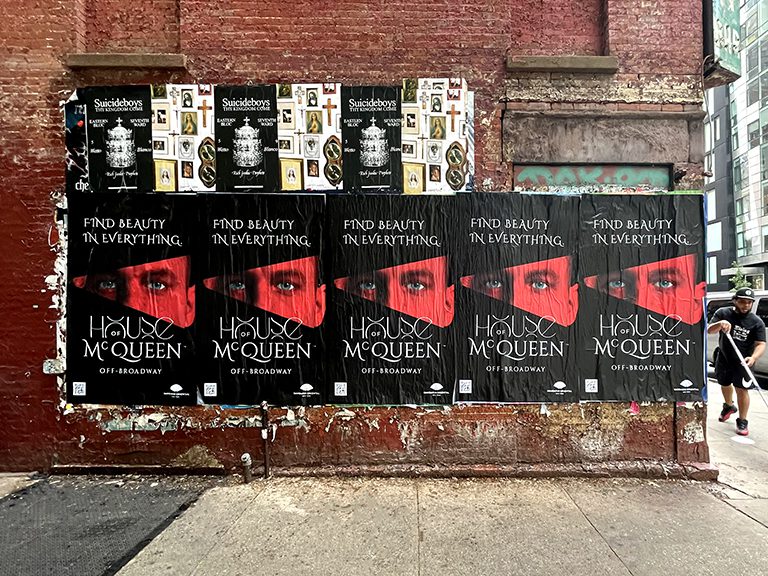
When a Broadway production goes on tour, the real marketing challenge is not national awareness , most shows have that. The challenge is making each city feel like opening night. Every market on the tour schedule needs its own ground-level campaign, its own physical presence, its own local push that makes the show feel urgent and alive in that specific place. That is what we build at American Guerrilla Marketing, operating out of Industry City, Brooklyn.
Touring theater runs on ticket sales. And ticket sales run on visibility. We put the show’s imagery in the streets, in commuter pathways, in the neighborhoods around the venue, and in front of the audiences most likely to buy. Our guerrilla marketing approach turns blank city walls and sidewalks into show-specific advertising that runs in the weeks before opening night.
The Street Marketing Challenge for Touring Productions
Broadway touring productions have a compressed window in each market. Unlike a New York run that can build over months, a tour stop might last one to four weeks. That means the marketing machine needs to hit hard, fast, and in the right places from the moment the production rolls into town.
National digital campaigns handled by the production’s marketing office get people generally aware. But it is the local street presence that converts awareness into ticket purchases. When someone walks past a dramatic poster of the show on their morning commute, then gets handed a card by a brand ambassador outside the venue on Thursday, and sees an LED truck circling the downtown core on Saturday, they buy tickets. That sequence of real-world touchpoints is what we engineer.
We have run theater campaigns in New York, Los Angeles, Chicago, San Francisco, Boston, Washington DC, Philadelphia, Seattle, Dallas, Atlanta, and dozens of mid-market cities that host touring productions. Each city gets a tailored ground campaign that respects the local environment while staying on-brand with the production’s national creative.
Wheatpasting for Touring Theater Campaigns
Theater key art is built for large-format display. The bold imagery, the dramatic typography, the recognizable iconography of major productions , all of it is designed to stop people in their tracks. Wheatpasted posters take that imagery and put it on the walls of the city at a scale that commands attention.
We source approved placement locations in each tour market, prioritizing walls near the performance venue, in cultural and entertainment districts, around transit stops frequented by the show’s target audience, and along pedestrian corridors in the urban core. For a major Broadway tour, we might place 20 to 60 poster locations in a single market, creating a saturation effect that makes the show’s presence feel inescapable in the weeks before opening.
Poster sizing varies based on wall availability and budget, but larger formats , 40×60 and above , create the most visual authority in competitive street advertising environments. We coordinate printing, shipping to each market, and installation through our vetted network of local crews.
Street Teams at Venue Perimeters and Entertainment Districts
Our brand ambassadors work the physical perimeter of the theater market in ways that digital campaigns simply cannot reach. We position street teams at the theater venue itself in the run-up to performances, at nearby hotels where visitors stay, at restaurants and bars in the entertainment district, and at transit stops that route into the venue area.
Brand ambassadors for Broadway tour campaigns typically distribute glossy show cards, discount offer cards tied to a promo code, and printed schedules of performance dates. They are trained to engage in a friendly, non-aggressive way that reflects the prestige of the production. They do not push. They invite.
For shows with broader popular appeal, we also deploy street teams at high-pedestrian-traffic locations outside the immediate theater district , shopping corridors, farmers markets, college campuses , to reach audiences who might not think of themselves as theater-goers but would absolutely enjoy the specific show being promoted.
LED Billboard Trucks for Opening Week Impact
Few tools create opening-night energy in a city like a moving LED billboard truck displaying full-color show imagery and ticket call-to-action through downtown streets. We deploy LED trucks on opening day and the weekend before, running timed loops through the entertainment district, past convention hotels, and along major pedestrian corridors.
The format is especially effective for shows with strong visual identity , musicals with iconic costumes, productions with recognizable source material, shows that have already generated cultural conversation. The truck carries that energy into the streets and generates social sharing when passersby photograph or video the display.
We program LED trucks with multiple creative rotations: show key art, performance schedule, QR code to purchase, and any early-buyer promotions the production is running. Drivers follow a route we optimize for maximum pedestrian impression per hour.
Sidewalk Stencils Near the Venue
On high-traffic sidewalks near the performance venue, sidewalk stencils create an additional layer of street presence at ground level. Water-based chalk stenciling with the show’s title, logo, and venue directional arrow guides foot traffic toward the theater and keeps the production top of mind for pedestrians who pass through the area repeatedly.
This tactic is particularly useful in markets where the venue is slightly off the main entertainment corridor and could benefit from wayfinding in addition to advertising. The stencils wash away naturally after rain and leave no permanent mark.
Multi-City Tour Coordination
Tour marketing managers are managing a lot. They are coordinating with local promoters, handling media buys, working with the production office, and managing a different vendor in every city. Our goal is to be the easiest part of that operation.
When we take on a Broadway tour campaign, we assign a single project manager who serves as the point of contact for the entire tour run. That person coordinates with local vendors in each city, manages creative asset logistics, confirms site approval acquisition, briefs street teams, and delivers post-deployment documentation. The marketing manager gets one set of updates, not fifteen.
We have run simultaneous campaigns in multiple cities during the same week. When a major tour has overlapping market launches, our network handles both without either suffering. We maintain relationships with ground crews in every significant touring market and vet them to meet AGM’s standard before we put them on any production campaign.
Aligning Street Campaigns with Digital and Media Buys
Street marketing does not replace the digital campaign. It multiplies it. When a potential ticket buyer sees the show’s Instagram ad in the morning, notices the wheatpaste poster on their lunchtime walk, and gets handed a discount card by a brand ambassador outside the theater district on Friday afternoon, the cumulative effect far exceeds any single-channel campaign.
We time our deployments to align with the production’s media schedule. If a local morning show segment is running on Wednesday, we have street teams at transit hubs near that network’s primary viewership corridor on Tuesday and Thursday. If a radio spot launches Monday, the wheatpaste goes up over the weekend. Coordination with the media plan makes every component of the campaign work harder.
Audience Targeting by Production Type
Not every Broadway tour appeals to the same audience, and our street campaigns reflect that. A family-friendly musical gets street team activity near schools, family recreation areas, and shopping centers frequented by parents. A drama with adult themes gets deployed in arts districts, upscale dining corridors, and hotel zones frequented by business travelers who might purchase tickets for an evening out.
We use the production’s audience data and box office demographics to guide where we deploy. If a show has a strong subscriber base in a market, we concentrate efforts on lapsed subscribers and new-to-theater audiences rather than over-saturating existing ticket buyers who already know about the show.
Reporting and Post-Campaign Documentation
Every campaign we run generates a documentation package. Street team supervisors photograph each deployment with geotagged images and distribution counts. LED truck logs record route, hours, and impression estimates by neighborhood. Wheatpasting crews provide before-and-after photos of each wall placement.
Tour marketing managers receive a post-campaign report for each market that includes all deployment documentation, impression estimates, and any notable field observations. This feeds into the production’s overall campaign analytics and helps inform strategy for remaining tour stops.
Ready to Launch Your Campaign?
What Makes AGM the Right Partner for Theater Tour Campaigns
We understand live entertainment marketing. We understand that the audience for a touring production is different from the audience for a consumer product launch. We understand that theater key art has specific creative requirements and that how it is displayed matters for the production’s brand.
We also understand urgency. Tour stops have hard deadlines. The show opens on a specific date, and the street campaign needs to be at full saturation before that date , not on it. Our team operates with the timeline discipline that live entertainment demands.
Producers and tour marketing managers who work with us find that we are predictable, documented, and accountable. We say what we will do, we do it, and we show you proof. In an industry where a lot of vendors overpromise, that track record is our best marketing tool.
Frequently Asked Questions About Broadway Tour Marketing
What is Broadway tour marketing?
Broadway tour marketing covers all promotional activity for touring theatrical productions across multiple cities. It includes street-level media, outdoor advertising, brand ambassador programs, and coordinated launch campaigns in each market. The goal is to build local ticket purchase urgency in a compressed promotional window.
How do street teams support Broadway tour ticket sales?
Street teams distribute show materials at high-traffic locations near performance venues, hotels, transit hubs, and cultural districts. Face-to-face outreach creates direct connections with potential ticket buyers and drives on-the-spot interest. Our brand ambassadors are trained to reflect the prestige of the production in every interaction.
What OOH formats work best for theater tour promotions?
Wheatpasted posters, LED billboard trucks, and sidewalk stencils are all high-performing formats for theater tours. Bold imagery of the show’s key art in high-visibility locations near the venue creates consistent exposure in the lead-up to opening night. The combination of fixed placements and mobile formats maximizes reach across the market.
How early should Broadway tour street marketing begin?
We recommend launching street-level activities three to four weeks before opening night in each market. This allows enough runway for multiple impression cycles before ticket purchase windows close and prevents campaign fatigue from oversaturation.
Can AGM handle multi-city Broadway tour campaigns simultaneously?
Yes. We manage coordinated campaigns across multiple markets at the same time using our national vendor network. Each city gets a localized execution plan while staying on-brand with the production’s national campaign creative and messaging.
Does AGM work with theater producers and tour marketing managers?
Yes. We work directly with tour marketing managers, general managers, producers, and in-house theater marketing teams. We slot into existing campaign structures as the ground-level execution partner and provide a single point of contact for the full tour run.
Related: Wheatpasting & Poster Campaigns | Guerrilla Marketing Services | Sidewalk Stencils | LED Billboard Trucks | Brand Ambassador Agency
Ready to Build Your Broadway Tour Campaign?
Millie Phillips
Campaign Architect , American Guerrilla Marketing
Email: [email protected]
Office: (646) 776-2770
Official Wheatpaste Pricing
We only quote from AGM’s published rate cards or from a custom scope tied to the actual market, route, staffing plan, and production load.
- 24×36 wheatpaste campaign, 100 posters: $4,500
- 24×36 wheatpaste campaign, 200 posters: $5,500
- 48×72 wheatpaste campaign, 100 posters: $10,500
- 48×72 wheatpaste campaign, 200 posters: $13,500
- Optional maintenance for the final two weeks of a monthly run: $3,500
If your campaign needs a different city mix, custom fabrication, or rush timing, contact AGM for a quote built from the same rate-card logic.
How AGM scopes Broadway Tour Marketing: Promoting Touring Productions City by City
Every wheatpaste deployment plan starts with the same field questions. Where will the audience actually see the work, how long will the message stay in view, what kind of crew does the job need, and what proof will the client want after the run is live. We scope those answers before we talk about volume. That keeps the program grounded in real conditions instead of broad theory. For broadway tour marketing: promoting touring productions city by city, the planning work matters because one weak choice at the start can waste the whole run. A strong route, a realistic install pace, and a clean recap process are what make the campaign feel sharp in the street instead of rushed.
What changes performance in the field
Performance usually comes down to placement, timing, and repetition. The best campaigns do not chase every possible block. They pick the blocks, venues, walls, stations, storefronts, or pedestrian paths that line up with the right audience behavior. We watch how people move through a neighborhood, what side of the street they face, how long they dwell, and what else is competing for attention. For broadway tour marketing: promoting touring productions city by city, that means the visible details, sightline, lighting, install condition, and recap quality all matter. Good field work looks obvious after the fact, but it only feels obvious because the plan was tight before the crew ever rolled.
Budget and timing without guesswork
AGM does not pad numbers with vague ranges. We tie budgets to rate cards where a public rate exists, then fill in the rest with real production needs, staffing, route density, timing, and market conditions. That keeps the conversation honest. On broadway tour marketing: promoting touring productions city by city jobs, timing is often shaped by access windows, weather, production lead time, and how much documentation the client wants back. If a project is simple, the schedule stays simple. If it has many neighborhoods, many surfaces, or several city teams moving at once, the schedule expands because the work on the ground expands. That is a normal operations decision, not filler.
How we document results
Clients do not just need the work done. They need to know where it landed, how it looked, and whether the rollout matched the brief. Our recap process is built around timestamped photos, neighborhood notes, route summaries, and clear proof of completion. On broadway tour marketing: promoting touring productions city by city work, recap quality often decides whether a client books the next run. Clean reporting also helps the next wave because the team can see what held up, what drew the strongest response, and which placements deserve a second pass. The recap is not an afterthought. It is part of the product.
Common mistakes brands make with Broadway Tour Marketing: Promoting Touring Productions City by City
The most common mistake is chasing surface area without enough planning. Brands sometimes assume that more units or more neighborhoods always means better results. In practice, sloppy spread kills recall. Another mistake is forcing creative that is too dense for the setting. Street work needs clear hierarchy, strong contrast, and a message that makes sense at the distance where the audience sees it. A third mistake is underestimating production details. The stock, finish, weather window, shift timing, and recap expectations all shape the outcome. Strong campaigns respect the boring details because the boring details decide whether the visible work looks premium.
Why this topic matters to AGM clients
Clients hire AGM because they need people who understand street conditions, not just ad concepts. Broadway Tour Marketing: Promoting Touring Productions City by City is valuable when it turns a broad brand idea into something that holds up in a real place, in front of moving people, with real constraints. That is where execution matters. A page like this should leave you with a clear sense of what the work involves, what can go wrong, and what a disciplined rollout looks like. If the campaign needs city selection, route design, crew planning, printing, fabrication, staffing, reporting, or a combined package, AGM can scope it from one operating plan instead of handing the job off across five vendors.
Frequently Asked Questions About Broadway Tour Marketing: Promoting Touring Productions City by City
How early should a brand start planning?
For most campaigns, the smart move is to start planning at least two to four weeks before the launch window so production, routing, staffing, and reporting are all lined up.
What makes one market perform better than another?
Market fit depends on audience density, neighborhood behavior, route efficiency, and whether the creative belongs in that setting. The busiest city is not always the best city.
Can AGM bundle this with other services?
Yes. AGM often combines this work with supporting formats so the campaign has stronger repetition and cleaner reporting across the whole run.
How does AGM quote pages like this?
We quote from official rate cards where they apply, then scope the remaining production, staffing, and routing details to the actual job.
What stronger planning looks like for Broadway Tour Marketing: Promoting Touring Productions City by City
The difference between a page that sounds informed and a campaign that actually works is operational detail. AGM plans around audience movement, neighborhood logic, field timing, production handoff, and recap standards before the work launches. For broadway tour marketing: promoting touring productions city by city, that means we are not just talking about what the format is. We are looking at where the audience encounters it, what they are doing in that moment, how long they see it, what visual hierarchy makes sense from that viewing distance, and how the field team will verify every completed step. Those details are what protect the budget from waste and keep the work aligned with the real conditions on the ground.
How AGM pressure-tests a rollout
Before a rollout goes live, we pressure-test the plan in plain language. Does the market choice make sense for the audience. Does the route create repetition instead of random spread. Is the production timeline realistic for the number of units, the surface type, the staffing pattern, and the documentation load. Is the creative simple enough to read in motion and strong enough to hold attention. When any of those answers are weak, we tighten the scope before launch. That is a better move than pretending every idea is ready. In street-level work, discipline usually outperforms volume because disciplined execution gets seen, remembered, and documented cleanly.
What clients usually underestimate
Clients often underestimate how much field quality affects outcomes. A weak install, a rushed route, or sloppy recap photos can make an otherwise strong campaign look smaller than it was. They also underestimate how much neighborhood context shapes audience response. A message that feels sharp in one district can feel out of place in another two miles away. That is why we treat routing and environment as part of the media itself. When the format, market, block, timing, and message all fit together, the campaign does not need inflated claims. The work feels native to the space and stronger because of it.
How this page should guide a real buying decision
This page should help a brand decide whether broadway tour marketing: promoting touring productions city by city belongs in the mix, what role it should play, how it should be measured, and what kind of scope is realistic. Some brands need a tight single-market push. Others need layered formats across several cities with one reporting standard. The right next step is not to guess. It is to define the audience, objective, timing, market list, and documentation expectations, then build the plan from there. That is how AGM turns a broad idea into a field-ready campaign that can actually be executed and reviewed without confusion.
Frequently Asked Questions