August 9, 2026
A book tour is one of the few moments when publishing buzz meets street reality. The author is in the city, the signing is scheduled, the book is on shelves , and everything depends on whether the right people know about it. That is where guerrilla marketing changes the equation. At American Guerrilla Marketing, based in Industry City, Brooklyn, we build the street-level infrastructure that turns a reading circuit into a cultural moment.
Most book tour marketing plans stop at social media posts and email newsletters. Those tools have their place, but they do not reach the person browsing a neighborhood bookshop on a Tuesday afternoon or walking past a literary district on the way to work. We reach that person. Our campaigns fill the physical world around each tour stop with the author’s face, the title, and a reason to show up.
Publishing is a crowded market. On any given week, hundreds of new titles compete for shelf space, press coverage, and reader attention. Authors on tour need more than a few Instagram posts to cut through the noise. Street-level advertising creates physical presence in the city , something that digital channels simply cannot do.
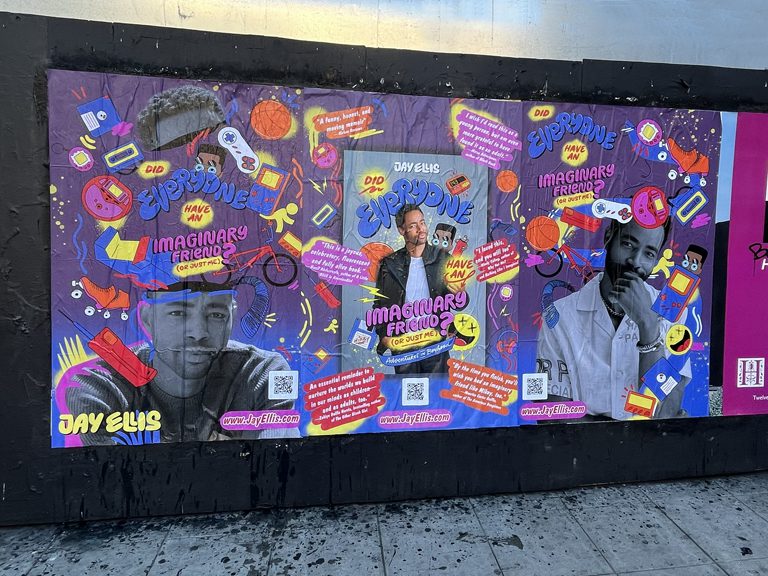
When a commuter sees a bold wheatpaste poster of an author’s cover image on a wall near a subway entrance, that impression lands differently than a banner ad that disappears in a scroll. It stays in their peripheral awareness. When a street team member hands them a postcard at the coffee shop next to the bookstore, the connection becomes personal. These are the touchpoints that convert curious passersby into event attendees and buyers.
Our approach to book tour marketing is built around one principle: show up where readers actually are. That means record shops, independent bookstores, university neighborhoods, coffee strips, and transit corridors. We map the physical environment of each tour city and deploy in the spots that matter.
Wheatpasting is one of the most striking ways to announce an author’s arrival in a city. A 24×36 or larger poster of the book cover and event details, placed on approved walls in high-visibility areas, creates an unmissable announcement. We source approved placement locations in every market, coordinate printing logistics, and handle installation so the author or publisher does not have to manage anything on the ground.
Poster campaigns work best when concentrated in a two-block radius around the signing venue and in the adjacent neighborhoods where the target reader lives. For a literary fiction release, that might mean the arts district. For a business book, the financial corridor. We target based on the book’s audience, not just geography.
Our brand ambassadors are trained promotional staff who know how to approach strangers and make a genuine connection around a book. We deploy them at farmers markets, university quads, coffee strips, indie bookshop queues, and transit hubs in the days before each tour stop.
Street teams distribute event postcards, bookmarks, and sometimes advance reading copies or sample chapters. They direct people to ticket or RSVP links. They photograph their activations for documentation. And because they are real people having real conversations, they create a type of word-of-mouth momentum that no sponsored post can buy.
For authors with wide cultural reach or publishers with serious marketing budgets, our LED trucks are a high-impact option. A mobile LED display driving loops through the city center on the day of a signing creates real-time visibility that draws attention and generates social sharing. The author’s cover art, event time, and bookstore name display on a screen size that cannot be ignored.
We have used LED trucks for debut novelists, celebrity memoirists, and major nonfiction releases. The format works especially well in dense urban markets where the truck passes thousands of pedestrians on a single hour-long loop.
In cities where sidewalk stencils are approved, we use water-based chalk stenciling to mark the path to a bookstore event. Arrows, book titles, author names, and dates appear on the pavement near the venue, creating a breadcrumb trail that guides foot traffic and reinforces name recognition. These wash away naturally and leave no permanent mark.
A book tour rarely stops in one city. Most meaningful tours hit five to twenty markets over weeks or months. Managing the logistics of street-level marketing across all those stops simultaneously is the hard part , and it is exactly what our team handles.
We maintain a national vendor and staff network that covers major publishing markets including New York, Los Angeles, Chicago, Boston, San Francisco, Washington DC, Seattle, Austin, and beyond. When a publisher signs on for a tour campaign, we coordinate vendors in every city, synchronize creative assets, manage print shipping logistics, and brief local street teams before the author arrives.
Each market gets a localized execution plan. A signing in a college town gets a different deployment strategy than one in a downtown financial district. We do not copy and paste the same playbook across cities. We adapt.
The pre-stop window is when most of the physical work happens. Wheatpasting goes up five to ten days before the event. Street teams begin distributing materials three to five days out. This creates a build-up of awareness that peaks the week of the signing.
We coordinate with the bookstore or venue on any in-store display elements, window graphics, or sidewalk presence that reinforces the campaign at ground zero.
On signing day, we typically deploy street teams near the venue for two to three hours before doors open. LED trucks run loops if the budget includes them. Our team documents everything , street photos, distribution counts, any notable moments , and sends a same-day report.
After the signing, we collect impression data and distribution numbers and compile a market report. Publishers and publicists use this data to assess campaign performance and plan future tour stops.
Not every book tour looks the same, and not every street campaign should either. We customize our approach based on the genre, the author’s existing audience, and the type of bookstore or venue hosting the signing.
For literary fiction releases, we focus on neighborhoods with dense concentrations of independent bookstores, arts spaces, and university buildings. For business and self-help titles, we target commuter corridors, co-working districts, and transit hubs near financial centers. For genre fiction , crime, romance, fantasy, thriller , we work with the author’s existing fan community and position materials where those readers cluster.
Children’s and young adult authors benefit from proximity to schools and libraries. Cookbook authors benefit from farmers markets and specialty food areas. The medium is always street-level, but the targeting is always specific.
Our clients for book tour marketing include major publishing houses, independent presses, literary agencies, and individual authors managing their own promotion. We work well with in-house marketing teams and external publicists who need a dependable ground-level execution partner.
The typical engagement begins with a discovery call to understand the book, the audience, the tour schedule, and the budget. From there, we produce a market-by-market campaign plan with recommended tactics and costs for each stop. Once approved, we handle everything: creative coordination, print management, site approval acquisition, vendor briefings, and staff coordination.
Authors do not have time to manage logistics while on tour. Publishers need to know their ground campaigns are running without hand-holding. We are the team that makes that possible.
Street-level campaigns work best when they are timed to reinforce other promotional activity. When a publisher has a local radio interview, a podcast appearance, or a newspaper feature scheduled around a tour stop, our street presence amplifies the effect. Someone who hears the author on a morning show and then sees their poster on the walk to lunch is far more likely to show up that evening than someone who had only one touchpoint.
We keep our campaign timing in sync with whatever media activity the publicist has lined up. The more coordinated the full campaign, the better the turnout.
Book tour marketing budgets vary widely. A debut novelist with a small press has different resources than a celebrity memoirist backed by a major publisher. We build campaigns at multiple budget levels, and we are transparent about what each tier gets you.
A lean campaign might include wheatpasting at one or two high-impact locations per city and a brief street team deployment. A full campaign adds LED trucks, multi-day street team presence, sidewalk stencils, and coordinated in-store signage. We help publishers and authors allocate budget where it delivers the most physical visibility for their specific audience and market.
We never oversell. If a tour stop is in a smaller market, we say so and budget accordingly rather than deploying big-city resources where they will not perform.
We are a street advertising agency, not a digital shop that added field marketing as an afterthought. Our core expertise is physical presence in urban environments. We have run campaigns in every major publishing market in the country, and we know how those cities work at street level.
Our production team handles creative development, print coordination, site approval research, and vendor management. Our field teams are trained promotional staff who take the work seriously. When we say a poster goes up, it goes up. When we say a street team runs for four hours, it runs for four hours , and we document everything.
Publishers working with us get a single point of contact who manages the entire ground campaign, regardless of how many cities are on the tour. That means fewer emails, fewer coordination headaches, and better execution.
Book tour marketing is the coordinated effort to promote an author’s appearances and new title across multiple cities using a mix of street-level tactics, out-of-home advertising, brand ambassadors, and local media outreach. It runs alongside digital and PR campaigns to build physical presence in each tour market.
Street teams distribute flyers, postcards, and samples in high-foot-traffic areas near bookstores, universities, and transit hubs. They create real-world buzz that digital ads cannot replicate, driving foot traffic to signings and readings. Our brand ambassadors are trained to approach people in a natural, non-intrusive way that creates genuine interest rather than friction.
Yes. Wheatpasting is one of the most cost-efficient ways to saturate neighborhoods around a bookstore event with bold, large-format imagery. We handle site-approval planning, placement, and design coordination across every tour stop. A striking 24×36 poster of the book cover placed on walls near a signing venue creates awareness that lasts for days before the event.
We recommend starting at least four to six weeks before the first stop. This allows time to design materials, coordinate vendors in each market, deploy wheatpasting, and brief street teams before the author arrives. For larger tours with many stops, we prefer to begin planning eight weeks out.
Yes. Our team manages campaigns across any number of tour stops nationwide. We coordinate local vendors, staff street teams, and ensure consistent creative execution in every city. We provide a single point of contact who oversees the full tour campaign from first stop to last.
We work with Big Five publishers, independent imprints, self-published authors, and literary agencies promoting debut titles, memoirs, genre fiction, and nonfiction releases of all kinds. Our campaigns scale up or down based on budget and market size.
We track exposures by market, event attendance figures, material distribution counts, and sales lift data provided by the publisher or retailer. We provide post-campaign reporting for each tour stop so publishers can see exactly what ran and where.
Related: Wheatpasting & Poster Campaigns | Guerrilla Marketing Services | Sidewalk Stencils | LED Billboard Trucks | Brand Ambassador Agency
Millie Phillips
Campaign Architect , American Guerrilla Marketing
Email: [email protected]
Office: (646) 776-2770
We only quote from AGM’s published rate cards or from a custom scope tied to the actual market, route, staffing plan, and production load.
If your campaign needs a different city mix, custom fabrication, or rush timing, contact AGM for a quote built from the same rate-card logic.
Every wheatpaste deployment plan starts with the same field questions. Where will the audience actually see the work, how long will the message stay in view, what kind of crew does the job need, and what proof will the client want after the run is live. We scope those answers before we talk about volume. That keeps the program grounded in real conditions instead of broad theory. For book tour marketing: promoting authors and publishers on the road, the planning work matters because one weak choice at the start can waste the whole run. A strong route, a realistic install pace, and a clean recap process are what make the campaign feel sharp in the street instead of rushed.
Performance usually comes down to placement, timing, and repetition. The best campaigns do not chase every possible block. They pick the blocks, venues, walls, stations, storefronts, or pedestrian paths that line up with the right audience behavior. We watch how people move through a neighborhood, what side of the street they face, how long they dwell, and what else is competing for attention. For book tour marketing: promoting authors and publishers on the road, that means the visible details, sightline, lighting, install condition, and recap quality all matter. Good field work looks obvious after the fact, but it only feels obvious because the plan was tight before the crew ever rolled.
AGM does not pad numbers with vague ranges. We tie budgets to rate cards where a public rate exists, then fill in the rest with real production needs, staffing, route density, timing, and market conditions. That keeps the conversation honest. On book tour marketing: promoting authors and publishers on the road jobs, timing is often shaped by access windows, weather, production lead time, and how much documentation the client wants back. If a project is simple, the schedule stays simple. If it has many neighborhoods, many surfaces, or several city teams moving at once, the schedule expands because the work on the ground expands. That is a normal operations decision, not filler.
Clients do not just need the work done. They need to know where it landed, how it looked, and whether the rollout matched the brief. Our recap process is built around timestamped photos, neighborhood notes, route summaries, and clear proof of completion. On book tour marketing: promoting authors and publishers on the road work, recap quality often decides whether a client books the next run. Clean reporting also helps the next wave because the team can see what held up, what drew the strongest response, and which placements deserve a second pass. The recap is not an afterthought. It is part of the product.
The most common mistake is chasing surface area without enough planning. Brands sometimes assume that more units or more neighborhoods always means better results. In practice, sloppy spread kills recall. Another mistake is forcing creative that is too dense for the setting. Street work needs clear hierarchy, strong contrast, and a message that makes sense at the distance where the audience sees it. A third mistake is underestimating production details. The stock, finish, weather window, shift timing, and recap expectations all shape the outcome. Strong campaigns respect the boring details because the boring details decide whether the visible work looks premium.
Clients hire AGM because they need people who understand street conditions, not just ad concepts. Book Tour Marketing: Promoting Authors and Publishers on the Road is valuable when it turns a broad brand idea into something that holds up in a real place, in front of moving people, with real constraints. That is where execution matters. A page like this should leave you with a clear sense of what the work involves, what can go wrong, and what a disciplined rollout looks like. If the campaign needs city selection, route design, crew planning, printing, fabrication, staffing, reporting, or a combined package, AGM can scope it from one operating plan instead of handing the job off across five vendors.
For most campaigns, the smart move is to start planning at least two to four weeks before the launch window so production, routing, staffing, and reporting are all lined up.
Market fit depends on audience density, neighborhood behavior, route efficiency, and whether the creative belongs in that setting. The busiest city is not always the best city.
Yes. AGM often combines this work with supporting formats so the campaign has stronger repetition and cleaner reporting across the whole run.
We quote from official rate cards where they apply, then scope the remaining production, staffing, and routing details to the actual job.
Ready to Run Your Campaign?
Call us or email us. Weβll tell you exactly what we can do in your market and what it costs.
American Guerrilla Marketing β Los Angeles
Street-level campaigns in Los Angeles and nationwide. Wheatpasting, LED trucks, street teams, and more.
(646) 776-2770
Related Services
Explore similar advertising solutions offered by American Guerrilla Marketing.
August 10, 2026
August 10, 2026
August 10, 2026
August 10, 2026
August 10, 2026