Every April, the Coachella Valley fills with one of the most concentrated collections of young, affluent, socially active consumers on the planet. Two weekends. Hundreds of thousands of people. Every major fashion, beauty, beverage, and lifestyle brand in the country either showing up with an activation or wishing they had. The festival itself is a cultural moment. The marketing opportunity around it is something our team at American Guerrilla Marketing has studied and executed against for years.
What most brands get wrong about Coachella marketing is they treat it as an either-or: either you have an official sponsorship and a footprint inside the gates, or you are not really part of the event. That is not how the crowd experiences it. The Coachella audience spends four or five days in the Coachella Valley, not just the hours they are inside the festival grounds. They are at hotel pools in the morning, on the road in the afternoon, at pop-ups and brand experiences in the evening, and back on the streets the next day. The opportunity to reach them exists at every one of those touchpoints, with or without an official festival relationship.
This is where guerrilla marketing and street-level tactics have an enormous advantage. Our team deploys mobile billboards, brand ambassadors, and OOH advertising throughout the Indio-Palm Springs corridor during both festival weekends, reaching the Coachella crowd at every point in their four-day experience without the seven-figure price tag of official sponsorship.
The Coachella Crowd: Who You Are Actually Reaching
Understanding the audience is the starting point for any Coachella marketing campaign. Coachella attendees skew 18 to 35, with the 21 to 30 segment representing the core. They index heavily on fashion, beauty, food, music, and lifestyle content. They are among the most socially active concert audiences in the country: a single weekend of Coachella generates hundreds of millions of social exposures across platforms, with a significant share coming from organic content created by attendees documenting their experience.
They are also, by definition, people who planned ahead. Coachella tickets sell out months in advance. Hotel and Airbnb inventory in the Coachella Valley fills up before the end of the prior year. These are people who made a deliberate decision to be there, who budgeted and arranged their lives around the trip, and who are primed to engage with experiences that feel native to the Coachella cultural moment.
For brands in fashion, beauty, beverage, streaming, food, consumer lifestyle, and tech accessories, this demographic is a primary or near-primary target. The question is not whether the audience is worth reaching. It is how to reach them in a way that feels right for the environment and generates the kind of recall and word-of-mouth that the Coachella moment uniquely enables.
The Valley as the Campaign Zone
Inside the festival grounds, the activation environment is controlled, expensive, and competitive. Outside the grounds, the entire Coachella Valley is the stage. The road from Palm Springs to Indio. The corridors around the main festival site. The hotel districts in La Quinta and Indio. The restaurants and pop-up spaces where attendees spend their non-festival hours. The shuttle staging areas where thousands of people wait in both directions, every day of both weekends.
Our approach to Coachella marketing is built around what we call the valley campaign zone: every touchpoint a festival-goer encounters from the moment they arrive in the desert to the moment they leave. We map the primary corridors, identify the highest-density gathering points, and assign tactics to each.
LED billboard trucks run the main roads during peak traffic windows: morning arrivals, afternoon return to hotel, evening departure to the festival site, and late-night egress. The trucks are visible from a distance in the flat desert terrain, which means exposures per route are higher than they would be in a dense urban market.
Brand ambassador teams cover hotel pool areas, restaurant patios, and the gathering spots where attendees spend their daytime hours. These are the hours when people are rested, social, and receptive to brand interactions. A sample, a conversation, or a branded photo moment in those spaces creates the kind of memory that stays with someone for the rest of the weekend.
Festival OOH Advertising in the Coachella Valley
The Coachella Valley has a well-developed OOH advertising market. I-10 and Highway 111, which bring the bulk of festival traffic into the area, carry significant billboard inventory. The weeks leading up to and including the festival weekends are premium booking windows for any brand that wants to establish presence before attendees even arrive on-site.
Static billboards on these corridors create frequency for the most important segment of the Coachella audience: the people driving in from Los Angeles, San Diego, Las Vegas, and Phoenix who spend 90 minutes to four hours on the road with very little to look at besides desert scenery and whatever is on the billboards. An attendee who sees your brand three times on the drive from LA to Indio is not going to forget it by the time they are standing in the festival crowd.
We layer OOH placements with mobile LED billboard trucks to create a saturation effect. Static placements build frequency. Mobile trucks create recency at the highest-density moments. Together, they ensure that the Coachella crowd has multiple brand encounters across their entire time in the valley, not just a single impression at a single moment.
Brand Ambassadors: The Human Layer
Every digital impression and every OOH placement has a ceiling on what it can do. It can create recognition. It cannot create a relationship. That is what brand ambassadors are for in a Coachella marketing program.
Our ambassador teams deployed in the Coachella Valley are trained on your brand’s story, products, and objectives before they set foot on-site. They work the public-facing gathering spots around the festival zone: hotel areas, shuttle corridors, restaurant patios, and the high-traffic zones around the festival perimeter. They do not require festival accreditation because they are not working inside the festival grounds. They work the spaces where the audience is available, approachable, and genuinely open to conversation.
The conversations that ambassadors have at Coachella are different from conversations they have at a typical street-level activation. People are in vacation mode. They are with their closest friends. They are in one of the most positive, social emotional states of the year. An ambassador who approaches someone well in that context is not interrupting anything. They are adding to an experience the person is already having.
For beverage brands, this means sampling. For fashion and beauty brands, it means gifting and styling interactions. For tech and lifestyle brands, it means demonstrations and hands-on time with the product. We customize the ambassador brief to fit the brand and the specific touchpoints we are targeting within the valley.
The Two-Weekend Structure: How to Build Over Time
Coachella’s two-weekend structure is a rare opportunity in festival marketing. Weekend one tends to draw more LA-based attendees and higher media coverage. Weekend two is often more relaxed, with a slightly different crowd mix and less chaotic logistics. Both weekends offer full campaign windows, and brands that show up for both have a compounding advantage over those who only commit to one.
We plan Coachella marketing campaigns across both weekends as a single cohesive program, with some tactical adjustments between the two. The pre-weekend one phase focuses on building awareness among attendees who may still be planning their on-site experience. The between-weekends window, typically five days, is a chance to extend reach in the LA market through street-level tactics in the city before the second wave of attendees heads out to the desert. Post-weekend two is the debrief and follow-through window: retargeting, follow-up content, and any campaigns designed to extend the Coachella conversation into the broader cultural moment that follows.
Pre-Festival Street Marketing in Los Angeles
The Coachella audience is largely an LA audience. The single largest feeder market for the festival is Los Angeles, and the two to three weeks before the festival are when that audience is in peak anticipation mode: buying outfits, planning their days, talking about lineups, and extremely receptive to anything connected to the Coachella moment.
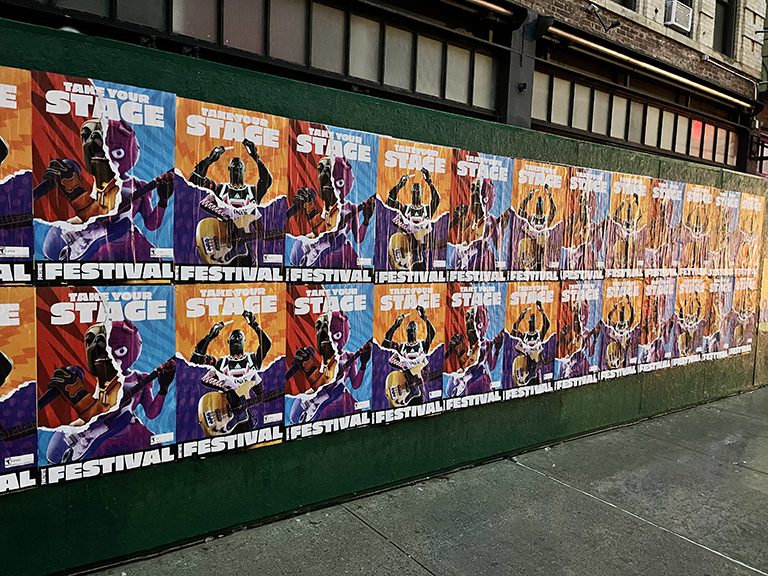
We run wheatpaste poster campaigns in the LA neighborhoods where Coachella attendees are concentrated: Silver Lake, Echo Park, West Hollywood, Venice, Los Feliz, and the surrounding areas. These campaigns go up three to four weeks before the first weekend and stay up through the event period, creating a consistent brand presence in the environments the audience inhabits every day in the weeks before they head to the desert.
Sidewalk stencils in high-foot-traffic corridors in these neighborhoods add a street-level dimension that catches people at eye level, in the moments when they are walking and genuinely looking at their surroundings. Combined with wheatpaste on the walls above, the stencils create a full-environment brand presence that feels like part of the neighborhood rather than an intrusion into it.
What Brands Get Wrong About Coachella Marketing
The most common mistake is trying to replicate the scale of official sponsors on an unofficial budget. A brand that shows up to the Coachella Valley with one small tent and a handful of people and tries to compete with the multi-million-dollar activations on-site is going to feel small. The right play is not to compete with official sponsors inside the gates. It is to own the spaces they cannot or do not reach.
Official sponsors own the interior. The roads, hotels, restaurants, bars, and surrounding community are open. A well-executed exterior campaign often generates more genuine exposures and more memorable brand encounters than an official interior placement, because it reaches people at multiple points in their experience rather than just once in a designated activation zone.
The second mistake is going silent between the two weekends. The five days between weekend one and weekend two are not dead time. They are a window to extend reach in the LA market, refresh creative for the second wave of attendees, and capitalize on the social content that weekend one generated. Brands that maintain campaign presence through both weekends and the gap between them build significantly more frequency than those who treat it as a single three-day event.
Brands That Win Coachella Without a Sponsorship
The most memorable Coachella moments in recent years have come from brands operating entirely outside the official festival relationship. Pop-ups along the corridors into the festival site. Branded shuttle experiences on the public shuttles. Product sampling at hotel pools. Roadside activation experiences that people stopped to photograph and share because they were genuinely interesting, not because a brand paid for the right to put a logo on a banner.
The modern Coachella marketing playbook is built around shareability. If an activation is designed to be photographed and shared, it becomes its own media. The OOH impression becomes a social post. The ambassador interaction becomes a photo that goes to thousands of followers. The product sample becomes a piece of content. This is the Coachella dynamic that savvy brands have been exploiting for years, and it does not require an official relationship with the festival to access.
Our team designs Coachella activations with shareability built into the brief. Every touchpoint is considered from the perspective of what it looks like in a photo, because that photo is often the most valuable output of the entire campaign.
Planning Timeline for Coachella Marketing
Coachella is an April event. Our recommended planning timeline:
November to December: Strategy sessions, brand brief, objectives defined, budget allocated. This is when the best ambassador staffing options are still available.
January: Campaign plan finalized, creative brief issued, print production for any wheatpaste or collateral initiated, truck routes and OOH placements booked.
February: Ambassador teams staffed and onboarded. site approvals filed for any applicable California locations. Pre-festival LA campaign elements confirmed.
March: Pre-festival LA wheatpaste campaigns launch, three to four weeks before weekend one. Any social or digital components aligned with the street-level campaign timing.
April, both weekends: Full valley deployment across all tactical channels.
Post-event: Performance reporting, photo documentation, impression data delivered. Debrief and recommendations for the following year.
Ready to Launch Your Campaign?
Connecting Coachella to a Broader Campaign
The Coachella moment does not live only in the Coachella Valley. The cultural conversation around the festival extends into cities across the country in the weeks before and after both weekends. Brands that execute well in the valley often find that the content and word-of-mouth generated there extends their campaign reach into markets they never physically operated in.
We help brands plan for this extension: creating campaign elements that are designed to travel socially, briefing ambassadors on content moments that are likely to generate sharing, and coordinating the Coachella activation with broader national or digital campaigns that can catch and amplify what the street-level work generates.
The Coachella marketing opportunity is bigger than the festival. It is a two-week cultural window in April when a specific demographic that matters to your brand is paying close attention. Use it accordingly.
FAQ: Coachella Marketing
Does AGM have an official relationship with Coachella?
No. AGM operates in the public corridors of the Coachella Valley, including the roads, parking areas, shuttle routes, and surrounding communities, not inside the festival grounds. No official relationship is needed for the street-level and OOH tactics we deploy. We have executed successful Coachella marketing campaigns entirely through exterior, public-space activation.
What are the best locations for Coachella brand activations?
The Indio-Palm Springs corridor is the primary activation zone. Shuttle staging areas, hotel districts, and the roads connecting the festival site to surrounding communities are highest-traffic. Ambassador teams work hotel pools, restaurant patios, and gathering spots in the days around both weekends, reaching attendees during the hours when they are most accessible and most socially active.
When should we book a Coachella marketing campaign?
January for April activations is the target. The best ambassador staffing, truck inventory, and print production windows all require 10 to 12 weeks of lead time for a festival of this scale. November or December conversations allow us to hold the best resources and build the most thorough campaign plan.
How do brand ambassadors work at Coachella?
Our ambassador teams work the public-facing festival perimeter: shuttle stops, hotel areas, parking corridors, and surrounding communities. They distribute samples, collateral, and brand experiences to the Coachella crowd without requiring festival accreditation. All ambassador work is conducted in public spaces where no permission from the festival is required.
What is the Coachella audience demographic?
Coachella attendees are primarily 21 to 35, with a significant 18 to 24 segment. They index highly on fashion, beauty, music, food, and lifestyle categories, and are among the most socially active concert audiences in the country in terms of content creation and sharing. They are also, by definition, planned travelers with meaningful disposable income for experiences.
Can we do OOH advertising in the Coachella Valley?
Yes. The Coachella Valley has significant billboard and OOH inventory along I-10, Highway 111, and the surrounding corridors. We can place static and digital OOH alongside LED billboard trucks, creating a layered presence throughout the region during festival weekends. This approach builds frequency across the entirety of an attendee’s time in the valley.
What kinds of brands do Coachella marketing?
Fashion, beauty, beverage, lifestyle, and tech brands dominate Coachella marketing. But the event also draws DTC brands, streaming services, food and snack companies, and consumer goods brands whose core audience skews young, affluent, and socially active. If your target demographic is 18 to 35 and cares about music, style, and experience, the Coachella moment is likely relevant to your brand calendar.
Related: Wheatpasting & Poster Campaigns | Guerrilla Marketing Services | Sidewalk Stencils | LED Billboard Trucks | Brand Ambassador Agency
Ready to Launch Your Campaign?
Millie Phillips
Campaign Architect , American Guerrilla Marketing
Email: [email protected]
Office: (646) 776-2770
Official Wheatpaste Pricing
We only quote from AGM’s published rate cards or from a custom scope tied to the actual market, route, staffing plan, and production load.
- 24×36 wheatpaste campaign, 100 posters: $4,500
- 24×36 wheatpaste campaign, 200 posters: $5,500
- 48×72 wheatpaste campaign, 100 posters: $10,500
- 48×72 wheatpaste campaign, 200 posters: $13,500
- Optional maintenance for the final two weeks of a monthly run: $3,500
If your campaign needs a different city mix, custom fabrication, or rush timing, contact AGM for a quote built from the same rate-card logic.
How AGM scopes Coachella Marketing: Brand Activations in the Coachella Valley
Every wheatpaste deployment plan starts with the same field questions. Where will the audience actually see the work, how long will the message stay in view, what kind of crew does the job need, and what proof will the client want after the run is live. We scope those answers before we talk about volume. That keeps the program grounded in real conditions instead of broad theory. For coachella marketing: brand activations in the coachella valley, the planning work matters because one weak choice at the start can waste the whole run. A strong route, a realistic install pace, and a clean recap process are what make the campaign feel sharp in the street instead of rushed.
What changes performance in the field
Performance usually comes down to placement, timing, and repetition. The best campaigns do not chase every possible block. They pick the blocks, venues, walls, stations, storefronts, or pedestrian paths that line up with the right audience behavior. We watch how people move through a neighborhood, what side of the street they face, how long they dwell, and what else is competing for attention. For coachella marketing: brand activations in the coachella valley, that means the visible details, sightline, lighting, install condition, and recap quality all matter. Good field work looks obvious after the fact, but it only feels obvious because the plan was tight before the crew ever rolled.
Budget and timing without guesswork
AGM does not pad numbers with vague ranges. We tie budgets to rate cards where a public rate exists, then fill in the rest with real production needs, staffing, route density, timing, and market conditions. That keeps the conversation honest. On coachella marketing: brand activations in the coachella valley jobs, timing is often shaped by access windows, weather, production lead time, and how much documentation the client wants back. If a project is simple, the schedule stays simple. If it has many neighborhoods, many surfaces, or several city teams moving at once, the schedule expands because the work on the ground expands. That is a normal operations decision, not filler.
How we document results
Clients do not just need the work done. They need to know where it landed, how it looked, and whether the rollout matched the brief. Our recap process is built around timestamped photos, neighborhood notes, route summaries, and clear proof of completion. On coachella marketing: brand activations in the coachella valley work, recap quality often decides whether a client books the next run. Clean reporting also helps the next wave because the team can see what held up, what drew the strongest response, and which placements deserve a second pass. The recap is not an afterthought. It is part of the product.
Common mistakes brands make with Coachella Marketing: Brand Activations in the Coachella Valley
The most common mistake is chasing surface area without enough planning. Brands sometimes assume that more units or more neighborhoods always means better results. In practice, sloppy spread kills recall. Another mistake is forcing creative that is too dense for the setting. Street work needs clear hierarchy, strong contrast, and a message that makes sense at the distance where the audience sees it. A third mistake is underestimating production details. The stock, finish, weather window, shift timing, and recap expectations all shape the outcome. Strong campaigns respect the boring details because the boring details decide whether the visible work looks premium.
Why this topic matters to AGM clients
Clients hire AGM because they need people who understand street conditions, not just ad concepts. Coachella Marketing: Brand Activations in the Coachella Valley is valuable when it turns a broad brand idea into something that holds up in a real place, in front of moving people, with real constraints. That is where execution matters. A page like this should leave you with a clear sense of what the work involves, what can go wrong, and what a disciplined rollout looks like. If the campaign needs city selection, route design, crew planning, printing, fabrication, staffing, reporting, or a combined package, AGM can scope it from one operating plan instead of handing the job off across five vendors.
Frequently Asked Questions
How early should a brand start planning?
For most campaigns, the smart move is to start planning at least two to four weeks before the launch window so production, routing, staffing, and reporting are all lined up.
What makes one market perform better than another?
Market fit depends on audience density, neighborhood behavior, route efficiency, and whether the creative belongs in that setting. The busiest city is not always the best city.
Can AGM bundle this with other services?
Yes. AGM often combines this work with supporting formats so the campaign has stronger repetition and cleaner reporting across the whole run.
How does AGM quote pages like this?
We quote from official rate cards where they apply, then scope the remaining production, staffing, and routing details to the actual job.