The NRF Big Show is retail’s most important annual gathering. Each January, over 35,000 retail industry professionals, technology vendors, and enterprise buyers descend on the Jacob K. Javits Convention Center in New York City for three days of keynotes, product demonstrations, and the business conversations that set retail technology investment priorities for the year ahead. For brands serving the retail market, NRF marketing is a high-stakes opportunity: the largest concentration of retail decision-makers in North America assembled in one city for a defined window. At American Guerrilla Marketing, we execute street-level NRF campaigns across New York City’s West Side convention district, reaching the retail audience at every touchpoint outside the Javits Center perimeter.
The NRF Audience: Retail’s Decision Class
NRF Big Show draws a purchasing audience that spans the full retail enterprise hierarchy. C-suite retail executives from major chains, VP-level technology officers from mid-market retailers, operations directors evaluating new systems, and innovation scouts from retail’s fastest-growing brands all attend NRF with specific evaluation agendas. This is not a browsing crowd. NRF attendees arrive with shortlists, scheduled vendor meetings, and often with specific implementation timelines in mind. Brands that achieve strong NRF awareness enter those pre-scheduled conversations with a recognition advantage that shortens the sales cycle.
NRF’s Home City Advantage
The fact that NRF happens in New York gives it a specific character that no other retail conference can match. The city’s own retail innovation density, its concentration of consumer brands and retail media companies, and the sheer scale of New York’s marketing industry all amplify the show’s influence. Brands that show up visibly in New York during NRF week are not just marketing to conference attendees. They are presenting in front of the US retail industry’s home market, with all the press and industry attention that implies.
The Media Coverage Environment
NRF generates significant retail trade press and financial media coverage. Business journalists, retail analysts, and technology reporters converge on the Javits Center to cover the show’s keynotes and product announcements. Any brand creating a distinctive street-level presence around the Javits during NRF week has an elevated probability of appearing in that coverage without a dedicated PR campaign attached to it. A memorable LED truck route, a well-placed wheatpaste campaign, or an unexpected brand activation near the convention creates the kind of physical story that journalists who are already in the neighborhood to cover NRF will notice.
NRF Marketing Zones in New York City
The Javits Center sits on the West Side of Manhattan at 11th Avenue and 34th Street. The surrounding convention geography defines where NRF attendees spend their time outside the official event.
Javits Center Perimeter and 11th Avenue
11th Avenue in front of the Javits Center, the pedestrian plazas around the convention’s main entrance on 11th at 36th Street, and the bus and shuttle arrival areas on 34th and 38th streets carry the full NRF audience during arrival, lunch, and departure windows. These are the highest-concentration locations for any NRF street marketing format. Brand ambassador programs at the pedestrian approaches, wheatpaste campaigns on available West Side surfaces, and LED truck routes on 11th Avenue all perform at peak efficiency in this zone.
Hudson Yards Complex
Hudson Yards, just north of the Javits Center, has become a significant node in the NRF network. The complex’s restaurant level, the public plaza spaces, and the retail within Hudson Yards itself attract NRF attendees during lunch, afternoon breaks, and post-session social hours. Brand presence in this zone reaches a cross-section of the NRF audience in one of New York’s most architecturally distinctive public environments.
Midtown West Hotel District
NRF attendees spread across a cluster of hotels in the 8th Avenue and 9th Avenue corridor between 30th and 50th Streets. The Marriott Marquis, the New Yorker Hotel, the Penn Hotel, and dozens of other properties serve as NRF home base. Morning departure windows from these hotels (7am to 9am) and evening return windows (6pm to 9pm) concentrate the full conference audience on the major crosstown corridors connecting the hotel cluster to the Javits Center. Brand ambassador programs and LED truck routes through these corridors during peak windows capture the daily attendee commute.
Times Square and Midtown Social Venues
NRF evening events and client dinners spread across Midtown Manhattan’s restaurant and hotel bar circuit. Times Square and the surrounding Midtown West venue district attract NRF’s social and networking crowd during conference evenings. Ambient brand presence and LED truck routes through Midtown during evening hours reach the NRF audience in its most social, relationship-building state.
Penn Station and Transit Hubs
Penn Station at 34th Street handles the rail commuter segment of the NRF audience: attendees from New Jersey, Long Island, and the broader Northeast corridor who commute into the city for show days rather than staying in Manhattan hotels. NRF’s morning commuter concentration at Penn Station creates a targeted, captive audience window that is often underserved by official event marketing. Wheatpasting near Penn Station approaches and ambassador programs in the 34th Street corridor capture this segment during its predictable daily arrival window.
NRF Marketing Format Playbook
LED Billboard Trucks
LED truck routes during NRF week cover the primary attendee transit corridors in an efficient loop: north on 11th Avenue past the Javits Center, east on 42nd Street, south on 8th or 9th Avenue through the hotel corridor, and back west on 34th Street past Penn Station. This route puts the LED content in front of the full NRF audience multiple times during the morning commute to the convention and the evening return. We program retail-specific messaging: product category identification, key value propositions, event invitations, and calls to action that speak directly to the retail technology buyer audience.
Brand Ambassador Programs
Brand ambassador programs at NRF work at multiple scales. Small, targeted deployments at specific hotel lobby locations reach defined account targets within the broader NRF audience. Larger programs at Javits Center pedestrian approaches during morning arrival create full-audience reach at the single moment when every NRF attendee is in the same location.
NRF ambassador programs should carry materials with genuine conference utility: show maps annotated with the brand’s booth location, event invitations to brand-hosted evening programs, product specification cards relevant to the retail buyer’s specific category, or branded items with practical value during a three-day conference in January. New York’s winter weather creates specific opportunity for ambassador programs around warm beverages or weather-relevant branded items near outdoor pedestrian corridors.
Wheatpasting in West Side Manhattan
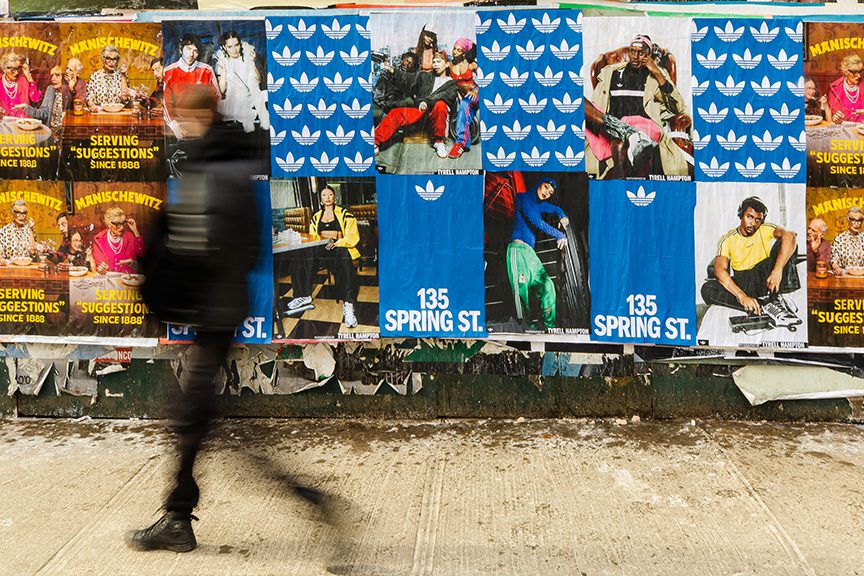
Wheatpaste campaigns around the Javits Center use the West Side’s industrial and commercial building stock, which provides large-format vertical surfaces that are well-suited to high-quality poster installations. Our team scouts and confirms surfaces in the 10th and 11th Avenue corridors, the adjacent blocks north and south of the Javits, and the cross-streets connecting the convention to the hotel district on 8th and 9th Avenues. NRF wheatpaste creative should communicate at the category level quickly: what industry the brand serves, what problem it solves, and where to go next.
Sidewalk Activations
Sidewalk stencils near the Javits Center’s pedestrian approaches and at key crosswalk intersections on 11th Avenue create ground-level brand touchpoints for every attendee making the walk to and from the convention on foot. In New York’s dense pedestrian environment, sidewalk formats reach the audience at the literal moment of street-level attention, where eyes are already down and pedestrian pace is slow.
Ready to Launch Your Campaign?
Why New York NRF Marketing Is Different from Other Convention Cities
New York City changes the NRF marketing calculus in specific ways that brands planning convention campaigns need to account for.
Higher Production Costs
New York production costs, talent rates, and logistics expenses are higher than other convention cities like Las Vegas or Orlando. A campaign that costs $20,000 in Las Vegas may run $28,000 to $35,000 in New York for the same format mix. This is a real planning consideration, but it reflects the media market premium of executing in the world’s most visible city. NRF’s position in New York means that press coverage, social amplification, and industry observer attention are all at peak density, which increases the value of every campaign impression delivered.
The AGM Home Market Advantage
American Guerrilla Marketing is based at Industry City in Brooklyn. We have executed hundreds of campaigns in New York City and have deep relationships with surface owners, installation crews, and the neighborhood institutions that make urban campaign execution smooth. For NRF campaigns at the Javits Center, we operate in our home market with the location intelligence, vendor relationships, and operational infrastructure that our campaigns in other cities build through our operator network. This home-market advantage means faster execution, better location access, and campaign monitoring from our own team rather than remote coordination.
The Density Multiplier
New York’s pedestrian density creates impression volumes per installation location that are significantly higher than any other convention city. A wheatpaste installation on 11th Avenue that would deliver 2,000 exposures per day in a comparable Las Vegas location delivers 8,000 to 15,000 in New York’s pedestrian environment. This density multiplier means that a smaller number of NRF installations can deliver equivalent or superior impression volume to larger geographic footprints in other markets.
NRF Campaign Planning Timeline
NRF takes place in early January. Planning should begin in September or October:
- September/October: Campaign brief, format selection, Javits-area location scouting, budget confirmation
- October/November: Creative development, location confirmation, talent sourcing, LED truck scheduling
- November/December: Creative production, ambassador briefing, logistics finalization
- Early January: Installation setup, talent deployment preparation
- NRF Big Show week: Full campaign in market, daily briefings
- Post-show: Documentation report, performance summary
What is NRF marketing?
NRF marketing refers to brand campaigns targeting the retail industry professionals, technology vendors, and buyers who attend the NRF Big Show at the Jacob K. Javits Convention Center in New York City each January. It includes official expo marketing as well as street-level campaigns that intercept attendees throughout the West Side Manhattan convention zone.
What NYC locations are best for NRF Big Show marketing?
The Javits Center perimeter on 11th Avenue, the Hudson Yards complex, the Midtown West hotel corridor on 8th and 9th avenues, Times Square and the surrounding hotel district for evening events, and the Hudson Yards-Chelsea restaurant zone are the highest-value NRF marketing locations.
How do retail technology brands market at NRF without a booth?
Brands run LED billboard trucks on the Javits-Midtown corridor and Hudson Yards area, deploy brand ambassador programs at conference hotels and Javits Center pedestrian approaches, execute wheatpaste campaigns on available West Side Manhattan surfaces, and create ambient activations at the high-traffic conventions corridors.
What is the advantage of street-level NRF marketing rather than official sponsorship?
Street-level NRF marketing reaches the full conference audience outside the official event perimeter without the cost constraints and approval requirements of official NRF sponsorship. For brands without large exhibition budgets, street-level campaigns deliver awareness across all 35,000+ NRF attendees throughout their NYC convention week.
How much does NRF marketing cost?
NRF street marketing campaigns in New York City typically run $15,000 to $55,000 USD depending on format mix and duration. New York’s production and talent costs are higher than other convention cities, but the concentration and quality of the NRF audience justifies the premium investment.
When should brands start planning NRF marketing?
NRF Big Show takes place in early-to-mid January. We recommend starting campaign planning in September or October of the prior year. New York City inventory around Javits during NRF week is competitive. Ten weeks of lead time from completed brief to campaign launch is standard.
What types of brands benefit most from NRF marketing?
Retail technology vendors, point-of-sale solution companies, inventory management platforms, e-commerce infrastructure providers, supply chain technology firms, retail analytics companies, payment processing brands, and any company selling into the retail industry network benefit from NRF Big Show marketing campaigns.
Official Wheatpaste Pricing
We only quote from AGM’s published rate cards or from a custom scope tied to the actual market, route, staffing plan, and production load.
- 24×36 wheatpaste campaign, 100 posters: $4,500
- 24×36 wheatpaste campaign, 200 posters: $5,500
- 48×72 wheatpaste campaign, 100 posters: $10,500
- 48×72 wheatpaste campaign, 200 posters: $13,500
- Optional maintenance for the final two weeks of a monthly run: $3,500
If your campaign needs a different city mix, custom fabrication, or rush timing, contact AGM for a quote built from the same rate-card logic.
How AGM scopes NRF Marketing: Retail Brand Campaigns Around the Big Show in NYC
Every wheatpaste deployment plan starts with the same field questions. Where will the audience actually see the work, how long will the message stay in view, what kind of crew does the job need, and what proof will the client want after the run is live. We scope those answers before we talk about volume. That keeps the program grounded in real conditions instead of broad theory. For nrf marketing: retail brand campaigns around the big show in nyc, the planning work matters because one weak choice at the start can waste the whole run. A strong route, a realistic install pace, and a clean recap process are what make the campaign feel sharp in the street instead of rushed.
What changes performance in the field
Performance usually comes down to placement, timing, and repetition. The best campaigns do not chase every possible block. They pick the blocks, venues, walls, stations, storefronts, or pedestrian paths that line up with the right audience behavior. We watch how people move through a neighborhood, what side of the street they face, how long they dwell, and what else is competing for attention. For nrf marketing: retail brand campaigns around the big show in nyc, that means the visible details, sightline, lighting, install condition, and recap quality all matter. Good field work looks obvious after the fact, but it only feels obvious because the plan was tight before the crew ever rolled.
Budget and timing without guesswork
AGM does not pad numbers with vague ranges. We tie budgets to rate cards where a public rate exists, then fill in the rest with real production needs, staffing, route density, timing, and market conditions. That keeps the conversation honest. On nrf marketing: retail brand campaigns around the big show in nyc jobs, timing is often shaped by access windows, weather, production lead time, and how much documentation the client wants back. If a project is simple, the schedule stays simple. If it has many neighborhoods, many surfaces, or several city teams moving at once, the schedule expands because the work on the ground expands. That is a normal operations decision, not filler.
How we document results
Clients do not just need the work done. They need to know where it landed, how it looked, and whether the rollout matched the brief. Our recap process is built around timestamped photos, neighborhood notes, route summaries, and clear proof of completion. On nrf marketing: retail brand campaigns around the big show in nyc work, recap quality often decides whether a client books the next run. Clean reporting also helps the next wave because the team can see what held up, what drew the strongest response, and which placements deserve a second pass. The recap is not an afterthought. It is part of the product.
Common mistakes brands make with NRF Marketing: Retail Brand Campaigns Around the Big Show in NYC
The most common mistake is chasing surface area without enough planning. Brands sometimes assume that more units or more neighborhoods always means better results. In practice, sloppy spread kills recall. Another mistake is forcing creative that is too dense for the setting. Street work needs clear hierarchy, strong contrast, and a message that makes sense at the distance where the audience sees it. A third mistake is underestimating production details. The stock, finish, weather window, shift timing, and recap expectations all shape the outcome. Strong campaigns respect the boring details because the boring details decide whether the visible work looks premium.
Why this topic matters to AGM clients
Clients hire AGM because they need people who understand street conditions, not just ad concepts. NRF Marketing: Retail Brand Campaigns Around the Big Show in NYC is valuable when it turns a broad brand idea into something that holds up in a real place, in front of moving people, with real constraints. That is where execution matters. A page like this should leave you with a clear sense of what the work involves, what can go wrong, and what a disciplined rollout looks like. If the campaign needs city selection, route design, crew planning, printing, fabrication, staffing, reporting, or a combined package, AGM can scope it from one operating plan instead of handing the job off across five vendors.
What stronger planning looks like for NRF Marketing: Retail Brand Campaigns Around the Big Show in NYC
The difference between a page that sounds informed and a campaign that actually works is operational detail. AGM plans around audience movement, neighborhood logic, field timing, production handoff, and recap standards before the work launches. For nrf marketing: retail brand campaigns around the big show in nyc, that means we are not just talking about what the format is. We are looking at where the audience encounters it, what they are doing in that moment, how long they see it, what visual hierarchy makes sense from that viewing distance, and how the field team will verify every completed step. Those details are what protect the budget from waste and keep the work aligned with the real conditions on the ground.
How AGM pressure-tests a rollout
Before a rollout goes live, we pressure-test the plan in plain language. Does the market choice make sense for the audience. Does the route create repetition instead of random spread. Is the production timeline realistic for the number of units, the surface type, the staffing pattern, and the documentation load. Is the creative simple enough to read in motion and strong enough to hold attention. When any of those answers are weak, we tighten the scope before launch. That is a better move than pretending every idea is ready. In street-level work, discipline usually outperforms volume because disciplined execution gets seen, remembered, and documented cleanly.
What clients usually underestimate
Clients often underestimate how much field quality affects outcomes. A weak install, a rushed route, or sloppy recap photos can make an otherwise strong campaign look smaller than it was. They also underestimate how much neighborhood context shapes audience response. A message that feels sharp in one district can feel out of place in another two miles away. That is why we treat routing and environment as part of the media itself. When the format, market, block, timing, and message all fit together, the campaign does not need inflated claims. The work feels native to the space and stronger because of it.
How this page should guide a real buying decision
This page should help a brand decide whether nrf marketing: retail brand campaigns around the big show in nyc belongs in the mix, what role it should play, how it should be measured, and what kind of scope is realistic. Some brands need a tight single-market push. Others need layered formats across several cities with one reporting standard. The right next step is not to guess. It is to define the audience, objective, timing, market list, and documentation expectations, then build the plan from there. That is how AGM turns a broad idea into a field-ready campaign that can actually be executed and reviewed without confusion.
Frequently Asked Questions
How early should a brand start planning?
For most campaigns, the smart move is to start planning at least two to four weeks before the launch window so production, routing, staffing, and reporting are all lined up.
What makes one market perform better than another?
Market fit depends on audience density, neighborhood behavior, route efficiency, and whether the creative belongs in that setting. The busiest city is not always the best city.
Can AGM bundle this with other services?
Yes. AGM often combines this work with supporting formats so the campaign has stronger repetition and cleaner reporting across the whole run.
How does AGM quote pages like this?
We quote from official rate cards where they apply, then scope the remaining production, staffing, and routing details to the actual job.