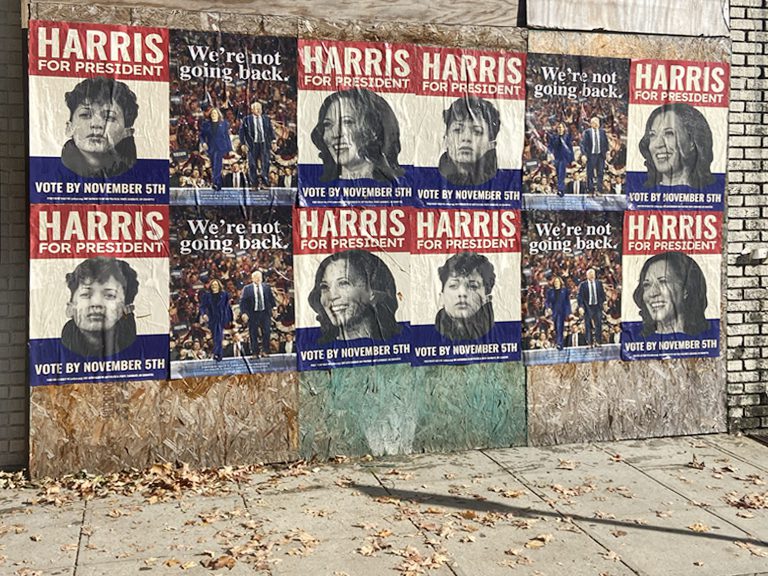
Political street poster campaigns put a candidate’s name or a cause’s message into the daily physical environment of voters — the places they walk, commute, and gather — in a way that digital advertising cannot replicate.
Political communication has used the street poster for as long as printing has existed. Before radio, before television, before any of the broadcast media that came to define twentieth-century political campaigning, political actors put paper on walls to reach the people who would vote, organize, or act on their message. The format has never gone away. It has professionalized, refined its materials, and developed more sophisticated location strategy, but the fundamental mechanism is the same: get your message onto the walls where your target audience lives and moves, make it unmissable at walking pace, and create physical presence in the communities where you need to build support.
We work with political campaigns, advocacy organizations, and civic institutions on fly posting as one component of their outreach strategy. This is not a primary voter contact channel the way canvassing and phone banking are. It is a presence-building tool that creates ambient name recognition, issue association, and community visibility in ways that digital advertising and mail cannot produce. At its best, political fly posting makes a campaign feel like it belongs to a neighborhood rather than looking at it from the outside.
This guide covers how political fly posting works operationally, how to think about location strategy for political goals, what the creative requirements are, how to plan and budget a campaign, and what role street poster advertising plays in a broader political communications strategy.
The use of posted paper for political communication predates modern electoral politics. In ancient Rome, political notices were painted or chalked onto walls at key public gathering points. In the early modern period, printed broadsides and handbills were the primary vehicles for public political communication. The walls of European cities during periods of political upheaval in the seventeenth and eighteenth centuries were covered in posted paper arguing for and against various positions, parties, and candidates.
In the United States, the nineteenth century saw bill posting develop into a commercial industry partly driven by political clients. Election campaigns for state and local offices used posted paper to build name recognition and communicate candidate platforms in an era when mass media consisted of newspapers with limited circulation. The walls of cities and small towns carried candidate imagery and slogans in the weeks before elections. Political parties maintained relationships with bill posting companies specifically for this purpose.
Through the twentieth century, labor movements and progressive political organizations made particularly extensive use of fly posting. Union organizing drives, civil rights campaigns, and anti-war movements all used street posters as primary outreach tools in urban communities. The format had inherent populist associations that made it culturally appropriate for causes positioning themselves as grassroots movements rather than institutional campaigns. Those associations persist. A fly posting campaign for a progressive urban cause reads differently from the same cause running television advertisements, because the medium itself carries a message about how the campaign sees its relationship with the community.
Contemporary political fly posting operates at a higher level of production sophistication than its historical predecessors while retaining its street credibility. Digital printing has replaced hand-drawn artwork. Methyl cellulose paste has supplemented traditional wheatpaste. Location strategy draws on demographic data as well as street-level knowledge. But the poster going up on a wall in a Brooklyn neighborhood the week before an election is carrying the same communicative logic as the broadside posted to a tavern wall in the eighteenth century.
AGM Field Note: Political fly posting works best when the campaign already has a physical presence in the neighborhoods being targeted. Posters in a community where your candidate has been canvassing and holding events reinforce recognition that is already developing. Posters in a community where the campaign has no other presence can feel extractive rather than embedded. The format rewards campaigns that are genuinely working the ground.
How Political Fly Posting Is Different from Commercial Fly Posting
The mechanics of political fly posting are identical to commercial fly posting: paste, paper, wall, overnight installation, documentation. The strategic logic differs in several important ways that affect how campaigns should approach it.
Geographic Precision Is More Important
Commercial fly posting campaigns optimize for cultural alignment between brand and neighborhood. Political fly posting optimizes for electoral geography. A commercial fashion brand wants its poster in the neighborhoods where its audience concentrates culturally. A political campaign wants its poster in the specific precincts where voter turnout is the priority variable. These are different kinds of geographic precision, and they require different kinds of location planning.
For a city council race, the location plan might concentrate placements within specific block clusters in competitive precincts, clustered around transit stops, polling locations, community gathering places, and high-foot-traffic commercial streets within the district. For a statewide ballot initiative, the plan might focus on dense urban corridors in the major population centers where building awareness among persuadable voters is the goal. The electoral strategy drives the location strategy, and the location strategy drives the placement plan. This sequence matters.
Timeline Is Fixed
Commercial campaigns can adjust their timeline based on production readiness, budget timing, and market conditions. Political campaigns run toward a fixed date. The election is on November 4th, and the campaign needs to be running in September or October, not whenever production happens to be ready. This means political fly posting campaigns require earlier planning and tighter timeline management than most commercial campaigns. We typically recommend that political clients initiate campaign planning at least six to eight weeks before the desired installation date to allow for creative development, production, and location planning without a rush premium on every stage.
The Creative Task Is More Direct
Political fly posting creative needs to communicate name, image, and key message in less time and at greater distance than most commercial advertising. A voter walking past a campaign poster has the same two-second window that any other street poster gets, but the stakes of that communication are different. Name recognition and basic issue association are the goals. The creative has to deliver those two things at walking pace from 15 feet away without requiring the viewer to stop or read beyond the headline.
Candidate photography is the primary visual driver for candidate campaigns. A clear, strong photograph of the candidate at scale, paired with name and office, is more effective than graphic abstraction for name recognition building. Advocacy campaigns for issues rather than candidates have more flexibility to use strong graphic design but still need to communicate the issue clearly at walking pace without assuming the viewer knows the context.
Location Strategy for Political Fly Posting
Political location strategy starts with electoral geography and works down to specific streets and surfaces. The process differs from commercial location strategy in that it begins with a data-driven precinct analysis rather than a cultural or demographic audience profile.
Precinct-Level Targeting
For candidate campaigns in city council, state legislative, or congressional races, the location plan should be built from a precinct-level analysis of voter registration, historical turnout, and persuasion opportunity. Precincts with high registration but lower historical turnout are typically priority targets for awareness and mobilization-focused poster campaigns. Precincts where the race is genuinely competitive and where voter contact is likely to move outcomes are priority targets for persuasion-focused campaigns.
This electoral geography analysis produces a map of priority neighborhoods and corridors that the location scout then translates into specific wall selections. The data tells you which neighborhoods to be in. The street-level scouting tells you which specific walls in those neighborhoods will generate the most foot traffic contact with the right audiences. Both steps are necessary.
Transit and Pedestrian Corridor Focus
Political fly posting campaigns focused on urban electorates should weight their location plans toward transit corridors and high-pedestrian commercial streets. Subway station approaches, bus stops, and the blocks immediately surrounding them concentrate foot traffic in ways that mid-block walls in residential areas do not. A placement on the approach to a busy subway station in a priority precinct will generate more contact with target voters in a single day than a residential block placement generates in a week.
Farmers markets, community gathering spots, parks, and neighborhood commercial corridors are secondary priorities that create visibility in contexts where community engagement is already happening. A campaign poster visible from the line at a popular neighborhood coffee shop creates a different kind of impression from one on an anonymous wall, because it appears in a context associated with community participation.
Timing Around Key Campaign Moments
Political fly posting is most effective when it goes up in coordination with other campaign activity. Installation timed to coincide with candidate events in a neighborhood creates a visual presence that reinforces the personal contact. Installation timed to precede mail delivery in a precinct creates a multi-touch sequence. Installation timed to coincide with a major news cycle moment in the campaign amplifies rather than operates independently of earned media.
Campaign Moment
Fly Posting Role
Optimal Timing
Campaign launch
Establish visual presence, build early name recognition
Within 1 week of launch announcement
Major endorsements
Amplify credibility signal in key neighborhoods
Concurrent with press release
Final stretch (4–6 weeks out)
Saturation in high-priority precincts, voter mobilization message
6 weeks before election day
GOTV push (2 weeks out)
Dense saturation around polling locations and transit corridors
14–10 days before election
Issue advocacy campaigns
Sustained awareness building, complement to digital and mail
Campaign-wide, not event-driven
Creative Direction for Political Fly Posting
Political fly posting creative requires the same street-scale design principles as any other fly posting campaign, applied to the specific communicative goals of political advertising. The core requirements are: high contrast, readable at distance and pace, single primary message.
Candidate Campaign Creative
For candidate campaigns, the creative hierarchy typically runs: candidate name at maximum type size, office being sought, and a short issue phrase or tagline. A strong candidate photograph is standard and effective. The photograph should be clear, well-lit, and readable at poster scale. Campaign photography that works beautifully on a web page often does not work at street poster scale because it was lit and composed for a small-format digital context.
Color selection for candidate campaigns is typically driven by the campaign’s established visual identity. We review all political campaign creative before print to check for street-scale legibility, color contrast under outdoor lighting conditions, and type size adequacy at the planned poster dimensions. These checks catch problems that are difficult to see in digital proofing but immediately obvious when a poster goes up on a wall.
Advocacy Campaign Creative
Issue advocacy campaigns have more creative flexibility than candidate campaigns but the same fundamental communication requirement: one primary message, readable at walking pace from 15 feet. For cause-based campaigns, the issue phrase or action call is often the primary visual element rather than a name or face. Strong graphic design that creates visual stopping power while communicating the issue clearly is the ideal.
Advocacy campaigns often benefit from a series approach, where multiple designs address the same issue from different angles across the same posting corridor. A voter registration campaign might run three different designs with the same visual system but different messages. A housing policy campaign might address affordability, displacement, and community investment as separate design executions within a unified campaign identity. The series approach creates recognition and depth without requiring each individual poster to carry the full argument.
AGM Field Note: Political campaign managers often want to put too much information on a poster. The voter registration deadline, the polling location, the website, the social handles, the candidate bio. None of that will be read at walking pace at 15 feet. Decide what one thing you want a voter who sees this poster to remember, and make that thing the entire poster. Everything else can live on the campaign website.
Materials for Political Fly Posting
Political fly posting uses the same materials as commercial fly posting, with format and quantity decisions driven by campaign geography and budget.
Paper and Print Production
The standard range of 60 to 80 lb text weight paper covers most political campaign applications. For campaigns running in urban environments with significant weather exposure, or for campaigns intended to hold through multiple weeks of the election cycle, 80 to 90 lb with a UV-resistant matte coating provides better durability. Print production for political campaigns often operates on tighter timelines than commercial campaigns because creative is frequently finalized late in the production window. We build contingency into our production scheduling for political clients because late creative changes are common.
Format Selection
For most urban political fly posting campaigns, 24×36 is the standard format. It provides adequate visual presence on pedestrian-scale walls and fits within the budget constraints of most local and state-level political campaigns. For major transit corridor placements where visibility from greater distances is valuable, 48×72 provides significantly more street presence. Snipe posters at 11×17 can be used for dense saturation around specific locations in the final weeks of a campaign when high-repetition contact is the goal.
Campaign Scale and Pricing
Political fly posting campaigns scale across the same range as commercial campaigns. The right scale for any political campaign depends on the geographic scope of the race or issue and the budget available for street advertising as one component of the overall media mix.
Focused single-market campaigns are appropriate for local advocacy or highly focused saturation around a specific campaign moment. At this scale, placement precision is more important than broad geographic coverage. Contact AGM for package pricing based on your market and objectives.
Mid-scale campaigns allow for meaningful presence across multiple neighborhoods simultaneously. Most city council, state legislative, and issue advocacy campaigns operating in urban markets run at this scale. Contact AGM for package pricing based on your market.
Large campaigns of 200 to 500 placements, single or multi-city, are project-specific. Statewide ballot initiatives running in multiple major urban markets and congressional campaigns with significant street advertising budgets fall into this category. Contact us directly at (646) 776-2770 to discuss the scope. Multi-city campaigns require four to six weeks of lead time for planning, print production, and crew coordination across markets.
How Political Fly Posting Fits Into a Broader Campaign
Political fly posting works best as one component of a coordinated outreach strategy rather than as a standalone channel. It creates ambient visual presence that reinforces other campaign activity and builds the kind of name recognition that makes voter contact through other channels more effective.
With Canvassing and Phone Banking
When fly posting runs in the same neighborhoods where ground teams are canvassing, the poster serves as a visual anchor that connects the physical contact with the campaign’s broader identity. A voter who received a canvassing visit three days ago and then walks past a campaign poster on their morning commute has now encountered the campaign twice in two different contexts. That second encounter deepens the recognition created by the first. The campaigns that integrate their ground operations and their street advertising in this way get more value from both activities than campaigns that treat them as separate tracks.
With Digital Advertising
Street poster campaigns and digital advertising are complementary in political contexts as they are in commercial ones. Digital campaigns can reach voters across the full electorate regardless of geography. Street campaigns create presence in specific neighborhoods where physical visibility matters. The combination produces more than either delivers independently: voters who encounter the campaign in both physical and digital environments register it more deeply than those who encounter it in only one.
For digital targeting purposes, street campaign geography can also inform audience building. If your fly posting is concentrated in specific neighborhood clusters, building a geofenced digital audience around those same neighborhoods creates a consistent campaign presence across both physical and digital contexts within those priority areas.
With Earned Media
Fly posting campaigns that generate strong documentation photography and authentic street presence can contribute to earned media strategy. A striking poster campaign in a high-visibility urban corridor can generate press coverage, particularly in local and alternative media that covers the cultural dimensions of political campaigns. The documentation we provide gives campaigns materials for earned media outreach and social content.
Frequently Asked Questions
What is political fly posting?
Political fly posting is the use of pasted paper posters in the urban environment to build awareness, communicate a campaign’s message, or drive voter engagement at street level. It is one of the oldest political communication formats and remains effective for reaching audiences in specific neighborhoods and precincts where voter turnout is a priority.
How does political fly posting reach voters differently from digital advertising?
Political fly posting reaches voters in the physical environment where they live and move, on the streets of their neighborhoods, near polling locations, on transit corridors they use daily. Unlike digital advertising, which reaches people on screens in controlled media environments, fly posting creates physical presence in the communities where campaigns need to build trust and turnout.
How much does a political fly posting campaign cost?
Poster campaigns are priced by package and market. Standard poster campaigns (24×36) start at $4,500 for 100 posters (two-week run) and $5,500 for 200 posters. Large format (48×72) campaigns start at $10,500 for 100 posters and $13,500 for 200. An optional two-week maintenance extension is $3,500. Contact AGM at (646) 776-2770 for a custom quote based on your market and objectives.
What neighborhoods should political fly posting target?
Political fly posting targeting depends entirely on the campaign’s electoral geography. Campaigns focused on building turnout in high-density precincts concentrate placements on transit corridors, commercial streets, and high-pedestrian blocks in those specific areas. Awareness campaigns for city or statewide issues use a broader geographic distribution across key demographic corridors.
How quickly can a political fly posting campaign be deployed?
With approved creative and a clear location brief, AGM can move from print production to installed campaign in 10 to 14 days for urgent timelines. Standard lead time from creative approval to installation is two to three weeks. Elections with fixed dates require early scheduling.
What poster sizes work best for political campaigns?
For high-pedestrian corridors, 24×36 is the standard format. For high-visibility intersections or major transit corridors, 48×72 provides significantly more visual impact. Snipe posters at 11×17 work well for dense saturation in specific blocks or around key locations in the final campaign stretch.
Does AGM document political fly posting campaigns?
Yes. Every campaign delivers geo-tagged placement photos taken immediately after installation and a campaign summary report with placement locations. This documentation gives campaign teams a complete record of where the campaign ran across its full footprint.
Can political fly posting campaigns run across multiple cities?
Yes. AGM coordinates multi-city campaigns with synchronized installation windows. For statewide or national advocacy campaigns running across multiple urban markets, we stage installation across cities to fall within the same 48-hour window. Multi-city campaigns require four to six weeks lead time.
How is political fly posting creative different from commercial campaign creative?
Political fly posting creative tends to be more message-direct. A candidate’s name, a key issue phrase, or a voter action prompt need to communicate immediately at walking pace. The design principles are the same, but the content hierarchy prioritizes name recognition and issue association over brand imagery.
Political fly posting is one of the oldest forms of public political communication. Printed handbills and broadsides were affixed to walls to advocate for political positions and announce elections from the earliest days of print. The format has been used continuously in political campaigning ever since, from nineteenth-century American elections through twentieth-century labor movements and into contemporary urban campaigns.