Chicago Wheat Pasting: How Poster Campaigns Work in Chicago’s Best Neighborhoods
Chicago has some of the best wheat pasting territory in the country. The walls along Milwaukee Avenue, the construction corridors in the West Loop, and the 18th Street stretch in Pilsen are all legitimate poster advertising zones. Here is how we work them.
Chicago is a city where street-level advertising works. The elevated train infrastructure, the dense commercial corridors in neighborhoods like Wicker Park and Logan Square, the long flat walls of construction projects running through River North and the West Loop, and the high-foot-traffic entertainment blocks in Wrigleyville and Lincoln Park all create a physical environment where poster campaigns reach their intended audience at eye level and at walking pace.
We run wheat pasting campaigns in Chicago regularly. Our team knows the corridors that reach the specific demographics that most brands are trying to connect with. We know which blocks on Milwaukee Avenue carry foot traffic from the 25 to 34 creative professional demographic all day Saturday. We know which construction boards on the West Loop carry the finance and tech audience on weekday mornings. We know which walls along 18th Street in Pilsen get photographed the most by people who then share those photos online.
This guide covers how wheat pasting campaigns work in Chicago, where the best locations are, what the format requires in terms of creative and production, how long campaigns last, and what brands can expect when they work with us on a Chicago poster campaign.
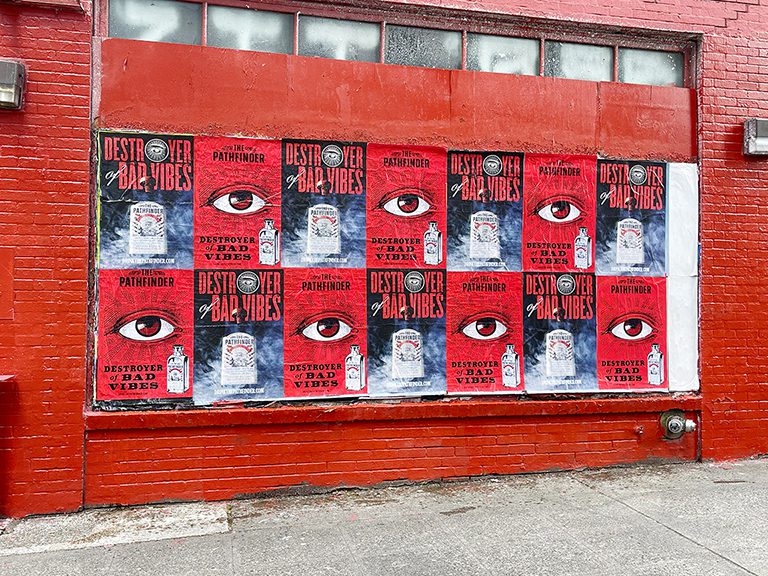
Wheat pasting is a poster advertising technique that uses a paste adhesive, traditionally made from flour and water but now typically a commercial wallpaper paste, to bond large-format printed posters to vertical surfaces. The paste is applied to the surface, the poster is placed against it, and then another layer of paste is applied over the top of the poster. When the paste dries, it bonds the poster firmly to the surface and seals the paper. A properly installed wheat paste poster on brick or concrete can last three to eight weeks depending on the surface and weather conditions.
Chicago’s climate presents specific considerations for wheat pasting campaigns. The city’s winters are harsh, with significant precipitation and freeze-thaw cycles that reduce poster longevity on exposed surfaces. Summer campaigns in June through September benefit from drier conditions and produce longer-lasting installations. The best Chicago poster campaigns time their installations for conditions that maximize duration: dry periods in late spring and early fall are particularly productive.
Chicago’s physical infrastructure is well-suited for wheat pasting. The city has extensive construction activity at any given time, producing long runs of construction board barriers along streets and sidewalks that are legitimate advertising surfaces in many cases. The elevated train infrastructure produces walls beneath the L tracks on Broadway, Wabash, and Lake Street that have long histories as advertising and art surfaces. The dense two-flats and three-flats in neighborhoods like Wicker Park, Bucktown, and Logan Square produce abundant flat wall surfaces visible from the street.
Chicago’s Best Wheat Pasting Zones
Not all of Chicago is equal for wheat pasting campaigns. Location selection determines whether the campaign reaches the right audience or runs in front of the wrong people entirely. Here is our assessment of the city’s strongest wheat pasting zones by neighborhood and audience.
Wicker Park and Bucktown: Milwaukee Avenue and Damen Avenue
Wicker Park is Chicago’s strongest wheat pasting zone for campaigns targeting 22 to 38 year old creative, entertainment, and culture audiences. The Milwaukee Avenue corridor between Division Street and North Avenue concentrates foot traffic from exactly this demographic all day every day. The intersection of Milwaukee, Damen, and North Avenue, known as the Six Corners, is one of the highest-traffic pedestrian points in the neighborhood and a strong location for highly visible installations.
The blocks along Damen Avenue between North Avenue and Armitage Avenue have a similar demographic character and excellent wall surfaces, including construction boards, the sides of commercial buildings, and utility infrastructure. Poster installations in this zone are visible to the same consumers who live and shop in the neighborhood and to the constant stream of visitors from other parts of the city who come to Wicker Park for restaurants, bars, music venues, and retail.
Logan Square: Milwaukee Avenue Corridor
Logan Square has become one of Chicago’s most culturally active neighborhoods over the past decade. The Milwaukee Avenue corridor from Kedzie Avenue to California Avenue concentrates the neighborhood’s restaurants, bars, coffee shops, and retail, and the foot traffic along this stretch includes a younger and more diverse demographic than Wicker Park with strong music, art, and food culture characteristics.
The walls adjacent to the Logan Square Blue Line station and the blocks surrounding the Logan Square Auditorium and the Comfort Station are particularly strong installation locations. These are places where event-goers, bar and restaurant visitors, and neighborhood residents move through at all hours. A poster campaign timed to a concert at Thalia Hall or a show at Logan Square Auditorium reaches the right audience at exactly the right moment.
Pilsen: 18th Street
Pilsen’s 18th Street corridor is Chicago’s most art-dense street-level advertising environment. The neighborhood has a long history as a center for murals, street art, and poster campaigns, and the walls along and adjacent to 18th Street between Halsted Street and Western Avenue regularly carry brand and artist poster installations. The audience in Pilsen is younger, heavily arts-engaged, and highly active on social media, making organic social amplification from poster campaigns here more likely than in most other Chicago zones.
Wrigleyville and Lakeview: Clark Street and Addison Street
The blocks around Wrigley Field on Clark Street and Addison Street are strong campaign locations for brands targeting sports and entertainment audiences. On game days, foot traffic in this corridor is enormous, with fans moving between transit stops, bars, restaurants, and the park entrance. Poster installations that go up before a home stand reach a concentrated audience of tens of thousands of people over the course of three or four days.
West Loop and River North: Construction Corridor
Chicago’s ongoing development activity in the West Loop and River North creates a constantly changing but reliably extensive inventory of construction board walls. These barriers line streets along major development projects for months to years, creating large uninterrupted wall surfaces that are among the most visible advertising environments in the city during their lifespan. Brands targeting finance, tech, and business-oriented audiences find strong placement opportunities in these corridors due to the proximity to major office developments and hospitality clusters.
Chicago location strategy: We do not install posters based on generic foot traffic data. We match the installation zone to the target demographic. A music label promoting a hip-hop artist needs installations in Logan Square and Pilsen, not in Lincoln Park. A financial services brand running a culture-focused campaign needs placements in River North and Fulton Market, not in Humboldt Park. Getting the demographic match right is the first job of every Chicago campaign we plan.
Chicago Wheat Pasting Campaign Formats
Chicago wheat pasting campaigns come in several format sizes and structures depending on the geographic scope, the surface inventory in the target neighborhoods, and the campaign budget.
Campaign Format
Location Count
Coverage Area
Typical Budget Range
Single Neighborhood Campaign
20 to 30 locations
One neighborhood (e.g. Wicker Park)
Contact for quote
Two-Neighborhood Campaign
35 to 55 locations
Two complementary zones
Contact for quote
City-Wide Campaign
60 to 100+ locations
Multiple Chicago neighborhoods
Contact for quote
Event-Targeted Campaign
20 to 40 locations
Event perimeter and approach routes
Contact for quote
Multi-Format Campaign
Variable
Posters plus stencils or murals
Contact for quote
Creative Requirements for Chicago Wheat Pasting Campaigns
The creative requirements for wheat paste posters in Chicago follow the same principles as any street-level poster campaign. The message has to work in a single glance from a pedestrian moving at walking pace. That constraint is non-negotiable. Chicago pedestrians move fast. They are not going to stop to read a poster with dense copy. The poster has to land before the pedestrian has passed it.
The practical implications of this constraint are straightforward. One dominant image, one clear brand mark, and a text element of six words or fewer. Strong contrast between the design elements and the expected background surface. Scale that allows the brand mark to read from 10 to 15 feet away. Those three requirements cover 90% of the creative decisions that determine whether a Chicago wheat paste poster works or disappears into the visual noise of the street.
Poster sizes for Chicago campaigns most commonly run from 24×36 inches for standard wall placements to 48×72 inches or larger for construction board surfaces where more wall space is available. We recommend the larger format for construction board campaigns because the additional visual weight makes the installation visible from further away and creates a presence that registers as more substantial to the pedestrian audience.
Print quality matters for wheat pasting specifically because the installation process involves wet paste coming into contact with the paper. We recommend printing on 100 lb or heavier matte paper or on weatherproof synthetic stock for Chicago campaigns, particularly for late-fall and winter timing when moisture is a constant consideration.
Creative review before production: We review all creative for suitability before any poster goes to print. If the design is too complex for street-level legibility, or if the poster size does not match the available surfaces in the target zone, we flag those issues before production begins. Fixing a creative problem before print is a small conversation. Fixing it after 500 posters are printed is a significant cost.
How We Run Chicago Wheat Pasting Campaigns
Our Chicago wheat pasting process starts with a location scout. Our team goes into the target neighborhoods and identifies specific installation surfaces that match the brief. We document each location with photos and GPS coordinates, note the surface material, estimate the daily foot traffic exposure, and flag any locations with access or logistics challenges. The client sees the full location list before any installation begins.
Installation happens during overnight hours in most cases. Late-night installation minimizes disruption to businesses and pedestrians, gives paste adequate time to cure before morning foot traffic, and allows our crew to work efficiently without navigating heavy sidewalk congestion. A two-person crew working from midnight to 5 AM can cover 30 to 50 installation locations in a single night.
Documentation is completed the following morning. We photograph every installation in daylight with GPS timestamps and deliver a photo report to the client within 24 hours of installation. Clients have a complete visual record of every location in the campaign.
Post-installation monitoring tracks any locations where posters have been damaged, removed, or covered and flags them for the client. For campaigns with ongoing duration, we conduct check-in documentation at one week and two weeks post-installation to assess campaign longevity.
Chicago Wheat Pasting for Music, Film, and Events
Music and entertainment brands are the most frequent users of wheat pasting campaigns in Chicago. The format has deep roots in the music industry as a low-cost, high-visibility way to announce tours, releases, and club nights to the specific urban audience that buys concert tickets and streams albums. A poster campaign in Wicker Park and Logan Square two weeks before a show at the Riviera Theatre or the Vic Theatre creates the street-level awareness that drives advance ticket sales among exactly the right audience.
Film studios use poster campaigns in Chicago to support opening weekend awareness for wide releases and for limited-run art house films. A limited-release film needs to reach the specific art film audience concentrated in neighborhoods like Evanston, Andersonville, and Logan Square. A targeted wheat pasting campaign in those neighborhoods is far more efficient at reaching that audience than a general market media buy.
Event promoters use Chicago wheat pasting for everything from club nights to food festivals to gallery openings. The format is fast, cost-effective for short-window awareness needs, and highly targeted by geography. A poster campaign that covers a 10-block radius around a new venue communicates that venue’s existence to everyone who lives and works in that radius for the duration of the installation.
Chicago Wheat Pasting for Streetwear, Sneakers, and Culture Brands
Chicago has a distinct streetwear and sneaker culture that is concentrated in a handful of neighborhoods and retail corridors. The Wicker Park strip of Milwaukee Avenue between North and Division, the blocks around Akira and the boutiques in River North, and the sneaker-heavy retail on Clark Street in Wrigleyville are the corridors where the Chicago streetwear consumer spends the most time. A wheat pasting campaign targeting this audience belongs in these corridors, not in a generalized city-wide spray that dilutes targeting for cost efficiency.
Chicago’s food and hospitality scene is similarly concentrated, and food and beverage brands, restaurant launches, and bar openings are among the most consistent users of wheat pasting in the city. A new restaurant opening in Logan Square needs street presence in Logan Square two to three weeks before it opens. A bar opening in Wicker Park needs posters on the walls of Wicker Park before it opens. The format puts the announcement exactly where the intended customer already is before they know they need to know about it.
What Chicago Wheat Pasting Campaigns Include
Every Chicago wheat pasting campaign we run includes four standard components: location scouting, creative review, overnight installation, and GPS-documented photo reporting. These are not optional add-ons. They are the baseline for a professional campaign execution that delivers reliable results.
Location scouting is specific to the campaign brief. We do not use a generic Chicago location list for every client. A music label promoting a hip-hop artist needs a different neighborhood profile than a tech brand doing a street-level awareness push. We build a location plan specific to each campaign’s target demographic and geographic objectives, photograph each candidate location, and get client sign-off before any installation begins.
Creative review catches format and legibility issues before they reach print production. A design that looks strong at 8×11 inches on a laptop screen may fail at 24×36 inches on a brick wall from 15 feet away. We flag these issues early. Installation is executed overnight by a crew with Chicago campaign experience. Photo documentation is delivered within 24 hours of installation, with GPS coordinates for every location in the report.
AGM Field Note: Chicago campaigns need weather-appropriate timing. We avoid scheduling installation in the 24 hours before significant rain or snow events. When campaigns are scheduled in late fall or early winter, we use commercial methylcellulose paste rather than flour paste for better cold-weather performance. A campaign that goes up in November needs paste formulated for the conditions, not the same formula we use in July.
Frequently Asked Questions
What is wheat pasting?
Wheat pasting is a poster installation technique that uses a flour-and-water adhesive paste to bond large-format printed posters to walls, construction barriers, and other vertical surfaces. The paste bonds the poster firmly to the surface and dries clear, leaving the poster in place for weeks to months depending on weather conditions and the surface material.
Where are the best wheat pasting locations in Chicago?
Chicago’s strongest wheat pasting locations are in Wicker Park along Milwaukee Avenue and Damen Avenue, in Logan Square along Milwaukee Avenue between Kedzie and California, in Pilsen along 18th Street, in Wrigleyville on Clark Street and Addison Street near Wrigley Field, and on the construction corridor walls along the River North and West Loop development zones.
How long do wheat paste posters last in Chicago?
In Chicago’s climate, wheat paste posters typically last three to six weeks on protected surfaces. Chicago winters with heavy precipitation can reduce poster longevity. Summer campaigns with drier conditions and lower humidity tend to produce longer-lasting installations. Brick and concrete surfaces generally hold posters longer than smooth painted surfaces.
What size posters work best for wheat pasting in Chicago?
Standard campaign sizes for Chicago wheat pasting are 24×36 inch single-sheet posters for standard surface applications and 48×72 inch or larger multi-sheet installations for high-visibility construction barrier placements. Larger formats work well along the major commercial corridors in Wicker Park and Logan Square where construction board walls provide continuous surface area.
How many locations does a Chicago wheat pasting campaign typically cover?
A standard Chicago wheat pasting campaign covers 20 to 60 locations depending on the geographic scope and budget. A focused neighborhood campaign in Wicker Park or Logan Square covers 20 to 30 locations. A city-wide campaign spanning multiple Chicago neighborhoods covers 40 to 80 locations or more.
Can AGM run wheat pasting campaigns in multiple Chicago neighborhoods at the same time?
Yes. We coordinate Chicago wheat pasting campaigns across multiple neighborhoods at the same time with a single crew or parallel crews depending on the installation window. We cover Wicker Park, Logan Square, Pilsen, Bridgeport, Wrigleyville, Lincoln Park, Bucktown, and other Chicago neighborhoods as part of multi-zone campaigns.
Does AGM provide photo documentation of Chicago wheat pasting campaigns?
Yes. We photograph every installation with GPS timestamps within 24 hours of deployment. Clients receive a complete photo report showing every poster location and installation in the campaign. Documentation is delivered within 48 hours of each installation date.
What brands run wheat pasting campaigns in Chicago?
Music labels and artists promoting tours and releases, record stores, bars and restaurants, streetwear and sneaker brands, film studios promoting Chicago area screenings, lifestyle brands, and event promoters are the most frequent users of wheat pasting campaigns in Chicago. The format works best for brands targeting 18 to 35 year old urban consumers in Chicago’s creative and entertainment corridor.
Does AGM work with Chicago-based brands as well as brands entering the market?
Yes. We work with Chicago-based brands that need street-level presence in their home market and with out-of-market brands launching in Chicago for the first time. For Chicago-based clients, we often have existing location intelligence about their target neighborhoods that shortens the scouting phase. For brands entering Chicago, we build the location plan from the ground up based on the specific demographic and geographic objectives of the campaign brief.
Chicago Transit Authority advertising, the cards inside CTA trains and the posters in L station platforms, reaches a broad transit ridership audience that skews heavily toward commuters. Wheat pasting campaigns reach street-level pedestrian audiences in specific neighborhoods where the target demographic lives and socializes. The two formats are complementary rather than competitive: transit advertising produces broad city-wide reach, while wheat pasting produces concentrated neighborhood-level presence. Many Chicago campaigns combine both.