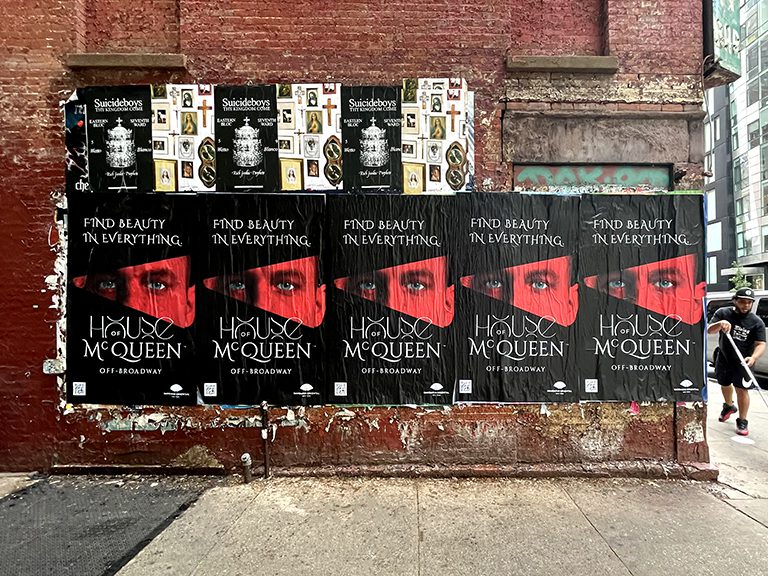
Phantom advertising withholds the full brand message to create anticipation. When executed with the right creative and the right location sequence, it is one of the most powerful tools in a launch campaign’s arsenal.
Phantom advertising is the practice of creating a brand presence in the physical world before revealing the brand itself. The campaign exists, the visual exists, the street-level footprint exists, but the full message, the product name, the brand identity, or the complete context, is deliberately withheld. The audience encounters something real and striking without knowing exactly what it is. That incomplete information does not frustrate them. It activates them. They start looking. They start asking. They start paying attention to the reveal when it comes, rather than filtering it out the way they filter out advertising that presents its entire message immediately.
We have executed phantom advertising campaigns for product launches, album releases, entertainment campaigns, and brand reintroductions across New York, Los Angeles, Chicago, and Miami. The format works when it is executed correctly: strong creative, precise location, credible mystery, and a reveal that delivers on the anticipation that was built. This guide covers every element of how phantom advertising works and how we build and execute it at a professional level.
Phantom advertising works because of a specific cognitive mechanism: the curiosity gap. When we encounter partial information that is interesting and important-seeming, our brains register an unresolved question and allocate cognitive resources to resolving it. That unresolved question keeps the stimulus active in working memory longer than a complete, processed message would. The brand or the product that created the curiosity gap has an occupancy in the audience’s mental space that conventional advertising, which presents a complete message and asks for immediate action, cannot achieve.
The key condition is that the partial information must be genuinely interesting. A blank wall with a small logo does not create curiosity. It creates confusion that resolves immediately into indifference. A visually striking image that clearly means something, that has a visual logic and a production quality suggesting intentionality, but that withholds the punchline, creates the kind of productive curiosity that makes people actively seek resolution. The strength of the tease creative determines whether the audience invests in the mystery or dismisses it.
The social amplification of phantom advertising is a secondary mechanism that compounds the primary one. When people encounter something in public that they cannot fully explain, they share it with others. Not to show off the brand, but to share the puzzle. Social sharing of a phantom campaign is qualitatively different from sharing of a conventional campaign: it is an act of communal curiosity, not brand endorsement. That quality of sharing is more credible and more engaging for the people who receive it.
The Three-Phase Phantom Advertising Structure
Most effective phantom advertising campaigns follow a three-phase structure. Each phase has specific creative requirements, specific timing considerations, and specific location requirements. Understanding the structure helps brands plan the campaign timeline and allocate budget across phases correctly.
Phase One: The Tease
The tease phase establishes the campaign’s presence without revealing the brand or the product. The tease creative should be strong enough to arrest attention and generate genuine curiosity, but deliberately incomplete. Common tease approaches include: a visual with a date but no brand identity; a striking image that suggests a product category without confirming it; a minimal text element that asks a question without providing the answer; or a brand element, a visual signature, a color palette, a graphic system, that hardcore fans of the brand might recognize but the general public will not.
The tease phase runs for seven to fourteen days before the reveal, depending on the campaign scale and the target audience’s patience for unresolved information. Shorter tease periods work for campaigns targeting audiences with high information consumption rates who will quickly seek resolution online. Longer tease periods work for brands with strong cultural cachet whose audience will tolerate and enjoy sustained mystery.
In New York, the tease phase typically covers a concentrated run of placements in one or two key neighborhoods: Bedford Avenue in Williamsburg for music and entertainment, or Wooster Street and Greene Street in SoHo for fashion and lifestyle. The geographic concentration of the tease creates a community of people who share the experience of having seen the same mysterious thing, which amplifies the social dimension before the reveal even happens.
Phase Two: The Build
The build phase, which runs in the final three to five days before the reveal, layers new information onto the tease without completing the message. The build creative adds one element: a secondary visual, a date clarification, a word that narrows the interpretation without resolving it. The build phase rewards the audience who was paying attention during the tease phase and signals that the mystery is approaching resolution, which increases anticipation rather than frustrating impatience.
The build phase is also where geographic expansion of the campaign begins. While the tease concentrated in two neighborhoods, the build expands to four or five. The visual saturation increases. The reach extends. The brand is building presence across a wider portion of the target market as the reveal approaches, so the reveal lands in an environment that has already been primed across a broader geographic area.
Phase Three: The Reveal
The reveal completes the message and introduces the brand or product with full creative context. The reveal creative benefits from having an audience that has been actively curious about it for one to two weeks. The reveal does not feel like the beginning of a campaign; it feels like the resolution of one. That positions the brand message as a reward rather than an intrusion, which produces measurably stronger engagement and recall than a campaign that simply announces itself from day one.
The reveal phase ideally coincides with a physical activation that brings the campaign off the wall and into direct audience engagement. A street team deployment on reveal day, positioned in the neighborhoods where the tease and build phases ran, creates a direct human encounter with the brand that the audience has been anticipating. The combination of the resolved mystery and the physical human engagement at the moment of resolution creates a brand memory that is significantly more durable than either element alone.
AGM Field Note: The most common failure mode in phantom advertising is a tease creative that is too oblique. It is not mysterious; it is just confusing. The audience needs to know that something intentional and interesting is happening, even if they do not know what. The tease creative needs to signal quality and intentionality clearly enough that the audience decides to pay attention to what comes next. If it looks like an accident or an inside joke, it does not create productive curiosity.
Phantom Advertising by Category
Music and Album Releases
Music releases are the most natural application of phantom advertising because the audience is already primed to look for clues about upcoming releases from artists they follow. A tease campaign that goes up in Williamsburg with a date and a visual signature that hardcore fans of the artist will recognize, but that the general public will not, creates a two-tier curiosity response. The hardcore fans amplify immediately. The general public’s curiosity is activated by seeing those fans engage. The combination creates momentum before the reveal that the reveal itself can feed.
We have run music phantom campaigns in New York and Los Angeles that generated social conversation at the tease phase, before any brand attribution, simply because the visual quality and mysterious context created enough interest to share. When those campaigns revealed, the reveal performed significantly better than standalone reveal campaigns for comparable artists, because the audience arrived at the reveal having already invested attention in the campaign.
Film and Streaming Launches
Film and streaming campaigns have used tease advertising for decades. The phantom advertising approach applies the same principle at street level, where the physical presence of the tease creates encounters that digital teasers cannot. A poster on Bedford Avenue with a visual and a release date but no title performs differently than a pre-roll ad with the same information. The physical encounter in a relevant neighborhood creates a context of discovery that the digital impression does not.
Streaming platforms in particular benefit from phantom campaigns that run in the neighborhoods where their target demographic lives and socializes. The tease creates awareness that the algorithm has not yet targeted at the individual. The awareness spreads through social sharing before the platform’s paid distribution reaches the same people. That pre-awareness makes the paid campaign more effective when it does reach the audience.
Product and Brand Launches
For product launches, phantom advertising builds awareness of the product’s existence before the product is available to purchase. The curiosity generated by the tease phase creates a pre-qualified audience for the reveal who is already engaged with the product before they have seen it or tried it. That engagement reduces the barrier to trial: the person who spent ten days curious about what a campaign was is more inclined to try the product when it is revealed than a person who sees the product for the first time with no prior exposure.
The reveal phase for a product launch connects naturally to sampling and trial generation. A street team deployed on reveal day in the neighborhoods where the tease ran can offer product samples to people who saw the tease and were curious. The combination of resolved mystery and direct product trial in one encounter is among the most effective single-day brand-building executions we run.
Location Strategy for Phantom Advertising
Phantom advertising is more location-sensitive than most other guerrilla formats because the cumulative experience of encountering the tease in the same neighborhood multiple times is part of the mechanism. If the tease is geographically dispersed across a broad area, individuals encounter it once, which creates a weak curiosity signal. If the tease is concentrated in a neighborhood where the target audience moves repeatedly during a ten-day period, those individuals encounter it multiple times, which builds the curiosity signal with each exposure.
The target neighborhood should be one where the target audience has high movement frequency: a neighborhood they live in, commute through, or spend multiple hours per week in during the campaign period. The more times a target audience member encounters the tease creative in the course of their normal movement pattern, the stronger the curiosity that builds and the more attentive they are to the reveal.
Campaign Phase
Duration
Geographic Coverage
Creative Reveal Level
Primary Goal
Tease
7 to 14 days
Concentrated, 1 to 2 neighborhoods
Minimal: visual and date only
Activate curiosity
Build
3 to 5 days
Expanding, 3 to 5 neighborhoods
Partial: additional information layer
Build anticipation
Reveal
1 to 2 days and ongoing
Full campaign geography
Complete: full brand and message
Deliver brand message to primed audience
Phantom Advertising and Social Media Amplification
The social media dimension of phantom advertising requires planning from the campaign’s design stage, not as an afterthought. The tease creative should be designed with social sharing in mind: what does it look like in a photograph? Is the mystery legible in a thumbnail? Does it look like something worth posting without additional context?
We brief our documentation team to capture tease installations in ways that are themselves shareable. The brand’s own social accounts can post documentation of the tease with the same level of mystery present in the physical campaign: something is happening, but what? That social seeding from the brand’s own channels creates a digital echo of the physical tease that reaches audiences who are not in the target neighborhood but are still part of the target demographic.
During the build phase, social listening is part of the campaign monitoring. We track what people are saying about the tease: what theories are circulating, what the most common interpretations are, and whether the mystery is generating genuine social conversation or confusion. If the conversation suggests the tease is being misinterpreted in ways that will undermine the reveal, we adjust the build creative to correct the interpretation while maintaining the mystery.
Phantom Advertising by City: Where It Works Best
Phantom advertising is most powerful in cities where the target audience has a strong habit of visually engaging with and photographically documenting their neighborhoods. The social documentation culture of the audience determines how quickly and how broadly a tease campaign spreads before the reveal, and that social amplification is one of the primary value drivers of the format.
New York is the strongest phantom advertising market in the country. The pedestrian density, the social documentation culture in neighborhoods like Williamsburg and SoHo, and the concentration of media and entertainment professionals who actively follow brand and cultural activity make it the ideal environment for a tease campaign. A well-placed tease poster in Williamsburg on a Monday will be photographed and shared by Tuesday morning. By the end of the week, conversations about what it is will be circulating on social media among exactly the audience the brand wants to reach. That social velocity is the highest of any market we operate in.
Los Angeles’s Arts District and Fairfax neighborhood function as the LA equivalent of Williamsburg for phantom advertising: high concentration of socially active, culturally engaged audiences with strong documentation habits. A tease campaign that runs in the Arts District will be documented by the neighborhood’s creative community within days and will circulate through art, design, and entertainment adjacent social networks that have large national followings.
Chicago’s Wicker Park and Logan Square neighborhoods support phantom advertising for brands targeting the city’s creative and young professional demographic. The music and arts community in these neighborhoods has a documentation culture comparable to the equivalent communities in New York and LA, though the social amplification radius is somewhat more locally concentrated. Miami’s Wynwood is the strongest phantom advertising zone in that market, with the documentation culture of the arts district creating strong local amplification that extends nationally during the Art Basel period in December.
Brands that are new to phantom advertising often ask how to maintain quality control over a three-phase campaign that runs over two to three weeks. The answer is that all three phases of creative need to be approved and production-ready before the tease phase begins. We do not build phantom campaigns sequentially, with each phase approved before the next is produced. All three phases are produced in parallel and locked before the tease launches. This ensures that the build and reveal phases execute on their planned timelines regardless of any client review cycles that might otherwise compress the reveal timeline.
Phantom Advertising Mistakes to Avoid
Several specific failure modes are common in phantom advertising campaigns. Knowing them in advance prevents the most avoidable ones.
Tease creative that is too minimal. A date and a color block are not a tease. A blank wall with a logo in the corner is not a tease. The tease creative needs to be genuinely interesting, visually compelling, and clearly intentional. It needs to make the audience feel like something is coming, not like something was accidentally posted in the wrong place.
A reveal that does not deliver. Phantom advertising builds an expectation. If the reveal does not meet or exceed that expectation, the campaign backfires. The audience feels misled. The product or brand that could not live up to its own mystery suffers a credibility hit that is worse than no tease at all. The reveal needs to be genuinely compelling before the tease phase begins.
Too long a tease for the audience. Different audiences have different tolerance for unresolved curiosity. A tease that runs three weeks before a reveal in a market with a high-information, social-media-engaged audience will be resolved by the internet long before the reveal phase. Research and social speculation will fill in the blank. The brand loses control of the narrative. Calibrate the tease duration to the audience’s information behavior.
AGM Field Note: The brands that get the most out of phantom advertising are the ones that have genuine content to reveal. The tease creates the container. The reveal needs to fill it with something real. If the product, the album, the film, or the brand is not genuinely interesting at the moment of reveal, the phantom campaign amplifies the disappointment rather than the launch.
Phantom Advertising Production and Creative Brief
The production brief for phantom advertising is different from a conventional campaign brief in one critical respect: the reveal creative needs to be fully produced and ready for deployment before the tease phase begins. Most campaign production can progress in sequence, with each phase’s production following from the previous phase’s approval. Phantom advertising does not allow this approach because the tease creative needs to be designed backward from the reveal. The tease visual needs to set up the reveal in a way that makes the reveal satisfying. That means you need to know what the reveal looks like before you can design the tease correctly.
We develop phantom advertising creative in the following sequence: full reveal creative first, tease and build creative second. The reveal establishes the complete brand or product story. The tease and build extract elements of that story that are evocative without being explanatory. The visual signature, the color palette, a key graphic element, or a partial image that creates curiosity about the rest. This backward sequencing ensures that the tease and build phases are genuinely set up to pay off at the reveal rather than being parallel creative tracks that happen to share a timeline.
Typography choices in phantom advertising require extra attention because text is often the element that most clearly signals a brand’s identity. If the reveal uses a distinctive typeface that the target audience might recognize, the tease should use the same typeface without the brand name, creating a visual continuity that rewards attentive fans while maintaining mystery for the general public. If the brand is entirely new, the typography should signal quality and intentionality without providing attribution.
Color is the most immediately recognizable brand attribute in a tease. A brand with a distinctive primary color can run a tease campaign that is entirely abstracted, consisting of nothing but the right color plus a date, and generate recognition from the brand’s core audience while maintaining genuine mystery for the broader public. This two-tier approach is highly efficient because it generates immediate organic social activity from the core audience, who amplify the tease before the general public’s curiosity has even been fully activated.
Integrating Phantom Advertising with Digital Campaigns
Phantom advertising on the street is most powerful when it is integrated with a coordinated digital tease strategy. The physical and digital tease campaigns serve different audiences and reinforce each other: the physical campaign reaches the target audience in their neighborhood, where the encounter is unexpected and memorable. The digital campaign reaches the same audience through their social feeds, where the encounter is anticipated and scrollable.
The integration requires coordination of timing and content. The physical tease goes up first, establishing the street-level presence. The brand’s social accounts post the first digital tease content shortly after, using photographs of the physical campaign to bridge the physical and digital environments. This approach creates a narrative in which discovering the physical tease on the street feels like being ahead of the curve, which is a highly motivating social experience for the kind of culturally engaged audience that guerrilla marketing targets.
Community and fan accounts will often document and share physical tease placements before the brand’s own social team does. Monitoring these organic posts and engaging authentically with them during the tease phase, without revealing anything the campaign has not yet revealed, sustains the community conversation and amplifies the reach of the tease without compromising the mystery. This requires a social team that is briefed on the campaign timeline and trusted to make real-time judgment calls about what level of engagement is appropriate at each phase.
The reveal moment is the inflection point where the coordinated physical and digital campaigns align. The physical reveal goes up overnight. The digital reveal goes live simultaneously. The brand’s social team is ready to amplify immediately. The community that has been building anticipation during the tease period has a clear and immediate destination for their curiosity, and the combined physical and digital presence of the reveal creates a sense of scale that either element alone could not achieve.
Frequently Asked Questions
What is phantom advertising?
Phantom advertising is a marketing approach that deliberately withholds the full brand or product identity in the initial phase of a campaign to create curiosity and anticipation. The campaign exists physically in the world, but it does not reveal its full message until a planned reveal moment. The partial information activates curiosity in the audience in a way that complete messaging does not.
How long should a phantom advertising tease last?
Seven to fourteen days is the standard tease window for most campaigns targeting socially engaged urban audiences. Longer teases risk being resolved by social speculation before the planned reveal. Shorter teases do not give the curiosity enough time to build to the level that makes the reveal impactful. The right duration depends on the audience’s information consumption rate and the campaign’s target markets.
What makes phantom advertising creative effective?
Effective tease creative is visually compelling enough to arrest attention, clearly intentional rather than random, and incomplete in a way that activates productive curiosity rather than confusion or indifference. The audience needs to know that something meaningful is coming without knowing what it is. Production quality is critical: low-quality tease materials suggest that nothing worth waiting for is coming.
What categories benefit most from phantom advertising?
Music and album releases, film and streaming launches, product launches for categories with strong cultural audiences, and brand reintroductions all benefit strongly from phantom advertising. The common thread is a category where the target audience has pre-existing investment in what the brand might reveal, which makes the curiosity more active and the reveal more anticipated.
How does phantom advertising generate organic social sharing?
People who encounter something incomplete and interesting in their physical environment share it to get others’ interpretations and to participate in communal curiosity. This sharing is qualitatively different from brand endorsement sharing: it is genuine puzzle-sharing behavior that carries the credibility of authentic personal encounter. The social reach of a tease phase can significantly exceed the organic reach of the reveal phase itself.
Which neighborhoods work best for phantom advertising in New York?
Williamsburg’s Bedford Avenue corridor works for music, entertainment, and culturally engaged consumer brands. SoHo’s Wooster, Greene, and Mercer Street corridors work for fashion, luxury, and lifestyle brands. The Lower East Side, specifically Rivington and Orchard Streets, works for music, food, and nightlife-adjacent brands. The neighborhood choice should match where the target audience has high movement frequency during the tease period.
Can phantom advertising work for a product in a category the audience does not know?
Yes, but the tease creative needs to do more work to establish that something genuinely interesting is coming. With known brands or known categories, pre-existing audience investment does some of the work. With entirely new categories, the tease creative quality and visual production must carry the full weight of generating curiosity without the benefit of pre-existing interest. It is harder, but it is achievable with strong creative.
How does AGM execute phantom advertising campaigns?
We build the campaign across all three phases: tease, build, and reveal. We scout and select locations for concentrated tease placements in the neighborhoods where the target audience has highest movement frequency. We produce tease, build, and reveal creative that escalates appropriately across the campaign window. We install each phase on the planned timeline and document every placement. We monitor social response during the tease and build phases and adjust if needed. Call (646) 776-2770 to discuss your campaign.