Guerrilla Marketing: What It Is and How It Works | AGM
Guerrilla marketing is not a stunt category. It is a philosophy about how brands earn attention rather than buying it. Here is what that looks like in practice.
The term “guerrilla marketing” was coined by Jay Conrad Levinson in his 1984 book of the same name. His argument was simple: small businesses could compete with large ones by being smarter, more creative, and more willing to use the physical environment as a media channel. The idea was that effort and imagination could substitute for media budget. More than forty years later, that idea is not only still valid, it is more relevant than ever.
At American Guerrilla Marketing, we have been executing guerrilla campaigns for over a decade. We have run campaigns in New York on the blocks around Times Square, in Los Angeles along the Fairfax corridor, in Chicago near Wicker Park, and in Miami in Wynwood. We have run campaigns for brands with million-dollar budgets and for brands that needed to make $10,000 work like $100,000. The core principles are the same at every scale.
This piece is our comprehensive explanation of what guerrilla marketing actually is, the formats it takes in practice, and how to determine whether it is the right approach for a specific campaign objective. We are not going to oversell it. Guerrilla marketing is not the right answer for every brand or every situation. But when it fits, nothing else comes close for generating genuine attention at an efficient cost.
Guerrilla marketing is a category of brand marketing that prioritizes unconventional execution, direct consumer engagement, and earned attention over paid media placement. It works by creating experiences or visual moments in the physical environment that break through the background noise of everyday life. The consumer encounters something unexpected, interesting, or striking in a space they normally move through without conscious attention, and that unexpectedness generates a genuine reaction.
The name comes from guerrilla warfare tactics: small, mobile forces operating with speed and surprise rather than frontal assault. Translated to marketing, that means doing more with less by being cleverer about how and where you show up, rather than simply outspending competitors in conventional media channels.
Guerrilla marketing is more than a collection of unusual formats. It is a strategic posture. It starts from the question: where is our audience, and what would actually get their attention at that moment? The format follows from that question. Sometimes it is a street team. Sometimes it is an ambient installation. Sometimes it is a large painted mural. Sometimes it is a live activation that creates a shareable moment. The strategy drives the format, not the other way around.
One important clarification: guerrilla marketing does not mean unauthorized, covert, or illegal activity. Real guerrilla marketing campaigns are planned, produced, and executed by professionals who understand the environments they are working in and operate within appropriate guidelines. The “guerrilla” refers to the unconventional thinking and the surprising execution, not to operating outside the rules.
Core Formats of Guerrilla Marketing
Street Team Activations
Street teams are one of the oldest and most effective guerrilla marketing formats. A trained team of brand ambassadors deploys to a specific location with a specific objective, distributing product samples, collecting contact information, demonstrating a product, creating a branded moment, and engages directly with consumers in their everyday environment. Street teams work because they create genuine human-to-human interaction, which is the highest-quality form of brand contact available.
The key to an effective street team is precise location selection, thorough team briefing, and clear measurement. We deploy street teams at transit hubs like Grand Central Terminal in New York, at commercial corridors like Michigan Avenue in Chicago, at outdoor markets and event footprints, and at any location where the target audience concentrates in meaningful numbers. The location has to be right for the campaign to deliver.
Ambient and Environmental Installations
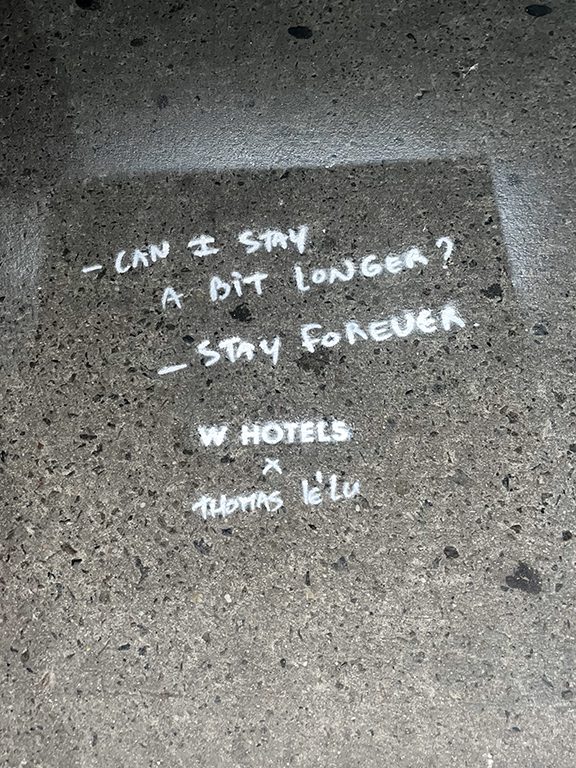
Ambient marketing uses the physical environment itself as the canvas for a brand message. A brand graphic on a construction barrier on 14th Street in Manhattan becomes part of the visual environment for every person who walks that block during the campaign period. A large-format poster on a building wall in the Arts District in Los Angeles becomes a neighborhood landmark that locals photograph and share. A branded stencil on a sidewalk near a venue entrance creates a brand impression before the consumer even enters the event.
Ambient installations have a compounding quality: they build exposures over days and weeks as the same people walk past repeatedly, and they generate earned media when new people photograph them and share them online. The initial investment in production and placement pays off many times over through extended exposure.
Projection and Light-Based Marketing
Projection marketing uses light to place brand imagery on building facades, public surfaces, and other large-scale canvases without any physical modification to the surface. A high-powered projector can put a brand logo or animated graphic on the side of a building in Times Square, on a bridge underpass, or on any large dark surface in a location where the target audience gathers after dark. The format is immediately arresting because it occupies physical space without conventional media placement.
Projection campaigns work particularly well in urban environments during evening hours, around nightlife districts, near venue entrances before concerts and events, and at cultural moments when after-dark audience concentration is high. We run projection campaigns during major city events, product launches, and cultural moments when the after-dark footprint of the target audience is predictable and concentrated.
Experiential and Participatory Formats
Experiential guerrilla marketing creates an immersive moment that the consumer actually participates in rather than just observing. This could be an interactive installation that people engage with in a public space, a brand-sponsored performance or live event in an unexpected location, a pop-up that offers a genuine experience worth stopping for, or any other format that invites active participation rather than passive exposure.
Participatory formats generate stronger brand memory than passive exposures. When someone interacts with a brand in a genuine way, tries a product, plays a game, participates in an experience, the brand association that forms is deeper than anything a poster or billboard creates. These formats are also highly shareable because the participant has a story to tell, more than a photo to post.
Guerrilla Marketing vs. Traditional Advertising
Dimension
Guerrilla Marketing
Traditional Advertising
Cost per impression
Lower, especially at scale through sharing
Higher, fixed media cost regardless of impact
Consumer response
Active, genuine reaction
Passive exposure
Earned media potential
High, people share surprising experiences
Low, paid media rarely generates organic sharing
Audience targeting
Location and time-based
Demographic and behavioral targeting
Brand memory
High, unexpected creates stronger recall
Moderate, dependent on frequency
Flexibility
High, can adapt in real time
Low, media buys are fixed in advance
The core advantage: Guerrilla marketing earns attention. Traditional advertising buys attention. When you earn it, the audience is genuinely paying attention. When you buy it, the audience has learned to look away. In a world where people have exceptional ad-filtering skills, earned attention is increasingly where the value is.
When Guerrilla Marketing Works Best
Guerrilla marketing is particularly effective in certain situations. Here is when we recommend it most strongly.
First, it works best when the brand has a clear, concise message that translates to a single strong visual or experiential moment. Guerrilla marketing is not the right format for complex messaging. The consumer encounter is brief. The message must land immediately. If a brand’s core value proposition requires three paragraphs to explain, a street activation is not the primary vehicle for that explanation.
Second, it works best when there is a specific geographic audience to reach. Guerrilla marketing is inherently local. It works in places. The more specifically a brand can define where its target audience is and when, the more precisely the campaign can be designed to intercept that audience at the right moment.
Third, it works best when the brand is willing to embrace some creative risk. The most effective guerrilla campaigns are surprising. Surprising requires doing something that is genuinely different from what has been done before in that location, in that format, for that audience. Brands that need every element to be familiar and safe tend to neutralize the guerrilla advantage before the campaign launches.
Fourth, it works best alongside other marketing channels rather than in isolation. Guerrilla campaigns generate awareness and brand moments. They work best when the consumer can follow up the in-person encounter with a digital touchpoint, a social post, a website visit, a conversion step, that deepens the relationship initiated in the physical environment. We always think about the digital follow-through when we design a guerrilla campaign.
When to use it: Product launches. Market entries. Competitive conquesting. Cultural moments when a brand wants to be present without paying premium media rates. Budget-constrained campaigns where creative intelligence needs to substitute for media spend. Campaigns targeting urban consumers who are especially resistant to conventional advertising.
The Real Cost of Guerrilla Marketing
One of the most persistent misconceptions about guerrilla marketing is that it is inherently cheap. Some guerrilla tactics are genuinely low-cost. Others require significant investment in production, staffing, and logistics. The cost depends on the format and the scale.
Street team activations start at $389.99 per 6-hour shift for a standard team member (minimum 5 days). Multi-city campaigns scale based on format, market count, and scope. The guerrilla advantage is in efficiency, the attention generated per dollar invested, not in absolute cost being low.
What guerrilla marketing is almost always more efficient at than traditional media is generating genuine, active attention per dollar spent. A $20,000 street mural that generates 200,000 genuine exposures over four weeks is a better investment than a $20,000 digital banner buy that generates 1,000,000 accidental exposures that no one actually registered. Efficiency is the argument, not cheapness.
Guerrilla Marketing Across Different Markets
Guerrilla marketing looks and works differently across different cities. New York, with its density and pedestrian culture, is the most natural environment for street-level brand activations. Chicago’s compact commercial districts and strong cultural event scene create excellent guerrilla opportunities. Los Angeles requires more strategic location selection given its car-centric geography, but the neighborhood-specific foot traffic zones and the city’s strong visual culture make it a powerful guerrilla market. Miami’s Wynwood Arts District, South Beach, and Brickell have distinct audience profiles that require distinct creative approaches.
We operate across all these markets and understand the city-specific dynamics that determine how a campaign should be structured. The format that generates the most attention on the Lower East Side in New York is not the same format that generates the most attention in Wynwood in Miami. Market knowledge shapes campaign design just as much as brand knowledge does.
The Psychology Behind Why Guerrilla Marketing Works
Guerrilla marketing works because it exploits how human attention actually functions. The brain is wired to notice novelty and to ignore repetition. When a person walks through a neighborhood they know well, their attention filters out most of what they see, they have learned what is there, and their brain stops registering it. An unexpected element in a familiar environment breaks through that filter. The brain flags it as worth paying attention to.
This is why the same budget that produces a banner ad that gets scrolled past can produce a sidewalk installation that stops people in their tracks. The banner ad appears in an environment the brain has categorized as ad space and learned to ignore. The sidewalk installation appears in an environment the brain thought it understood, and the unexpectedness triggers genuine attention.
The second psychological mechanism is social proof through sharing. When someone photographs a guerrilla installation and shares it, their followers see more than the brand but also the person’s implicit endorsement, they found it interesting enough to share. That social proof layer is one of the most powerful trust-building mechanisms in marketing, and guerrilla campaigns generate it naturally when they are genuinely interesting.
The third mechanism is memory formation through experience. Information that enters the brain through a genuine experience, something the person did, touched, tasted, or participated in, forms stronger memories than information delivered through passive exposure. A consumer who samples a product on a street corner, interacts with a brand installation in their neighborhood, or participates in a pop-up experience will remember that brand encounter far longer than they would remember a digital ad for the same product. Experience creates memory. Memory builds brand relationship over time.
How to Brief a Guerrilla Marketing Partner
The brief is where most guerrilla marketing campaigns succeed or fail before a single dollar of production budget is spent. A tight brief produces a focused campaign. A loose brief produces a campaign that tries to do everything and accomplishes nothing clearly.
A guerrilla marketing brief needs to answer five questions with specific, non-generic answers. First: who is the target consumer, described in behavioral terms, not just demographics? Not “women 25-40 with household income over $75K” but “women 25-40 who are the primary grocery decision-maker for their household, who walk to and from transit and stop in neighborhood retail on their way home, and who are already aware of the product category but have not tried our brand.” That behavioral description tells us where they are, when they are there, and what they are thinking about. That is the foundation of location and format selection.
Second: what is the single thing we want this person to do or feel as a result of encountering our campaign? Try the product. Visit the website. Associate the brand with a specific neighborhood or cultural context. Feel something specific about what the brand represents. One answer. Not three. The format and execution flow from that single answer.
Third: where does this campaign need to happen? Not “wherever our target consumer is” but specific cities, and ideally specific neighborhoods within those cities. The more geographic specificity in the brief, the more precisely the campaign can be designed around actual locations rather than theoretical geographies.
Fourth: what is the budget? Not a range, a number. Campaigns designed around ranges always end up at the top of the range after the scope is determined. A specific number creates a real constraint that forces honest tradeoffs between format ambition and geographic reach.
Fifth: what does success look like, in a way you could actually measure? Not “we want the campaign to be successful” but “we want to generate 10,000 direct consumer interactions” or “we want to produce 50 pieces of organic social media content” or “we want to run sampling in three markets with a minimum of 2,000 product trials per market.” Measurable success criteria make the post-campaign evaluation honest and useful.
Guerrilla Marketing Strategy: The Framework We Use
Every campaign we run at AGM goes through the same strategic framework before we commit to any format or location. Here is how that framework works in practice.
We start with the audience map. We translate the brief’s consumer description into a geographic and temporal map: where is this person, when, and what are they doing? For a consumer brand targeting young professionals in New York, that map identifies the transit corridors they use in the morning, the neighborhoods they shop in during lunch, the gym and fitness corridors they use after work, and the restaurant and entertainment zones they visit on weekends. That map becomes the guide for location selection.
We then select formats based on what type of consumer encounter the objective requires. If the objective is brand awareness and cultural credibility, visual formats, murals and large-scale graphics, carry the campaign. If the objective is direct consumer trial, sampling and street teams are the primary vehicle. If the objective is a dramatic launch moment, projection or ambient installations create the visual event. Often the right answer is a combination: a visual anchor that builds awareness, plus staffed activations that create direct engagement windows during peak traffic periods.
We build the production timeline backward from the campaign launch date. Every format has specific production lead times: printed materials need four to six weeks, murals need six to ten weeks including artist time, street team campaigns need three to four weeks for staffing and briefing. The timeline determines whether the ambitions of the brief are achievable in the available window, and if they are not, we say so before the campaign is in motion.
AGM Field Note: The most common strategic mistake we see in guerrilla marketing briefs is choosing the format before defining the objective. “We want to do a street team campaign” is not a brief. It is a format preference that is disconnected from the question of whether a street team is actually the right tool for the campaign’s purpose. We always start with objective and audience, then move to format. The format serves the strategy, not the other way around.
Guerrilla Marketing and Brand Safety
A frequent concern from brands new to guerrilla marketing is brand safety: how do you ensure the campaign does not create problems by placing the brand in inappropriate contexts or generating unwanted attention? The concern is legitimate. Here is how we manage it.
Location vetting is the primary brand safety mechanism. Before any installation or activation, we assess the surrounding context of every proposed location. What else is on that block? What is immediately adjacent to the placement? Are there any elements in the surrounding environment that could create problematic visual associations? We bring any concerns to the client before proceeding. Nothing gets installed over a concern without explicit client sign-off.
Creative review for the physical context is the second mechanism. A design that looks clean and appropriate in a digital presentation can read very differently on a specific wall in a specific neighborhood. We review creative in the context of the actual installation environment, not just on a screen, before finalizing production. Issues that would only become apparent in the field get identified and corrected before materials are produced.
Field supervisor authority is the third mechanism. Every staffed activation has a field supervisor whose job includes calling a hold if something in the activation environment creates a brand safety concern during the campaign. They have standing authority to pause or relocate the activation without waiting for client approval, and they document the situation for the client reporting. The field supervisor is the brand’s representative in the environment, not just a logistics coordinator.
Frequently Asked Questions: Guerrilla Marketing
What is the minimum budget for a professional guerrilla marketing campaign?
Street team activations start at $389.99 per 6-hour shift for a standard team member (5-day minimum). We would rather help a client with a small budget find the right-sized campaign that executes at a professional level than oversell a scope that will underdeliver on quality.
Frequently Asked Questions
What is the origin of the term “guerrilla marketing”?
No. Jay Conrad Levinson originally framed it as an equalizer for small businesses, but the principles are just as relevant for large brands. Some of the most effective guerrilla campaigns in history were run by major companies. The advantage for large brands is that guerrilla marketing can deliver outsized results relative to the budget allocated, even when that budget is a small fraction of the total marketing spend. Large brands also use guerrilla campaigns to reach audiences or create moments that conventional advertising channels cannot produce.
What is the difference between guerrilla marketing and experiential marketing?
Experiential marketing is a subset of guerrilla marketing that specifically emphasizes creating participatory experiences for consumers. All experiential marketing is guerrilla in spirit, but not all guerrilla marketing is experiential. An ambient outdoor installation is guerrilla marketing but not necessarily experiential. A pop-up activation that invites consumer participation is both. The terms are often used interchangeably in the industry, but experiential technically refers specifically to formats built around consumer experience and participation.
Can guerrilla marketing work for B2B brands?
Yes, though it requires more precise location selection. B2B guerrilla campaigns work best when they are built around specific professional environments, conference centers, office district corridors, industry event footprints, where the target business decision-makers actually are. A well-executed street team or ambient installation targeting the footprint of a major industry conference can generate extraordinary B2B awareness at a fraction of the cost of conference sponsorship.
How do you measure the success of a guerrilla marketing campaign?
Measurement depends on the campaign format and objectives. For street team campaigns, we track direct consumer interactions, the number of people who engaged, sampled, or received materials. For ambient installations, we estimate exposures based on foot traffic counts and campaign duration. For all formats, we monitor earned social media content generated by the campaign. For campaigns tied to a specific conversion objective, we track the downstream digital behavior that follows from the in-person encounter.
How long does a guerrilla marketing campaign take to plan?
Simple street team campaigns with existing brand materials can be planned and launched in two to three weeks. Campaigns involving custom production, murals, projection equipment, large-format installations, or complex experiential structures, need four to eight weeks of lead time. Multi-city campaigns require six to twelve weeks depending on the number of markets and the complexity of the format. We tell clients the real timeline upfront rather than promising speed we cannot deliver.
What cities do you run guerrilla marketing campaigns in?
We operate in New York, Los Angeles, Chicago, Miami, Las Vegas, San Francisco, Boston, Washington DC, and a network of secondary markets. New York is our home market and where we have the deepest operational infrastructure. For campaigns in markets where we do not have standing field presence, we work with vetted local partners who operate within our quality standards.
Does guerrilla marketing still work in the social media age?
It works better. Social media has amplified the reach of physical guerrilla campaigns enormously. When a striking street installation gets photographed and shared, it reaches an audience that extends far beyond the people who physically walked past it. The most effective guerrilla campaigns today are designed with both their physical audience and their social media audience in mind at the same time. The field activation creates a moment; the social sharing extends it.