Guerrilla Marketing Ideas That Actually Cut Through
A decade of street campaigns across NYC, LA, Chicago, and Miami distilled into the ideas, formats, and field tactics that consistently generate outsized brand impact.
Guerrilla marketing is not a mood board exercise. It is operational. You need the right idea, the right location, the right crew, and the right timing. A concept that looks brilliant in a deck can fall flat on the street if the execution does not match the environment. We have been building and executing guerrilla marketing campaigns in New York, Los Angeles, Chicago, Miami, and more than a dozen other cities for ten years. We know what makes an idea translate from the page to the pavement, and we know the specific streets and neighborhoods where each format performs.
This guide is built from a decade of field experience. We walk through the formats that consistently produce results, the cities and specific neighborhoods where we run campaigns, guerrilla marketing ideas organized by brand category, and how we approach scouting and measurement. If you are looking for a list of creative concepts to pin on a board, this is not that. If you are looking to understand how guerrilla marketing actually gets executed at a professional level, read on.
What Makes a Guerrilla Marketing Idea Actually Work
After ten years of campaigns, the criteria for a genuinely effective guerrilla marketing idea come down to five factors. An idea can have all of them or some of them, but the more it hits, the better it performs.
Surprise. The best guerrilla marketing ideas are unexpected in their environment. They are not another poster on a wall full of posters. They are an image projected onto a blank building that was not there yesterday. They are a crew on a corner doing something nobody expected to see that morning. The surprise is what creates the memory and, by extension, the social share.
Location specificity. A guerrilla marketing idea that works on Bedford Avenue in Williamsburg will not necessarily work on Michigan Avenue in Chicago. The best ideas are built for the specific streets, the specific demographics, and the specific pedestrian patterns of the target location. Generic does not cut through. Specific does.
Built to be photographed and shared. The organic documentation of a guerrilla campaign by the people who encounter it is the primary amplification mechanism. If the idea does not stop someone long enough to pull out their phone, the reach stops at the sidewalk. The visual and experiential design of a campaign needs to account for how it looks in a photo on a phone screen, not just from thirty feet away.
Audience relevance at the specific location. A guerrilla activation targeting sneaker culture that runs on the wrong block, even a block away from the core streetwear corridor, is talking to the wrong people. The idea and the audience need to converge in the same place at the same time.
Production quality that matches brand standards. Guerrilla marketing has a reputation for being scrappy. That reputation is a trap. A poorly printed poster or an underprepared street team is worse than no campaign because it signals that the brand does not take its own work seriously. Every format we execute is built to the same production standard we would apply to any visible brand touchpoint.
Street-Level Formats Worth Considering
The format a guerrilla marketing idea takes shapes everything else: the location, the timing, the crew requirements, the budget, and the visual impact. Here are the core formats we work with and what makes each one distinct.
Postering and Print Placements
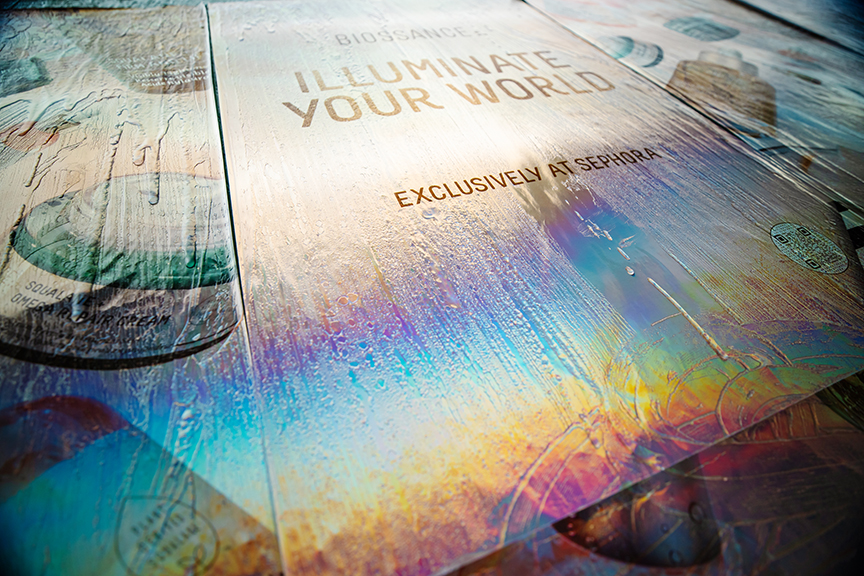
Poster and print placements on boards, on available wall space, and on free-standing structures in high-density pedestrian areas are one of the foundational guerrilla formats. Done well, a postering campaign creates visual saturation across a neighborhood. Done at scale across a city’s key cultural neighborhoods, it creates the impression that a brand is everywhere at once. The format rewards strong graphic design and benefits enormously from placement precision. The right six boards on the right two blocks in Williamsburg can outperform fifty generic placements across a wider geographic spread.
We print at scales from standard 24×36 sheet up to full-building coverage. Paper weight, ink, and finish are selected for the specific climate conditions of each market. A campaign running in Miami in August needs different material specs than one running in Chicago in March. Getting these details right is part of what keeps campaigns looking professional through the full run duration.
Street Teams and Experiential Sampling
Street teams are the highest-engagement guerrilla format because they create a real human interaction. A trained brand ambassador on the right corner, at the right time of day, offering something of genuine value to the person walking by, creates a brand moment that no digital touchpoint can replicate. The interaction is brief, but it is memorable. Sampling adds a product dimension: the person walks away with something in their hand. That physical touchpoint extends the moment beyond the sidewalk.
The quality of the team matters as much as the location. We brief every ambassador on the brand, the product, and the specific talking points relevant to the audience at that particular location. A street team that is well-briefed and genuinely knowledgeable creates real conversations. A team that is reading off a script creates nothing worth remembering.
Building Projections
Building projections are the highest-impact single-night format available in guerrilla marketing. A high-lumen projector throwing brand content onto a large building facade in a dense urban neighborhood creates an event. People stop. People photograph. The content circulates. We run projections in New York, Los Angeles, Chicago, and Miami, and the response is consistent: a well-placed, well-designed projection gets organic social documentation from the people who walk past it, every single time.
The logistics require advance work. We scout projection surfaces, measure throw distances, calculate lumen requirements for the ambient light conditions at the target location, and test content scaling before the night of the activation. A projection that looks great in a test setup and falls apart in execution does not serve the brand. We run clean activations because we prepare for them properly.
Stencil and Chalk Graphics
Stencil graphics and chalk placements cover geographic footprint quickly and at relatively lower cost than other formats. They are ephemeral by nature, which paradoxically makes them more interesting to people who encounter them. A stencil that appears overnight on a sidewalk in a culturally active neighborhood creates a moment of discovery. It is unexpected, it is specific, and it does not look like advertising. That is the point.
Brand-Wrapped Vehicles and Mobile Activations
A vehicle wrapped in brand creative and positioned at a specific high-traffic location functions both as a visual statement and as a mobile sampling or engagement platform. In cities with heavy pedestrian traffic around transit hubs, a brand-wrapped vehicle parked at a corner adjacent to a subway entrance creates a sustained visual impression over the hours it is positioned there. The combination of vehicle presence and a crew working from or around the vehicle amplifies both elements.
AGM Field Note: Wrapped vehicles work best when they are treated as a platform, not just a sign. A truck with a crew distributing product, a generator running branded audio, and a backdrop for photos creates a self-contained activation that earns the space it occupies.
Guerrilla Marketing Ideas for Product Launches
Product launches are the highest-frequency use case for guerrilla marketing, and for good reason. The goal of a launch campaign is to create awareness and trial at once, in a compressed time window. Guerrilla marketing does that better than almost any other format at comparable cost.
The most effective product launch guerrilla ideas create a moment of discovery. The product appears in the world in a way that feels more like an event than an advertisement. A street team in the Flatiron District, positioned at 23rd Street and 5th Avenue, the busiest pedestrian intersection in that neighborhood, offering a new product sample to morning commuters builds awareness through direct engagement. Each person who accepts a sample carries a physical brand touchpoint into their day.
For tech and app product launches, guerrilla activations that express the product’s core value proposition in a physical way work best. Not a crew handing out flyers, but a crew demonstrating what the product actually does in a way that is impossible to explain with a banner. The Flatiron District works for tech brands because of its proximity to the city’s tech and media industry office clusters. An activation at 19th Street and Park Avenue South or at Madison Square Park on 23rd Street puts a product launch in front of a professional, digitally native audience at the right moment in their day.
For food and beverage brands, launch sampling programs near major transit hubs and commuter corridors are consistently effective. Grand Central Terminal at 42nd Street and Park Avenue creates a morning sampling window from 7am to 10am that covers a massive volume of commuters. The perimeter streets, including 42nd Street east to Lexington and west to Vanderbilt, extend the reach of a sampling crew across more entry points.
A serial reveal approach layers well onto launch sampling: week one is a teaser postering run with no explicit product name, just a strong visual and a date. Week two is the product reveal, timed to coincide with direct sampling. The person who saw the teaser and then encounters the crew with product on launch day has already been primed. The conversion rate from encounter to trial is measurably higher than a cold approach with no prior exposure.
Guerrilla Marketing Ideas for Entertainment Brands
Entertainment brands, including film studios, streaming platforms, record labels, and concert promoters, are among the most frequent and experienced users of guerrilla marketing formats. The creative territory is naturally suited to street-level tactics: the content is visual, the audience skews young and culturally engaged, and the geography of entertainment consumption clusters in the same neighborhoods where guerrilla marketing performs best.
For film and streaming campaigns, the street-level tease campaign has a long and effective track record. A poster campaign that goes up without full context, creating curiosity before the full reveal, works because it respects the audience’s intelligence. It creates a discovery experience rather than a broadcast experience. In Williamsburg, a poster campaign running along Bedford Avenue from North 7th to North 12th Streets reaches the exact demographic that streaming platforms covet: young, creative, highly socially connected, and highly vocal about what they find interesting.
Building projections are particularly effective for entertainment launches. A projection of a film title or streaming show’s key visual on a building in SoHo at Spring Street and Broadway, running Thursday through Saturday night, creates a high-visibility event during the nights when that neighborhood’s foot traffic is highest. We have seen projections for entertainment campaigns generate organic social content that circulates for days after the activation ran.
For music releases, street team activations near the venues and neighborhoods that anchor music culture in the target city are standard. In New York, that means Bedford Avenue in Williamsburg, Rivington Street in the Lower East Side, and the blocks around Bowery between Houston and Delancey. In Los Angeles, Sunset Boulevard between Laurel Canyon and La Cienega in West Hollywood, running past venues including the Roxy and the Troubadour, is the core music corridor for street-level activation.
Guerrilla Marketing Ideas for Fashion and Lifestyle Brands
Fashion and lifestyle brands have a natural home in guerrilla marketing because the format itself is a cultural statement. Being on the right streets, in the right neighborhoods, with a visually strong campaign is an extension of the brand’s identity. Where you show up says as much as what you show.
For streetwear and sneaker brands, the Melrose Avenue and Fairfax Avenue intersection in Los Angeles is the most culturally loaded corner in American streetwear. The Fairfax District, running from Melrose north to Oakwood along Fairfax Avenue and along Melrose between Gardner and La Brea, is home to Supreme LA, Undefeated, and dozens of independent streetwear retailers. A campaign that runs on these streets with strong visual design is speaking directly to the culture’s most engaged participants. A postering campaign combined with a street team presence on Fairfax and Melrose reaches influencers, collectors, and early adopters who will carry the brand narrative further than any paid media placement.
For fashion brands targeting a broader audience, SoHo in New York is the primary battleground. The blocks between Prince Street and Spring Street, along Broadway and Mercer Street, see some of the highest-density fashion consumer foot traffic in the world. A street team positioned at Broadway and Prince on a Saturday afternoon, combined with poster placements running from Houston down to Canal, creates a campaign presence that is hard to miss if you are in that neighborhood shopping.
Wheat paste campaigns on the side streets off of Melrose, on the walls behind galleries in Bushwick, and on the construction-board corridors of major development zones give fashion brands a canvas that feels appropriate to their aesthetic without requiring a billboard budget. The format communicates cultural awareness in a way that a paid placard on a bus shelter does not.
AGM Field Note: Fashion brands often ask us what separates a “good” placement from a “great” one. In almost every case the answer is the same: context. A poster that is placed where the specific culture it is speaking to actually lives outperforms a technically superior placement in a generic high-traffic zone by a wide margin.
Guerrilla Marketing Ideas by City
The best guerrilla marketing ideas are city-specific. Here is how we think about the primary markets where we run campaigns.
New York City
New York is the most varied guerrilla marketing environment in America. Every borough and every neighborhood has its own culture and demographic. SoHo, specifically the Broadway and Spring Street corridor, is the flagship fashion and lifestyle destination. Williamsburg’s Bedford Avenue between North 7th and North 12th is the creative class hub in Brooklyn. The Flatiron District at 23rd Street and 5th Avenue is the tech and finance adjacent zone. The Lower East Side, specifically Orchard Street, Delancey Street, and Rivington Street, is the music and nightlife corridor. Each of these neighborhoods rewards campaigns that are built for their specific culture, not repurposed from a generic city-wide brief.
Los Angeles
Los Angeles requires a multi-neighborhood approach because no single area captures the full city. Melrose and Fairfax is the streetwear and fashion capital. Venice Beach’s Ocean Front Walk and Abbot Kinney Boulevard cover the outdoor, wellness, and lifestyle consumer. Silver Lake, specifically the Sunset Boulevard corridor between Fountain Avenue and Silver Lake Boulevard, is the music and creative class zone. The Downtown LA Arts District along Traction Avenue and South Hewitt Street is one of the most photographed neighborhoods in the city for brand activations. Each of these zones has distinct demographics and distinct activation formats that work best within them.
Chicago
Chicago’s primary guerrilla marketing zones cluster in its cultural neighborhoods. Wicker Park, centered on the Milwaukee Avenue and Damen Avenue intersection, is the city’s most active creative and nightlife corridor. River North, around Ohio Street and State Street, is the upscale entertainment and gallery district. Wrigleyville at Clark Street and Addison Street draws massive crowds around Cubs games and serves as an entertainment-adjacent corridor year-round. Logan Square along Milwaukee Avenue between Kedzie and Sacramento has emerged as a second creative neighborhood that rewards brands targeting younger demographics.
Miami
Miami’s guerrilla marketing environment is anchored by Wynwood, the art district centered on Northwest 2nd Avenue and 25th Street, which is the most mural-dense and brand-activation-friendly neighborhood in the city. South Beach’s Lincoln Road pedestrian mall is the highest-density foot traffic zone in Miami Beach. Brickell, along Brickell Avenue and Southeast 8th Street, serves the professional and finance-adjacent demographic with different creative expectations than Wynwood or the Beach.
Guerrilla Marketing Campaign Formats at a Glance
Format
Best Brand Category
Typical Duration
Primary City Zones
Social Amplification
Street Teams
CPG, tech, entertainment
1 to 7 days
Transit hubs, commercial corridors
Moderate
Postering
Fashion, music, film
2 to 4 weeks
Cultural neighborhoods
Moderate
Building Projections
Entertainment, luxury, tech
1 to 5 nights
SoHo, Williamsburg, Arts District
High
Sampling Activations
Food, beverage, personal care
2 to 5 days
Transit hubs, campus zones
Low to Moderate
Brand-Wrapped Vehicles
All categories
1 to 3 days
Transit hubs, events, corridors
Moderate
Stencil and Chalk
Streetwear, music, arts
Ephemeral
Creative neighborhoods, corridors
Low to Moderate
Wheat Paste Murals
Fashion, entertainment, CPG
2 to 6 weeks
Bushwick, Wynwood, Arts District
High
How We Scout and Validate Every Guerrilla Marketing Idea
An idea without a validated location is a proposal. We turn proposals into campaigns through a structured scouting process that confirms every element before production moves. We offer focused location scouting, digital or in-person, to identify the exact locations that are right for your campaign. Contact AGM to discuss location scouting as part of your campaign planning. Post-campaign, we run brand recall surveys to measure awareness lift in your target markets.
The scout answers the operational questions that a brand brief cannot answer from an office: Is the target wall accessible? Is the pedestrian density what the map suggests? What is the competitive visual environment on those specific blocks? What time of day is traffic highest? The ranked placement report translates those field answers into a prioritized list of specific locations, so you are not making placement decisions based on assumptions.
We also look at competitive clutter. If your category has three other brands running campaigns on the same blocks you are considering, we know that from the scout and we can direct you to zones where you get clear visual territory. Category isolation is a real competitive advantage in guerrilla marketing, and you can only achieve it if you know what is already out there before you commit to locations.
Measuring Guerrilla Marketing Beyond the Impression Estimate
The traditional out-of-home industry measures reach through pedestrian count estimates. We do not use that methodology for guerrilla marketing because it does not tell you anything meaningful about campaign performance. The number of people who walked past a placement on a given day does not tell you how many absorbed the message, how many will recall the brand, or whether the campaign moved the needle on awareness in the target market.
We measure guerrilla marketing campaigns through brand recall surveys. After a campaign runs in a market, we survey people in the target demographic to assess what they remember, what they recall about the brand, and whether brand perception has shifted. Awareness lift is the metric we track: the delta between pre-campaign and post-campaign brand recognition in the target market. That is the number that tells you whether the guerrilla marketing investment actually performed.
We also track organic social volume during and after campaigns. When a campaign generates significant photography and sharing on Instagram, TikTok, or Twitter, that is a direct signal that the creative and placement are resonating. A campaign that earns 200 organic posts from people who genuinely encountered it and found it compelling is worth more than one that generated 20,000 counted exposures but zero engagement.
Budgeting Guerrilla Marketing Ideas
One of the most common misconceptions about guerrilla marketing is that it is always a low-budget tactic. It can be. A postering run in a single neighborhood with modest print quantities is a relatively modest investment. But a building projection campaign across four markets with a professional production team, high-lumen projection equipment, and comprehensive documentation is a significant budget line. The format does not determine the cost as much as the scale, the market, and the execution quality do.
What guerrilla marketing consistently delivers is value relative to conventional media buys. A street presence campaign that runs across five key neighborhoods in New York and Los Angeles for three weeks, with poster placements, a street team component, and documentation, typically costs significantly less than an equivalent period of digital advertising while delivering a depth of brand presence that digital cannot replicate. The return on investment calculation is not just cost per impression; it is cost per genuine brand encounter with a target-appropriate audience.
We help brands calibrate their budgets to the goals of the campaign. A launch campaign that needs to create awareness fast across multiple markets has different budget requirements than a sustained presence program designed to maintain brand visibility in a single city over a full year. Understanding the goal first lets us build the most efficient path to achieving it within the available budget.
AGM Field Note: The brands that get the worst value from guerrilla marketing are the ones that compress timelines and cut production budgets. A poorly produced campaign that goes up fast costs almost as much as a well-produced one and delivers a fraction of the value. Give us the lead time to do it right and the budget to produce it correctly. That is where the return lives.
Guerrilla Marketing Ideas for Seasonal Campaigns
Seasonal campaigns require both the right idea and the right timing. The street-level environment changes significantly with the seasons in most major markets, and campaigns that account for seasonal dynamics consistently outperform those that do not.
Summer activations in New York benefit from the dramatic shift in street life that warm weather produces. More people are outside, more people are lingering, and more people are in the neighborhoods where guerrilla activations run best. A summer sampling program at Madison Square Park on weekday lunch hours reaches office workers who are actively seeking outdoor time. A weekend postering run through Williamsburg and the Lower East Side during summer reaches a much larger volume of foot traffic than the same run in February.
Holiday season campaigns require a different approach. The November and December period creates intense competition for attention in retail corridors. The guerrilla advantage during this period is reaching people outside of the traditional retail advertising environment. A campaign that hits the residential neighborhoods adjacent to shopping districts reaches the same consumers in a moment of lower advertising saturation, which produces better recall even though the physical proximity to the retail opportunity is similar.
Festival season campaigns in markets like Miami, Austin, and Chicago are some of the most efficient uses of guerrilla marketing because the event context creates a pre-warmed audience. People attending major cultural festivals are in a state of heightened sensory engagement. They are actively looking at what is around them in a way that routine commuters are not. A campaign that surrounds an event with strategic street presence reaches those people at the most receptive moment in their day.
Frequently Asked Questions
What is guerrilla marketing?
Guerrilla marketing refers to unconventional, street-level marketing tactics that create brand awareness through physical, experiential means. The term covers formats including street teams, postering, building projections, sampling activations, stencil graphics, and environmental installations. The defining characteristic is that the campaign meets the audience in their physical environment rather than competing for attention through paid media channels.
What are the best guerrilla marketing ideas for a limited budget?
Postering and stencil graphics are the lowest-cost guerrilla formats because they require minimal crew and can cover large geographic areas quickly. Street teams are mid-range in cost and high in direct engagement. The key is location precision over raw volume. Twenty well-placed posters on the right blocks in the right neighborhood outperform two hundred random placements across a wider area.
What cities are best for guerrilla marketing campaigns?
New York and Los Angeles are the primary guerrilla marketing markets in the US because of their pedestrian density, cultural influence, and social sharing culture. Chicago, Miami, Austin, and Atlanta are strong secondary markets. The city matters less than the specific neighborhood. A campaign in Williamsburg in Brooklyn reaches a culturally influential audience. A campaign in a low-pedestrian suburban corridor of any city does not, regardless of how large the city is.
How do guerrilla marketing ideas differ from traditional advertising?
Traditional advertising competes for attention within channels that the audience is already trying to tune out. Display ads get scrolled past. TV spots get skipped. Guerrilla marketing creates brand encounters in physical spaces where the audience is not expecting advertising, which is why it produces stronger recall. The surprise of encountering a brand in an unexpected context is what drives the memory formation that traditional advertising struggles to achieve.
How long does a guerrilla marketing campaign run?
Duration depends on the format and the campaign goal. A street team activation might run for three to five days in a market. A postering campaign runs for two to four weeks. A building projection typically runs for one to three nights. Most effective campaigns combine multiple formats running on different timelines to create layered, sustained brand presence rather than a single moment.
How do you measure guerrilla marketing campaign performance?
We measure performance through brand recall surveys conducted with the target demographic in the markets where the campaign ran. We track awareness lift: the difference in brand recognition and recall before versus after the campaign. We also track organic social volume generated by the campaign. We do not use pedestrian count estimates as a performance metric because they do not indicate whether anyone actually absorbed the brand message.
Can guerrilla marketing campaigns run in multiple cities at once?
Yes. We have crews in every major US market, which allows us to run coordinated multi-city campaigns. Each market gets its own placement plan based on city-specific geography and demographics. The campaign strategy can be consistent across markets while the execution is calibrated to the specific streets and neighborhoods in each city.
How far in advance should we plan a guerrilla marketing campaign?
For campaigns requiring printed materials, projection content, or custom fabrication, six to eight weeks of lead time is the minimum for clean execution. Street team deployments can move faster, but we recommend starting planning conversations four to six weeks before the target launch date. A market scout, which is the foundation of any location-based campaign, takes one to two weeks to complete and report out.
What makes AGM different from other guerrilla marketing agencies?
We do not subcontract. Every campaign runs through our own field staff, which means consistent execution, real accountability, and results you can verify. We have deep location relationships in every major market we work in, giving our clients access to placements that are not available through generic networks. And we report honestly on what each campaign delivered, including campaigns that underperformed expectations.
Yes, with the right targeting. B2B brands can use street-level tactics to reach professional audiences in districts adjacent to their industry’s office clusters, at trade show perimeters, and in the commuter corridors that serve specific business districts. The key is identifying where the target professional population moves through public space and designing activations that are relevant to their professional context.